
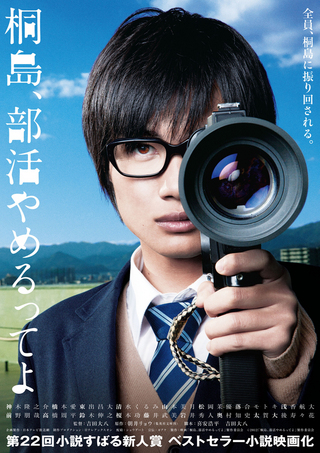

A work that changes the way it is seen by the hierarchy.
As the title suggests, the story centers on a man named Kirishima, but Kirishima does not appear at all.
Just by not having the central character appear in the story, the reader's imagination is tested at once.
It makes you wonder what kind of person Kirishima was, who became such a topic of conversation just by quitting club activities, and even ruined other people's lives.
The main character behind the scenes this time is Maeda, a young man at the bottom of the hierarchy.
If you are not sure what I am trying to convey when you watch this film, I would like you to focus on Maeda.
It is not just a slice of everyday life, but a good opportunity to rethink how to live and enjoy the present moment.
The drawback is that there are many characters in the film, but each of them has something to hold on to, and I recommend that you try to focus on each of them.
Among them, Hiroki, whose tearful appearance in the last scene is impressive, and Aya, who is no longer enthusiastic about club activities, are deeply involved in a scene with Maeda.
The film club, which is so low in the hierarchy that it is not even able to shoot enough films, is able to face itself through the relationship with these two people.
What do you really want to do, rather than just being satisfied with the appearance of it? This is a film that gives you the courage to face up to yourself and the coolness of sticking to your core.
The words, "We have to live in this world," sum up everything in this work.