
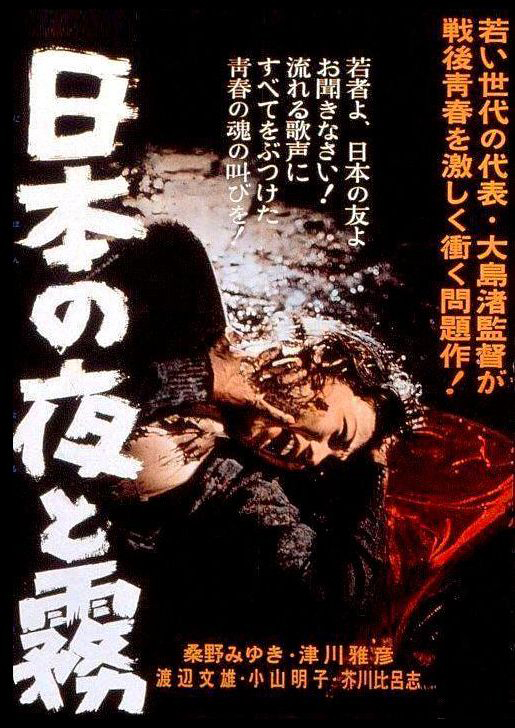

Japanese Night and Fog, a masterpiece of socially-conscious cinema that uses innovative cinematic techniques to plumb the dark side of contemporary Japanese politics
Night and Fog in Japan is a Japanese film released in 1960 and directed by Nagisa Oshima. The film is highly political in terms of both its subject matter (the opposition of the Zengakuren in the 1950s and 1960s to the Security Treaty) and the political memory and subjective dynamics of the social movement.
Commentators on "Night and Fog in Japan" have noted its formal innovations, especially its theatricality. Maureen Tsurim discusses a new cinematic theatricality in addition to innovative long takes reminiscent of Kenji Mizoguchi. Spatial constraints, lighting, color, human gestures, and most importantly, dialogue, as well as confrontations between characters are ordered by camera movements and shots, so that "cinema becomes a vehicle for redefining theatricality.
Dana Pollan sees the film as part of a group of Oshima works that reveal political meaning "as a process between the screen and the audience. For example, during the ten-minute opening shot, the symmetry of camera movement and the wedding ceremony suggests a political stability threatened by an external fog, while the tracking shot introducing the uninvited guests renders both screen composition and ideological certainty indeterminate. More than a narrative that suggests a political process, Oshima's cinematic technique requires the viewer to contemplate the political and personal implications of the cinematic form and characters.