
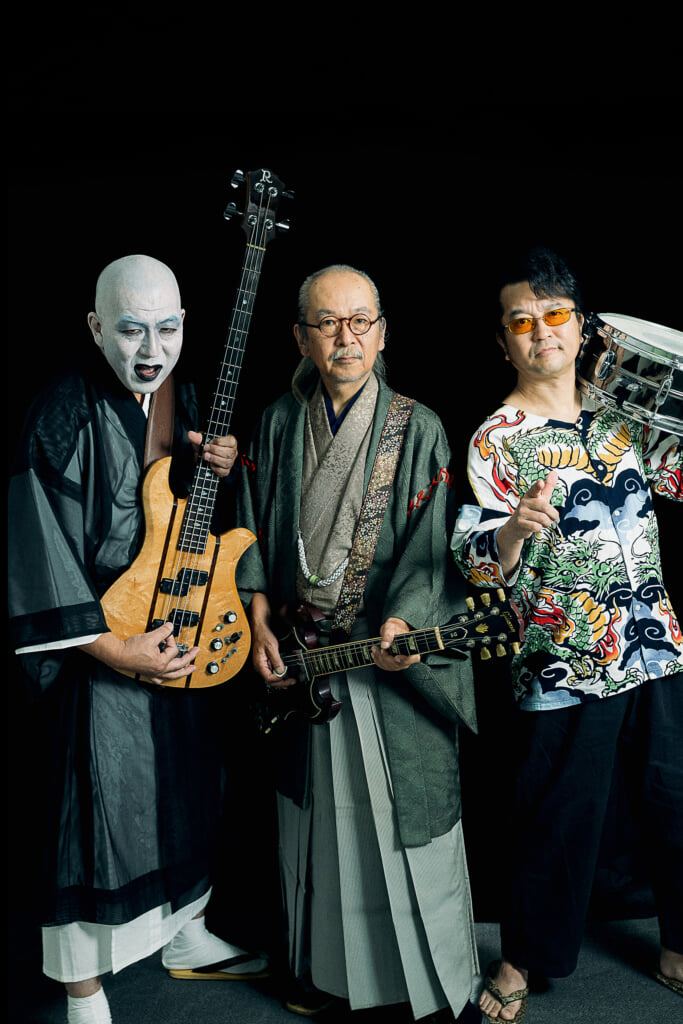

Japanese-style metal spun by men who will not bend and cannot be bent
Born in 1987 in Hirosaki City, Aomori Prefecture, far from the bubble economy of Tokyo, the three-piece band was formed by Shinji Wajima (guitar/vocals) and Kenichi Suzuki (bass/vocals).
Although the word "metal" is often used to describe a wide variety of genres among metal aficionados, the main characteristics of Human Chair from the beginning have been the unique sense of rhythm brought out by the Tsugaru dialect, the customs of Tsugaru and other parts of Japan, especially the Tohoku region, and Wajima's pursuit of a world with a mixture of occult and Buddhist elements. The band's unique world is so distinctive that it is difficult to categorize them as "metal".
The band gained attention through a popular audition program and made their major label debut in 1990, but the musical trends of the 1990s were far removed from the HR/HM sound they pursued and from the worldview spun out by their unique poetry.
The core members, Mr. Wajima and Mr. Suzuki, have been consistent members of the band, but the drum members have changed from time to time, each making the most of their own characteristics, so that even though the roots of the tunes remain the same, the superficial tunes of some songs have different characteristics depending on when the drummer was with the band. It is fun to compare them.
Since the end of the 2000s, the band has been re-evaluated, and has not only gained new fans in Japan, but has also exploded in recognition overseas through large-scale festivals and a high number of views on Youtube for "heartless scat," etc. As of 2020, the band has gained high recognition and sales to high acclaim.
There are many impressive works, but I think the characteristics of their works and their transition from period to period are well represented in "Ringo no Tears," "Shinigami no Feast," "Colors from Outer Space," "Black Cat," "Happiness Screw," "Namahage," and others.