
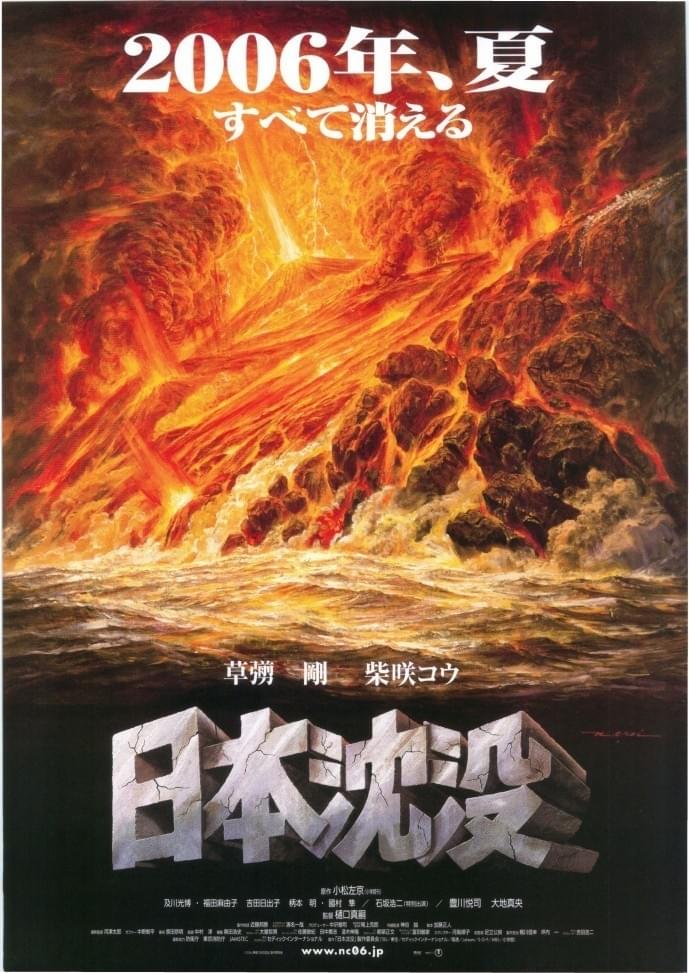

The charm and showpiece of "The Sinking of Japan" is "everyday crisis" and unity!
<A synopsis in 30 seconds>.
Dr. Yusuke Tadokoro (Etsushi Toyokawa), a geophysicist, suspects that something unusual is happening in the Japanese archipelago based on earthquake observation data, and sets out to investigate. He and his assistant, Associate Professor Nobuhiko Yukinaga, dive into the Japan Trench off the Ogasawara Islands and discover strange cracks and turbulent mudflows running along the seafloor.
Convinced of a natural cataclysm, Tadokoro continued to gather data and reached a conclusion. It was that "in the worst case scenario, most of the land in the Japanese archipelago will sink below sea level within two years due to crustal deformation.
From this point, a project was launched to avert the "sinking of Japan" and reduce the damage!
The government, skeptical at first, after some twists and turns, devises and launches "Plan D," a plan to get the Japanese people out of Japan. However, the subsequent deterioration of the situation far exceeds Tadokoro's imagination, and the government and others find it difficult to respond and implement policies.
The natural disasters that destroyed Japan continued, starting with the sinking of Shikoku, followed by a series of magnitude 7.4 earthquakes in various regions, with the Kyushu, Kinki, Chubu, and North Kanto regions also suffering the full brunt of the quakes and tsunamis. The Japanese archipelago was then in a predicament of complete sinking.
Tadokoro then decides to take a gamble.
Differences between the original story and the movie version
Onodera is from Kobe in the original story, but he is the son of a sake brewer in the Aizu region.
Abe was born in Shimoda City in the original story, but his parents died in the Great Hanshin-Awaji Earthquake in Kobe and he was taken in by his aunt in Tokyo.
Dr. Tadokoro is younger than in the original, and he and Minister Takamori are a former married couple.
Nakata appears in the story, but he is a defense liaison coordinator, not an intelligence scientist as in the original story.
Professor Fukuhara is a professor of comparative civilization theory in the original story, who is planning the aforementioned remedial measures.
Chief Cabinet Secretary Nozaki is a diplomat who leads the negotiations for the acceptance of refugees in the original story.
The old man Watari does not appear in the film from the beginning.
What is the charm of this film? No.1]
Japan is sinking!
While the main focus of the film is the sinking of Japan, the sense of slow and steady build-up to the start of this critical situation is quite remarkable, and the climax, which highlights the mayhem and tragic fate to be seen there, is created by precise and cleverly executed handholding of the story.
After Tadokoro discovers the changes in Japan, he shares this information with Onodera and others, and as the signs of change gradually become reality, the "emotional entrance," the climax of the film, is colored by the innovative direction.
It is interesting whether you watch it casually or seriously, so please experience these signs that lead up to the conclusion with your own presence!
[What is the charm of this film! Part 2]
The heart of the doomed community!
For the Japanese people, a kind of warmth can be felt in the fact that all Japanese people can unite in the sight of humanity confronting the crisis that will soon come, with the theme of "the sinking of Japan" as a community of destiny. Eventually, after the destruction of the Japanese land begins, the story climbs to a safe zone with all Japanese people having the same attitude throughout the story.
The sense of camaraderie and the warmth of the bonds that people have with each other that is reflected in the film adds to the charm of the film, which continues all the way to the final scene where the ship is saved from sinking.
Perhaps, by watching this film, you will be able to experience the warmth of camaraderie and bonding, and the pure emotion of humanity towards nature.
What is the charm of this film! Part 3
The power of nature!
The main part of this film is the disaster and tragedy caused by the earthquake. As is the case in the 1973 version, which is similar to the original work, the computer graphics (CG) synthesis of the disaster is brilliant!
The production quality, which makes the viewer feel as if he or she is actually at the scene of the disaster, is a masterpiece compared to the graphics in other films.
With the power of this realistic synthesis, the film runs from the beginning to the last scene.
The 2006 version seems to be superior in this area. Overall, I felt that this film focused on the human behavior that is not derived from the disaster, which makes us think, "If such a catastrophe happens, we would probably behave in this way in our daily lives".
Please take a glimpse at the power of this CG synthesis and see, with your own experience, how different it is from the original and the previous film!
Review
I rented and watched this film on the first day of its DVD release.
The story of this film is, after all, set on a very grand scale, "The Sinking of Japan," and depending on how you look at it, you may find it quite moving.
If I were asked to give three highlights of "The Sinking of Japan," I would have to say
The scene where Onodera learns of the signs of Japan's destruction and invites Reiko and her mother to England.
The scene where Onodera becomes serious about Dr. Tadokoro's plan to blow up the fault line with a nuclear-grade bomb.
In the last scene, Kotori returns to her parents' house as if she is Onodera's reincarnation.
I guess!
These three scenes are still very much in my mind's eye, and probably must be very deeply moving for anyone.
The film is set in Japan, the hometown of the Japanese people, and the crisis of the loss of each Japanese person's base is depicted in a very moving way, and is effectively completed with CG and other effects to create the grand charm of Japanese cinema.
If there are any of you who have not seen "Sinking of Japan," please give it a try and experience such genuine emotion!