
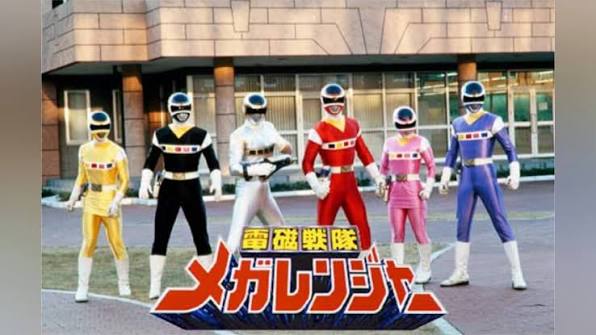

A fine piece of transitional work that still has the foresight to grow.
This film, the 21st in the Sentai series, is not to be mentioned as such a notably funny masterpiece of all time. This is because, of course, the previous work "Gekisotai Sentai Carranger" and the next work "Seijuu Sentai Gingaman" have as their main writers Mr. Yoshio Urasawa, a veteran of the mysterious comedy series, and Ms. Yasuko Kobayashi, who has written many masterpieces based on her taste for historical dramas, respectively, and their colors and directions are clear, so there is a strong impression that they are somehow caught between the two. The impression of being sandwiched between the two is very strong.
This is because Mr. Takadera, the chief producer who actually produced this work, said, "It was a difficult production," and "I was so lost that I had to think about what Sentai is. In fact, this work was first produced as a "mega-range" series for the main characters, and then as a "mega-range" series for the main characters, and then as a "mega-range" series for the main characters. In fact, in this work, there is a lack of connection between the "electromagnetic = digital device" motif of the main characters and the "high school student" setting of the Megarangers, the fact that the enemy Negresia exists in a different space, and the fact that the main characters are not "strong warriors" with much determination or resolve to fight against the enemy Negresia. The main characters are not "strong warriors" fighting against the enemy Negresia.
In terms of style, in the early stages of the series, the story was created with a somewhat vague image, and Kenta and his team were not that serious about their mission or their desire to fight. The story is not only about the Kenta's fight, but also about their high school life, which is not well described. Overall, the setting and description do not fit well together, and almost all the members are amateurs, so it is not a "strong squadron" by any stretch of the imagination.
However, what makes this work above average for me is that in episode 16, Kenta and the other members are driven to despair both mentally and physically, and in the midst of this, they take a hard look at the fact that they are "high school students" and "human beings" before they are "warriors". This realization leads to spiritual growth, and from there, the diamond in the rough begins to shine, leading to the tragic development of the last half of the story after Nejiranger's appearance. From there, the characters of Kenta and the others were broadened, and with the entry of Megasilver Yusaku Hayakawa, the story became more and more colorful and polished.
And it was precisely because this work dealt with the "weakness" and "immaturity" of the heroes to the utmost and depicted heroes who were once persecuted by the people but fought to protect the earth with a renewed vigor that the next work, "Gingaman," was able to create a "strong hero" with a complete system. This work has an indescribable charm, even though it is rough and ready, as a fine work of transition from "Car Rangers" to "Gingaman," that is, from a "weak hero" to a "strong hero.