
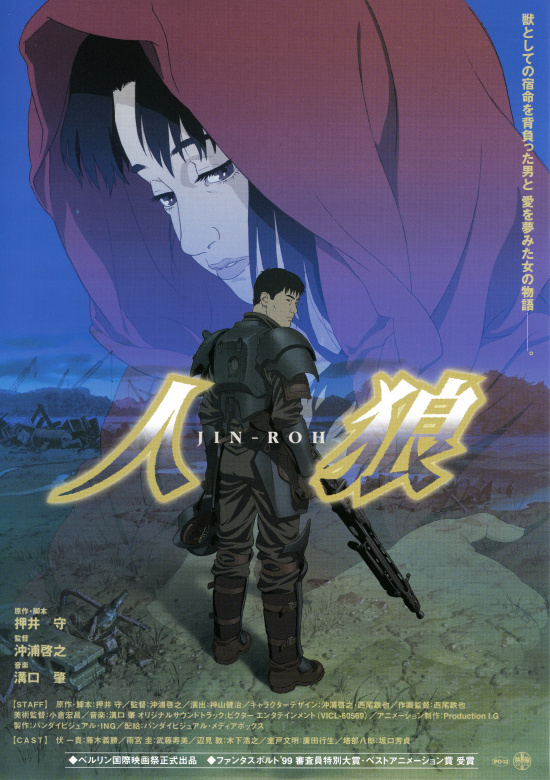
JIN-ROH" is an animated feature film produced in 1999 and written by Mamoru Oshii (Ghost in the Shell) and directed by Hiroyuki Okiura (Letters to Momo). The film focuses on the human drama of a young man in the security forces who meets a woman who used to be an anti-government guerrilla and struggles between his love and his mission. This animation film has attracted attention at international film festivals around the world for its meticulous direction and visual expression, which is almost as good as live-action film.
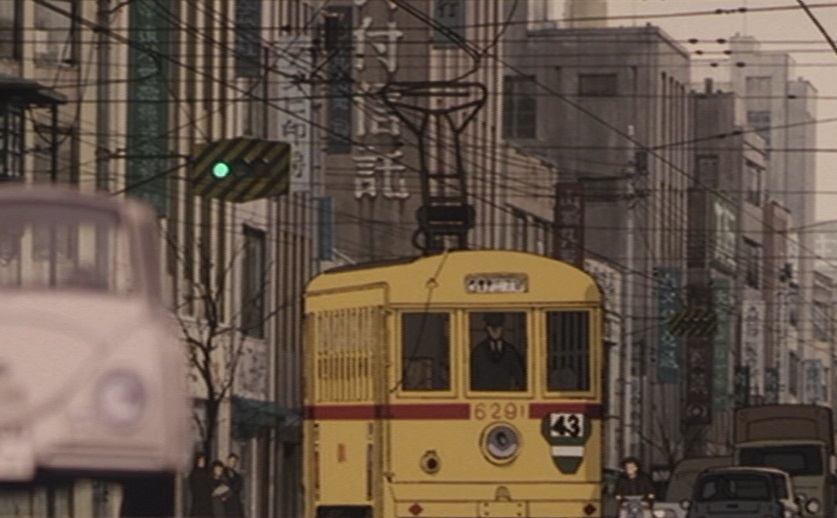
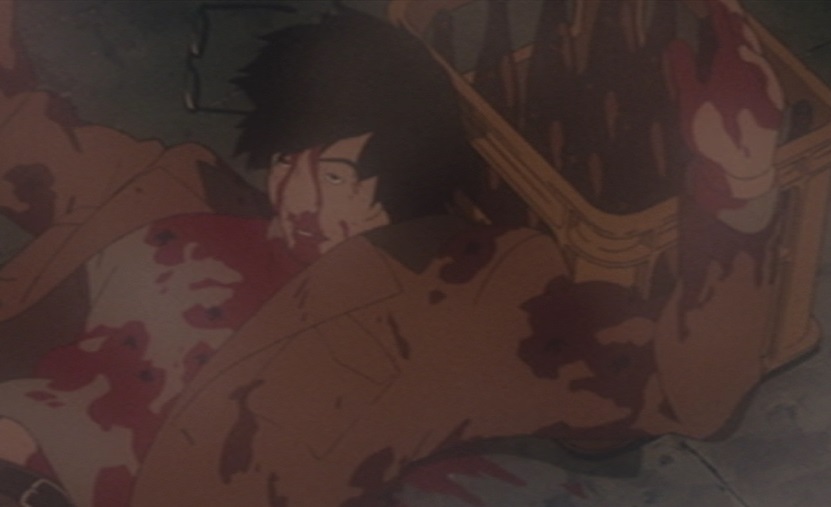
Hiroyuki Okiura, who made his directorial debut with this film after receiving a recommendation from Mamoru Oshii, pays close attention to detail, delves deeply into the inner lives of the characters, and creates a deep human drama with such detailed direction and visual expression that it could be mistaken for live action.
The film's extremely realistic movements and expressions are one of the highlights of the film, and some overseas viewers even suspected that rotoscoping or CG was used for the movements of the characters and the expression of water.
The film's commitment to realism is such that even the shooting scenes are so graphic and brutal, with blood splattering loudly like in a splatter movie, that the film received a PG12 rating.
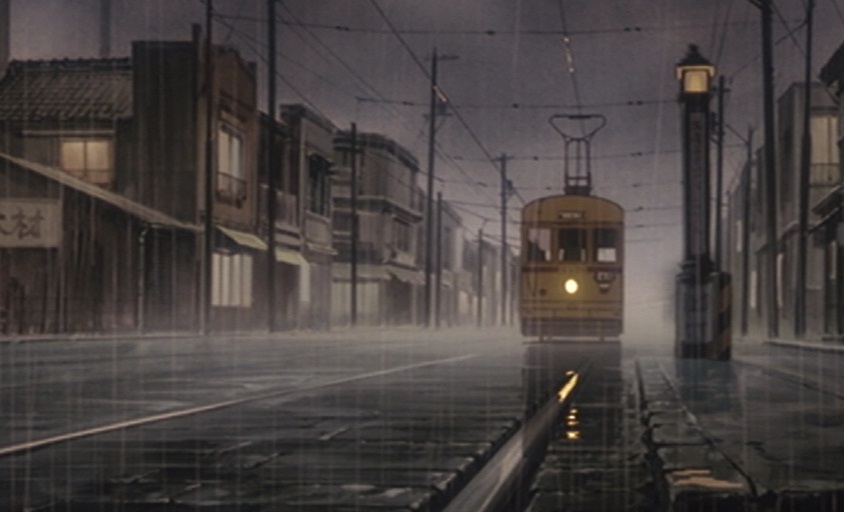
Another highlight of the film is the careful depiction of the scenery of the Showa 30s (1960s), the period in which the story takes place. The streets of Ginza with its streetcars and the rooftops of department stores with their numerous balloons are nostalgic for middle-aged and older viewers, and fresh for younger viewers.
Famous Scenes from "Werewolf JIN-ROH
Agawa Nansei's Self-Destruction
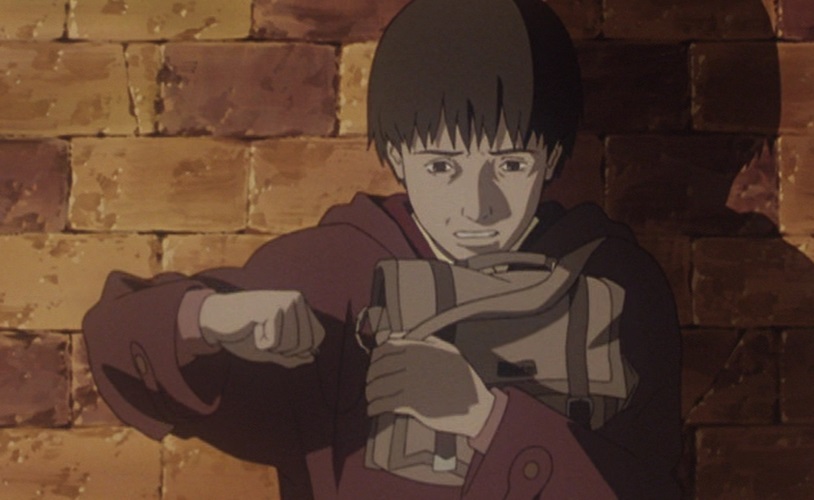
This is an important scene in which Fuse's mind wanders as his conviction as a special forces unit to eliminate dissident organizations wavers in the face of Nanao Agawa's self-destruction.
The film depicts the tension in Nanao's facial expressions and gestures as he is surprised by the sudden appearance of Fuse in his armor and protective gear, realizes that there is no escape, and pulls out the fuse cord of the bomb, in a manner as realistic and detailed as live-action.
The film also surprises us with its subtle depiction of Fuse's expression and even his feelings in the protective gear, which we can read.
The scene is sufficiently convincing to convince Fuse that the shocking event would not leave his mind and that her image would often appear in his dreams, shaking his heart.
Fuse and Kei's final farewell
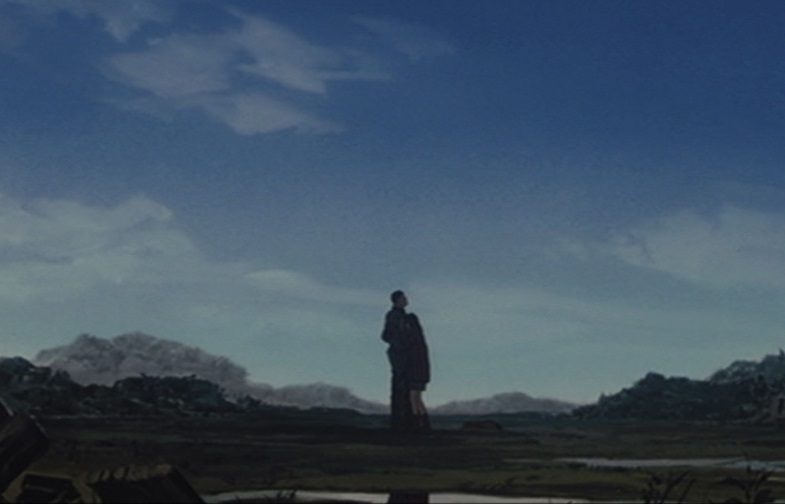
Fuse is upset when Toubu orders him to kill Kei, who had thwarted the schemes of the Public Security Bureau and was working as their pawn in the end.
Kei does not beg for his life, but cries out and tells him the end of the story of "Red Riding Hood," a fairy tale.
Fuse is torn between love and mission, and Kei clings to him,
Their facial expressions and actions are meticulously described, full of emotion and full of dramatic excitement.
Then, just as the shot switches from a bust shot of Fuse and Kei to a distant view, a gunshot rings out.
It is a famous scene that leaves a sad but deep aftertaste.
Backstory, trivia, small stories/episodes, and anecdotes of "JIN-ROH" (Werewolf JIN-ROH)
From a half-hour video series to a theatrical production
Originally, "Jinruo" was planned as a 30-minute animated video series, and was originally to be directed by Oshii himself.
However, Oshii gave up the project due to other commitments, and asked Okiura, an animator who had shown his ability in "Mobile Police Patloper 2 The Movie" at the time, but he had no experience in directing and was not very enthusiastic. However, he had no choice but to accept the project as "one of a video series.
However, later, it was changed from a video series to a theatrical production! Okiura was surprised and complained to Oshii, but in the end he agreed to direct the film on the condition that he would be allowed to make it as he liked.
Thoroughly hand-drawn celluloid movements
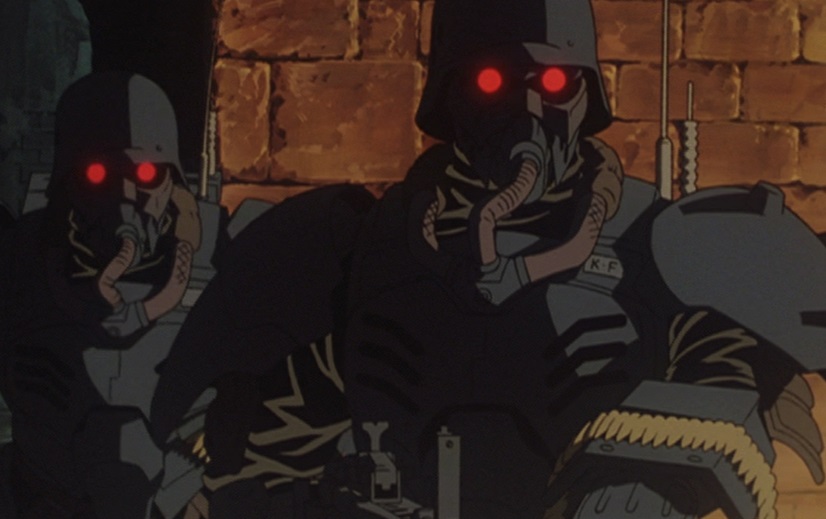
JIN-ROH" took nearly three years to complete, far longer than originally planned.
The reason for this was due to director Okiura's excessive focus on "moving pictures" as a former animator.
One of the reasons for this is the movement of the people wearing armor and protector gear. When the person in the protector gear moves, the armor moves with a slight delay.
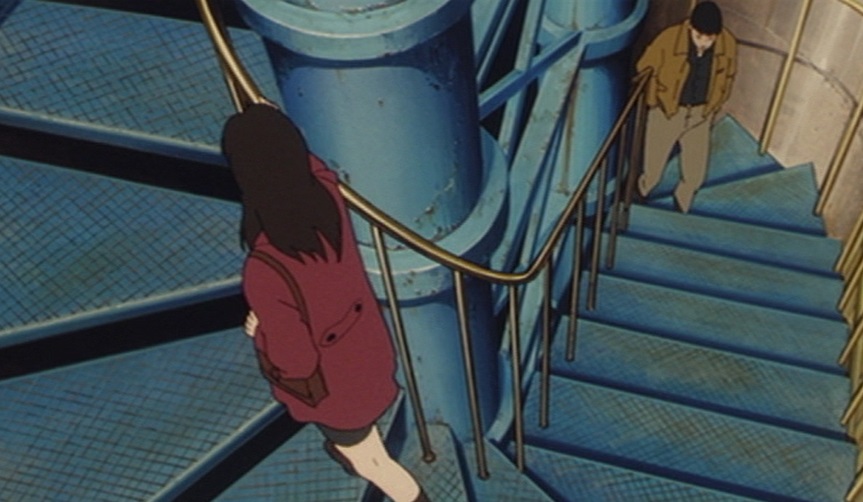
Also, the skirt of the girl Nanao sways as she walks, the tram running toward the front in the rain and the movement of the conductor inside, the scene of Fuse and Kei going up the spiral staircase, etc., which are ordinary images in a live-action movie, are very time consuming and technically challenging to express realistically with hand-drawn animation. This is said to make animators cry, but Director Okiura dared to stick to such a style of drawing.
The flow of the images is so natural that it doesn't seem like a lot of work to the viewer, but when animators and others involved in the animation industry see it, they understand the painstaking work that went into it.
staff
Director/Character Design/Hiroyuki Okiura
Born in 1966 in Katano City, Osaka.
At the age of 16, he joined Animation R, an animation drawing studio in Osaka, and became the first drawing director for the TV animation "Star Musketeer Bismarck" in 1984.
After working on original drawings for "AKIRA" and "Mere Old Man Z," he became a freelance artist and has since worked on original drawings for numerous works.
He made his directorial debut with "Jin-Roh JIN-ROH. Winner of the Animation Film Award at the 54th Maynichi Film Contest, the Toshiko Minami Award at the Yubari International Picture Fantastic Film Festival 2000, the Best Animation Award / Special Grand Jury Prize at the Overseas Fantasporto 1999, and others.
In 2012, "A Letter to Momo", for which he worked alone as an original idea, director, scriptwriter, and storyboard artist, won the Excellence Award in the Animation Division of the Japan Media Arts Festival, as well as many other awards.
His wife is Sumi, who voiced Kei Amemiya in "Jin-Roh.
Original Story/Screenplay by Mamoru Oshii
Born in Tokyo in 1951.
Joined Tatsunoko Productions in 1977, and moved to Studio Pierrot in 1979. He was the chief director of the "Urusei Yatsura" TV series, and directed his first theatrical film "Urusei Yatsura Only You" in 1983. He then went freelance and directed "Mobile Police Patloper the Movie" and "Mobile Police Patloper 2 the Movie," etc. "Ghost in the Shell," produced in 1995, became popular overseas and was ranked No. 1 in the home video category by Billboard magazine in the United States.
In addition to animation, he has also directed live-action films, starting with the original video "Red Spectacles" in 1987, and has filmed "Avalon," "Asatru Girls," "Garm Wars," etc.
Music, Hajime Mizoguchi

Related Articles
PSYCHO-PASS the Movie: Cunning Bite is back! The stage is set overseas, and the hot battle is about to begin!
A man who had done justice for himself became a murderer and disappeared. What is he thinking now, and what is he trying to accomplish? Akemi Tsunemori, who has grown up to be a full-fledged detective, steps into the "Sheen," where the new sibula system has been introduced. In the danger zone where bullets fly, he meets a man again.
Read Article
Mamoru Oshii takes a stab at "The Wind Rises"! Hayao Miyazaki's contradictions are pointed out!
Mamoru Oshii, an animation director who is also widely known for his abilities, gave a tongue-in-cheek review of "The Wind Rises" by world-renowned animation director Hayao Miyazaki. According to Oshii, this work "contains Hayao Miyazaki's 'contradictions,'" and his merciless critique was controversial. Here are some of the reactions at the time.
Read Article
Contents
- Outline of "Werewolf JIN-ROH
- The story of "JIN-ROH" (Werewolf JIN-ROH)
- Main characters
- Kazuki Fuse (voice: Yoshikatsu Fujiki)
- Kei Amamiya (Amamiya Kei/Voice: Hisami Muto)
- Atsushi Henmi/voice: Hiroyuki Kinoshita
- Nanami Agawa (voice: Eri Sendai)
- Hachiro TOBE (voiced by Yoshisada SAKAGUCHI, also narrator)
- thing to note
- Famous Scenes from "Werewolf JIN-ROH
- Agawa Nansei's Self-Destruction
- Fuse and Kei's final farewell
- Backstory, trivia, small stories/episodes, and anecdotes of "JIN-ROH" (Werewolf JIN-ROH)
- From a half-hour video series to a theatrical production
- Thoroughly hand-drawn celluloid movements
- staff
- Director/Character Design/Hiroyuki Okiura
- Original Story/Screenplay by Mamoru Oshii
- Music, Hajime Mizoguchi
- A live-action version of "Jin-Roh" will be produced in Korea.