
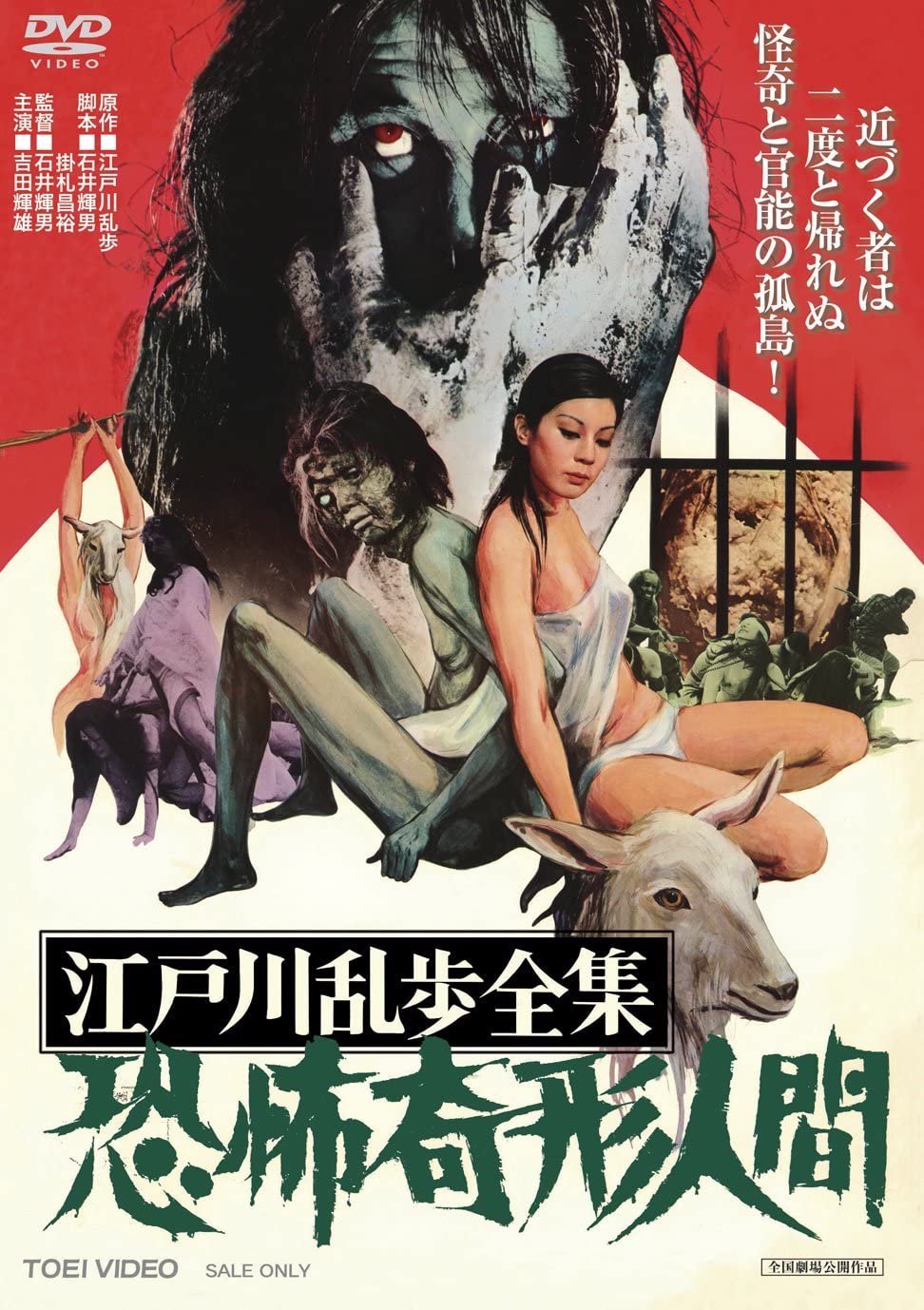
Edogawa Rampo: The Complete Works of Edogawa Rampo" is a mystery film directed by Teruo Ishii and released in 1969. It stars Teruo Yoshida. The film is a collection of fragmentary images from the works of writer Edogawa Rampo.
The protagonist, an aspiring doctor who is confined to a mental hospital for unknown reasons, uncovers the secret of his birth when an attempt is made on his life and he is framed for murder. The key to solving the mystery lies in the hands of his own father, who is manufacturing deformed humans on a deserted island.
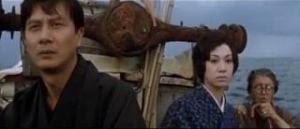
広介 (left), Shizuko (center), and Hirugawa (right) toward the island
The lullaby in 広介's memory of the play is an important part of the story, and the line that this lullaby is a reverse Japanese lullaby appears several times.
There was a time when the region on the Pacific side was called Omote Nihon, while the region on the Sea of Japan side was called Ura Nihon. Since it is not used now, it is an unfamiliar word.
There are not a few cases where the word' Ura' or' Ura' does not have any negative connotation but has a derogatory image. Therefore, the word' Ura' was used in the weather forecast at that time, but it is said that the term' Ura nihon' ceased to be used around the end of the 1960s due to complaints, as it was discriminatory and derogatory.
Siamese twins
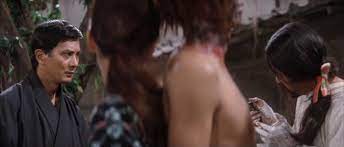
Hideko (left) and Takeshi (right) are artificial siamese twins.
The Siamese twins, also called conjoined twins or Siamese twins, are identical twins whose bodies are joined by a symmetrical body.
It is said to occur in about one pair per 50000 to 200000 births, with a slightly higher incidence in Southeast Asia and Africa.
Born in Siam (now Thailand) in 1811, the Chan & En Boonker brothers were united near the mid-point of their chests and abdomens. They had been in an American circus for american circus for many years and were given the nickname the Siamese twins, from which the term originated.
It is characterized by the sharing of an organ, part of an organ, or most of an organ. For this reason, even in modern medicine, separation is not easy.
Words, lines, scenes and scenes from "Edogawa Ranpo Zenshu Kyokaku Shika Ningen"
広介 "Oka-san"
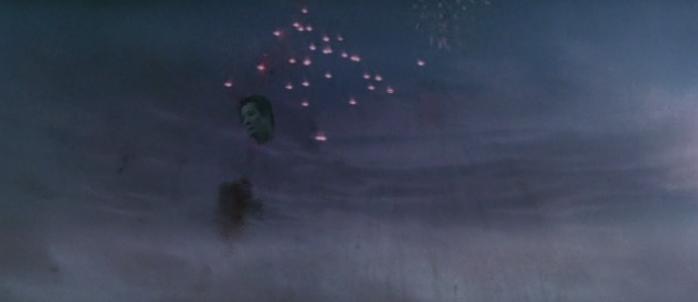
The heads of 広介 dancing in the air shouting "Oka-san!"
広介 fell in love with her younger sister, Hideko, who was different from her father, and even had a physical relationship with her. However, she could not separate from Hideko, and 広介, who was obsessed with her, left a suicide note saying that she wanted to scatter beautifully like firework. As the suicide note says, 広介 and Hideko were falling apart like firework in the air, and the word "Oka-san" is the one that she cries while flying in the sky. It is a line that shows how 広介, who could not spend time with their real mother because they were adopted, and Hideko, who was made into Siamese twins soon after birth and could not see her mother, missed their mother. It is a shocking scene, but it is one of the short and simple but impressive lines.
Kogoro AKECHI' I have taken out the bullets,'
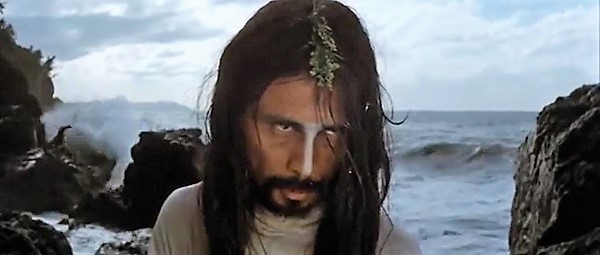
Jogoro trying to make 広介 create a deformed human being
Jogoro was trying to build his ideal land, an island of misshapen humans. This required 広介's surgical skills. Jogoro had artificially created a misshapen human and had 広介 make Bato Kannon, the guardian god of the island, which he had dreamed of. Jogoro tried to use a gun to threaten 広介, who would not accept Jogoro's request no matter how much he said. However, Kogoro AKECHI had already taken out the bullets. At the height of the crisis, Akechi's cool-headed line was "I have taken out the bullets." It was a phrase that made one feel like a great detective with his shrewdness and gentlemanly behavior. One could not tell when the bullets were taken out.
Artificial malformation human scene
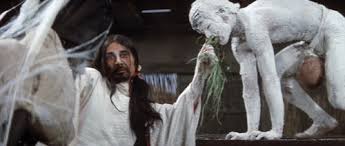
Feed a misshapen human Jogoro (left)
Jogoro manufactures malformed human beings on an uninhabited island in order to create an ideal island. There is an ideal that malformed human beings become kings and live happily with many beautiful women.
This is a scene that shows 広介 the result of making normal babies and old people into deformed human beings.
In this scene, Jogoro's strange movements, which make them eat grass, leave a strong impact. Jogoro's face looks like an animal, his skin color is abnormal, and he cries like a beast. This makes you want to cover your eyes. This is also a scene where you can see the part where Jogoro, who himself is also malformed, acted because of his suffering.
Behind the Scenes, Trivia, Small Stories / Episodes, and Anecdotes of "Edogawa Ranpo Zenshu Kyokaku Tokujin" (The Complete Works of
The Birth of a Japanese Cult Film
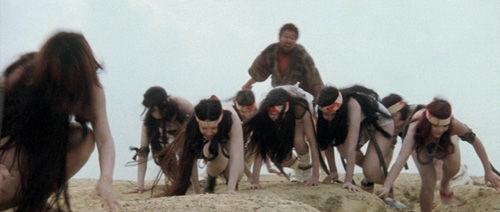
Women brought to the island
At that time, because of its extreme content, it was considered to be a film for adults even though it had few scenes. Moreover, because it had the name of Edogawa Ranpo in the title, there was criticism that it was not a film by Ranpo. At the time of its release, it was screened together with an ill-made anime, and the number of customers was low. It had a poor box-office performance, and it was closed 10 days after its release. It was so popular that even an evening paper refused to introduce it.
However, at the end of 1970, when it was shown at a revival house (general term for movie theaters that mainly show old movies), customers rushed to the theater out of curiosity, and it became a topic of conversation by word of mouth.
Furthermore, the concept of a cult movie was introduced from America in the 1980s, and this movie became famous as a Japanese-made cult.
At the ヴーディネ Far Eastern Film Festival in 2003, a special feature by Director Ishii was shown, and this film was also shown. This film was very popular.
It is currently popular as a cult movie. The last scene is often talked about as a legendary scene.
Tatsumi Hijikata who played Jogoro
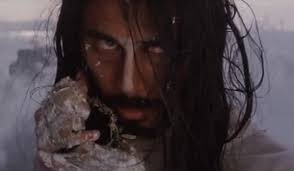
Jogoro standing on the rocks
The film's most striking personality is that of Komoda Jogoro, whose bizarre movements and dances have more impact than his appearance. The character of Komoda Jogoro, who once seen has an unforgettable personality, is a man called Tatsumi Hijikata.
Tatsumi Hijikata is a Japanese choreographer, choreographer, director and actor who, along with Kazuo Ohno, is an internationally recognized choreographer as the founder of Dark Dance.
The Dark Dance is a form of avant-garde dance established in the 1955 s. It is one of the avant-garde arts. It folk and physical subjects were used and influenced many artists. By the way, avant-garde art is closer to being innovative and experimental than the avant-garde used here, which means a person who stands on the cutting edge. In general, there is a strong image that they are white-haired and wearing underwear that covers only their private parts. The dance is not just an art of movement, but a presentation of the texture of the body.
Tatsumi Hijikata, who had expressed himself in his own way, performed Jogoro, who was strange and sad, beautifully in this play.
The theme song and inserted song of "Edogawa Ranpo Zenshu Kyokaku Shika Ningen" collection of collection
OP (opening): Hajime Kaburagi "Toei Mark - main title"

Contents
- Overview of "Edogawa Ranpo Zenshu Kyokaku Tokujin"
- The plot and story of "Edogawa Ranpo Zenshu Kyokaku Tokujin"
- Memory of a lullaby
- For the Genzaburo of Komoda: 広介 HITOMI
- The Misshapen Island and His Father Jogoro
- The Great Detective Kogoro AKECHI appears.
- List of characters in "Edogawa Ranpo Zenshu Kyokaku Tokujin"
- 広介 Hitomi (played by Teruo Yoshida) (Mihiro Hitomi)
- Genzaburo Komoda (played by Komoda, Teruo Yoshida)
- Hatsuyo (played by Teruko YUMI)
- Hideko (played by YUMI Teruko)
- Jogoro Komoda (played by Komoda, Tatsumi Hijikata)
- Komoda Toki (played by Komoda Mitsuko)
- Chiyoko Komoda (played by Chiyoko Komoda and Michiko Obatake)
- Shizuko (played by Yukie KAGAWA)
- Hirugawa (played by Asao Koike)
- Kin (played by Yoshitomo Tanaka)
- Kogoro AKECHI (played by Minoru Oki)
- Takeshi (played by Masaomi Kondo)
- Miki (played by Eimi)
- Miki (played by Yoko OYAMA)
- Kei (played by Kei Kiyama)
- HAYASHIDA (played by Toshio Oida)
- Female Patient A (played by Yumiko Katayama)
- Female Patient B (Played by Asano KANAMORI)
- Male Patient A (played by Sachio Miyagi)
- Male Patient B (Played by Isamu Tsuchihashi)
- Otoko no Kyojin (Actor: Hideo Ayuha)
- Female Lunatic (Played by Reiko Mikasa)
- The Girl to be Slashed (played by Miki Obana)
- Kanshu (played by Hideo Ko)
- Anma (Actor: Yoshiko Kato)
- Bozu A (played by Toru Yuri)
- Bozu B (played by Akira Oizumi)
- Doctor (played by Kichijiro Ueda)
- Nurse (played by Kyomi Sakura)
- Hunchback A (played by Shoken Sawa)
- Hunchback B (played by Misao Kawasaki)
- Secretary (played by Chiyo Okada)
- Terms in "Edogawa Ranpo Zenshu Kyokaku Tokujin"
- Edogawa Ranpo
- Ura Nippon
- Siamese twins
- Words, lines, scenes and scenes from "Edogawa Ranpo Zenshu Kyokaku Shika Ningen"
- 広介 "Oka-san"
- Kogoro AKECHI' I have taken out the bullets,'
- Artificial malformation human scene
- Behind the Scenes, Trivia, Small Stories / Episodes, and Anecdotes of "Edogawa Ranpo Zenshu Kyokaku Tokujin" (The Complete Works of
- The Birth of a Japanese Cult Film
- Tatsumi Hijikata who played Jogoro
- The theme song and inserted song of "Edogawa Ranpo Zenshu Kyokaku Shika Ningen" collection of collection
- OP (opening): Hajime Kaburagi "Toei Mark - main title"