
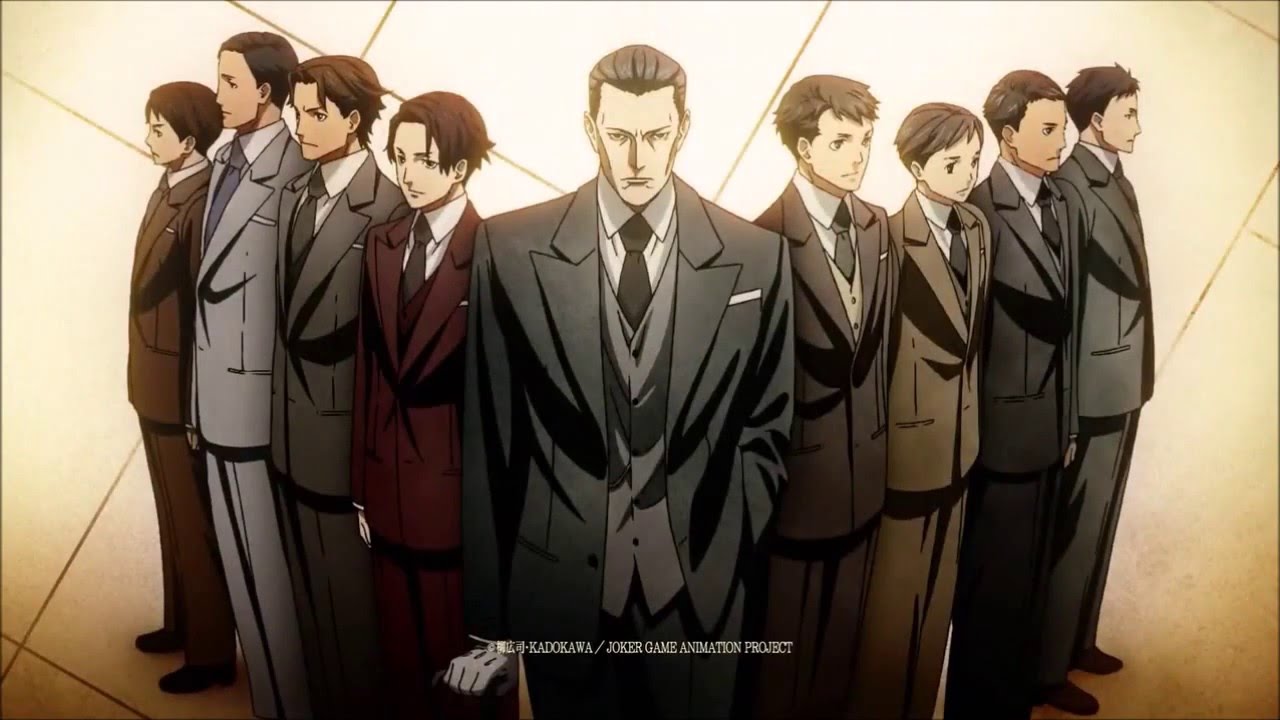
The Joker Game is a Japanese short mystery/spy novel by Hiroshi Yanagi and a manga and anime work based on it. It aired from April to June 2016 on AT-X, TOKYO MX, and elsewhere. The D Agency is a spy training division established in secret by Lieutenant Colonel Yuki in the Imperial Army before World War II. The anime depicts a total of 12 episodes in which members of the D Agency are involved in dark activities around the world.
Model of D Institution "Army Nakano School
It was established in 1938 to nurture personnel capable of espionage and intrigue. The school produced more than 2,000 graduates in the seven years leading up to the war's end, but the full picture is still largely unknown. The name of the school, Nakano, is derived from the fact that it was actually located in Nakano Ward. The military cadets who graduated from the Military Academy were selected from among privates, ordinary soldiers, and students of the Reserve Military Academy, because military personnel who had been trained in the military spirit were likely to be discovered when they infiltrated the civilian world. The school culture was free for the time, and students were not allowed to wear military uniforms, but were encouraged to wear plain clothes and long hair. The students were not allowed to tell their families that they were being educated as spies.
The school taught the ironclad rule for those engaged in espionage activities: "Never speak of your merits, but do not be spoken of them," and cultivated the spirit that they were giving their lives not for the government, the military, or the emperor, but for the Japanese people. Many of the graduates became civilians and blended in with the enemy while conducting intelligence activities, but many of them died unnoticed in enemy territory and were treated as civilians.
Background of the Establishment of the Army Nakano School
According to Mitsunori Saito, "Rikugun Nakano Gakko" (Heibonsha, 2006), Kanji Ishihara, who drew the grand design of Manchukuo, arrived in 1935 as Chief of the Operations Section, First Department, Army General Staff Headquarters. Ishihara said, "Our Army and Navy have an operational plan but no war plan. He insisted that it was necessary to "promptly formulate a war plan and establish a national defense general plan. The Ni-Ni-VI Incident of 1936 was the impetus for the reorganization of the General Staff Headquarters. Ishihara emphasized the importance of Japan's relationship with the Soviet Union and separated the section in charge of the Soviet Union from Section 6 (Europe and the United States Section) and newly established Section 5 (Russia Section) to strengthen intelligence gathering against the Soviet Union. Under Ishihara's organizational reforms, Lieutenant Colonel Shun Akikusa, who later became director of the "Rear Service Personnel Training Institute," was appointed head of Section 5, Team 5 (Document Intelligence Team).
Meanwhile, in the War Ministry, which was in charge of military administration, the Military Affairs Bureau was newly established in July 1936, and from December of the same year, it was charged with "anticommunist" duties. Three years later, in January, the Defense Division was newly established, and this division would be in charge of anticommunist affairs. In September 1936, Tadayuki Anami, the first Director General of the Military Affairs Bureau, announced the need to immediately establish a "scientific counter-intelligence organization" in response to the international situation, and secretly prepared for the establishment of a counter-intelligence organization. He had Shinichi Tanaka, Gao Iwashide, Kameji Fukumoto, and Shun Akikusa plan the establishment of a scientific counter-intelligence agency. Iwakuro and Fukumoto played a central role in this plan, and they established it on the grounds of the Army Medical School and Einu Hospital (currently Toyama 1 or 2-chome, Shinjuku-ku, Tokyo). In January 1938, Akikusa, Iwakuro, and Fukumoto established a training center for logistics personnel within the Military Bureau under the direction of Director General Anan. This training school for logistics personnel was the prototype of the Army Nakano School.
Army Nakano School Curriculum
Italian, German, British, American, French, Chinese, military, strategic, and military geography of the South), languages (English, Russian, Chinese), specialties (intelligence service, conspiracy service, counterintelligence service, propaganda service, economic conspiracy, secret communication methods, counterintelligence techniques, secret weapons, code breaking), practical studies (secret communication, photography, disguise techniques, opening locks, opening (secret communications, photography, disguise, opening and closing, lock-picking, driving, aircraft operation, kendo, aikido), and special lectures (ninjutsu, criminal operations, forensic medicine, Kaikyo affairs, Polish affairs, and Turkish affairs).
In order to obtain information, he would sometimes illegally infiltrate foreign embassies, military installations, or companies he had his eye on and open their safes. The person who taught them was a veteran "locksmith" who was said to be a thief in his own right. The Nakano School instructors were dispatched from active duty army officers, instructors from the Army Medical College, military medical school instructors, weapons administration headquarters engineers, military police school instructors, accounting school instructors, driving school instructors, communications school instructors, and officers from the War Ministry and General Staff Headquarters.
Anime cover version of the original novel is now available.
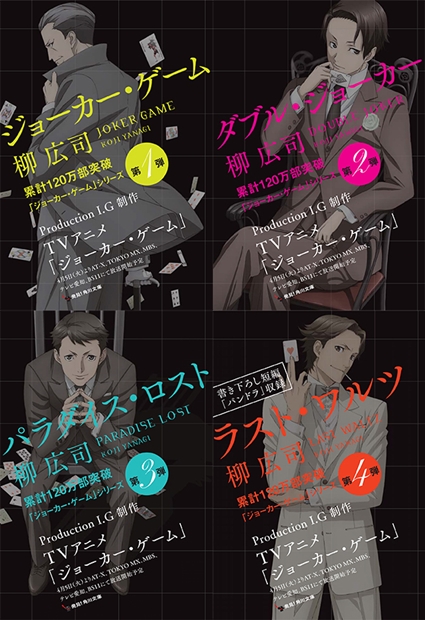
The original novel series published by Hiroshi Yanagi includes "The Joker Game" and its sequels "Double Joker," "Paradise Lost," and "The Last Waltz" in four previously published volumes.
An anime cover version, which differs from the standard version, was released in conjunction with the 2016 anime adaptation.
Theme and insert songs for "The Joker Game
OP (Opening): QUADRANGLE "REASON TRIANGLE
Words and music by HIDEO NEKOTA / Arranged by QUADRANGLE
ED (Ending): MAGIC OF LiFE "DOUBLE
Joker Game" ED "DOUBLE" MAGIC OF LiFE (Fuli)
Words and music by Nobuyuki Takatsudo / Arranged by MAGIC OF LiFE and Hidetoshi Miyai

Related Articles
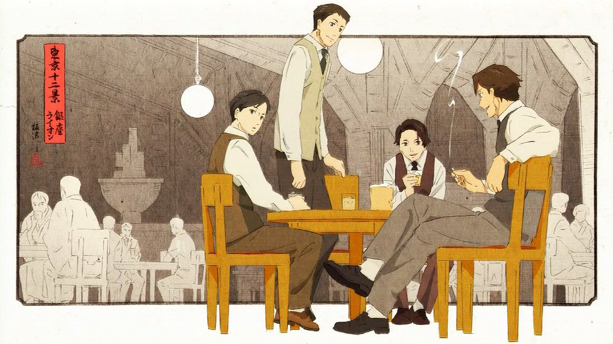
[Joker Game End Card Collection / Tokyo Twelve Scenes
A compilation of end cards for "The Joker Game," an anime with a retro flavor. The unique worldview of the early Showa period, a fusion of Japanese and Western styles, is a must-see. Also included is a behind-the-scenes look at the production of the end cards.
Read Article
木島日記(漫画・小説)のネタバレ解説・考察まとめ
『木島日記』とは大塚英志原作、森美夏画による漫画及び大塚による小説である。漫画は1998年5月号から2003年まで連載され、単行本は4巻まで刊行された。漫画では未完であったが、2017年に小説『もどき開口 木島日記完結編』が刊行され、小説の形で物語は完結した。同原作者及び漫画家による三部作の第二部にあたり、第一部として『北神伝綺』、第三部として『八雲百怪』がある。仮面の男の書店店主・木島平八郎が主人公のオカルト伝奇ミステリーで、昭和初頭の複雑怪奇な世相がその魅力である。
Read Article
![The Joker Game] D Agency Member Character Summary/ Points to Recognize and What They Look Like When They're Active!](https://renote.net/files/blobs/proxy/eyJfcmFpbHMiOnsiZGF0YSI6MzM3MTksInB1ciI6ImJsb2JfaWQifX0=--26511b88bcafd159db914994595fbf92a990a099/001l.jpg)
The Joker Game] D Agency Member Character Summary/ Points to Recognize and What They Look Like When They're Active!
The characters of the Joker Game have been discussed in various places as to what makes them recognizable. Here we summarize the characters of the D Agency, led by Commander Yuki, who are engaged in espionage activities, based on character information and characteristics.
Read Article
![Joker Game] Shirow Miwa's Interesting Twitter Summary ~ Episode 12 / Afterwards](https://renote.net/files/blobs/proxy/eyJfcmFpbHMiOnsiZGF0YSI6MzM5MTMsInB1ciI6ImJsb2JfaWQifX0=--aa61e81f1917a4405075faef044def08eb6b7389/1400652956_1_sub1_l.jpg)
Joker Game] Shirow Miwa's Interesting Twitter Summary ~ Episode 12 / Afterwards
A compilation of small stories and interesting tweets by Shiro Miwa (三輪士郎), the original character designer of the spy mystery anime "Joker Game". The comments emanating from his unique viewpoints and doodle illustrations that can only be seen here are a must-see for fans.
Read Article
![JOKER GAME] Finally the last episode! What about the second season of JOKER GAME? Joker Game" Anime: Commentary, Thoughts, and Discussion! Spoiler Warning!](https://renote.net/files/blobs/proxy/eyJfcmFpbHMiOnsiZGF0YSI6NzU1OTEzLCJwdXIiOiJibG9iX2lkIn19--b0cb61d5689d251a102c3418083d2331878234ac/jokerg.jpg)
JOKER GAME] Finally the last episode! What about the second season of JOKER GAME? Joker Game" Anime: Commentary, Thoughts, and Discussion! Spoiler Warning!
The "D Agency," a spy training division secretly established before World War II. The anime "Joker Game" depicts the dark deeds of the D Agency members. Will there be a second season? How can you tell each character apart?
Read Article
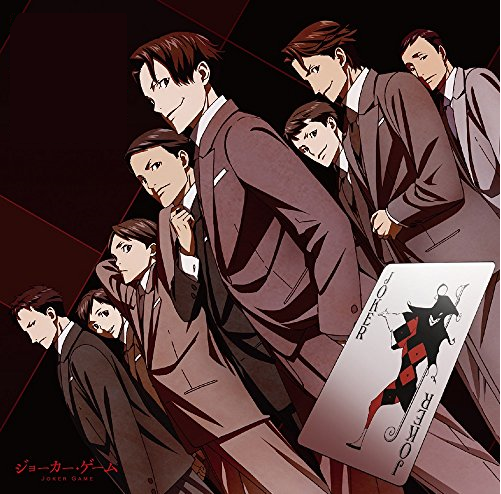
Deceive all and survive. What kind of anime is the spy mystery "Joker Game"?
Introducing "The Joker Game," a film about a Japanese spy who worked in the dark around the world before World War II. Based on a novel by Hiroshi Yanagi. It does not have the flashy action seen in "007," one of the most famous spy films, but the psychological battles and exquisite tactics shown by the characters when they are in a tight situation are fascinating.
Read Article
![Terror of the Reverberation] An introduction to this fascinating anime with a genius-like protagonist and head-to-head battles! The Joker Game](https://renote.net/files/blobs/proxy/eyJfcmFpbHMiOnsiZGF0YSI6ODU5ODAxMiwicHVyIjoiYmxvYl9pZCJ9fQ==--ca5aa65b45db85333b699df19274fc966acbab57/e786f006.jpg)
Terror of the Reverberation] An introduction to this fascinating anime with a genius-like protagonist and head-to-head battles! The Joker Game
We have compiled a list of anime featuring protagonists with genius brains and fascinating brain battles. Many of these works, such as "Zankin no Terror" and "Joker Game," offer viewers a variety of things to think about as well. If you enjoy reading the thoughts of characters and characters and solving mysteries, please check out these works.
Read Article
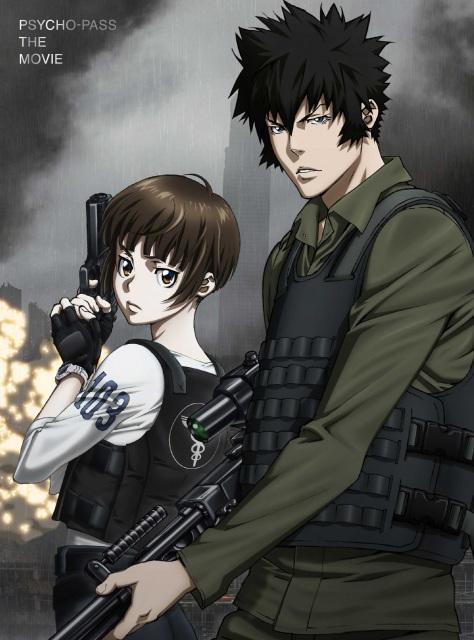
PSYCHO-PASS the Movie: Cunning Bite is back! The stage is set overseas, and the hot battle is about to begin!
A man who had done justice for himself became a murderer and disappeared. What is he thinking now, and what is he trying to accomplish? Akemi Tsunemori, who has grown up to be a full-fledged detective, steps into the "Sheen," where the new sibula system has been introduced. In the danger zone where bullets fly, he meets a man again.
Read Article
Tags
Contents
- Overview of "The Joker Game
- The Joker Game
- joker game
- miscalculation
- haunts of wicked men
- Robinson.
- Asia Express
- cipher name Cerberus
- double joker
- tracking (e.g. in computer graphics)
- coffin
- XX (double-cross)
- Characters from "The Joker Game
- key people
- Lieutenant Colonel Yuki
- D Institution Trainee
- Miyoshi
- Kaminaga
- Odagiri
- Jitsui
- Hatano
- Amari (not so much)
- Fukumoto
- Tasaki
- Other than D Institutions
- Lieutenant Sakuma
- John Gordon
- Colonel Muto
- Alain Lernier
- Jean Victor
- Marie Torres.
- Captain Masayuki Oikawa
- Sergeant Eiji Honma
- Howard Marks.
- Jeffrey Morgan (Lewis McLeod)
- Cynthia Grahn
- Emma Grahn.
- Kiichiro Shirahata
- Ernest Graham.
- Jane Graham.
- Tetsumasa Kazato
- Jiro Gamo
- Lieutenant General Akutsu Yasumasa Chujo
- Aaron Price
- Hermann Wolff.
- Johann Bauer.
- Carl Schneider
- Yuriko Nogami
- Miyoko Yasuhara
- Terminology for The Joker Game
- D Organization
- wind engine
- spymaster
- group of imperial coins
- Famous quotes, lines/scenes, and scenes from "The Joker Game
- Commander Yuki: "What awaits you all in the future is pitch black loneliness."
- Commander Yuki: "You think only men are recruited to the D Agency? Because women kill when they don't have to. For such inconsequential things as love and hate."
- Backstories, trivia, subplots/episodes, and anecdotes from "The Joker Game".
- Model of D Institution "Army Nakano School
- Background of the Establishment of the Army Nakano School
- Army Nakano School Curriculum
- Anime cover version of the original novel is now available.
- Theme and insert songs for "The Joker Game
- OP (Opening): QUADRANGLE "REASON TRIANGLE
- ED (Ending): MAGIC OF LiFE "DOUBLE