
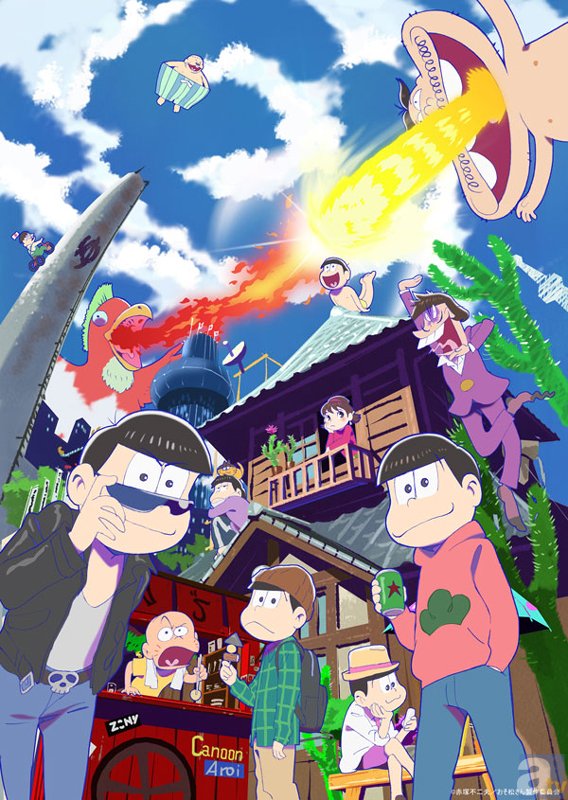
Osomatsu-san" is an animated film based on Fujio Akatsuka's manga "Osomatsu-kun". The catch copy is "Even if you grow up, you are still an idiot. The six children Osomatsu, Kalamatsu, Choromatsu, Ichimatsu, Jyushimatsu, and Todomatsu, who were children in "Osomatsu-kun," grow up and become adults, but they become virgins and NEETs. The six live at home and spend their days idly without working. Iyami, Chibita, Totoko, Hatabo, Dekapan, and Dayon, all familiar faces from "Osomatsu-kun," also make an appearance. A nonsense and surreal gag comedy.
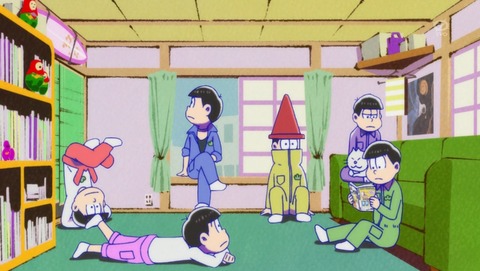
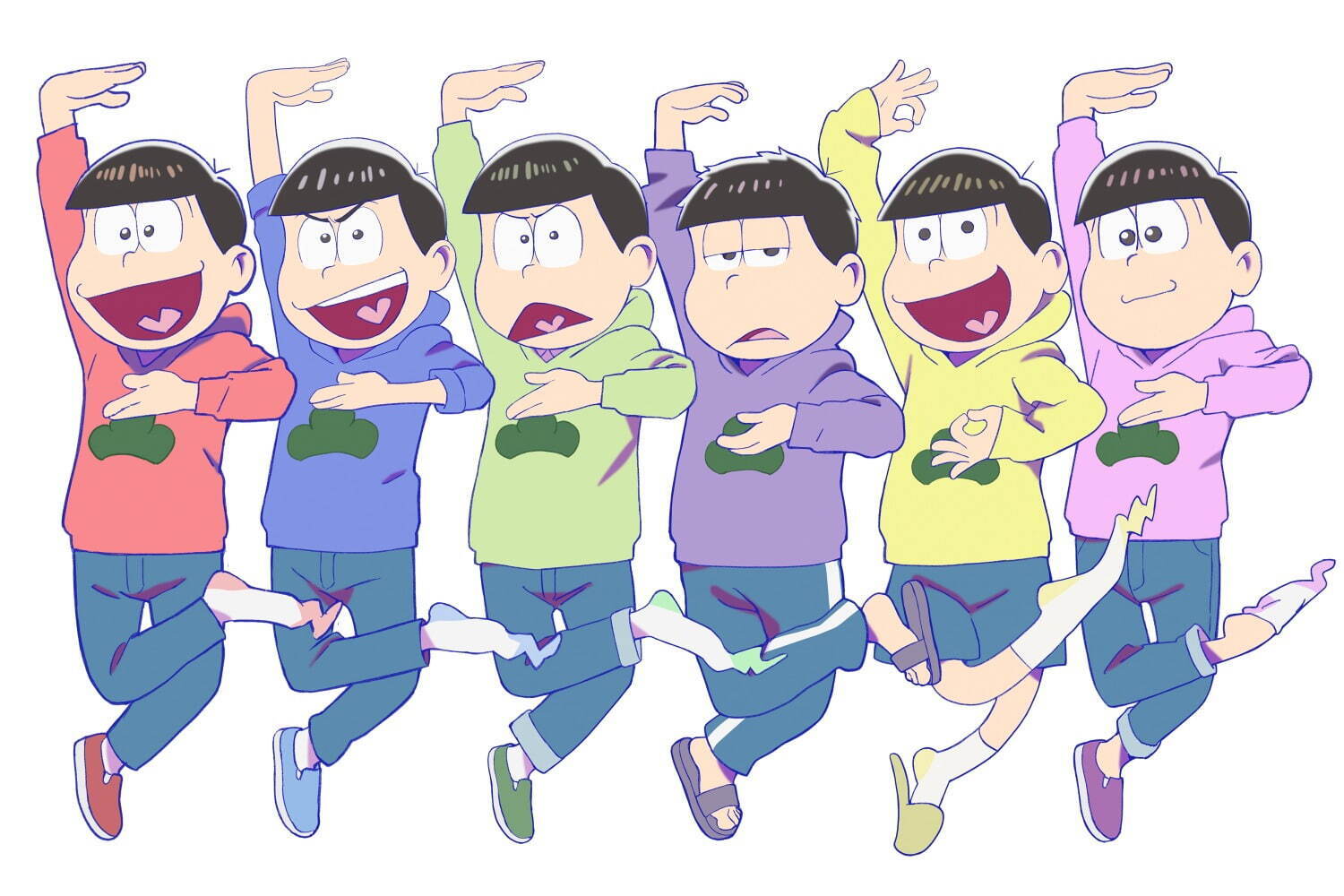
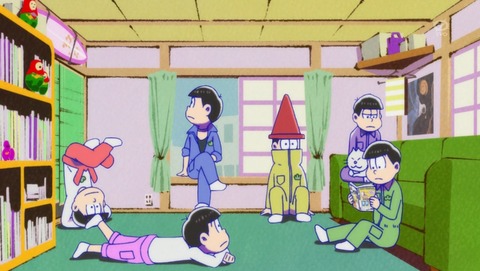
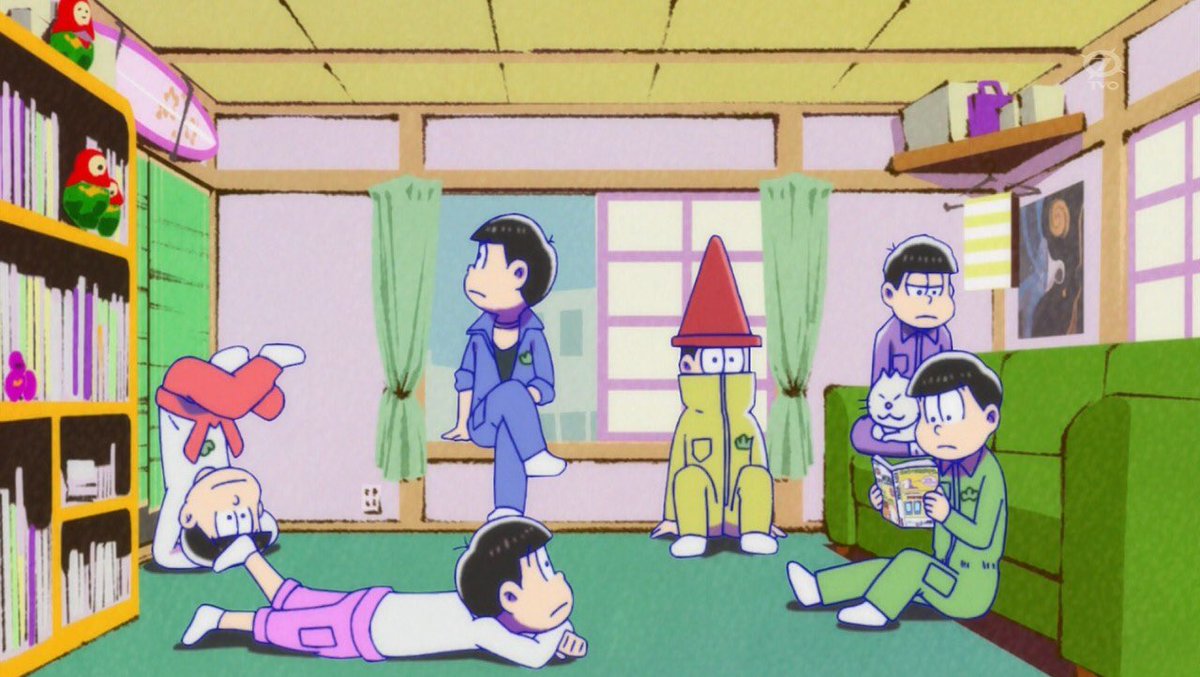
Osomatsu is the one turned over, Todomatsu is the one lying down, Karamatsu is the one sitting on the window sill, Jyushimatsu is the one wearing a color cone, Choromatsu is the one reading a book, and Ichimatsu is the one with the cat.
In "Osomatsu-kun," the six children have the same looks and personalities, and they are all six in one.
Since they all have the same facial parts, it is difficult to tell who is who at first sight, and many people initially identify them by their voice actors.
However, there are significant differences in facial expressions and behavior, and once the eye becomes accustomed to them, it becomes possible to tell who is who.
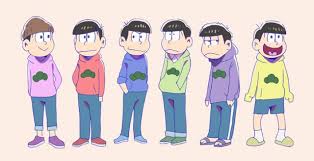
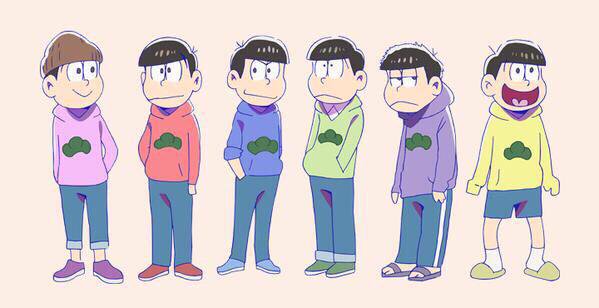
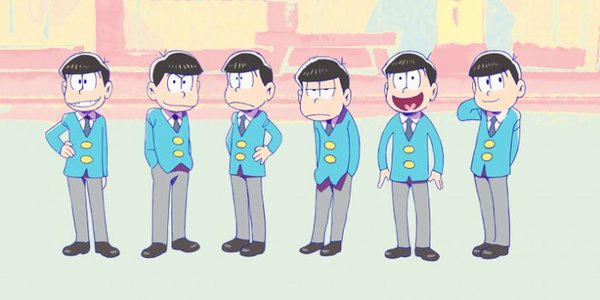
The easiest way to tell them apart is by color: red is Osomatsu, blue is Karamatsu, green is Choromatsu, purple is Ippomatsu, yellow is Jyushimatsu, and pink is Todomatsu.
Furthermore, Osomatsu, Karamatsu, Ippomatsu, and Todomatsu have two ahair, Jyushimatsu has one ahair, and Choromatsu has no ahair.
The number of hairs on each of the fourteen pine trees can be used to distinguish them from Choromatsu.
There are also differences around the eyes and mouth. The standard face is Osomatsu.
In appearance, Osomatsu and Todomatsu are the most similar, and it is sometimes difficult to tell them apart when they have the same expression.
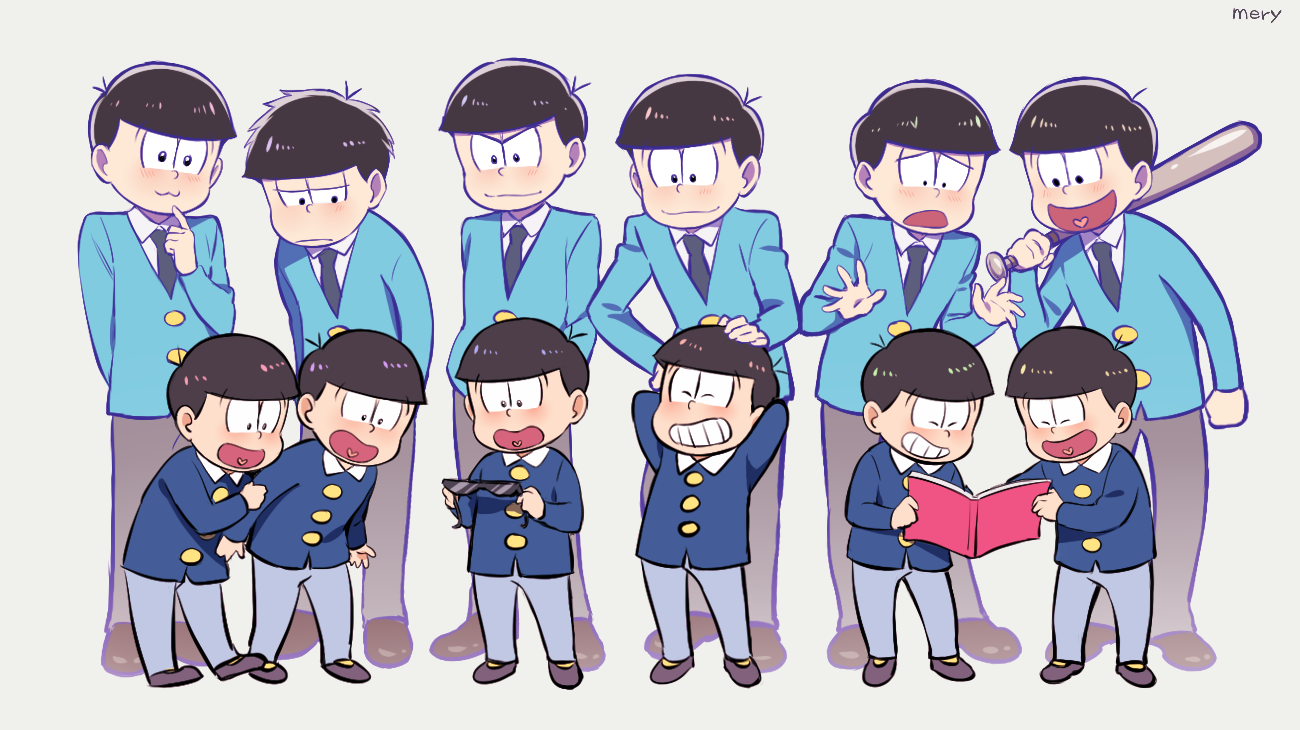
When they are all wearing the same clothes, at an angle where their ahogashira cannot be seen, and when they all have the same expression, it is possible to distinguish them by the color of the highlights in their hair, although it is a little difficult to check.
It is very subtle, but it is the coloring of the color of each person's hair.
The individuality of "Osomatsu-san" is quite clear, but when they all have the same expression, it is easy to tell that they are the same six children from "Osomatsu-kun.
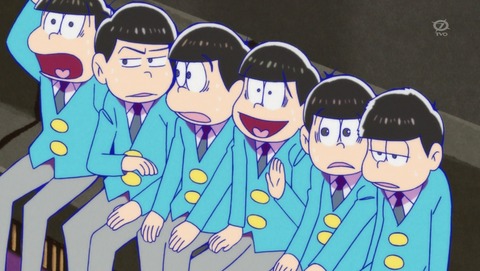
From left to right: Jyushimatsu, Karamatsu, Osomatsu, Choromatsu, Todomatsu, and Ichimatsu.
Duality of the sextuplets
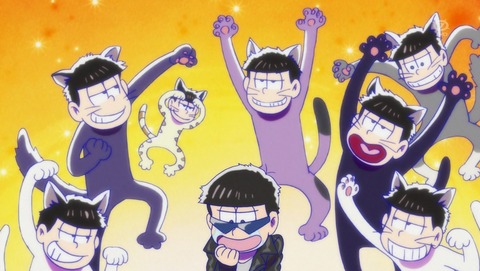
Although Kazumatsu is dark-rooted and called Yami-matsu (dark pine), he is actually a talkative and tsukkomi type in his head.
The main personalities of the six children are Osomatsu, the scruffy eldest son; Karamatsu, the narcissistic and painful one; Choromatsu, the serious and quick-witted one; Ichimatsu, the dark-rooted cat lover; Jushimatsu, the cheerful madman; and Todomatsu, the mocking youngest brother.
At first, however, the behavior of each of the six children takes on the characteristics of these characters, but gradually we begin to see a different side of each of the six children.
The most obvious example of this tendency is Ichimatsu.
He is usually described as quiet, dark, and as if he would commit a crime if left alone, but in fact, inside he is a sensible person who talks a lot and gets upset a lot.
In the first half of the story, he is a character with an unfathomable darkness that makes you wonder what he is thinking, but in the second half, Ichimatsu is probably the most normal of the six.
On the other hand, Choromatsu, who was considered to be a sensible person, turns out to be a sexually active Shikomatsu, and he also turns out to be an overly self-conscious and painful person who has no idea of his own abilities.
Todomatsu, the youngest brother, was also thought to be a sensible person, but his facial expressions and dryness with no interest in others came to the fore, and he was called the worst of the six children by his siblings.
He is also a character who understands the feelings of others, such as Kazumatsu, who has difficulty expressing his emotions.
He is also the strongest and the most unpredictable character in the gags, but when things get serious, he becomes the more mature character of the fifth son, the second younger brother from the bottom.
The painfully narcissistic Karamatsu is in fact a scared man who is unable to resist others.
However, in episode 24, he stops Osomatsu from fighting with Jyushimatsu and takes him outside, showing the behavior of a second son who is almost on equal footing with the first son.
He is usually on the playful side, but when he gets involved with Jyushimatsu, he becomes a bit more of a cliche.
Osomatsu is an optimistic bum, but he also has a big brotherly side that worries about Jyushimatsu and his girlfriend. However, in episode 24 we see that he is the most dependent on his brothers and cannot allow them to leave his side.
The gap between the two sides of the characters is referred to as "A" and "B," with the first season's first episode showing the "A" side and the second episode showing the "B" side.
The fact that the characterization of the six children cannot be grasped just by watching the show once or twice is one of the attractions that make viewers think and are attracted to the show.
Relationships among the six children
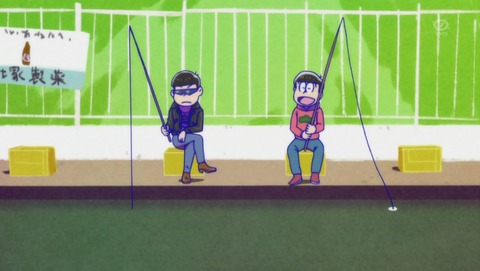
Among the six children, there are slight differences in their relationships, such as the two who are often involved and the two who are not so involved.
In "Osomatsu-kun," the relationship is often divided into the following pairs: Osomatsu and Choromatsu, Karamatsu and Todomatsu, and Kazomatsu and Jyushimatsu.
Perhaps for this reason, Osomatsu-san also has many depictions of these three pairs.
Osomatsu is relatively close to all of his brothers, has a little bit in common with all of them, and has many episodes with Choromatsu.
Karamatsu confides his problems to Osomatsu, is physically close to Choromatsu, is disliked by Kazumatsu, has more gags with Jyushimatsu in the latter half of the season, and is often portrayed as a pair with Todomatsu.
Choromatsu fights a lot with Osomatsu, is not as hard on Kalamatsu as the other siblings, has a fair amount of gag interactions with Jyushimatsu, and is sometimes portrayed as a sensible pair with Todomatsu, but he and Ichimatsu tend to be shy of each other.
Ichimatsu has a close relationship with Osomatsu as brother and brother, Karamatsu is basically an object of hatred, Choromatsu and Choromatsu are shy of each other, Todomatsu and Choromatsu fight at times, and Ichimatsu is most often involved with Jyushimatsu.
Like Osomatsu, Jyushimatsu is involved with all of his siblings, and is most often seen with Ichimatsu.
Todomatsu also has many interactions with all of his siblings, and he is often in a bloviating relationship with Karamatsu, and is somewhat kind to Jyushimatsu.
Especially in the first half of the first season, Karamatsu and Ichimatsu never had a proper conversation, with Ichimatsu often one-sidedly cursing Karamatsu's behavior and getting no response from Karamatsu.
However, in the 17th episode, the exchange between Ichimatsu and Karamatsu occurred to such an extent that it became a hot topic of conversation on Twitter and other social networking sites that day.
Perhaps because Karamatsu was a bit of an outcast in the first episode, he was not shown talking with the other six children, and some people thought he might not be a part of their group.
He was involved with Ichimatsu in episode 16, "The Ichimatsu Incident," and with Jyushimatsu in episode 17, "The Jyushimatsu Festival." Perhaps his characterization was complete, but after that he joined the conversation among the six children and began to talk with Ichimatsu as well.
The older brothers tend to be relatively free-spirited jerks, while the younger siblings have their own ideas and are pushed around by their older brothers.
Osomatsu and Totoko
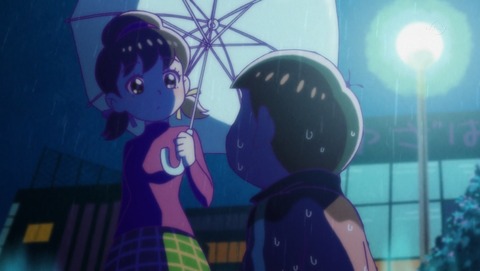
Totoko is like an idol to the six children, but Osomatsu is the most frequently involved with Totoko alone, perhaps because he is the main character and the eldest son.
Totoko has never mispronounced any of the six children's names and is able to recognize all of them correctly.
In episode 24, after all the younger brothers leave the house, Osomatsu shuts his mouth and his usual happy expression disappears.
Totoko whimsically asks Osomatsu out on a date, but Osomatsu, who is usually crazy about Totoko, ignores the invitation.
Totoko, who usually says that she does not like the six children, shows concern for Osomatsu, and it seems that she asked Osomatsu out on a date because she knew he was not doing well.
Also, in the second cool episode 16, "My Neighbor's Cutie," Rokutsuko becomes infatuated with Kinuko Inuyama, who has moved in next door.
When Totoko's invitation coincides with their plans to go out with Kinuko, the Rokko's give priority to Kinuko because she will be moving soon.
However, Totoko sees Rokutsuko and Kinuko together on the day she turns down the invitation, and she is bothered to see Rokutsuko, who was crazy about her, flirting with another girl.
He follows Roppongi and Kinuko around and ends up making things worse.
Karamatsu and his friends try to quiet him down and praise Totoko, but Osomatsu is the only one to cut her off, saying she is not cute enough.
In the 24th episode of the second season, Osomatsu begins to wonder if he is really doing the right thing, or if he is just living life as it comes.
Osomatsu goes home, but the only one at home is Ippomatsu, who is sleeping because he works the night shift, and Ippomatsu says he doesn't know where his other brothers are.
Osomatsu looks for a place where his brothers might be, but they are nowhere to be found.
Totoko appears, and Osomatsu tells her about his problems and apologizes for his uninteresting talk.
Totoko does not lecture or give advice, but laughs at the uninteresting story and pushes Osomatsu, saying that if he wants to do what he wants, he should do it.
Although he is usually egoistic, Totoko cares about her childhood friends, the six children, and without them she would be out of sorts, and Osomatsu is the representative of those six children.
Osomatsu and Iyami
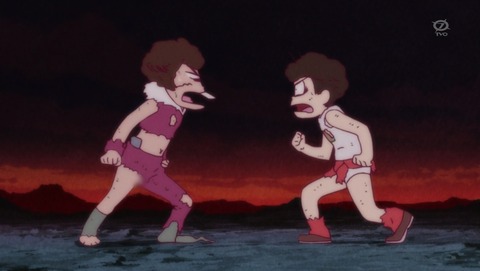
Iyami kills all the characters in the story, including the six children, but only Osomatsu is unharmed.
Contrary to Totoko, who never misspells the names of the sextuplets, Iyami is the one who can never correctly say the names of the sextuplets.
Iyami is the most popular character in "Osomatsu-kun" and is the rival of Osomatsu and his friends, a relationship that continues in "Osomatsu-san.
However, this rivalry is not between each of the six children and Iyami, but rather Iyami vs. the six children, which is a group battle for the six children.
In this way, Osomatsu is always the leader when the six children work as "the six children" rather than individually, which clearly shows that Osomatsu is still the main character.
Osomatsu is a little less individualistic than the other six children, and is a grown-up version of Osomatsu-kun, a kind of plain, unseasoned character.
However, when they are pitted against the character Iyami, they are in the position of Osomatsu, the main character of the series.
The six children are united, and the center of their unity is absolutely Osomatsu, the eldest son.
In "Gyakusyu no Iyami," however, Osomatsu is attacked by his younger brothers because he is in their way.
The battle with Iyami is depicted in the first season episode 18 "Gyakusou no Iyami", the second season episode 6 "Iyami ga Kitaeru", the second season episode 18 "Iyami wa Hitori Kaze no Naka" (Iyami is the main character here), and the second season episode 24 "Jigoku no Osomatsu-san".
Matsuzo, Matsudai and the Six Children
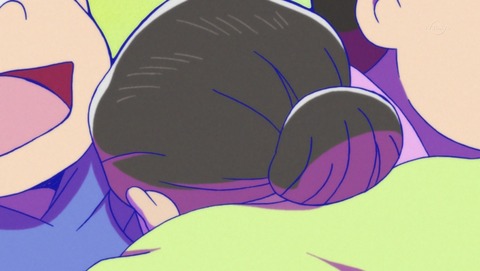
My own children are cute, even if they are neat.
Husband Matsuzo and wife Matsudai have the enormous burden of six NEETs.
There are several scenes in which they blast their sons to work, but none of them really push them away.
In the 21st episode of the second season, "NEET Correctional Facility," they decide to send one of them to a correctional facility, but Matsudai has a hard time choosing one of them.
He consults with Choromatsu, but in the end, he opens up that he would miss any of his sons if they were gone, and that he doesn't care if they are NEETs or not, as long as they are healthy.
Matsuzou says that if he cannot decide on one son, he will send three, but when the six children pay him off one after another, Matsuzou is exempted one after another, and in the end, the six children lift him up in their arms.
Matsudai, who was watching the situation, laughed and hugged his sons.
The six children are able to live happily as NEETs because of Matsudai's generosity in accepting them and Matsuzou's earnings.
The two parents seem sensible at first glance, but they are also the parents who have a little bit of each of the sextuplets' personalities, and their trivial actions are depicted in a way that makes us think that they are the parents of the sextuplets after all.
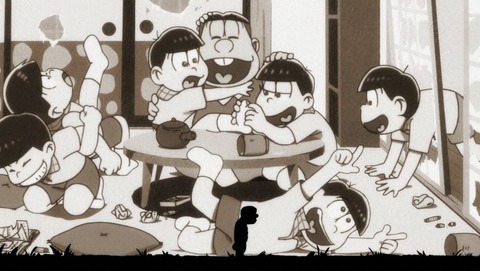
Childhood was, in other words, the era of "Osomatsu-kun," but I can distinguish just a little who is who.
Totoko and Meow-chan
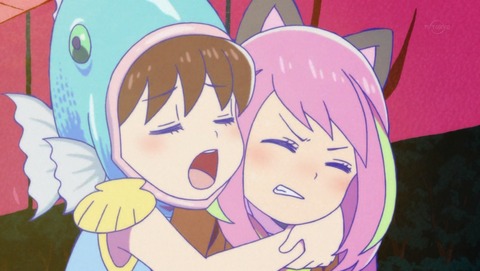
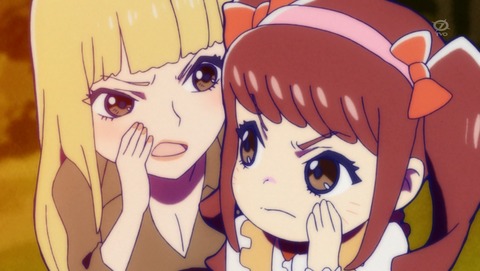
Nya and Totoko, both underground idols, are acquainted with each other and see each other as rivals.
Nya pushes Totoko away and speaks harshly to her, while Totoko speaks to Nya without hesitation.
The two are not close, but in the second season, they have more scenes together, and Totoko is portrayed as feeling friendship with Nya.
Nya also dislikes Totoko's involvement, but in the end she listens to Totoko's advice on her problems, and a relationship is being built between the two rivals.
However, in the end, they end up arguing and fighting, and it turns into a catfight with fisticuffs.
Chibita gets in trouble for getting into a fight at a food stall, and Choromatsu, who has illusions about women, sees a real fight between women and screams, causing damage to others as well.
Totoko seems to have only friends who are characters in "Osomatsu-kun," namely, the opposite sex. Totoko, who tends to look down on the same sex as being uglier than her, may unconsciously want a friend of the same sex.
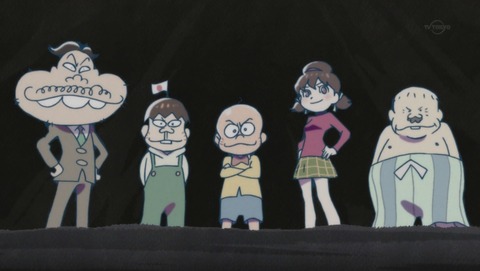
Sub-characters from "Osomatsu-kun" in action

Related Articles
TV anime Osomatsu series, voice actors of Osomatsu in the past!
This is the third installment of the Osomatsu series. This time, we will introduce you to the cast members of the modern Osomatsu and the first Osomatsu in the series!
Read Article
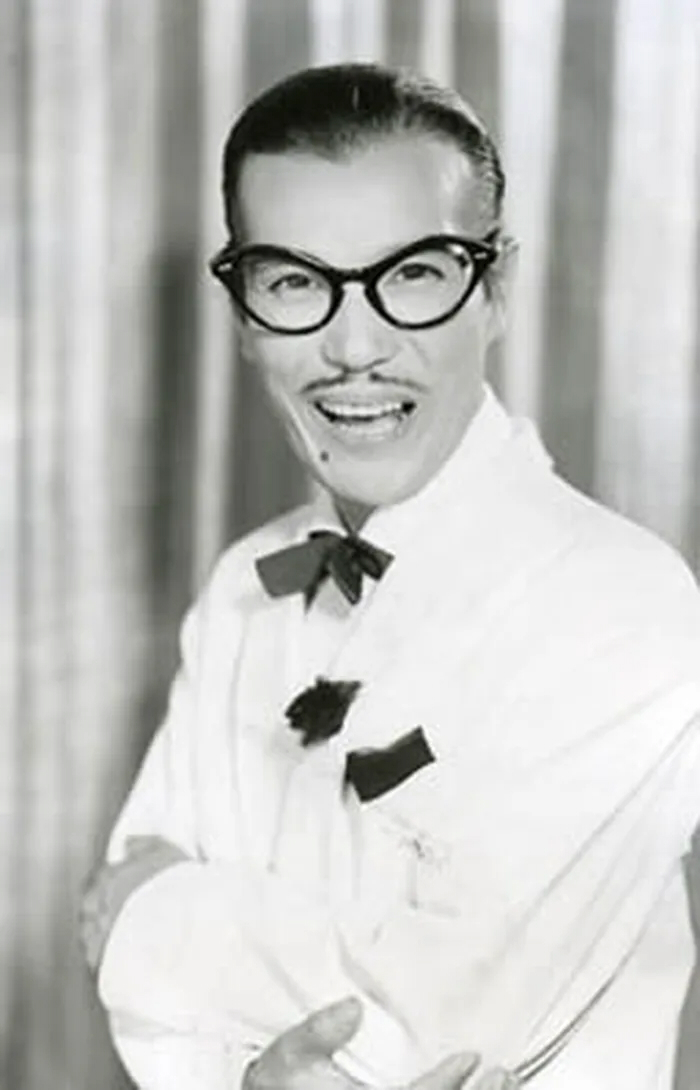
Osomatsu-kun in the Showa era, the model for Iyami, "Tony Tani
Iyami" appears in many Fujio Akatsuka cartoons, including "Osomatsu-kun. We have compiled a list of popular words created by "Tony Tani," a stage performer in the 1950s who modeled himself after Iyami.
Read Article
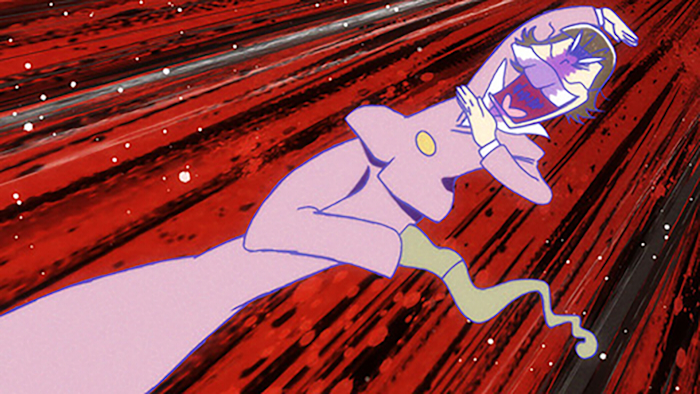
An evolved national gag. A variation of "Shae! in "Osomatsu-san".
Our own Iyami said to himself, "The national gag," "Shay! Shay! I used to strike this pose myself when taking pictures, but in "Osomatsu," the "Shay! has evolved.
Read Article
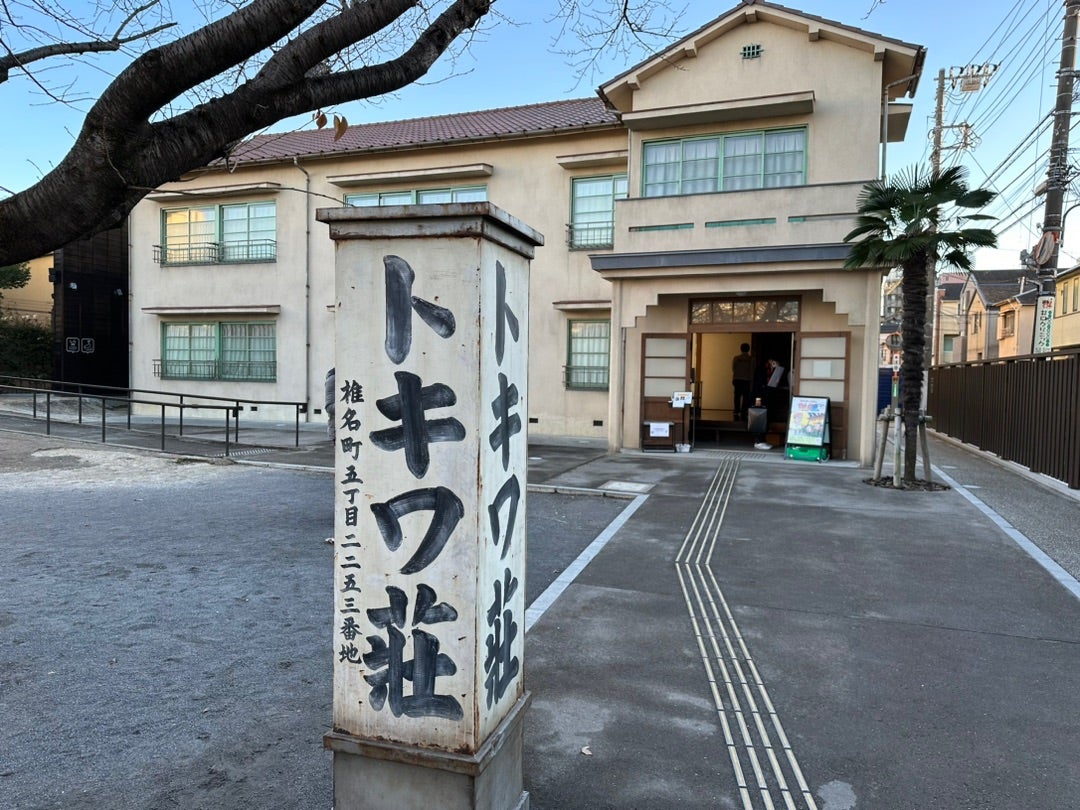
What is Tokiwasou? History, anecdotes, trivia, cartoonists who lived there, members, and where it is located!
Tokiwa-so is a two-story wooden apartment building in Minami-Nagasaki 3-chome, Toshima-ku, Tokyo. Although the building was demolished in 1982 due to aging, it is still very well known as a "sacred place for manga. Even today, the Tokiwa-so Manga Museum and the Tokiwa-so Project have left their mark on the manga world. This article provides information about Tokiwa-so and the manga artists who lived there.
Read Article
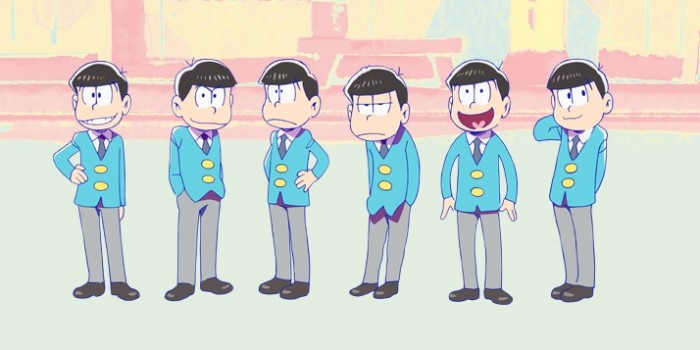
Now you are a Matsuno master! How to identify the Matsuno siblings & profile summary
I don't know the difference between the Matsuno brothers... I am sure there are many of you who do. So, I've compiled a list of ways to tell the Matsuno brothers apart & their characteristics!
Read Article
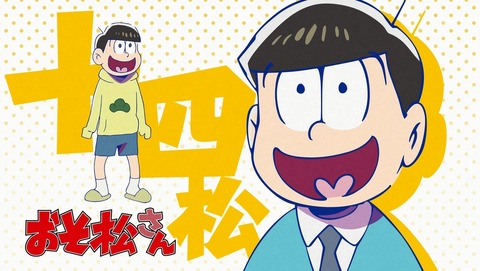
Not just smiling! A summary of Jyushimatsu's facial expressions
Jyushimatsu is often thought of as always smiling. Surprisingly, he makes a lot of different faces! So this time we have compiled a list of Jyushimatsu's faces.
Read Article
Arina Tanemura's "Osomatsu-san" 18-unit BL doujinshi has been discontinued...too bad, what's the reason for that!
Arina Tanemura is known as the author of famous manga such as "Kamikaze Kaito Jeanne" and "Full Moon wo Sagashite. In fact, she was working on a secondary work for the popular anime "Osomatsu-san," and was apparently in the process of publishing an 18-unit BL doujinshi. However, the publication was suddenly cancelled. Twitter was in an uproar over the incident. What exactly happened? This article summarizes.
Read Article
About the six mourning female figures in the official female adaptation of Osomatsu-san's "Jyoshimatsu-san" that are too realistic.
The popular gag anime "Osomatsu-san" finally reached its final episode on March 25. The "Jyoshimatsu-san", female versions of the six children, made their first appearance in the 13th episode. The same voice actors as the Matsuno family's six children play the roles of the female characters, giving them a creepy-cute charm like the male characters. But that's not all. Let's take a look back at the real "mourning women" in the "Joshimatsu-san" series. But that's not all.
Read Article
Which is your favorite? A list of girls' (and a few boys') characters and their uniforms in anime (and a quiz!)
The uniforms of female characters in anime are far more glamorous, distinctive, and adorable than the unadorned uniforms of real life. From the colorful ones to the ones with a particular sense of fashion, to the simple but quaint ones, they are all impressive. And you can almost tell what the original story is just by looking at the uniforms. In this article, we have compiled a list of uniforms worn by girls in anime.
Read Article
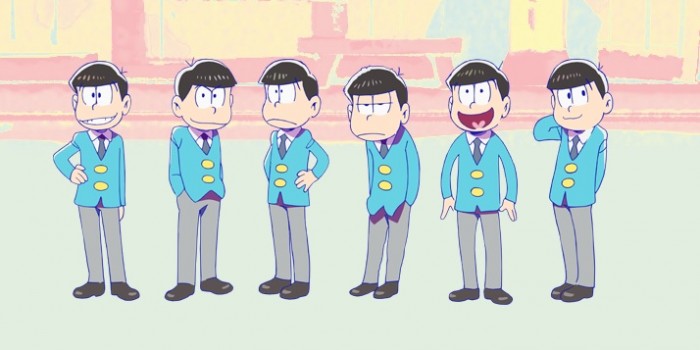
New Osomatsu-kun is on the air! Here's a comprehensive review of Osomatsu-kun!
Fujio Akatsuka returns to commemorate the 80th anniversary of his birth with the return of the six children. What kind of adults have they grown up to be over time...?
Read Article
Thinking very much now, based on online opinion and my own judgment, "Sanjimatsu-san" (spoiler alert).
Osomatsu-san" has shown us something indescribably dense since the beginning of the New Year, but more than "Josimatsu-san," what caught my attention more than anything else was the TV series "Sane-matsu"....
Read Article
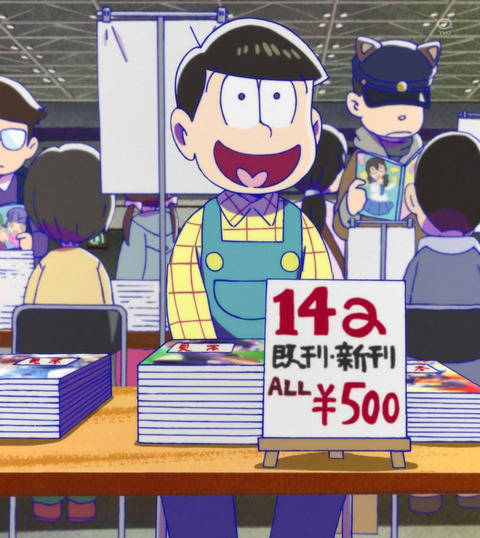
BL Words in a Row! A summary of the Jyushimatsu words that appeared in Osomatsu-san Episode 17.
Episode 17 of Osomatsu-san is a fourteen pine festival! In the story, there is a scene where Jyushimatsu is selling fanzines, and he utters a series of BL words. So this time, we've compiled a list of those memorable Jyushimatsu words!
Read Article
This is the work of a professional! The craftsmanship of a voice actor in animation!
There are professionals in every field. They are also known as "craftsmen. Their uncompromising workmanship is so impressive that it sometimes makes me lose my voice. Here are some examples of the craftsmanship of voice actors.
Read Article
Osomatsu-san" = "Gintama"? The new anime "Osomatsu-san" is too much of a troll for other works.
In the fall of 2015, "Osomatsu-san," one of Fujio Akatsuka's best-known works, was adapted into a TV anime to commemorate the 80th anniversary of his birth and to show what happens after "Osomatsu-kun," one of his best-known works, has grown up. The reason why its unprecedented content has been so well received is the "voice actors"!
Read Article
After 27 years, the anime is back! Introducing the characters and voice actors of "Osomatsu-kun" and "Osomatsu-san" all at once!
Osomatsu-kun," an original story by Fujio Akatsuka, was first made into an anime in 1966 and the second in 1988. Osomatsu-kun," which was adapted into an anime for the first time in 27 years as a grown-up version of "Osomatsu-san," which became a hot topic! In this issue, we will introduce the characters of "Osomatsu-kun" and "Osomatsu-san" and the animation production staff of the past generations!
Read Article
Late Night Gintama⁉"Osomatsu-san" Episode 1 Parody Summary Part 1
Osomatsu-san, you were blown away from the very first episode. So this time I have compiled a lot of parody stories. Since there are so many, I will introduce them separately.
Read Article
Late Night Gintama⁉"Osomatsu-san" Episode 3 Parody Summary
Episode 3 had a lot of parodies from outside the anime and manga. So here's a roundup of all the parroted material from episode 3!
Read Article
Late Night Gintama⁉"Osomatsu-san" Episode 7 Parody Summary
Episode 7 is all about Totti! We've also included a parody of Totti... and this time we've put together a parody of episode 7!
Read Article
Urban Legends of Osomatsu-san (actually the eight children): A collection of chilling and scary rumors about the afterlife.
We have compiled a list of urban legends about the popular anime "Osomatsu-san. The episode in the original story in which the entire Matsuno family ate a blowfish and died led to whispers that "Osomatsu-san takes place in the afterlife?" The episode of the original "Anonye" episode, the reason why Osomatsu-san gave a bullshit map was to kill the other siblings, and other scary episodes and fan's thoughts will be introduced.
Read Article
The character introductions on the official "Osomatsu-san" website have changed...! How in the world has it changed?
The introduction of the six children on the official website of "Osomatsu-san" has changed. Here is a comparison with the previous introduction!
Read Article
Late Night Gintama⁉"Osomatsu-san" Episode 1 Parody Summary Part 3
Osomatsu-san, you've been blowing me away since episode 1. This is my last parody compilation! I can't wait for episode 2 to air.
Read Article
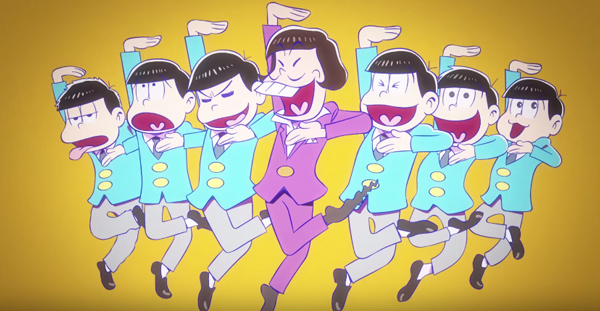
Late Night Gintama⁉"Osomatsu-san" Episode 2 Parody Summary
I didn't realize there were two episodes of parrots! So here's a roundup of all the parrots from episode 2!
Read Article
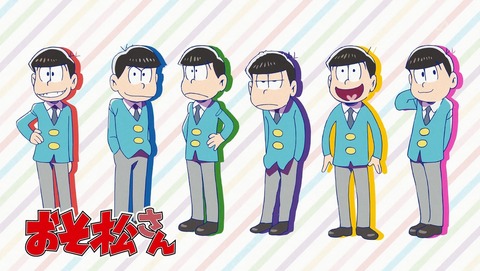
Eye-catching compilation of "Osomatsu-san"!
Here's a collection of the cutest eye catchers from the anime "Osomatsu-san"! Lots of Christmas and parody eye-catchers!
Read Article
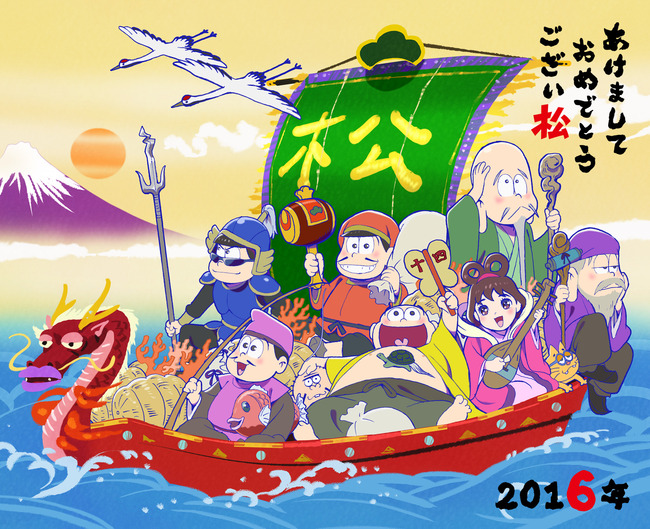
A great collection of illustrations! New Year's Illustrations from Anime, Manga, and Games
We're compiling all the great illustrations released in the new year! Take a look at these and enjoy the rest of the year!
Read Article
A deeper look at "Osomatsu-san" now (with spoilers for the final episode).
Osomatsu-san" has been the talk of the town despite being broadcast in the late-night slot. It is a work by the master of gag manga. It's not just the name value that makes it such a hit, but it's not just a gag, it's a satire. It's a little late for this, but I'd like to look back at the first episode and other episodes, and give you some insights, or at least some in-depth reading. It's really too late! I'm sure my brother Choromatsu would give me a hard time about it.
Read Article
Late Night Gintama⁉"Osomatsu-san" Episode 6 Parody Summary
Episode 6 also has a lot of parody material... so here's a roundup of all the parody material from episode 6!
Read Article
Osomatsu-san" is full of parodies! I put it together with the original stories of Utapuri, V6, Gintama, etc! Also, a commercial for the second season of the anime is introduced!
The anime "Osomatsu-san" has become a hot topic not only because of its fascinating characters and characters, but also because of the parody stories of various works and real people. In this article, along with captured images of the anime, we will also introduce the original works that were used as the source material. A commercial video of the second season of the anime is also included.
Read Article
Late Night Gintama⁉"Osomatsu-san" Episode 14 Parody Summary
There are plenty of parodies in the anime Osomatsu-san! Here is a compilation of parody material from episode 14. Again, lots of funny parodies!
Read Article
Late Night Gintama⁉"Osomatsu-san" Episode 10 Parody Summary
In this issue, we have compiled a list of parody stories from episode 9. Again, lots of parody here!
Read Article
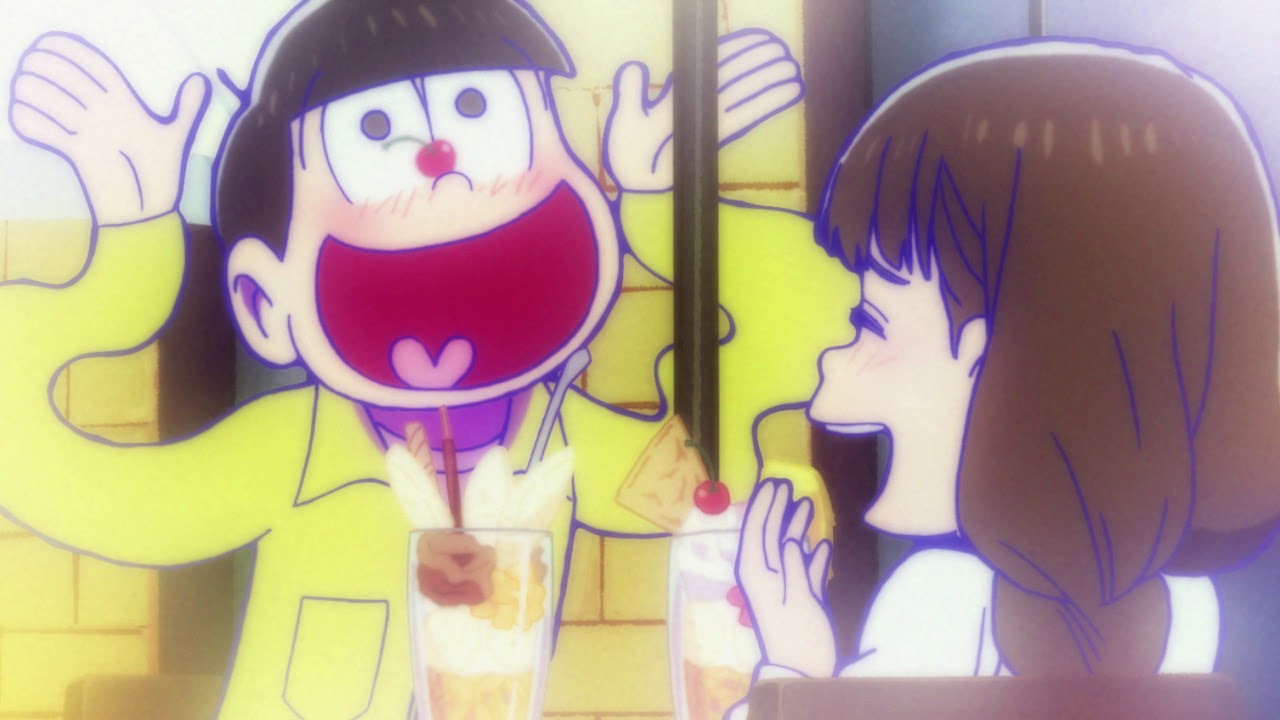
A discussion of the seven mysteries left unanswered in Osomatsu-san Episode 9, "Fourteen Pines' Love"! What do the cliff characters and station names mean?
In this section, we will discuss the "seven mysteries" in "Osomatsu-san's Love" episode 9, "Jyushimatsu's Love," including "the letters on the cliff and the station name," "her wrist," and "the meaning of the color coding of the main line. This episode contained many meaningful descriptions, and some viewers felt indigestion.
Read Article
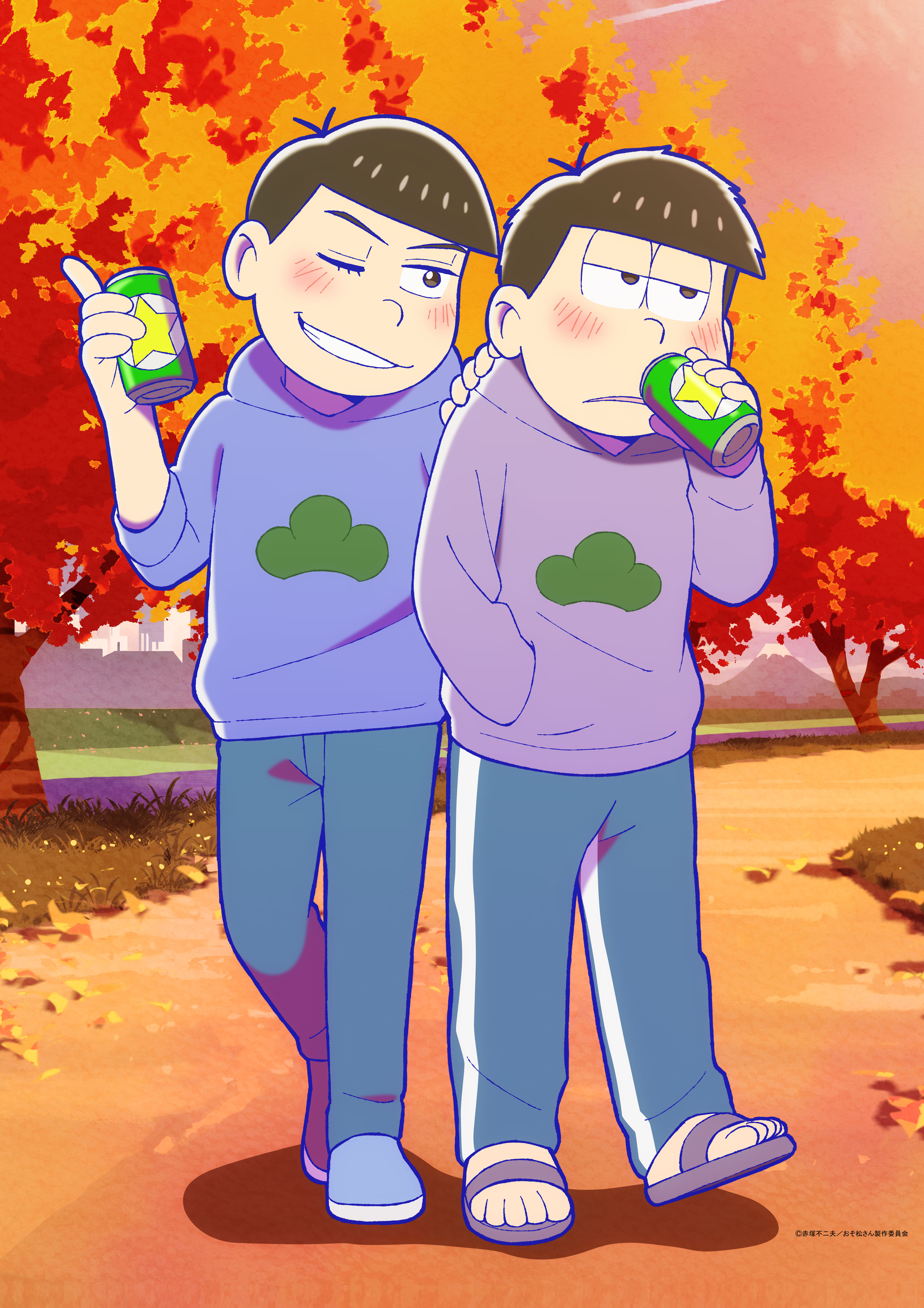
Fan art and manga of Karamatsu and Kazumatsu from "Osomatsu-san" [The Colored Pine Combination].
Here is a collection of fan art and manga of Karamatsu and Kazumatsu from the anime "Osomatsu-san" uploaded by fans on the Internet. The majority of the works were published mainly on Twitter. Some of them are illustrations of couplings for fujoshi (rotten girls), so please be careful if this is not your cup of tea.
Read Article
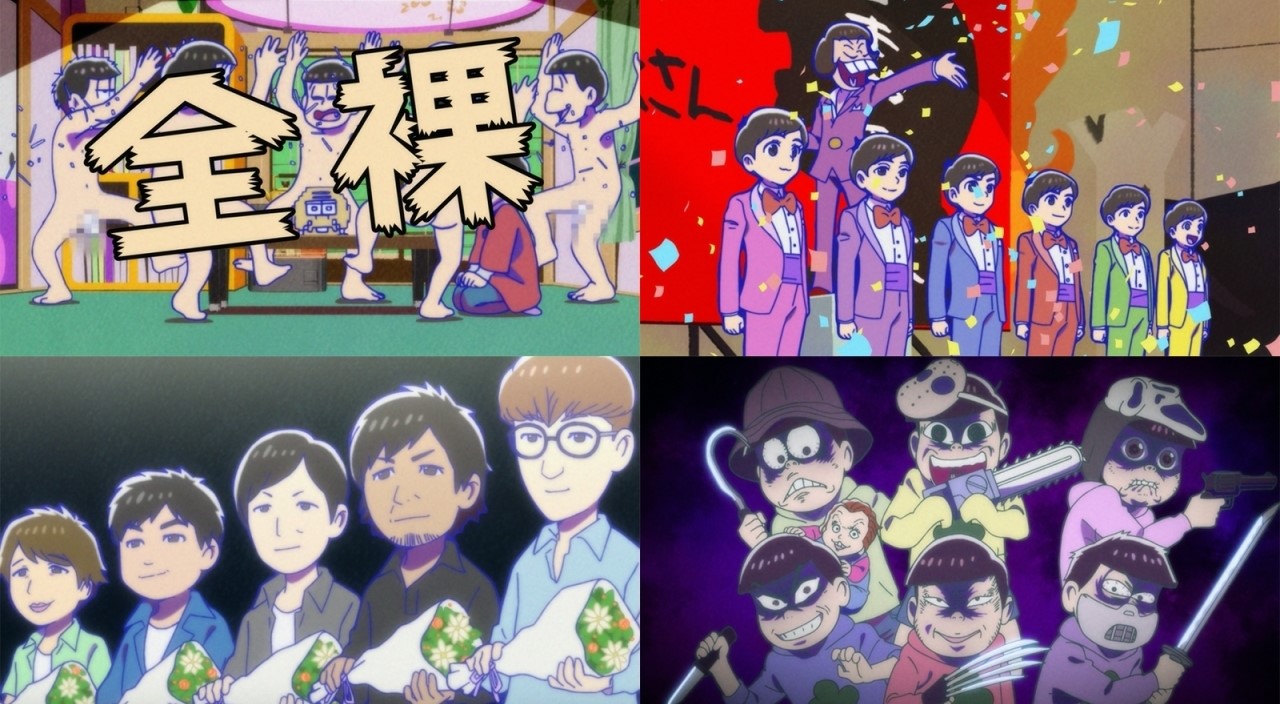
A list and explanation of the names of the duo and trio in "Osomatsu-san"! Elder brother Matsu, etc.
Here we have compiled a list and explanation of the duo and trio names used by fans of the TV anime "Osomatsu-san". In addition to the explanations within "Osomatsu-san," the characters and their actions in the original "Osomatsu-kun" are also introduced.
Read Article
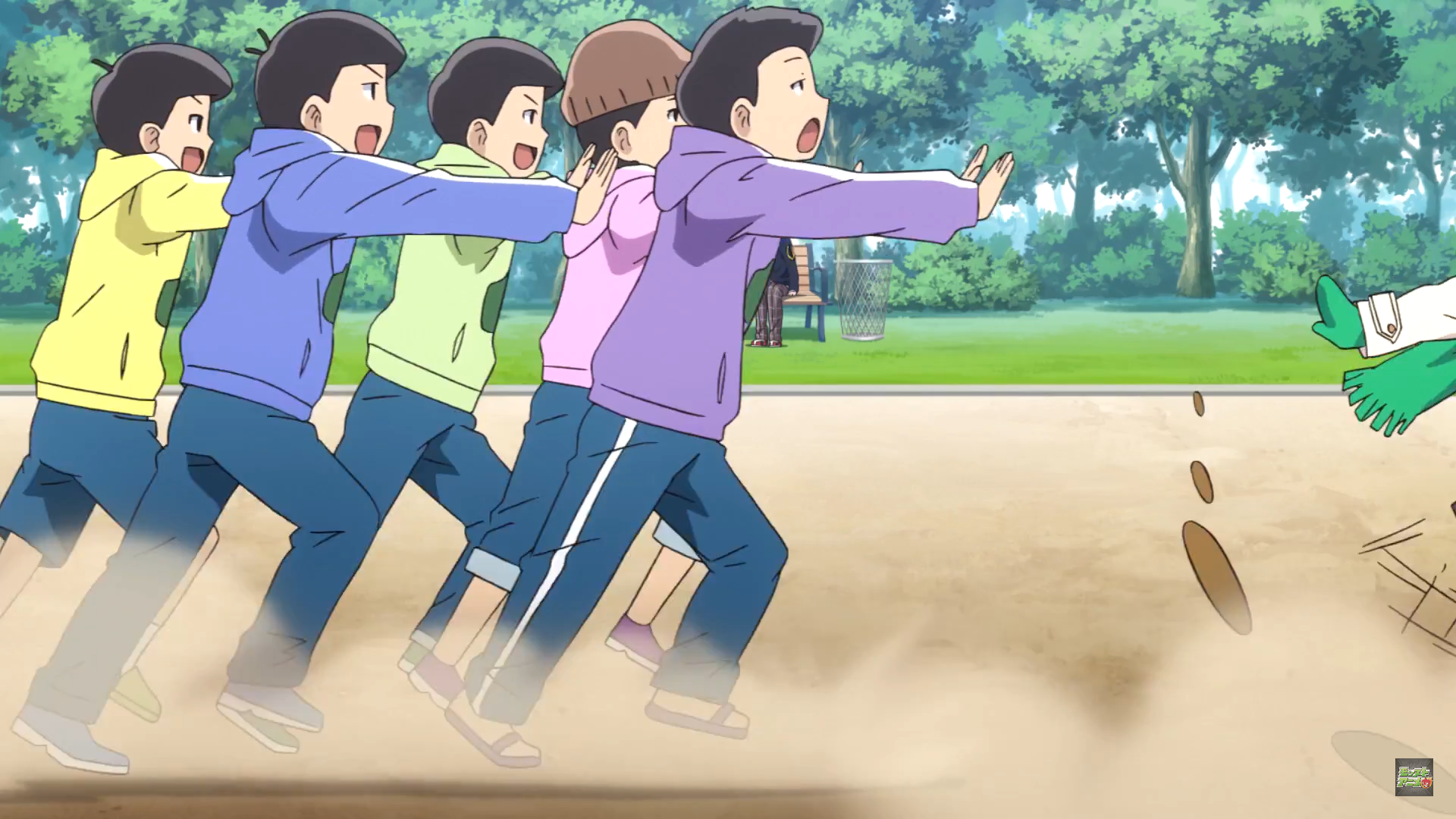
Not Just an Adventure Anime! A Parody of "Monstro" Episode 11
Monstar was adapted from a game application into an anime. It was a normal adventure anime...or so we thought, but it had a lot of parodies elaborated. In this article, we will summarize the parody material in Monstar episode 11! In episode 11, there is a parody of Osomatsu-san, a popular anime that is currently enjoying great popularity...!
Read Article
Late Night Gintama⁉"Osomatsu-san" Episode 17 Parody Summary
There are plenty of parodies in the anime Osomatsu-san! Here is a compilation of parody material from episode 17. This time we have a parody of that famous and popular manga that we all know!
Read Article
The height of the six children of "Osomatsu-kun" is considered! In "Osomatsu-kun," they are all 150cm tall!
How tall are the six children in "Osomatsu-san"? Considering the size of the room, it seems that they are not taller than 170 cm. Incidentally, in "Osomatsu-kun," which depicts their elementary school days, they were all 150 cm tall.
Read Article
Summary of "Osomatsu-san" related disturbances, including allegations of pacri and the suspension of distribution of doujinshi.
We have compiled a list of "Osomatsu-san" related disturbances that occurred due to the popularity of the anime, such as "Matsumatsu Maker," which became a topic of conversation for its ability to create "Osomatsu-san"-style avatars, and the "Katamusubi Incident," in which the character settings and other aspects of the application were accused of being a rip-off of the anime. Details of the uproar and fan reactions are introduced here.
Read Article
Tags
Contents
- Outline of "Osomatsu-san
- The story of "Osomatsu-san
- first term
- Second period
- Characters in "Osomatsu-san
- sextuplets
- Matsuno Osomatsu
- Karamatsu Matsuno
- Choromatsu Matsuno
- Ichimatsu Matsuno
- Matsuno Jushimatsu
- Todomatsu Matsuno
- Matsunoya family
- Matsuzo Matsuno
- Matsuno, Matsuyo
- minor characters
- Totoko Yowai
- sarcasm
- Chibita
- mayday
- huge pants
- Hatabo.
- Shonosuke Hijirisawa
- Nya Hashimoto
- Esper Nyanko (Japanese cartoon character)
- guest character
- Aida / Sachiko
- The girlfriend of Jyushimatsu
- The Spirit of the Flower
- ditch
- ancient Shinto pine (Pinus densiflora)
- bad pine
- Iyayo / Chibi Mi
- Dayon Tribe / Daughter Dayon
- man who is easily compelled into giving a woman advice
- Teruei
- Eitaro's mother
- Mai Komatsu (member of India's Communist Party)
- Kinko Inuyama
- chrysanthemum (Chrysanthemum morifolium)
- DAYONE KIMURA
- Derivative characters from "Osomatsu-san
- F6 (F6)
- Matsuno-Osomatsu
- Japanese larch (Larix leptolepis, Larix kaempferi)
- Matsuno Choromatsu (Japanese pine tree)
- pine needle pine
- Matsuno Jyushimatsu (fourth highest of the eight hereditary titles)
- Abudo pine (Pinus dorsalis)
- Totoko Weakai
- Nagomi Detective Osomatsu-kun
- the late king
- yellow-winged pine (Pinus parviflora)
- Inspector Choromatsu.
- one pine tree
- Jyushimatsu Forensic Examiner
- Lieutenant Todomatsu
- Mrs. Jyoshimatsu (Mrs. Jyoshimatsu)
- late child
- Chinese smoked and salted ham
- very young fish (esp. a konoshiro gizzard shad)
- a child
- 14
- crested myna (species of mynah bird, Acridotheres cristatellus)
- Mr. Sanematsu
- school pine (Pinus spp.)
- A proper pine tree.
- atomic layer deposition
- Comrades of the Three Kingdoms
- summer mask
- late
- Cabaret Club "Nekoyashiki
- Toti Beauty
- Ichimatsu Manager
- Other Characters
- Terms for "Osomatsu-san
- Fujio Akatsuka
- the late king
- Matsunoya family
- This is the way to go.
- Starbucks Kowhee.
- Dayon Counseling Office
- Mr. Flagg.
- anaesthetic
- remedy for a broken woman
- Famous quotes and lines from "Osomatsu-san
- Shay!
- My hope is big! Also, Charisma, Legend, Living National Treasure!"
- Self-Responsible Animation."
- "Finally, the Karamatsu Girls..."
- No plan."
- Oh my little Jyushimatsu!
- Mmm-hmm.
- Choroshkoski and Rising Sikorsky.
- Is he a god? Is this guy a god? On the contrary, die!"
- What is this guy's kindness? On the contrary, you should die! I'm already Karamatsu Boys!"
- Hustle hustle hustle hustle hustle hustle hustle hustle hustle hustle Muscle Muscle~!"
- Boehe!"
- BOEVER!"
- I'm beyond narcissistic, I'm a psychopath!"
- Totti."
- Tottie loves Tottie."
- Please!" Please go home!!!!"
- I hope Mr. Akatsuka isn't mad at me. He died a long time ago.
- Help me, Akatsuka-sensei~!
- Highlights of "Osomatsu-san
- How to identify the sextuplets
- Duality of the sextuplets
- Relationships among the six children
- Osomatsu and Totoko
- Osomatsu and Iyami
- Matsuzo, Matsudai and the Six Children
- Totoko and Meow-chan
- Sub-characters from "Osomatsu-kun" in action
- Contrast between Phase I and Phase II
- Famous Scenes from "Osomatsu-san
- The first episode of the phantom
- delivery contr
- Episode 5 "Karamatsu Incident"
- Episode 5 "Esper Nyanko"
- Episode 7 "Todomatsu and the Five Devils"
- Episode 9 "Fourteen Matsus in Love"
- Episode 11 "Christmas Osomatsu-san"
- Episode 17 "Jyushimatsu Festival
- Episode 18 "Iyami Strikes Back"
- Episode 19 "Choromatsu Rising"
- The 2nd season, Episode 16 - My Neighbor, Kawaiiko-chan
- The 2nd season, Episode 18 "Iyami is Alone in the Wind"
- 2nd season, episode 19 "Valentine's Day".
- Backstory, Trivia, Minor Stories/Episodes, Anecdotes of "Osomatsu-san
- How the work was created, its setting and content
- casting
- reverberation
- trouble
- Media Development of "Osomatsu-san
- Web Radio
- Run! Oh pine!
- Other Video Works
- game
- stage (theater, theater)
- novel
- cartoon
- voice dramatization on CD (usu. based on manga, anime, etc.)
- Theme song and insert song of "Osomatsu-san
- Opening theme of the 1st season
- A-O-P: "Hanamaru-pippi wa yokko dake" (Hanamaru-pippi is only for good children)
- AoP: "Zenryoku Batankyu
- Opening theme of the 2nd season
- A O.P.: "Kimi ou kouji koukou yore" ("You're in danger, but you're close")
- A-O-P: "Maboroshi Wink"
- Ending theme of the 1st season
- Iyami feat. Osomatsu x Kalamatsu x Choromatsu x Ichimatsu x Jyushimatsu x Todomatsu: "SIX SAME FACES - Tonight is the best !!!!!! ~"
- Totoko feat. Osomatsu×Karamatsu×Choromatsu×Ichimatsu×Todomatsu×Todomatsu: "SIX SHAME FACES - Tonight is the best !!!!!! ~"
- Iyami & Totoko feat. Osomatsu-san All Stars: "SIX SAME FACES - Tonight is the best !!!!!!!!!!!!!! -type FINAL-"
- Iyami feat. Osomatsu x Karamatsu x Choromatsu x Ichimatsu x Jyushimatsu x Todomatsu: "SIX SAME FACES - Must Win on Horseback !!!!!! ~"
- Ending theme of the 2nd season
- ROOTS66 Party with the Matsuno Family 6 Brothers: "Let's Go! Mutsu Go! 〜6-color rainbow
- The Osomatsu-san's with the 6 Matsuno Family Brothers: "Adults ÷ 6 x Children x 6
- Iyami (Kenichi Suzumura): "Iyami Ondo
- featured songs
- Yusuke Saeki: "Proper Combination Theme"
- Yusuke Saeki: "The Young Man Who Became a Dolphin
- Related Product to "Osomatsu-san
- First anime season Blu-ray
- Animation 2nd season Blu-ray
- Other Blu-ray
- Osomatsu-san Special Event Fesmatsu-san '16
- Osomatsu-san Kohanashi Atsume
- Links to "Osomatsu-san