
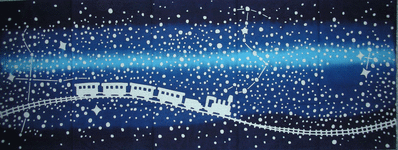
Although "Night on the Galactic Railroad" by Kenji Miyazawa, a famous children's story writer, is an unfinished work, its content is so large in scale that it could be described as science fiction, and it is filled with an imagination that is uniquely Japanese. Let's take a moment to unravel this work that continues to have a profound influence on future generations.
About Kenji Miyazawa, author of "Night on the Galactic Railroad
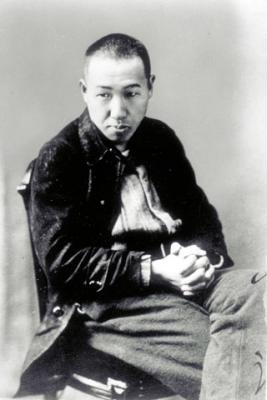
Kenji Miyazawa (1896-1933) is perhaps best known for this photograph.
His poem "Ame ni mo Makezu" is probably his best-known work.
In fact, this poem was written in his notebook at his hospital bed several years before his death, and was discovered after his death.
Many people may think of Kenji Miyazawa as a religious "great man" because of his Lotus Sutra-like spirituality (Kenji was a devoted follower of the Lotus Sutra during his lifetime), which can be seen in this poem.
In fact, however, I think that Miyazawa's greatness is not so much in those areas (although I am sure he was excellent in those areas as well), but in his creation of outlandish fantasies that far exceeded the imagination of ordinary people.
And that was nearly 100 years ago.
Of course, the concept of "fantasy" did not even exist yet.
I think it is a miracle that a story of such a large scale and science fiction-like fantasy was created in Japan at such a time.
About "Night on the Galactic Railroad
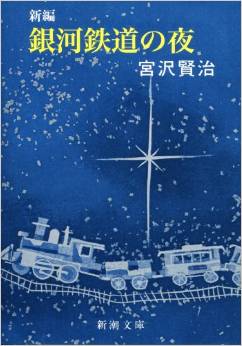
The first draft of "Night on the Galactic Railroad" was written around 1924 (Taisho 13), and was revised many times before his death at the young age of 37. After Kenji's death, it was edited and published in 1934 by Kotaro Takamura and others, but it is true that it is not known whether the work was ever really completed.
The image is "The Night on the Galactic Railroad" from Shincho Bunko.
In his short stories, he created many "magical" worlds, and "A Night on the Galactic Railroad" should be considered the culmination of his work.
Brief synopsis. Giovanni, a young boy, lives alone with his sickly mother after his father goes away for a long time. To help make ends meet, he takes an after-school job as a type picker at a print shop.
One day, his classmates make fun of his father, and Giovanni, unable to bear it any longer, goes to a hill outside of town.
There he gazes up at the starry sky, and before he knows it, he is on a "galactic railroad" running through the night sky. His friend, Kam panela, was also on the train.
And so began their mysterious journey together.
So it has a somewhat European, exotic flavor.
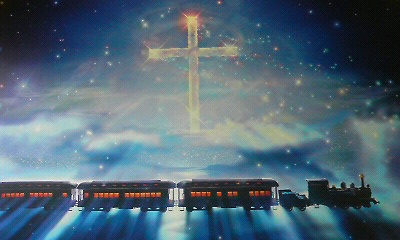
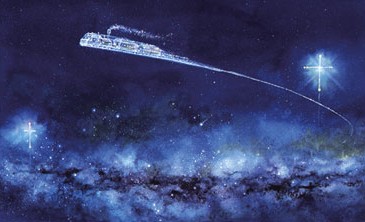
This image shows a scene from the latter half of the story, drawn by illustrator KAGAYA.
A girl called "Kaoru" (about the same age as Giovanni and his friends), her young brother, and a young man who claims to be their tutor, boarded the galactic train from the middle of the train. They got off the train at this "Southern Cross".
As you read the story, you learn that they were on a Titanic ship that hit an iceberg and sank into the sea.
In other words, this cross-shaped Southern Cross is truly "the source of God" and the "afterlife" for Christian believers.
The train starts to move, the cross gradually becomes smaller and smaller, many people get off the train and kneel down to pray, and they see "a divine person in white stretching out his hand and coming toward them. I was moved as if I were looking at a Western painting.
Kenji Miyazawa had a strong interest in Esperanto (a universal language) and actually studied it.
Perhaps Esperanto had a great influence on his works, as the names of the characters often appear in his works as names that are not quite Japanese.
The names of the main characters in "Night on the Galactic Railroad," Giovanni and Kam panela, also have a somewhat southern European sound to them.
Many descriptions that stimulate the imagination.
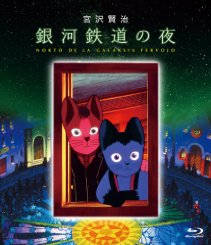
This image is a poster for the 1985 animated theatrical film "Night on the Galactic Railroad.
Giovanni and Kam Panelra are depicted as "cats," which is different from the original work, but all the characters in the film are in the aforementioned "Esperanto," and the content of the film is of a very high quality.
It is also well known that the grandfather of Haruomi Hosono, who was in charge of the music, was actually on board the "Titanic," the ship that appears in the film.
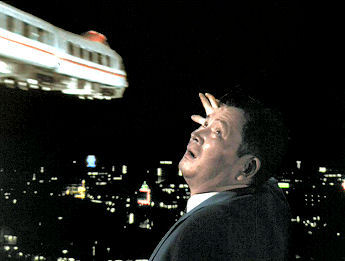
On the other hand, the image of "Galactic Railroad" was also used in such places! Here is an example.
The image shown here is a scene from the "Ultra Q" series, familiar to the author's generation (although I was quite a child myself), the final episode of which was a half-hour drama series titled "Open Up! This is a scene from the last episode of the series, a half-hour drama titled "Open Up!
Perhaps it was because the content was quite bizarre, but I remembered this episode very vividly.
Recently, I had a chance to rewatch it on TV and felt it was quite horrifying even with my adult eyes.
In this drama, there is a middle-aged businessman who has opened a door to another dimension, but it is not clear whether it is a hallucination he saw because he has lost his mind due to too painful reality, or whether there really was an alternate dimension where trains fly in the sky.
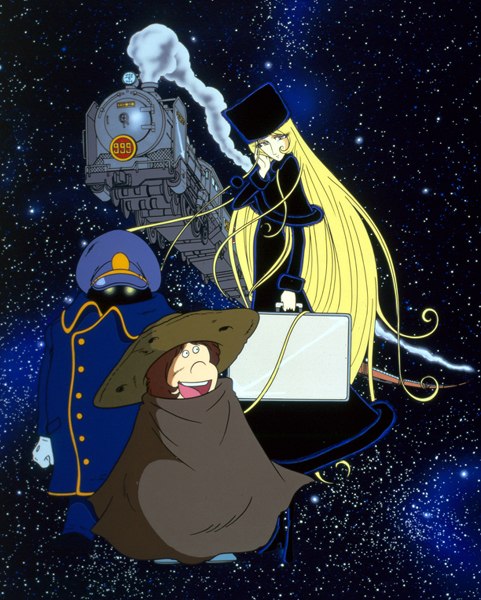
And here is the very famous "Galaxy Express 999 (Three-Nine)".
It is an immortal masterpiece written and drawn by Leiji Matsumoto.
From the title, it is obvious that the work is based on Kenji Miyazawa's "The Galaxy Express.
Thus, "Night on the Galactic Railroad" has something that stimulates the imagination of many creators.
summary
I think "Night on the Galactic Railroad" is the result of a perfect collaboration of scientist-like observation and beautiful cinematic description.
How on earth does one come up with such a phrase as "When you peel an apple, the peel turns into a corkscrew-like shape before falling to the floor, glowing gray and evaporating?
Once again, I am reminded that geniuses are always prematurely born.
