

Funghi," popular among children and women, is a comic strip that in many ways is a bold attempt to recreate literary works from the past and present in comic form. Why Funghi? Just because he's a popular character? You may think, "Why Funghi?" But if it gets your attention, the seller wins. It is easy to understand and interesting... Even if you are not good at reading, why don't you try it as an introduction?
All cast members are lickety-split characters.
Even if you are not familiar with "Funghi", you will be surprised by this work. The variation of Funghi, and the exquisiteness of its casting.
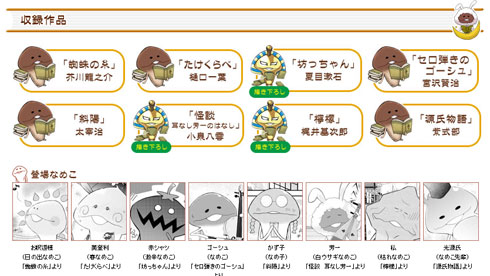
I had no idea there was such a wide variety.
Attractiveness #1: No sense of discomfort
Is it safe to reproduce classic works of literature from the East and West by such a pretty group of people? But that's the skill of the creators. But that's the skill of the creators. The audience is drawn into the story just like the original.
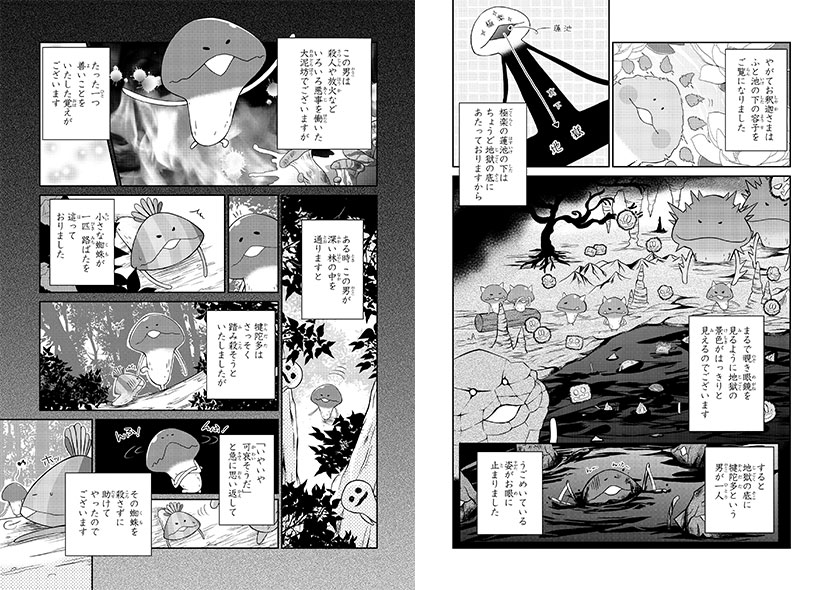
From Ryunosuke Akutagawa's "Spider's Thread
Even the cute nameko mushrooms are made to look "creepy" in the creepy scenes. Especially in this "Spider's Thread". The texture of the pool of blood and the scene in the forest before his death seem to be in some kind of contrast, don't they? The deceased who crowd around the threads and the old woman in "Rashomon" are unreservedly "scary".
Attraction #2: Easy to understand the world view
The world view and characters are expressed in a way that is easy to understand.
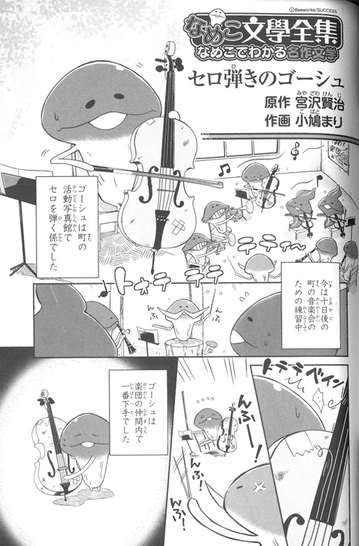
From Kenji Miyazawa's "Gauche the Cellist
Page 1 of "Gauche the Cellist". Unlike the other players, he is forced to play with no room to spare to watch. He even breaks a string. The artist expresses Gauche's poor skills and ineptitude in just a few frames. Moreover, the rhythm "tootete, tete-toe" that the musician said in the original work is reproduced as onomatopoeia in the music. This is a development that is sure to make fans of the original grin. And the cello is in tatters, too.
Attraction #3: Some things can be imagined and conveyed because they are pictures.
The art of fiction and writing alone is wonderful enough, but the addition of the element of "pictures" to it expands the imagination in some scenes.
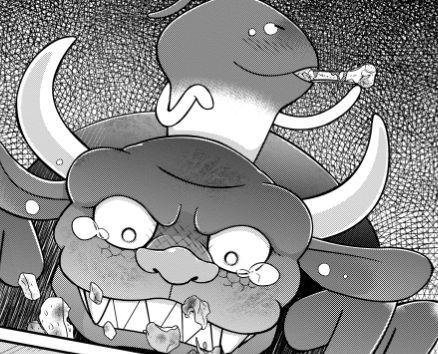
From Kafka's Metamorphosis
The eating scene of Zamza, who has become like an insect not only in appearance but also in his food preferences. I think I read that he "ate with tears of joy," but when I look at the picture again, it looks like sad tears. I don't know if this was intended or not, but the scene makes me think that he must have had such a feeling. Fear of gradual loss of humanity and a kind of unconscious willfulness that "I am human, that's why I cry" seem to be implied in the shading in the background. The "insect's" face, which looks like a demon or a monster, may also be an expression of such anxiety.
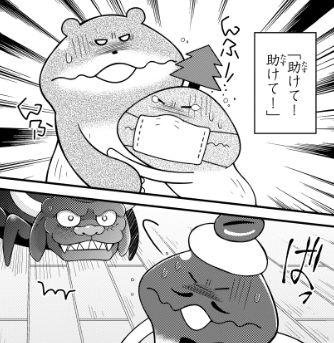
Also from "Metamorphosis
This scene. You only see the "insect" part of Zamza. From the beginning until he leaves the room, the "human" part is hidden, and sometimes only the "insect" part is shown. Yes, in other words, it shows "how Zamza," who is considered an "insect" even by his family and is locked in his room, is "seen. Perhaps the "human" part that Funghi represents is only seen by the reader...?
Question: why "Funghi?"
Many authors have been working on comic book adaptations of literary masterpieces. But why did they decide to do it with "Funghi"? Perhaps it was to achieve the effect of "something that stands out only when performed by a cute character.
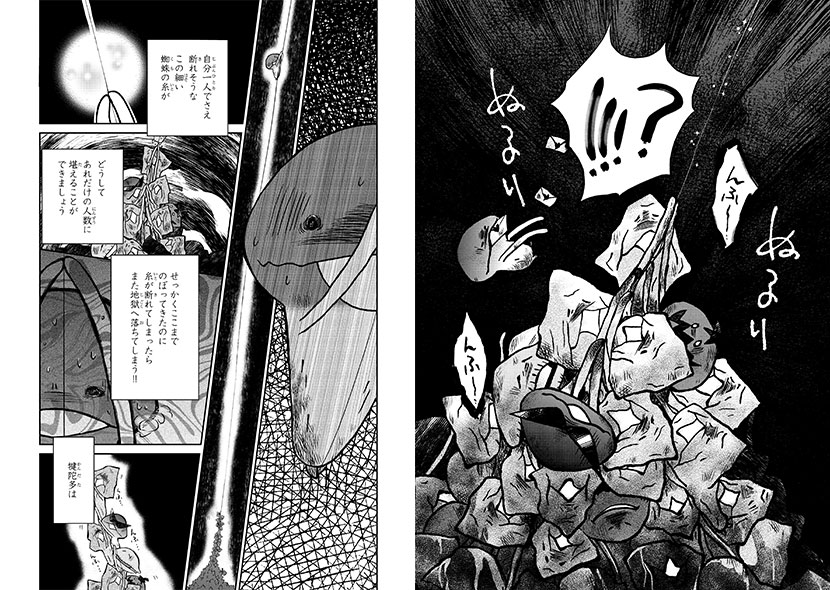
From "The Spider's Thread
There are some glassy-eyed lickspittle and some love letters visible, but still, there is a sense of discomfort that cannot be swept away. A darkness that reminds us of the hell of the abyss. The fear, despair, and conflict that Kandata experiences are conveyed properly, and even the cute illustrations and characters tell us that "scary scenes are scary" as much as possible.
Works that suggest possibilities for summary and creative work
I feel that "Funghi Bungaku Zenshu" shows readers the possibilities of manga as well as novels. The dialogue is all "nnhmmm" and the non-human characters play human characters. And yet, there is no sense of discomfort or discomfort. Even if you haven't read the original work, you don't feel pessimistic that you've lost out. You may be able to approach the film with a kind of fresh feeling.

Tags
Contents
- All cast members are lickety-split characters.
- Attractiveness #1: No sense of discomfort
- Attraction #2: Easy to understand the world view
- Attraction #3: Some things can be imagined and conveyed because they are pictures.
- Question: why "Funghi?"
- Works that suggest possibilities for summary and creative work