
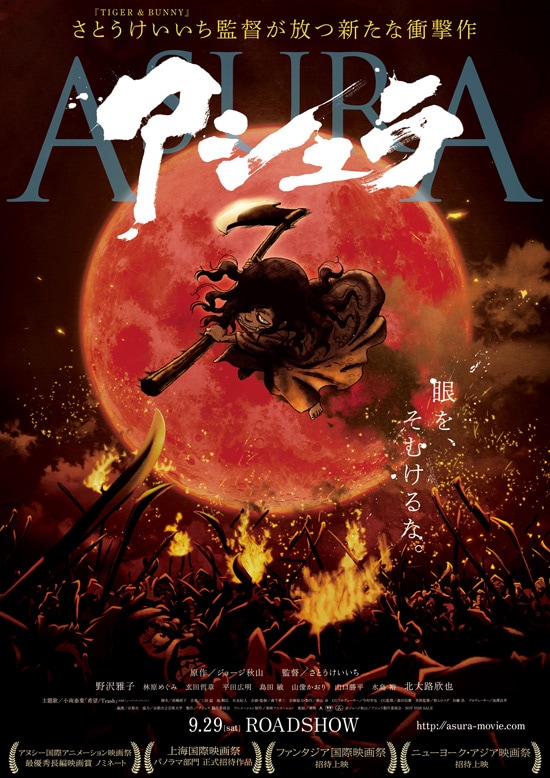
Don't Turn Away Your Eyes" - A controversial work designated as a harmful book has unexpectedly been made into a film! Even though this work has been condemned, it still has a message to convey. Why don't we face the "meaning of life" now more than ever?
又八(またはち)
CV:大浦冬華
過酷な環境を生き抜く散所の子供。
『アシュラ』の名言・名セリフ/名シーン・名場面
I wish I had never been born!"

アシュラが作中で放った「生まれてこなきゃ良かった!」という言葉は、過酷な運命に翻弄された主人公の絶望を象徴する名セリフである。
母に捨てられ、飢餓に苦しむ世界で野生の獣のように生き抜いてきたアシュラは、人間の温かさを知った矢先に、自身が犯してきた殺生や凄惨な現実と直面することになる。「こんな苦しいところに生みやがって!生まれてこなければ良かったぎゃあ!」と叫び、「人でなし!皆…皆同じだぎゃ!あいつらだって食うもんが無けりゃ、殺し合いをしてるだぎゃ!子供を食う奴だっているだぎゃ!皆、敵だぎゃあ!いつも食うか食われるか…だから俺には牙が要るんだぎゃ!!」と訴える姿は、綺麗事では生きられない極限の社会の残酷さを浮き彫りにしている。
法師「人を憎むな、己を憎め。己のケダモノを憎め。これはおまえが人になった祝いじゃ」
It is true that we all have beasts. But they are clearly different from other beasts. It is the heart. We all have a heart. The more one walks the path of the beast, the more one suffers. What you just said about suffering is the sign of a person.
When Ashera still insisted that he was not a man, the Master cut off his own left arm and held it out to him.
"Come on, eat! Eat my arm! ...I am the same way. No one wants to eat human flesh. That's because they have reason. But sometimes, we all have a devil's advocate and reveal our animal nature. But you have to fight the animal inside you. Don't hate others, hate yourself. Hate your animal. This is your celebration of becoming a man."
crime and punishment

The emptiness of not being believed by the people she loved, and the contradiction of the fact that she had killed and eaten people as enemies without thinking of them as people. When the funeral procession passed by Wakasa's funeral procession, a single tear fell from Ashra's eye.
Viewer Comments
The film is about 70 minutes long, but there was not a moment wasted.
The majestic background music, the images that could be described as ugly and beautiful.
Ashrah's sad emotional conflict, the limits of human beings, and the horror of human beings.
I was drawn in more and more, and my mouth kept forming the shape of an "A" throughout the film.
It was different from the original work, but I was happy with this one.
Source: www.amazon.co.jp
In today's age of food saturation, we forget the happiness of not having to starve and suffer in this way.
The famine depicted in this film and the scene where the main character eats people are truly depressing, but necessary to the work.
This film teaches us this without ever being "pretty" about it, and it has a certain persuasive power.
Source: kagehinata64.blog71.fc2.com
Do they end up eating to live or do they end up defending their dignity as human beings?
The people in this story are not about pleasure, but about the ultimate choice.
As the traveling monk says, "No one eats because they want to. No one eats because they want to.
It is because they are people with hearts that they suffer in agony between morals.
In less than 80 minutes, Ashura, who has survived by devouring people like a beast, goes through the agony of becoming a "human being" and the last scene of the film.
To be honest, even after seeing this film, I'm still not sure what to think.
Source: www.anikore.jp
『アシュラ』の主題歌・挿入歌
主題歌:小南泰葉「希望」
作詞:藤田敏雄
作曲:いずみたく
編曲・Gt.:西川進
Ba.:KenKen
Dr.:石田悠也
Manipulater:中山信彦
主題歌:小南泰葉「Trash」
編曲:西川進
Gt.:楢原英介
Ba.:中村昌史
Dr.:吉澤響
Pf.:ハジメタル
Manipulater:中山信彦
作詞・作曲・歌:小南泰葉

Contents
- 『アシュラ』の概要
- 『アシュラ』のあらすじ・ストーリー
- アシュラの誕生
- 人間性との出会いと苦悩
- 新たな旅立ち
- 『アシュラ』の登場人物・キャラクター
- 主要人物
- アシュラ
- 法師(ほうし)
- アシュラに関わる人々
- 若狭(わかさ)
- 七郎(しちろう)
- 藤乃(ふじの)
- 散所太夫(さんじょだゆう)
- 荘園・村の関係者
- 地頭(じとう)
- 小二郎(こじろう)/小太郎(こたろう)
- 義助(ぎすけ)
- 孫六(まごろく)
- 散所の子供たち
- 丹治(たんじ)
- 初治(はつはる)
- 呉作(ごさく)
- カポ
- 三郎(さぶろう)
- 又八(またはち)
- 『アシュラ』の名言・名セリフ/名シーン・名場面
- I wish I had never been born!"
- 法師「人を憎むな、己を憎め。己のケダモノを憎め。これはおまえが人になった祝いじゃ」
- crime and punishment
- Viewer Comments
- 『アシュラ』の主題歌・挿入歌
- 主題歌:小南泰葉「希望」
- 主題歌:小南泰葉「Trash」