

Space Invaders, an arcade game developed by Taito Corporation, is considered one of the original Japanese shooting games. It soon swept the game market in the U.S. and around the world.
What is Space Invaders?
It was first announced to the world on June 16, 1978, at a presentation of new products at the then Taito headquarters building.
Space Invaders Arcade version (1978)
The objective of the game is to shoot down the approaching invaders while they attack from above the screen with your mobile turret and annihilate them all. Sometimes UFOs appear in the sky, and players can earn bonus points by shooting them down.
The system was very innovative at the time, with the computer (the enemy) actively attacking its own ship and the player responding to the attack from both sides, and this system was carried over to Galaxian (Namco, now Bandai Namco Entertainment, released in 1979) and other games. These successors and similar or imitative software made by other companies are collectively called "invader games.
Becoming a social phenomenon
Computer Game -Theme from the invader-" by Yellow Magic Orchestra, which was active in the same period.
The novelty of these games attracted the general public, who had not been interested in games before, and they became a social phenomenon.
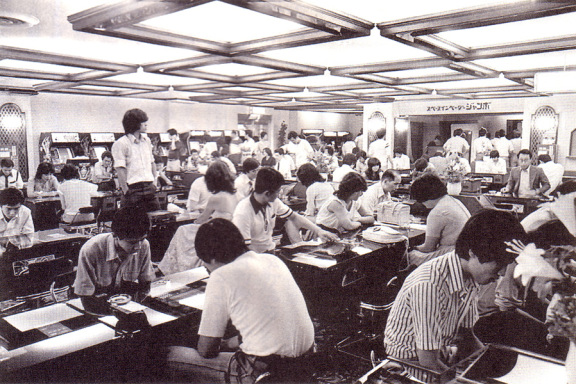
Game centers opened one after another across Japan, and game centers called "Invader Houses," where all game tables were replaced with Space Invaders, appeared.
There were also two types of arcade games: upright and tabletop, and coffee shops called "Invader Cafes," where tabletop machines were set up in place of tables so that people could play Space Invaders with friends over a cup of tea.
What is Nagoya Shooting?
This technique was popular at the time, taking advantage of the bug that "missile attacks on Invaders that have descended to the bottom row have no hit detection. The top row of enemies at the end of the row are left behind, and several rows of Invaders are destroyed to create a safe zone in order to avoid attacks. Then, by luring the enemies to the bottom row and shooting them all at once, the player could buy time to play, destroying many high-scoring UFOs and aiming for a high score.
There are various theories as to the origin of the name, but some say it came from "Nagoya," "Owari," "the end," and "the end if one more level is invaded.
Other model series video 80's
Atari 2600 (1980)
SG-1000 (1985)
MSX (1985)
Family Computer (1985)
Video of other model series 90's
PC Engine (1990)
Game Boy (1990)
Super Nintendo Entertainment System (1994)
Virtual Boy (1995)
Sega Saturn (1996)
