

Among the many handheld games in existence, have you ever heard of the Game & Watch, which was released by Nintendo in 1980?
Many of you may have heard of it through the appearance of the character "Mr. Game & Watch" in the Super Smash Bros. series.
Here we introduce the Game & Watch series, which has its roots in portable gaming.
About Game & Watch
Game & Watch was Nintendo's first portable game console, launched in 1980.
The story behind the development of this device began when Gunpei Yokoi, then head of Nintendo's Development Department, saw people playing with a calculator to kill time while traveling on the bullet train and came up with the idea of a "small portable game console that could be used to kill time".
The design was designed to be pocket-sized enough to fit in a shirt, and the first "Ball" was released in 1980.
It was designed for businessmen so that they could play it on their way to work, but the craze spread to elementary and junior high school students.
After that, the emphasis shifted to gameplay, and "Blackjack" was released in Japan in 1985, but was developed overseas until 1991.
The main unit has buttons labeled "GAME A," "GAME B," and "TIME" and round buttons to control the characters. (Initial)
Games are written on a single ROM in the main unit, one hardware and one software, and games are not interchangeable.
The system is simple: after starting up, the user first selects GAME A, which has a lower difficulty level, and GAME B, which has a higher difficulty level, and plays.
When not in use, the game can be used as a clock.
The game console has sold 43.4 million units worldwide and can be said to be the root of portable game consoles such as the Game Boy and the Nintendo DS, which were released later.
The cross-shaped buttons that are now commonplace on Nintendo and non-Nintendo game consoles also originated with the Game & Watch.
Today, Nintendo DSiWare distributes reprinted versions of some games (also downloadable on 3DS), and Club Nintendo, which is no longer offering this service, distributes a DS software called "GAME & WATCH COLLECTION" that includes original games, so people who did not know about this game at that time had a chance to touch it. I think that even those who did not know the game at that time had a chance to touch it.
As mentioned in the description, the Super Smash Bros. series features a character named "Mr. Game & Watch," based on the character who jumps off the building in the Game & Watch work "Fire.
He uses techniques based on the motifs of the works that appeared in Game & Watch.
As for home stages, the latest "3DS/WiiU," the former "3DS" is "Flat Zone 2," a stage that recreates scenes from "Oil Panic," "Lion," "Fire" and "Chef" and changes with each hour, and the latter "WiiU" is the former one with the DX home stage "Flat Zone" to the former one, and "Flat Zone X" which adds scenes from "Flat Zone", the home stage of DX.
Mr. Game & Watch has appeared in various games since his first appearance, and in "GAME & WATCH GALLERY 4/ADVANCE" (not released in Japan), he is the host along with Mario and they have a normal conversation.
This is a long story, but from here I will introduce each series of GAME & WATCH.
Silver Series
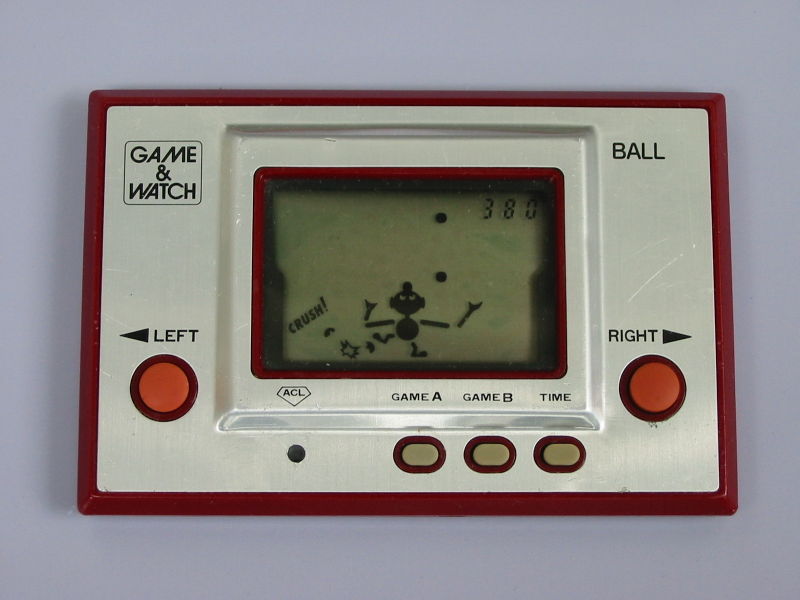
This is an early series with a silver body.
The legend of this series began with very simple games, such as ball and piddling games.
The name "Silver" was not decided at the time, but was decided afterwards.
Gold Series
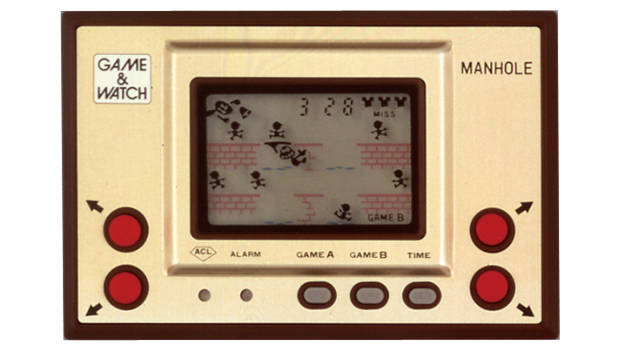
The front of the main unit is now gold-colored, and a stand is attached.
For the first time, an alarm was added to the clock function.
Some of the screens were also colorized, and a feature was added to reset mistakes after a certain number of points had been scored.
widescreen

As the name suggests, the screen is 1.7 times larger.
It was the second most widely released series, and was the one that sparked the game and watch boom.
multiscreen (system)
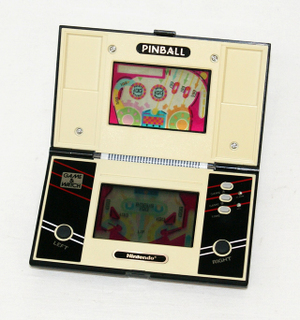
As the name suggests, this series had two screens, and as mentioned above, some of the games in this series were the first to feature cross-shaped buttons, which became the basis for later game consoles.
It was also the basis for the Nintendo DS's two screens, so when the DS was released, those who were playing at the time may have thought, "Game & Watch! When the DS was first released, some people may have thought, "Game & Watch!
This series is the most popular of all the Game & Watch series, and the Japanese release of this series, Blackjack, has ended.
Color Screen Table Top

It has levers and plastic buttons, so the main unit is reminiscent of the game cabinets found in old arcade games.
Since it is more expensive than other series, it did not become popular, but it is traded at a high price in the second-hand market.
panoramic screen
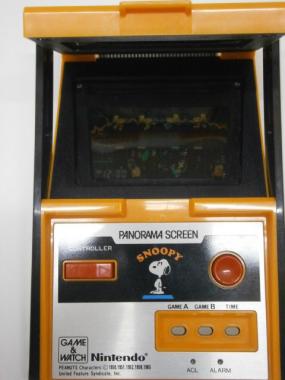
This is a compact version of the aforementioned color screen tabletop with the same game content.
This one is also sold at a high price in the used market.
new widescreen (system)

This is a later version of the widescreen series, but it is not a new part of the series and did not hit the market much.
Only two units of this series have been released in Japan.
Also, the Game & Watch series was completed with "Mario the Juggler," a remake of the first "Ball," although only overseas.
