
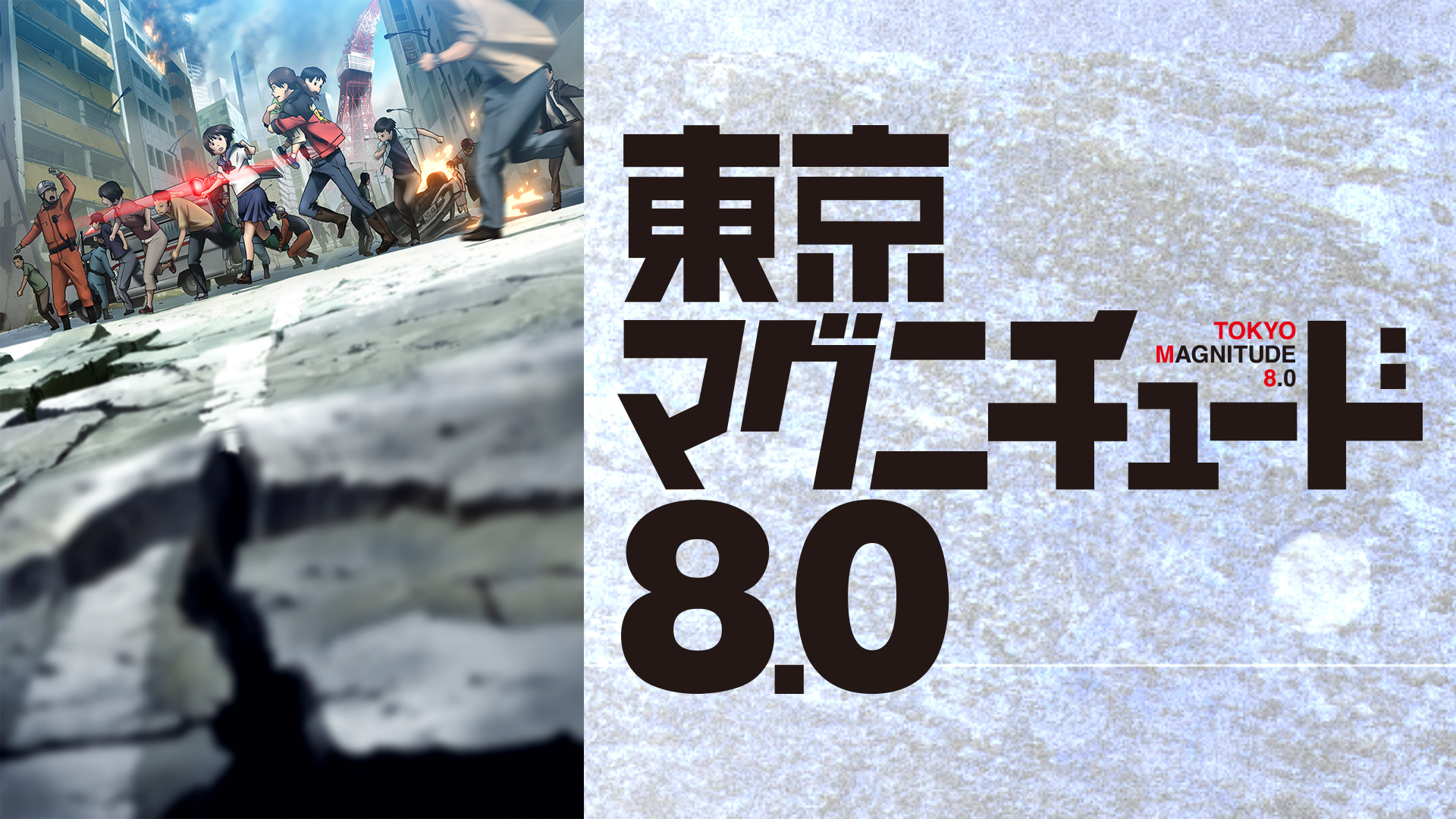
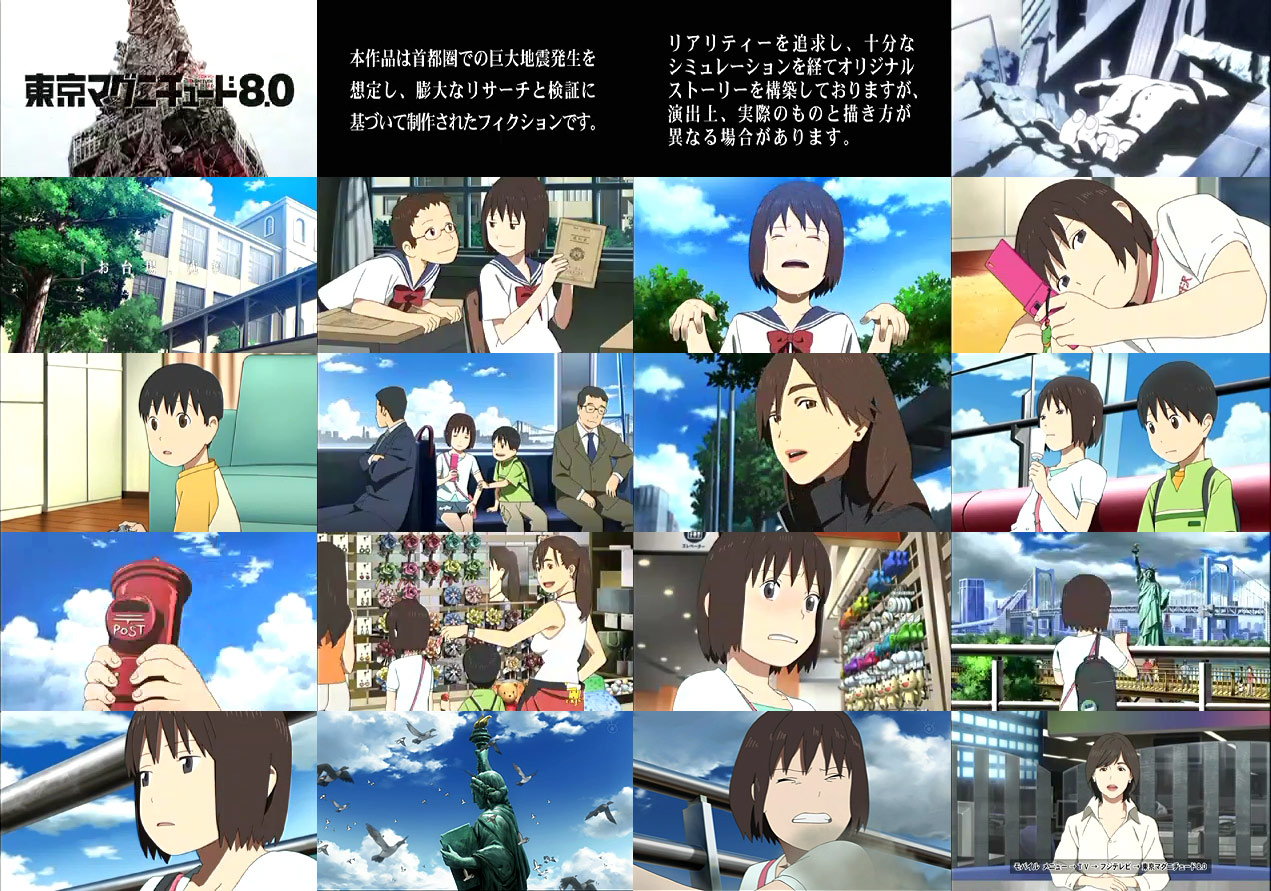
Tokyo Magnitude 8.0" is a TV animation about disaster prevention and family love that aired from July to September 2009 on Fuji Television's Noitamina slot. It won the Excellence Award in the Animation Division of the 2009 Japan Media Arts Festival. Set in the city of Tokyo, which was severely damaged by a huge earthquake, the story progresses from the perspective of a young girl and the victims. On the first day of summer vacation, Mirai Onozawa visits a robot exhibition in Odaiba to babysit her younger brother Yuki, when she is suddenly struck by a massive earthquake with a maximum intensity of 7. This is a human drama anime that will make you cherish the days with your family that you have taken for granted.
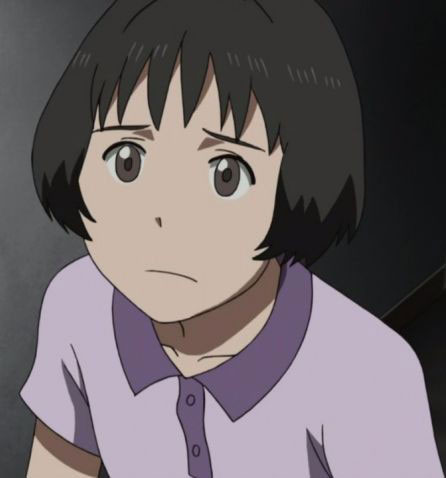
Voice: Ai Nonaka
Mari is a junior at Mari's workplace. He lived in the office for a while after the earthquake in consideration of his employees returning to his motorcycle delivery office. He also remained in the office for the reason that he felt more secure in the office than in an apartment where he lived alone. Mari, who was upset about his family, offered to take care of them, but they were turned down and left off.
Kento Nonomiya

Voice: Shin'ya Hamazoe
This is a boy who loves robots and met on his way home. When he was an elementary school student, he had a debris flow disaster at his home. At that time, he saved his family with a rescue robot. In the future, he wants to develop a rescue robot. When the future met, he was also sketching a rescue robot, and he had a lot of sketches and notes in his notebook. Yuki also loves robots, so the two of them talk and get along well. Like Mirai, Mirai is in the first year of junior high school, but Kento is thinking about the future. With regret and envy, Mirai takes a curt attitude. If there is a robot, you can't see the danger around you, so that's why the future gets hurt. When he leaves, he gives Yuki a sketch of the robot.
Kazuaki Kawashima Itsuki
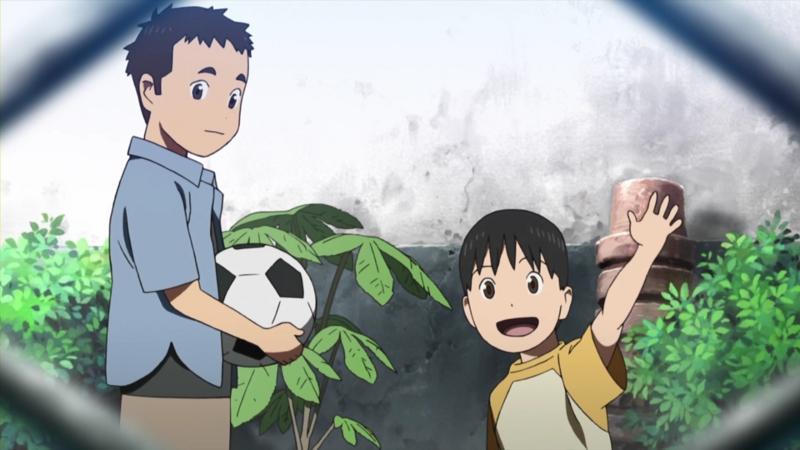
The boy on the left side of the image is Trees Kawashima.
Voice: Miyuki Sawashiro
She was a friend of Yuki. Yuki and her husband planted a Marronnier in the elementary school and promised to write an observation diary in turn. After meeting the future again after the earthquake, she looked for the hallucination of Yuki that could only be seen in the future together with the future, but since she could not find it, she entrusted the observation diary of Marronnier to the future. After that, Marronnier is being raised by the future.
Convenience store clerk
Voice: Mai Nakahara
Yuki came to buy a drink that the future had asked her to buy. She and Yuki were struck by the earthquake and asked for help under the shelf. With the help of the future and the truth, she continues to work at convenience stores even after the earthquake.
Mr. Yamane.

Source: animeperson.com
Voice: Kenji Takahashi
The homeroom teacher of Yuki's elementary school. Used to be the homeroom teacher of the future.
Terms of the TOKYO MAGNITUDE 8.0
Magnitude
It refers to the index value that expresses the magnitude of the energy generated by an earthquake in logarithm. It is said to be a huge earthquake, and the Great Kanto Earthquake in 1932 was also an earthquake of this scale. In this work, it is an "epicentral earthquake", so it is a type of earthquake that has a large magnitude but a localized severe earthquake.
Portable toilet
It refers to a simple toilet used when the toilet cannot be used due to a water outage or inability to drain water during a disaster. It has been made in various forms such as being attached to the original toilet bowl or being portable. The Mirai were provided with portable toilets, which Mirai reluctantly used because the temporary toilet was full of people.
Rescue robot
This refers to robots designed for the purpose of rescuing people affected by disasters such as earthquakes and floods. Currently, development is mainly focused on the search for people who need help, and the focus is on the development of sensor technology to find people. However, following the accident at the Fukushima Dai-ichi Nuclear Power Station in 2011, the development of robots to collect information inside power plant facilities at the time of the nuclear power plant accident and to work in dangerous areas has been strengthened. The robots encountered by the future also searched for people who need help, and they were able to remotely search even in places with poor footing using cameras and sensors.
Shelter
The Basic Act on Disaster Control, which was revised in June 2013, makes a clear distinction between a designated Emergency Evacuation Area for escaping from imminent disaster and a designated shelter for staying for a certain period of time to ensure the living conditions of evacuees. A designated Emergency Evacuation Area is a place to avoid danger for the time being. It is designated as a sturdy building that is safe against disasters and as a playground or parking lot in an open area that is considered to be safe from danger. On the other hand, a designated shelter is a place to stay for a certain period of time. It is designated as a school, gym, or community center where a certain number of people can be accommodated indoors. There are evacuation centers that have both types of facilities. Parks and women's academies visited by future generations were also used as evacuation centers by many people.
Triage
It refers to a method used at the scene of an emergency accident to determine the order of treatment of patients, the order of emergency transport, the destination facility, etc. In general, triage tags are used for communication and information sharing between teams in cases where multiple rescue teams are involved. This triage tag was used in this game, and it became known in Japan after the Great Hanshin-Awaji Earthquake. The priority of rescue is determined by color, but black is given to the deceased.

Related Articles
Summary of characters whose shocking deaths surprised readers and viewers.
In anime and manga, there are many characters who die in order to avoid an easy development. However, in some of these works, killing off a character is the opposite of an easy way to avoid an easy turn of events. We have compiled a list of characters who died tragic or unexpected deaths.
Read Article

8 titles of depressing anime with grotesque and grotesque scenes.
Are you getting bored with only light-hearted works? In such a case, we recommend dark and heavy depressing anime. In this article, we will introduce 8 recommended depressing anime titles (Elfen Lied, Tokyo Magnitude 8.0, etc.) along with their depressing points.
Read Article
Tear Gland Collapse is a Must! A compilation of popular anime works that make you cry [Anohana, Clannad, etc.
Tear-jerking" is a way to refresh your mind by shedding tears as much as you can when you want to cry. Among the vast number of anime, there are many "tear-jerking" works that are perfect for "tear-jerking. In this article, we will introduce "tear-jerking" anime works that have received particularly high ratings on SNS, including a brief synopsis, characters, and information on media development.
Read Article
Contents
- Overview of TOKYO MAGNITUDE 8.0
- Outline and story of "TOKYO MAGNITUDE 8.0"
- Major earthquake
- Encounter with Truth, Discovery of Grace
- Departure from Odaiba
- Collapse of Tokyo Tower and volunteers at the evacuation center
- Mari's ill health
- Disaster Robots and Robootaku Boys
- Morning at the hospital
- Reunited with the Family of Truth
- Yūki no Himitsu
- List of TOKYO MAGNITUDE 8.0 characters
- Key person
- Onozawa Mirai
- Onozawa Yuki
- Mari Kusakabe
- Family
- Seiji Onozawa
- Masami Onozawa
- Kusakabe Hina
- Kazuyo KUSAKABE
- Ryuta KUSAKABE
- Other
- Mayu
- Yuka
- Lisa.
- Meg
- Newscaster
- Seiji FURUICHI
- Misako FURUICHI
- Kawasaki Aya
- Kento Nonomiya
- Kazuaki Kawashima Itsuki
- Convenience store clerk
- Mr. Yamane.
- Terms of the TOKYO MAGNITUDE 8.0
- Magnitude
- Portable toilet
- Rescue robot
- Shelter
- Triage
- Famous Sayings, Famous Remarks / Famous Scenes from "TOKYO MAGNITUDE 8.0"
- Mari: "Yes, I can't leave her."
- FURUICHI'S SORROW AFTER LOSING HIS GRANDCHILD
- Tears of the Future
- Behind the Scenes, Trivia, Small Stories / Episodes and Anecdotes of "TOKYO MAGNITUDE 8.0"
- Interviews with disaster prevention specialists
- Meaning of anime rather than live action
- A life-size junior high school student
- Theme song and insert song of "TOKYO MAGNITUDE 8.0"
- OP (opening): abingdon boys school "キミノウタ"
- ED (ending): Shion Tsuji "M/elody"