
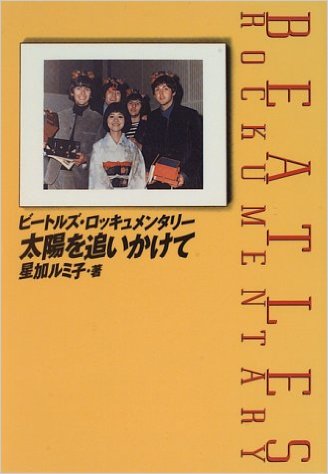
One of my old dreams was to become an editor of a magazine specializing in Western music like "MUSIC LIFE"! I had a dream of becoming an editor of a magazine specializing in Western music like "MUSIC LIFE". Although this dream did not come true, it is the foundation of my life as a painter and writer. And the woman of my dreams at that time was Rumiko Hoshika, who was the chief editor of "MUSIC LIFE".
Rumiko Hoshika Profile

Rumiko Hoshika was born in Hokkaido in 1940. From the time she was in the sixth grade, she listened to "FEN," the Far East Broadcasting Company at that time, and became familiar with American pop music. It was during her high school years that she was shocked to learn of Elvis Presley, which would later determine the course of Ms. Hoshika's life.
During her time at Toyo Women's Junior College, she was passionate about studying English and popular music at jazz cafes.
While still in school, she began working part-time at "MUSIC LIFE," a magazine specializing in Western popular music, which was still rare at the time, and eventually became a prominent editor-in-chief there.
MUSIC LIFE" was a pioneering magazine specializing in Western music
MUSIC LIFE was a music magazine edited and published by Shinko Music (Shinko Music Shuppansha at the time of its first issue). The magazine mainly featured Western music and ceased publication with the December 1998 issue.
It was re-launched in January 2011 as MUSIC LIFE plus, a free application for IPad/iPhone.
Source: ja.wikipedia.org
What a history! It dates back to the 1930s.
1937 - The first issue of the magazine was published as a magazine of popular songs (titled "Myusic Line"). At first, it was not a monthly magazine, but an irregular publication.
1938 - The title was changed to "Uta no Hanakago" (Flower Basket of Songs).
1943 - The magazine ceased publication due to the Pacific War.
1951 - The magazine was re-launched as Music Life.
1964 - The April issue featured the Beatles for the first time. A month later, a large number of copies of the magazine, with only the cover cut off, were returned[1].
1998 - The magazine ceased publication in December.
Source: ja.wikipedia.org
The first issue under the name "MUSIC LIFE" was published in the September 1951 issue (released on August 20), and its first editor-in-chief was Shoichi Kusano. (Deceased).
Mr. Hoshika succeeded Mr. Kusano and became the editor-in-chief in 1965.
An example of the cover at that time

This is the cover of the February 1972 issue.
Rod Stewart was very popular at that time.
Rod so young!
Western hits at that time included Led Zeppelin's "Black Dog," Isaac Hayes' "Black Jaguar Theme (Shaft)," Bad Finger's "Day After Day" (tears!) Cat Stevens' "Rain-soaked Morning" and others.
And speaking of Mr. Hoshika, this is what he is all about!
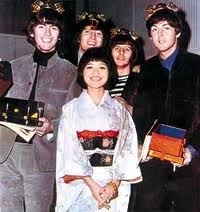
Perhaps the most famous image of Mr. Hoshika is this one.
Mr. Hoshika in kimono standing and smiling in front of the young Beatles.
The relaxed expression on the faces of the four is impressive, but there was a tremendous amount of hard work that went into getting to this point.
In one of his talk shows, Mr. Hoshika described the "hardships" he faced at that time as follows.
In 1964, the Beatles embarked on a massive tour of North America. The venues, airports, hotels, and everywhere they went were filled with tens of thousands of teenage girls, and their superstar status reached the Japanese media with no small degree of certainty. In order to get a story out of them, I had no choice but to go to London to interview their manager, Brian Epstein, but he politely turned me down.
Hoshika: After that, I went to Mr. Ishizaka, the executive director of Toshiba Sound Engineering, to ask for his cooperation. He told me, "The Beatles are filming the movie "Help" throughout May '65, but they will be in the studio in June to record the soundtrack for the movie, so if you come at that time, you might have a chance. If you come at that time, you might have a chance. So, relying on that "there might be a chance," I decided to go anyway and left for Japan. I stopped in Hamburg, Germany, to interview and photograph the manager of the Star Club and Kaiser Keller, where the Beatles performed before their debut, and then went to Paris to meet my photographer and interpreter. There I interviewed France Gal, Sylvie Bartin, and others, and finally arrived in London at the beginning of June. There I went to say hello to Stan, who told me, "Epstein is a tough, hard, smart guy, so be careful. At first I didn't understand what he meant, but he said, "He is mentally very strong, difficult, and smart. Then I went to see Brian and the first thing he asked me was, "How long will you be here?" I said, "I'm not leaving until I can do the interview. I answered in broken English, "I won't leave until I can do the interview, and if I can't, I'll jump into the Straits of Dover. I was told like it was a person's responsibility (laughs).
(Laughs) - A few days later, when he visited Brian again, he brought him something as a souvenir.
Hoshika: Since England is a world of chivalry, I thought a sword would be good, so I brought a Japanese sword. I thought it would be meaningless without a real sword, so I brought a real one (although I think the statute of limitations has expired, I put it in a bag with four imitation swords for each member and brought it on board, and customs cleared it as a "souvenir toy"). ) I did not miss the change in the color of Brian's eyes when he pulled out the sword and saw the blade. I thought to myself, "Now I have about a 96% chance of getting an interview! Then he asked me when I would be leaving again, and I told him, "I'll stay until the 16th, and then I'll go to New York. I have Elvis Presley and Simon & Garfunkel interviews lined up," I answered, half-truthfully (laugh).
First interview at EMI Studios in 1965
─ ─ It is said that when they announce the dates of interviews, they often do so on the day before the departure date overseas. On June 15, the hotel where he was staying was notified, and he hurriedly changed into a kimono and headed for EMI Studios in the evening, carrying souvenirs. There he found the four members recording "It's Only Love.
Hoshika: From here on, this will be an episode of actually meeting the Beatles, so I would like to ask photographer Hiroshi Hasebe, who went into the interview with us and took wonderful photos of the four members, to join us. This is today's guest, Mr. Hasebe (welcomed by applause, and then to the stage by cameraman Mr. Hasebe).
Hasebe: I didn't know anything about the Beatles, so I saw "Hard Days Night" in Paris. I saw "Hard Days Night" in Paris, and the screams of the girls were so loud that I thought, "I don't want to shoot this kind of thing" (laughs). (Laughs.) And when I actually met them, they weren't at all stuck-up.
Hoshika: On the contrary, they were ordinary boys without any pretensions at all, ordinary 20-something boys with tremendous talent.
Hasebe: They were very interested in the kimono that Mr. Hoshika wore.
Hoshika: What is this big belt? or "What do you put in the long hem? People said that John Lennon was the one who was a bit twisted among the four of us, but I didn't feel that way at all. When I was talking to the other three, he would start out at a distance, asking how things were going, and then gradually move closer and closer to join us. He is very cautious or a little bit small-minded.
Hasebe: He is shy.
Hoshika: He is very sensitive. After that, I was going to do an interview based on the 10 typed questions for each of the four that I had received from Music Life readers, but Paul said, "Let me see, are you going to do this for all of them? He gave me the questionnaire and explained it to each of them. He gave each of us a questionnaire and explained it to us. The first question was, "You wrote that Paul's hair is brown, but sometimes it looks black. Which is it?" Paul got a big kick out of that one, and he was laughing and flailing his legs and saying, "What color is my hair, guys?" (laughter). I guess he liked that kind of humorous question. Before we started, we were told the interview would last 30 minutes, but it went over three hours.
Hasebe: But I got tired of listening to the recording. They would ask, "How's it going? I said, "Well, I don't know, but it's okay.
Hoshika: They played only the recorded performance from the mixer room upstairs to the studio downstairs. When I asked Epstein the name of the song, he said it was "Tears for Ticket. Well, we were able to cover a superstar at the peak of his popularity worldwide for three hours like that. John Lennon said, "If I ever go to Japan, I want to see sumo wrestling," and it hit me, so I was allowed to take handprints of the band members. After the interview, I sent a telegram to Japan saying "banzai.
The above is an excerpt from the "Rumiko Hoshika Talk Show
Source: www.shinko-music.co.jp
In addition to Mr. Hoshika, "MUSIC LIFE" has a lineup of other famous editors-in-chief.
After Mr. Hoshika, the editors-in-chief of MUSIC LIFE were all unique in their own ways.
Among them, especially Kaoruko Togo, who was the editor-in-chief from around 1978 to 1990, left us a wonderful saying, "Meeha is a wonderful watchword. (Because I personally really think so!)
Also, Mr. Shiro Kishibe, who was a member of The Tigers, one of the greatest Japanese group-sounds bands, was a music correspondent for a time.
Yuichi Masuda, who was a member of the first issue of "BURRN!", a heavy metal magazine, also served as editor-in-chief until 1997.
Two of the biggest names in Western music criticism (though they are women)
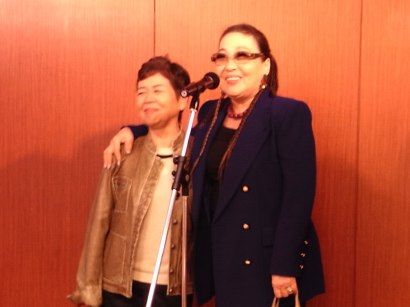
We will upload this image at the end.
This is a two-shot image of Ms. Hoshika shoulder to shoulder with another woman I admire, Ms. Reiko Yukawa (right).
I apologize that it was taken about five years ago and is a bit old, but it seems that the two of you are good friends.
For me, both of you have always been women whom I admired for their abundant knowledge of Western music and excellent English skills.
I hope that you will continue to introduce more and more wonderful music to us in a meek way.

Contents
- Rumiko Hoshika Profile
- MUSIC LIFE" was a pioneering magazine specializing in Western music
- An example of the cover at that time
- And speaking of Mr. Hoshika, this is what he is all about!
- In addition to Mr. Hoshika, "MUSIC LIFE" has a lineup of other famous editors-in-chief.
- Two of the biggest names in Western music criticism (though they are women)