
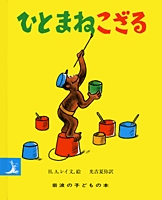
As I was preparing my New Year's greeting cards, I learned that the Chinese zodiac sign for next year is "sami" (meaning "monkey" in Japanese).
When I think of monkeys in the world of picture books, "Osaru no George" comes to mind, published in the 1960s, with its lovable George and his conversation with the man in the yellow hat. Unlike the cartoon version, the characters are simple and the story has a lot of flavor.
Hitomanekozaru to Kiiroioboshi" published in the U.S. in 1941 and in Japan in 1966.
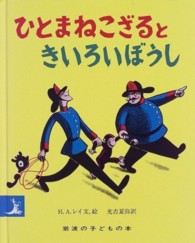
The Cat-Monkey and the Yellow Hat
Written and illustrated by H.A. Rey
Translation: Natsuya Mitsuyoshi
Publisher: Iwanami Shoten
Did you know that George's owner (or should I call him "partner" rather than "owner"?) Do you know that George's owner (or should I call him a partner?) is an old man with a yellow hat? He lives with George and helps him whenever George makes a mistake.
The story begins when the uncle meets George, a local monkey, on his way to explore Africa. He takes him on his boat and tells George that he will take him to the zoo. There is no reason to believe that he can understand human language or live like a human, but the story goes on.
George is a curious boy, so he can't sit still, and all sorts of happenings occur. He solves his own problems, or luck is on his side, and the problems are solved.
This picture book was first published in the United States in 1941 and in Japan in 1966. The author's use of simple colors gives the book warmth and makes it a very tasteful work. The fact that George is written in hiragana "joji" also plays a role.
What happened after George?
Hitomane kokazaru to kiroi boshi no ojisan" was first published in the U.S., but it seems that "Hitomane kokazaru" was first translated and published in Japan. The back cover of the book states that the first edition was published in 1954.
In this story, George, who lives in a zoo, becomes interested in the outside world and escapes from the zoo. He wanders around town and, of course, gets into mischief and ends up injuring his leg. A newspaper article about George's antics happens to catch the eye of the man in the yellow hat, and the two are reunited.
I am a friend of George's," the uncle said.
I hope you will help her to get well soon. (Please keep her quiet so that she won't misbehave again until I can take her home.
-(quoted from the text).
What a kind-hearted uncle! How could he say that George the animal was his friend? Is this the kind of person who has a heart like a boy?
The curious George also causes a ruckus at the hospital, but you will have to wait until you read the book to find out what he does.
There is a George series that is not based on the original, "Osaru no George Goes Camping."
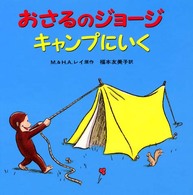
Osaru no George Goes Camping
Original Story: M. & H. A. Rey
Translated by Yumiko Fukumoto
Publisher: Iwanami Shoten
The "M" refers to Hans' wife, Margaret, and the books seem to have been co-written and published together.
Reading the end of the book, one reads, "The new series was created based on the characters of Mr. and Mrs. Rey. There are 16 books in the series, from the first to the fourth collection, and "Going to Camp" is included as the third collection.
I can't speak professionally, but the atmosphere of "Camp ni Ikku" is different from the two books mentioned above. The word "Joji" is now written in katakana "George," and George's facial expressions and movements seem to have lost depth.
However, it can be said that the range of the stories has been greatly expanded. The original readers, children, are now given the pleasure of choosing which story they want to read.
An alphabet picture book like an illustrated resource, "The ABC's of Hitomanekomaru".
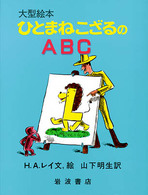
The ABC's of the Human-Mannequin Monkey
Written and illustrated by H.A. Rey
Translator: Akio Yamashita
Publisher: Iwanami Shoten
A picture book for learning the alphabet, "The ABC's of Hitomanekomaru".
It is illustrated by an uncle with a yellow hat, using the alphabet from A to Z for George. Of course, the book comes with a story, so it can be enjoyed as a reading book as well.
The following is a quote from the text of "The Big H".
HOUSE.
It stands over the HEDGE on top of the HILL.
George's HOME used to be a jungle, but now he spends most of his time in his uncle's HOUSE.
An illustration of a house with the letter "H" is drawn on top of the text.
I can imagine an uncle in a yellow hat talking to George. What a kind look, what a reassuring analogy. George must have thought, "Running around in the jungle was great, but living by the side of my favorite uncle is the best.
