
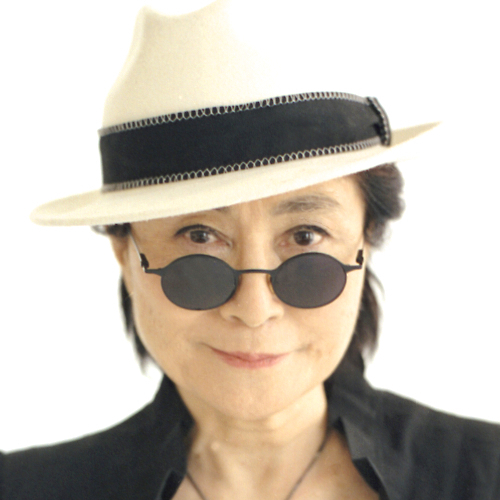
Yoko Ono is generally known as the partner of John Lennon. Overseas, she is one of the most famous Japanese, along with Ryuichi Sakamoto and others, but in fact she has been active as an avant-garde artist since the 1950s.
In commemoration of her solo exhibition "Yoko Ono: Through My Window" at the Museum of Contemporary Art Tokyo, we will take a closer look at her life and works.
Yoko Ono Profile
Yoko Ono (born Yoko Ono Lennon on February 18, 1933) is a Japanese-born American artist and musician. She is married to John Lennon of The Beatles and is known for her numerous collaborations with Lennon.
In 1953, at the age of 20, he left Gakushuin University to attend Sarah Lawrence College in the U.S., where he studied music and poetry. 1959, he began working as an avant-garde artist based in New York City. 1966, he moved to London, England. In 1966, she moved to London, England, where she held a solo exhibition in November of the same year, where she met John Lennon, whom she married in 1969, and worked with him on numerous creative projects and peace initiatives during the late 1960s and 1970s. He is one of the most active artists in the field of dance/club music, with 12 songs that have reached No. 1 on the Billboard charts. In June 2009, he was awarded the Golden Lion for Lifetime Achievement at the 53rd Venice Biennale, the world's premier festival of contemporary art. He lives and works in New York City.
Source: ja.wikipedia.org
Solo exhibition "Yoko Ono: Through My Window
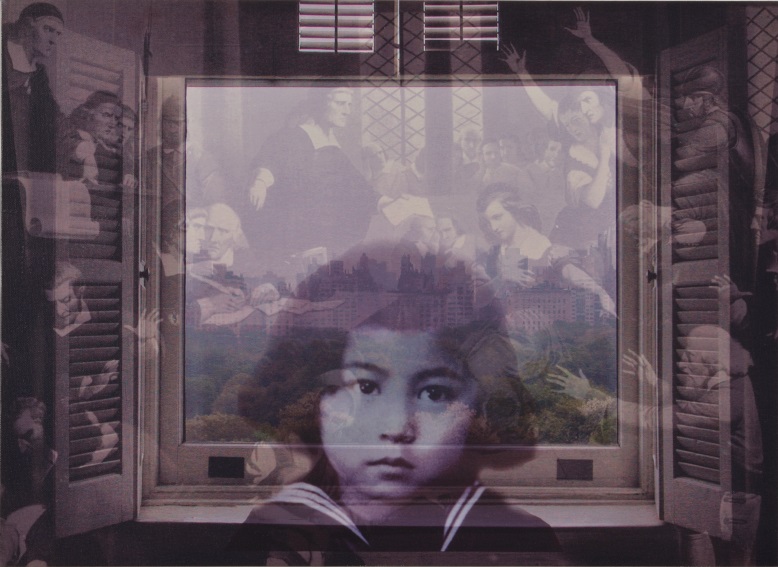
Yoko Ono, FROM MY WINDOW: Salem1692, 2002, pigment on canvas, private collection ©YOKO ONO 2015
Exhibition|MUSEUM OF CONTEMPORARY ART TOKYO
www.mot-art-museum.jp
Yoko Ono|From My Window
Yoko Ono (1933- ) has been creating new circuits by connecting different things in various fields for 60 years. This exhibition reconsiders Ono's activities, which have been discussed mainly in the context of postwar American art, in the context of her hometown, Tokyo. Through materials related to Ono's career up to the beginning of his artistic career, his creative works, his activities in Tokyo from the 1950s to the 1970s, and his recent works, this exhibition introduces Ono's original creative activities that connect modern and contemporary, Europe, Japan, and the United States, art, music, and literature, avant-garde and popular culture, and society and the individual.
As a pioneer of conceptual art, with his unique approach to poetry at its core, Ono has addressed serious issues in society to a wide audience with a humorous approach. This exhibition will be an excellent opportunity to trace the trajectory of his work, which was nurtured in Tokyo, a city that had already become sufficiently internationalized before World War II, from today's perspective.
Exhibition Highlights
In the 1930s, Ono received his musical education at Jiyu Gakuen. There, he was exposed to a way of thinking that did not draw a line between art and life, such as composing music based on the sounds of everyday life, such as the ticking of a clock. This was long before he was exposed to the American musical trends of the 1950s and 1960s. This exhibition introduces Ono's early activities and what nurtured him until he began his career as an artist.
■Ono's masterpiece and one of the most important books in the history of conceptual art, "Grapefruit," was published in the summer of 1964 as the culmination of a two-and-a-half-year residency in Tokyo. This exhibition introduces works on view for the first time in Japan, including its voluminous typescript on postcards and the instructional paintings exhibited at Sogetsu Hall in 1962, which were converted to a reproduction pictorial medium and advanced in conceptual character. Of course, the original handwritten instructional paintings and the first edition of "Grapefruit" in the museum's collection will also be exhibited, revealing the process of the development of a new art form in Tokyo that, like a musical score, uses simple words to stimulate the imagination and action of the viewer.
In Tokyo, Ono has been confronting social issues since the 1960s and has been involved in conceptual art using advertising media since the 1960s, such as the "War is Over! In addition to presenting his work as conceptual art using advertising media, Ono has also widely communicated his message through outdoor concerts, recordings, and other popular music methods. In recent years, Ono has also been creating art works and songs on the subject of violence that has occurred in various places. These intersect with Ono's own personal experiences and the memories of many others.
Source: www.mot-art-museum.jp
Yoko Ono (@dream_power) Twitter
twitter.com
The latest Tweets from Yoko Ono (@dream_power) I love to dance. I think dancing is better than marching through life. Tweet me your interesting questions to me with the hashtag #dearyoko. I will reply to you on Twitter. Please be sure to visit this website before posting -> http://t.co/jholQ1K0fV Nutopia
Former daughter of a large conglomerate moves to the U.S. to become an avant-garde artist.
Yoko Ono (Yoko Ono) is a daughter of the prewar Yasuda Zaibatsu family. After graduating from a prestigious university, Gakushuin, she moved to the United States with her family. There she studied poetry and music, and around 1960 began her career as an avant-garde artist.
I think it was very difficult for a Japanese woman to be active as an artist at that time.
In fact, when Ms. Ono held an event at Sogetsu Kaikan in Tokyo in 1962, she was very much criticized by men.
She also faced racism in the United States because she was Japanese (yellow race).
Later, when she had a fateful encounter with John Lennon and married him, and when the Beatles broke up, she was accused of being a "witch from Japan, Yoko Ono," who was the culprit for playing with Lennon and breaking up the Beatles.
Meet John.
The first encounter with John Lennon took place on November 9, 1966. Lennon visited the preview show of Ono's solo exhibition "Unfinished Paintings and Objects" at the Indica Gallery in London the day before it opened, and was attracted by the work on display there, "Ceiling Painting ( YES Painting"). The work featured a white stepladder in the center of the room, which the audience climbed up and used a magnifying glass hanging from the ceiling to see small letters on a canvas affixed to the ceiling [2]. Lennon recalled that time: "If there had been a nasty word like 'no' or 'phony,' I would have left the gallery immediately. But if it had said 'yes,' I would have thought, 'This is a good idea, this is the first art exhibition that makes me feel warm and fuzzy inside.
Source: ja.wikipedia.org
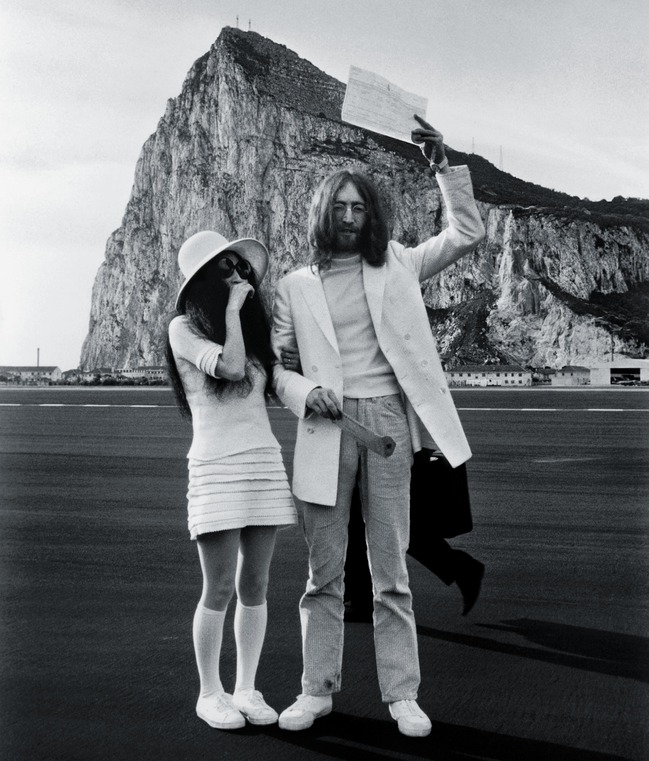
John and Ono shortly after their marriage in 1969.
At that time, they were often referred to as "John & Yoko" in one set.
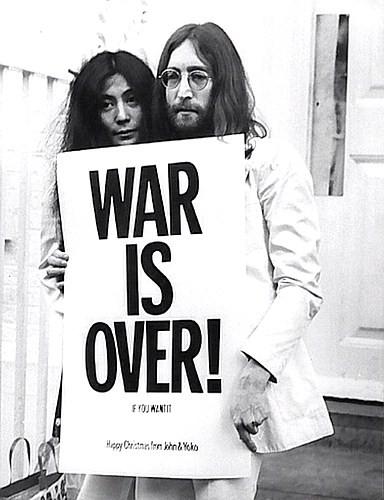
Two people holding up a card that reads "WAR IS OVER (IF YOU WANT IT.)"
This phrase is still well known today as the lyrics to "HAPPY CHRISTMAS".
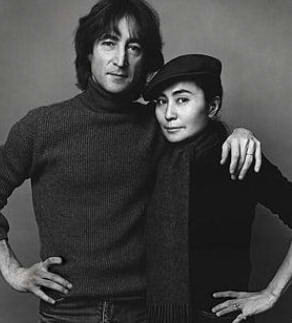
The two of them around the time of the release of "Double Fantasy" in 1980, John's last work.
For a while after John was shot and killed by an overzealous fan in 1980, Ono also went through a period of great mental shock and suffering, but his inherent vitality helped him overcome the pain and he is still active as an artist today.
In the "Culture Section" of the Yomiuri Shimbun on November 19, 2015, she wrote, "I encountered racism (in the West), but now I also feel ageism (ageism). It is a loss not to listen to those who have experienced it. For example, artists usually don't want their works to be touched, and I used to feel that way. But at some point, I found it interesting to be touched and intervened. Eventually, I started making artworks that both old people and children could freely enter." he said in an interview.
Sean, son of John and Yoko, and Julian, son of John's ex-wife Cynthia
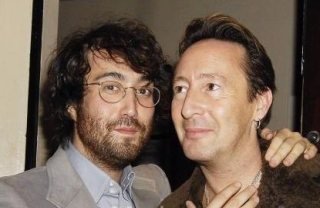
On the left is Sean, born to John and Ono. On the right is Julian, born to John and his ex-wife Cynthia.
The photo of them together is quite precious.
Both Julian and Sean are active in music, and both of them have a trace of John in them.
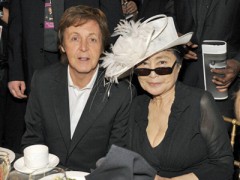
For a long time, the disagreement between Ono and Paul McCartney has been discussed.
However, in 2012, Paul said that Yoko was not the reason the Beatles broke up.
And in 2013, Ono said, "I have never had any ill feelings toward Paul. My husband did a wonderful job with Paul. I have a lot of respect for that." This strongly implied that the two had "reconciled" publicly.
Finally.
I am ashamed to say that there was a time when I, too, was led by the media to believe that Yoko Ono was the one who broke up the Beatles.
However, I gradually came to understand that the cause of the Beatles' breakup was not as simple as she alone could have caused it, and I now consider Ms. Ono to be a wonderful artist.
