
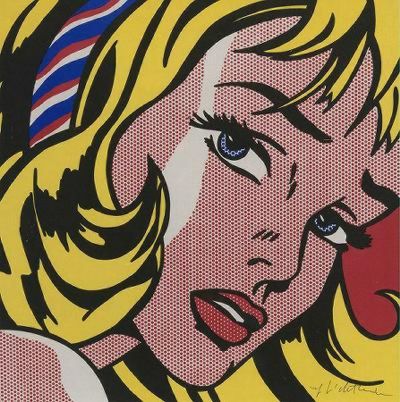
Roy Lichtenstein, along with Andy Warhol.
recognized as one of Pop Art's leading painters, but
His brightly colored paintings, based on American comic books
His brightly colored paintings based on American comic books are characterized by a craftsman's spirit.
Lichtenstein, the artist who developed cartoons into an art form
Roy Lichtenstein was born in 1923 in New York City
painter, born in 1923 in New York City. Along with Andy Warhol
Lichtenstein has become a leading figure in Pop Art, and is best known for his works
His works, which look like enlarged cartoons, are representative of his work.
He uses primary colors and thick black lines for outlines.
The outline is made with thick black lines. The dots are applied to the shadow areas,
By using these dots, the viewer can enjoy the painting both from a distance and up close.
The use of these dots allows the viewer to appreciate the picture both from a distance and when viewed up close.
Source: ja.wikipedia.org
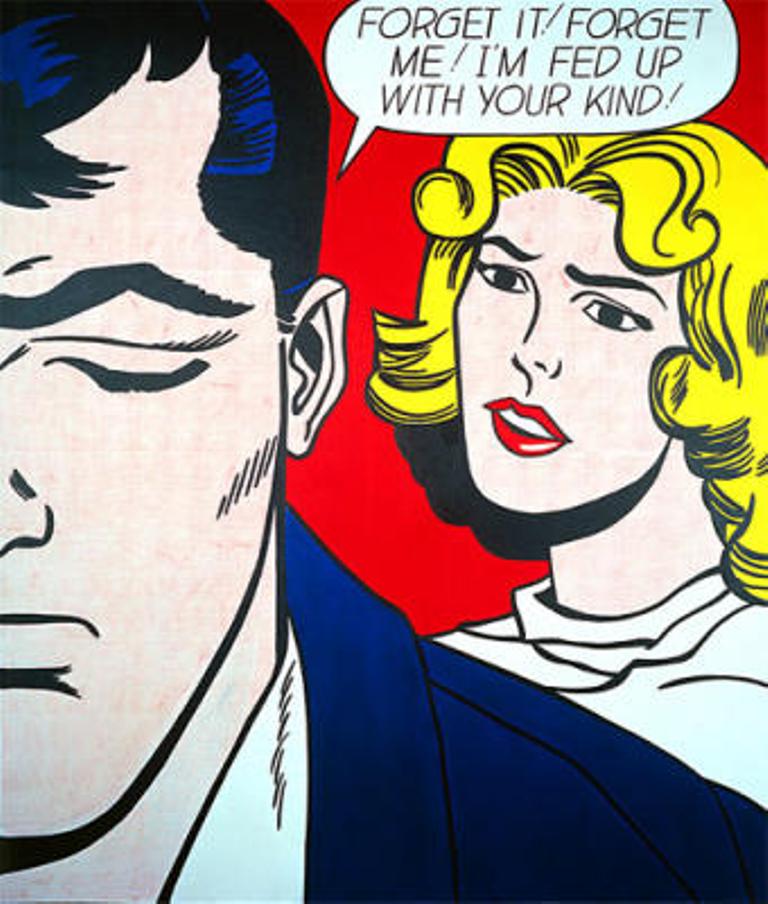
You're persistent! Enough!" (Forget it! Forget me! I'm fed up with your kind!)
Making manga accessible to the general public as a work of art
Lichtenstein was born in New York City in 1923.
He was born in New York City in 1923, and in 1940 he entered the Ohio State University School of Fine Arts
in 1940. During his studies, he was drafted into the military and temporarily
He returned to school after World War II and received his MFA in 1949.
He returned to school after World War II and received his MFA in 1949,
He returned to school after World War II, earning a master's degree in 1949, and worked as an instructor until 1951.
His first solo exhibition was held in 1951 at the
Carl Buck Gallery in New York City in 1951.
In the 1950s, he worked as a college instructor and a draftsman to make ends meet.
draftsman while working on his artwork.
Source: ja.wikipedia.org
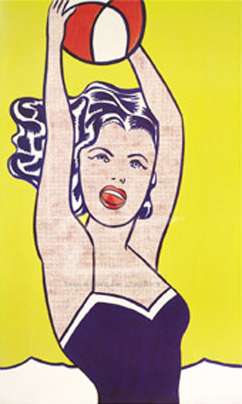
Girl with a ball, Mini art print," a fresh and lively image of a young girl.
Fateful Encounter
In the 1960s, a work based on American comic books was
were born. I drew Mickey Mouse cartoons for my own children.
He realized that cartoons could be more versatile than works of art.
He realized that cartoons could be more versatile than works of art.
His works are characterized by the use of three primary colors in solid color on a flat surface surrounded by thick outlines like cartoon cuts, and the use of dots and shadows.
The shadows are expressed by the size and density of the dots.
Shadows are expressed by the size and density of dots. Ordinary people would not consider a cartoon to be a work of art.
but he found the expression of cartoons very beautiful.
He thought the expression of manga was very beautiful.
Source: ja.wikipedia.org
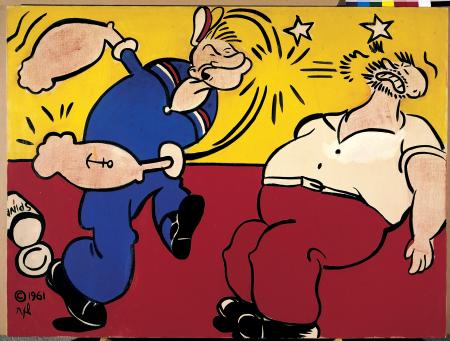
A scene from the well-known "Popeye
Commonalities between Modernism and Lichtenstein's work
His work and that of Piet Mondrian, a modernist
The works of Piet Mondrian and those of Piet Mondrian, a modernist abstract painter, have much in common.
The paintings have much in common with the work of Piet Mondrian, a modernist abstract painter, in that they use only five primary colors (red, blue, and yellow), white, and black,
Abstract Expressionism, which emphasized flatness, and cartoons, which
and the fact that cartoons are expressed in two-dimensional space.
In addition to cartoons, there are also a series of paintings that emphasize flatness in their depiction of masterpieces.
series, and originally, touchstrokes such as brushstrokes (brushstrokes with a thick layer of paint).
(The series of works with a touch like brushstrokes (brushstrokes) are painted on a flat surface.
The colors are three primary colors as well as In addition to the three primary colors, he also uses other colors
He also uses colors other than the three primary colors and incorporates mirrored surfaces into his paintings,
He has also started to create three-dimensional works.
Source: ja.wikipedia.org
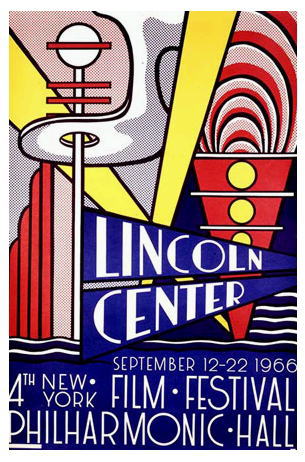
Lincoln Center Film Festival" Modern design using three primary colors
Moment of Birth of a New Artist
Lichtenstein was discovered by art dealer Leo Castelli
In the summer of 1961, when Lichtenstein showed him his work
Lichtenstein's work and immediately decided to sell it to him as a new artist.
The use of cartoons as a subject matter had also been
had also come up with the idea, but like Lichtenstein
Lichtenstein did not draw dots on uncolored areas with the precision of a machine.
dots on the uncolored areas as precisely as a machine. Two weeks late in bringing his work to Leo
Warhol brought his work to Leo two weeks late, frustrated that he could not come up with Lichtenstein's
Lichtenstein's idea.
Source: ja.wikipedia.org
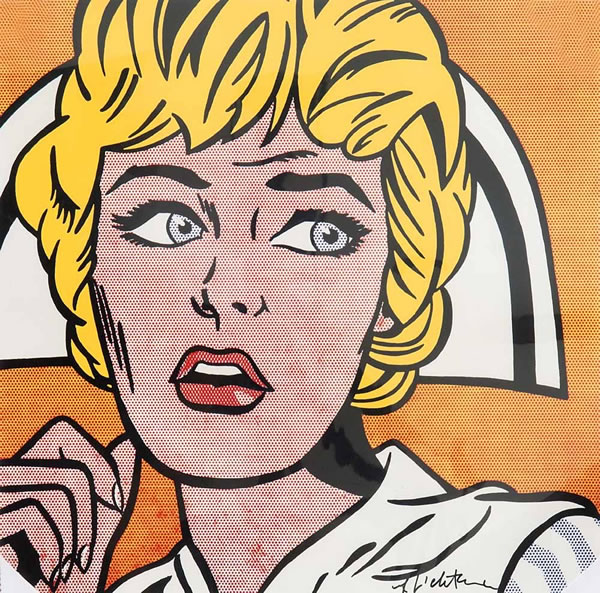
I'm surprised that all of the "nurse" dots were hand-drawn by Roy...
Lichtenstein's aims when creating his work
How did Lichtenstein use the cartoon as a subject for his work?
did he want it to look like?
"It doesn't look like a picture of something, it looks like the thing itself.
but the thing itself." (Roy Lichtenstein, 1995, Benedis Hendrickson, 1995)
(Roy Lichtenstein, Janis Hendrickson, 1995, Benedikt Taschen)
Lichtenstein's success was due to the machine's ability to produce the dots used in comic book printing.
Lichtenstein succeeded because he hand-drew the dots (dots) used in comic book printing as if they were done by a machine.
Lichtenstein succeeded because he drew the dots by hand, just as a machine does. By depicting the dots, his drawings look to anyone who sees them as if they were enlarged prints.
the printed matter to look as if it were enlarged, and to emphasize the
aspect of the object itself.
He is another pop artist who deserves praise.
Source: www.curiobooks.jp
