
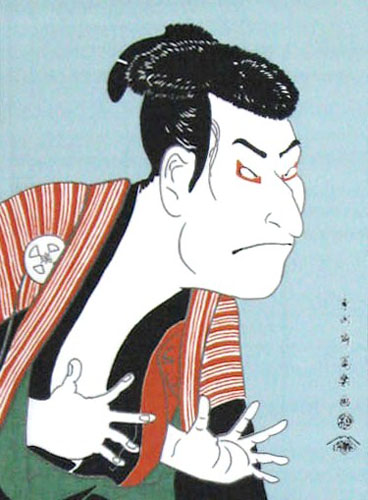
Toshusai Sharaku produced over 145 works in just 10 months from May of the 6th year of Kansei to March of the 7th year of Kansei.
Sharaku Toshusai produced more than 145 works in a period of only 10 months, from May of 1775 to March of 1775. His works are excellent large head paintings of actors who were active at the time.
His works are boldly deformed by capturing the facial features of the actors. After producing a large number of works in a short period of time, he suddenly disappeared.
He is a rare artist who became a topic of conversation when he suddenly disappeared after producing a large number of works with an individuality that no other painter had.
Ukiyoe artist who also painted unsuccessful actors
Sharaku continued to paint not only popular actors but also unsuccessful ones. This is
This is believed to be because he used the models of his works as his alter egos. Shigsaburo Tsutaya spent a large sum of money to have him make his debut.
Sharaku was not a popular actor at the time, but an actor who was not a popular actor at the time.
Sharaku's popularity at the time was due to the fact that he focused on minor roles, rather than on the more popular actors of the time.
In recent years, a theory has emerged that Sharaku's real name was Saito Jurobei, a Noh actor, because he was a wakitsure (a minor role of a minor actor).
Sharaku was a Noh actor, Jurobei Saito, who was a wakitsure (a minor role in a minor role).
Source: www.nagaitoshiya.com
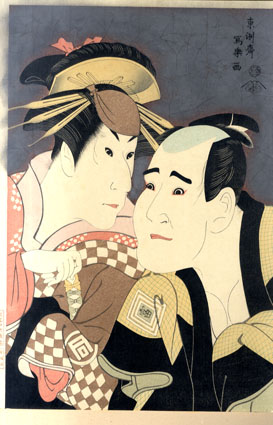
Tomiemon Ichikawa, Fujima Kanizaka, Ichimatsu Sanokawa, Onayo Shirouto
How did you come up with the name Toshusai Sharaku?
The name "Toshusai" means "residence in the middle island of the east river.
In 1794, when Sharaku made his debut, the land in Nakasu, located east of Edo Castle, was
It was called Toshusai. It is said that this was because Jurobei Saito lived in that area.
The origin of the name "Sharaku" is said to be an abbreviation of "Sharaku-za," which means "to copy the dressing room," since many of his works are pictures of actors.
Some say that the name "Sharaku" comes from the word "sharaku," which is an abbreviation of "to copy the dressing room," since many of his works were paintings of actors.
Originally, the word was used from the Muromachi period (1336-1573), and it meant "being unconcerned about things, and being refreshing.
It was originally used from the Muromachi period (1333-1573), meaning "not being particular about things, but being refreshing.
Sharaku's works are stylish and elegant. Sharaku's works are stylish and tasteful, so this makes sense.
It makes sense.
Source: www.nagaitoshiya.com
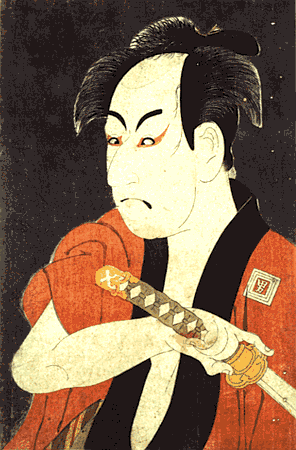
The red eyes and haori are impressive.
Hailed as one of the "world's three greatest portrait painters
Sharaku was not popular in Japan, but in the book "Sharaku" (1910) by the German art researcher Julius Kurt
Sharaku" (1910, German edition) by German art researcher Julius Kurt, who praised Sharaku, along with Rembrandt and Velázquez, as one of the "world's three great portrait painters.
In his book "Sharaku" (1910), German art researcher Julius Kurt praised Sharaku as one of the three greatest portrait painters in the world, along with Rembrandt and Velasquez.
During the Edo period, the actor paintings of Toyokuni I were more popular than those of Sharaku, because Sharaku
Mikio Nakayama has a theory that the reason for this was because Sharaku painted actors' faces too honestly.
At that time, many customers preferred to buy paintings that depicted actors' faces beautifully, and Sharaku's deformed paintings were not popular.
Sharaku's deformed paintings were not popular.
Source: www.nagaitoshiya.com
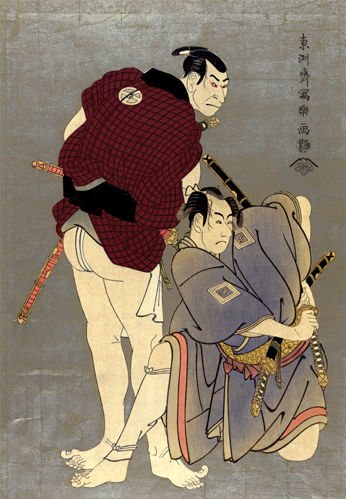
Beautiful contrast of movement and stillness "Otani Oniji III and Ichikawa Gekizo I
The unpopular Sharaku
All Sharaku works were published by Tsutaya Shigesaburo's store. The Tsutaya mark (Fuji with ivy) in the lower left corner of the illustration is evidence of this.
Fuji and ivy) can be seen in the lower left corner of the illustrations, which is evidence of this. The period of publication was divided into four phases, and as the period moved from the first to the fourth, the quality of the prints declined in popularity.
The quality of the prints declined and lost popularity as they moved from the first to the fourth period.
Most of his masterpieces are from the first period of large head paintings, but from the middle of the first period, there are some cases in which a different person painted them, or a large number of them were produced in his workshop.
However, there is a theory that a different person painted them in the middle of his career, or that he created a large number of them in his workshop.
Source: www.nagaitoshiya.com
Who is Sharaku?
The predominant theory is that Toshusai Sharaku was Saito Jurobei, but some believe he was a different person. Other candidates
Other names mentioned include ukiyoe artists Utagawa Toyokuni I, Ukiyoe artist Utagawa Toyokuni, Uta-Mai-Kodo Tsuyokagami, Katsushika Hokusai, and Kitagawa Utamaro,
Shiba Ehan, Tani Buncho, Maruyama Okyo, Kabuki actor Nakamura Konozo, Western-style painter Doi Arinon, caricaturist Santo Kyoden, and Jippen Jippen, among others.
Kabuki actor Nakamura Konozo, Western-style painter Doi Arinon, and playwrights Santo Kyoden and Jippensha Ikku, and haiku poet Tani Sogai, to name a few.
The reason why Jurobei Saito is so influential is because there was no one whose real name had to be withheld.
The reason why Jurobe Saito was so influential was because there was no one whose real name had to be withheld. At that time, kabuki actors were called "kawaramono" (low-ranking samurai) and were considered a lowly profession.
(Jurobe Saito was a samurai (a low-ranked samurai), but to work on ukiyoe paintings of actors was to lower his status.
It was a way to lower his status. He was not allowed to go on stage, but only as a guest, so it would be a problem if his side job was discovered.
It would be a problem if his side job was discovered. It was because of his main job that he was able to quit his job as a painter after only 10 months.
Source: ja.wikipedia.org
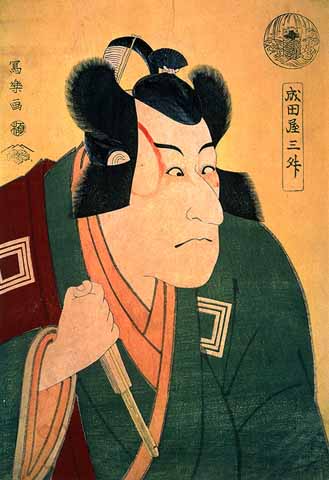
Naritaya Sanmusubi" (Naritaya Sanmasu) large head painting, with a good sense of kimono, as if he were a popular actor.
What if Sharaku switched careers to become a painter?
What would have happened if Sharaku had changed jobs? If he had been successful in his first period,
He would have continued to create and become a popular Ukiyo-e artist in Japan at an early stage.
He would have continued to work as he did in the first period. However, it is impossible for forgeries of his works to appear here and there, no matter how unsuccessful they may be.
However, it is impossible for forgeries of his works to appear here and there, no matter how unsuccessful they may be. Although he did not make actors as beautiful as other painters
but his unique style of painting is probably the reason why his works were accepted.
It is regrettable that his life as a painter ended in a short period of time, but he will remain in history as an enigmatic painter.
He will remain in history as an enigmatic painter.
Source: www.nagaitoshiya.com
