
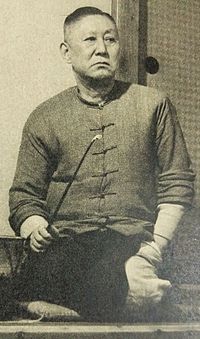
He was an active writer from the Taisho to Showa periods. He was active between the Taisho and Showa eras, but he may be overshadowed by his mentor Soseki Natsume and friend Ryunosuke Akutagawa. However, his style, career, and everything about him gives the impression of being "unique. He loves trains so much that "it doesn't hurt even if you put it in your eyes" and cries over his lost cat... What kind of person is Uchida Hyakken, a writer so "unique" that it is hard to stop talking about him? What is so "unique" about Uchida Hyakken that we cannot stop talking about him?
career
Born in Okayama Prefecture in 1889. His real name is Eizo Uchida. His pen name "Hyakken" was derived from "Hyakken River" in his hometown. He also had another name "Hyakki-en", both of which were changed to "Hyakki-en" after the war. He was a pupil of Soseki Natsume and also had a close friendship with Ryunosuke Akutagawa, his junior. His family was a sake brewer, and his grandmother doted on him, making him a "selfish" person. Incidentally, after his father died at the age of 16, the sake brewery went out of business, and he was forced to live in considerable poverty. Even so, he enrolled in Tokyo Imperial University. He made the acquaintance of Soseki Natsume while visiting him for medical treatment and proofread his works. He graduated with a degree in German literature. He taught at the Military Academy, the Naval Engineering School, and Hosei University. Died in 1971.
What is your style?
The style is also unique. It is what we would now call "surreal" type. The development is strange and bizarre, as if in a dream. And yet, it is somehow realistic. That is why it is somewhat scary. But I am curious... "Meizu," the first collection of short stories, is a parade of such stories, describing events that seem "familiar" in the dream world. Two of the most memorable are "Santo Kyoden," in which the protagonist becomes the apprentice of the Edo period novelist, Santo Kyoden, and is asked to "receive visitors" while making pills by the front door, and "The Case," in which the protagonist becomes a yokai, a demon who makes predictions that always come true, and is confused by the people around him who worship him.
German Teacher
There was a time when I was a German teacher at Hosei University and other universities, but my teaching method was a "cramming" style. He seemed to be teaching with the force of a flooded river. What did he say to the protests of students who said, "I'll forget it if you don't teach like that? He said, "You can forget it when the exam is over, so remember it now. So remember it now. Okay? Not knowing is not the same as remembering and forgetting. It's a great quote, although it's not so easy for the students.
man who started out as a railroad worker, but grew into an iron worker
The "no pain in the eye" thing is children, but in his case, trains, trains of sorts, seemed to be it.
It doesn't hurt to let the train run with your eyes."
Source: ja.wikipedia.org
He even went to the trouble of taking a train and published a book about it. There are many of them, including "Abo Train" (Chikuma Shobo), which you should read if you are interested.
Unique aspect
Take the lid off and look at it for a moment, then give the order to the buns... "Be careful, rest! Then he takes one and eats it. It is something cute. Other than that, he wrote down a list of things he wanted to eat during wartime, listened to a broadcast at a kindergarten in his neighborhood calling attention to children with honorifics, and said to his cat in honorifics, "Please don't play here," and wrote a book about his beloved cat, although he said he was not much of a cat lover. He even wrote a book about his beloved cat and cried in the cat's favorite place when the cat was gone... What is this moe father?
Lucky or unlucky?
Because of his debt, he was unable to enter the dormitory of the Sixth High School (now Okayama University) and had to commute from home, and he was in considerable financial trouble after that. In his desperation, he once decided to ask Soseki Sensei to borrow money for him. When I went to see him, he was on a trip. He told me where he was going and where he would be staying, and I took the train with what little money I had and was able to get him to promise to borrow 200 yen (at the time). However, I was not satisfied with the teacher's words, "You should stay the night," and when I got into my futon, I realized that I had borrowed 200 yen today. I realized that I had been extremely lucky to be able to borrow 200 yen today. I might not have been told where I was going, or I might have gone somewhere I couldn't go with the money I had on hand. Besides, he may have left in different ways, and even if he was still there, he may not have met me... and even if he did, he may not have lent me the money... It makes me cringe to read this.
sweet wood
In his essays, a person named "Amagi" often appears, but it is not necessarily the same person. It is an anonymous name for the sake of convenience, just a corruption of the word "nogashi," which shows his care and sense of humor.
Finally.
There are many other episodes, different but interesting aspects, so if you are interested, you should read his book. I hope that you will find another writer you like!" I hope you will like his books.
