
Jan Švankmajer, a Czech surrealist filmmaker, and Sylvain Chaumet, a French animator. Both are quite famous as filmmakers. But of course, they too had their "newcomer" days. So, we have compiled a list of their debut works. Shomé, who has won many awards, and Švankmajer, whose style is heartbreaking. What is their origin...?
Jan Švankmajer, "The Last Trick of Mr. Schwarzegard and Mr. Edgal."
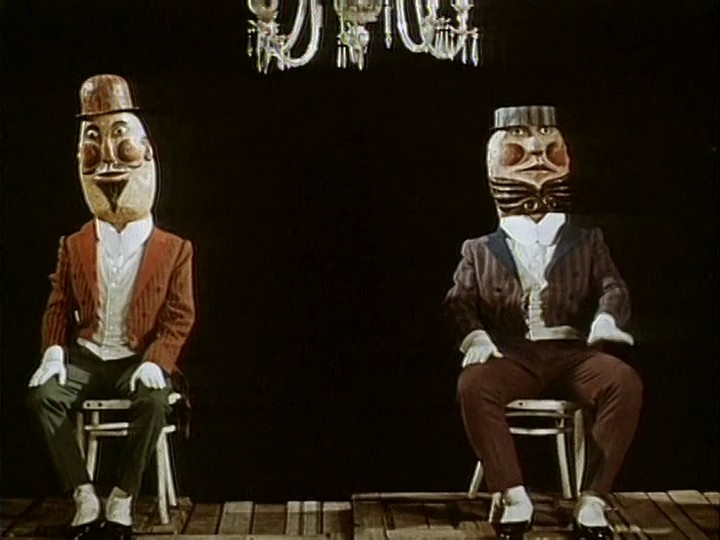
Mr. Schwarzewald and Mr. Edgal's Last Trick"... It is a rather long title, but I guess the two people in the picture are "Mr. Schwarzewald" and "Mr. Edgal". They seem to be magicians, and they take turns to perform their "magic tricks". The content of their "magic tricks" is quite "surreal" and enjoyable to watch. But...these two. On the surface, they are exchanging first moves and applauding each other's "magic tricks," but I wonder what they are thinking on the inside. The handing over seems like they are pushing each other, saying, "You should be the front runner," and the clapping seems somewhat "obliging. They shake hands, but they shake their hands as if to say, "Don't touch me with your dirty hands," or they climb up on their chairs to avoid shaking hands... It is strange that their expressions seem to change even though they are masked. I especially like the "What the hell are you doing?
Mr. Schwarzewald and Mr. Edgal's final trick.
Poslední trik pana Schwarcewalldea a pana Edgara / 1964 / Color / 11 min 43 sec / Winner of the Bergamo Film Festival, Mannheim Film Festival, and Tours Film Festival Other mylist/12834745
Profile of Jan Švankmajer
Born in Prague in 1934. After working as a puppeteer, he became a filmmaker. His wife is the surrealist Eva Švankmaierová. His major works include the feature film "Otesanek" and the short films "Etcetera," "The Room," and "A Quiet Week at Home. His style is not so much about "food" as it is about the act of "eating," as in the way the food in his films all look bad, or in the close-ups of his large mouths. He says, "I have not liked eating for a long time. A self-described "militant surrealist," his seemingly absurd style seems to contain some kind of political agenda or satire.
Sylvain Chaumet, The Old Lady and the Pigeon
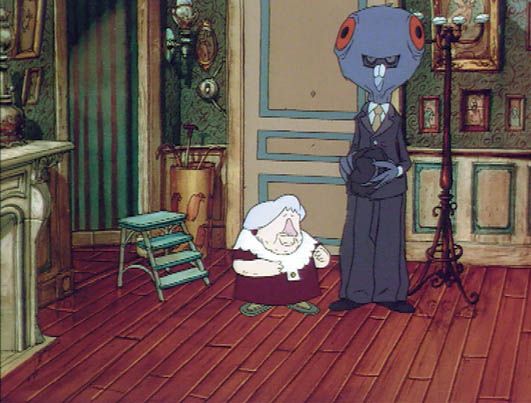
Standing on the right is a human wearing a pigeon headdress. Why is he doing that? To beg for food from the old lady next to him. Why then? In Paris, where fat tourists come to see the city, the police officer, the person wearing the headdress, is a skinny man. He is so skinny that he is the only skinny person in the film. He is so skinny that he is the only one in the film. He has a job, but his salary is so low, or for some other reason... Pigeons that are pecking at his window are fattening up, while he has to sleep after eating a small piece of fish. Then I see an old woman who is feeding the pigeons a big slice of delicious-looking cake. The policeman finds out where the old lady lives, plucks the feathers from her pigeons, puts on the aforementioned headdress, and goes to the old lady's house. But it is not just out of kindness that she lets the "pigeon man" feed her... It is a scary piece of work in more ways than one. But it is addictive.
Old lady and pigeons
Sounds delicious when you are eating....
Profile of Sylvain Chomé
Born in France in 1963. He apparently majored in art in high school, graduating in 1982. After graduating from art school, he published his first comic book and met Nicolas de Crécy, a bande dessinée artist, around this time. In 1991, he began work on "The Old Lady and the Pigeon," which was originally a trilogy but was combined into one film. In 1991, he began work on "The Old Lady and the Pigeon," which was originally a trilogy that was combined into a single work. Nicolas de Crécy was in charge of the background. In 2004, he founded the animation studio Django Studio.
Finally.
Both are high quality works and remind us of the saying "Genki is better than Futaba. I am deeply moved by the influence of my career up to that point. I also feel the depth of visual art. It is a perfect autumn season for art, isn't it?
