
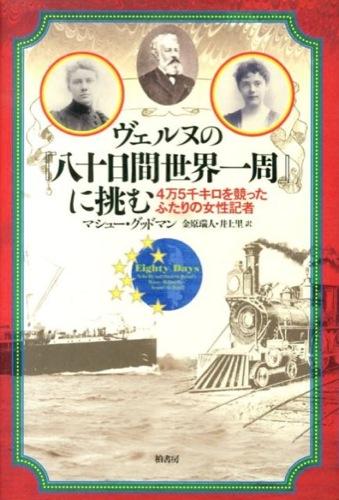
Seventeen years after Phileas Fogg, the main character in Jules Verne's masterpiece "Around the World in Eighty Days," the father of science fiction, two female journalists actually made it around the world. Nellie Bly, from the North, and Elizabeth Bisland, from the South. The two contrasting women had one adventure in common: they both wanted to make their own way in the male-dominated newspaper world. Both women, in contrast, had one common adventure: to make a place for themselves in the male-dominated newspaper business.
Who is Jules Verne anyway?
Jules Verne (February 8, 1828 - March 24, 1905) was a French science fiction writer.
The quickest way to find out is to read the Wikipedia article.
Jules Verne - Wikipedia
ja.wikipedia.org
Jules Gabriel Verne (French: Jules Gabriel Verne; February 8, 1828 - March 24, 1905) was a French novelist. He is known as the founder of science fiction (SF) along with Herbert George Wells, and is also called the father of SF.
The year 2015 was depicted in the movie Back to the Future as a future visited by a time machine.
When the film was released in 1985, 2015 must have seemed a long way in the future.
Marty and Doc flew to 2015, the future, in the first film in the series, but in the third film, they flew to 1855, the past.
There, Doc falls in love at first sight with a woman named Clara Clayton. They discuss science fiction novels while looking at the moon.
Doc mentions Verne as a classic science fiction novel he read as a child, and Clara mentions Verne as a recently released science fiction novel.
Verne is famous as a science fiction writer, and his best-known work is "Around the World in Eighty Days.
His other famous works include "20,000 Miles Under the Sea" and "A Trip to the Moon.
Even if you have never read "20,000 Miles Under the Sea," you probably know it from the Disney Sea attraction.
Incidentally, "A Trip to the Moon" was made into a movie in 1902, and as the world's first science fiction movie, it is an indispensable work in the history of cinema.
What is "Around the World in Eighty Days"?
The protagonist, Phileas Fogg, is a wealthy English aristocrat. As a bachelor, he considers it of utmost importance to lead a regular life.
His butler, who could not meet his exact demands, is mercilessly dismissed, and his new hire for the day is a Frenchman named Passepartout.
Later that day, at his favorite club, Fogg and a group of other gentlemen discuss some news and he declares, "Around the world in 80 days is now possible. Then the betting began.
If he fails to make it happen, Fogg loses all his money. If he could make it happen, he would win the bet and a lot of money.
He and Passepartout set off that day, a journey that would take them around the world and back again.
This famous masterpiece by Verne was made into films in 1956 and 2004.
It has been adapted not only for the cinema but also for the stage, where a locomotive and a real elephant appeared on stage.
"Around the World in 80 Days" (1956) Trailer
Who are the two female journalists who took on the challenge of traveling around the world?
Seventeen years after Verne's "Around the World in Eighty Days" was released.
Reporters were busy working at the newspapers that lined New York City. Most of them were men, and there were no women to be seen.
There were some female reporters. However, they were entrusted only with articles for women.
They wrote about high society gossip, wedding dresses, embroidery, and tea parties.
Nellie Bly, a reporter for "World" magazine, made a name for herself by going undercover, risking her life to write an inside story.
She moved from upstate Pennsylvania to New York City to work hard and save herself and her mother from a life of poverty after her father died.
Eventually, she came up with a project. The idea was to see if Verne's work was real or not.
Before that, there had been others who had attempted to circumnavigate the world. All had been men, and all had failed.
She brought the project to the desk, and although it was not accepted at the time, it was realized again when World magazine's sales began to decline.
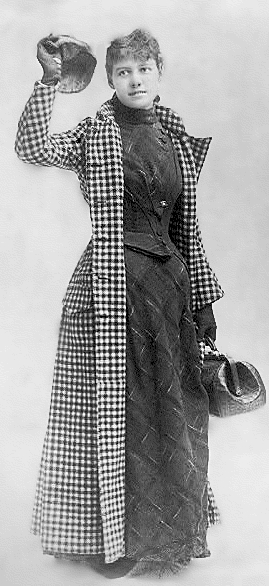
Elizabeth Jane Cochran (May 5, 1864 - January 27, 1922)
Pen name "Nellie Bly".
On the same night that Nellie Bly leaves New York City for her eastbound world trip, another female reporter leaves for her westbound world trip.
Her name is Elizabeth Bizland.
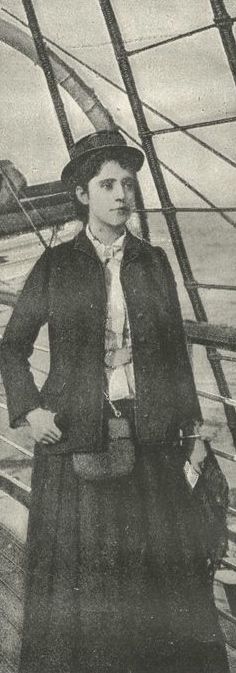
Elizabeth Bisland (Bisland) Wetmore (February 11, 1861 - January 6, 1929)
A native of southern Louisiana, she was raised by parents who lost much during the Civil War.
She had a deep knowledge of literature and poetry, and was friends with Lafcadio Hearn, known in Japan as "Koizumi Yakumo.
If Nellie Bly was brave and combative, Elizabeth Bisland was the opposite.
She was not interested in sensational headlines in the press, preferring instead to write reviews of literary works and poetry.
With her slow Southern drawl and deep education, she charmed the men in the literary salons.
She was directed by John Brisbane Walker of Cosmopolitan magazine to take a trip around the world the night Nellie Bly departed.
She was not too keen on the idea, but it was clear that if she did not accept the job, it would be a hindrance to her future work.
And so the two women set out on their round-the-world journey.
What are the highlights of the book?
The author can travel around the world by reading books. And in the 19th century.
While we don't see any exciting adventure action, there is drama in this book.
The scenes of the countries depicted in the book are fascinating because of their distant past, even if they are far away from the past.
In Japan, Yokohama makes an appearance, and it is nice to see that it is written about rather favorably.
One could read the book as to which woman would win.
In that case, I recommend not to look at their Wikipedia articles because it would be a waste to know the results before reading them.
At the same time, the book gives us an idea of the position women were pushed into in society at the time.
The book is a bit thick, but the travelogue is easy to read. It is a book that you should definitely pick up.
