
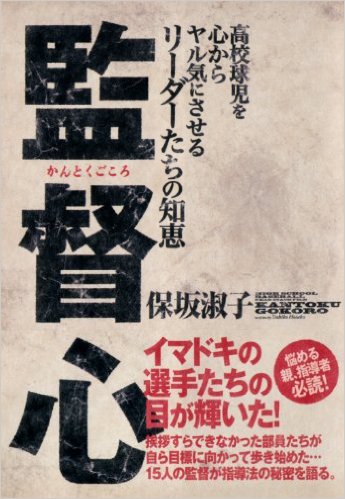
What does a coach of a strong baseball team think and do? In this book, you will find out the thoughts and anguish of the commanders of prestigious high school baseball teams, as well as their personal growth and development along with their teams. This is the third and final part of the book, introducing two coaches from the first and second parts.
Akihiko Fujita Toyo Univ.
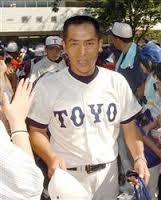
Hyogo Prefecture is the hometown of the Koshien. The school is a regular at the Koshien Tournament, even in a prefecture full of strong schools such as Houtoku Gakuen, Takigawa II, Ikuei, and Kobe Kokusai Daitsuke. It is a prestigious school that has won the 59th Koshien Tournament in the summer as well. Coach Fujita himself participated in the Koshien Tournament twice during his career. He was manager from 1997 to 2006, and then left the team for five years. In February of 2011, he was appointed manager again. That summer, the team won the ticket to the Koshien National Championship.
The person who influenced Fujita's coaching was his former high school coach, Mr. Tanaka. He was a very Spartan coach, and many of his team members quit the team. He was so enraged by the players' slack attitude toward practice that he repeatedly punched the captain to make an example of him, and the players at that time feared him. But before the big game in the summer prefectural tournament, he relaxed the players by saying with a smile, "If we lose today, let's all go swimming together. Perhaps this helped the players to relax and play more freely, and as a result, they won the game and decided to go to the Koshien Stadium.
Fujita recalls his mentor's attitude during his time at the school, and says, "I believe that a coach is in a sense an actor. An actor's "hai" is not a person. I believe that he became an actor as a director and was able to play a role that was not his true self. Sometimes he would be a devil sergeant with an iron fist, and sometimes he would be a kind and loving older brother. He must have learned from his mentor that by doing so, he could successfully motivate his players.
However, he has his own experience of losing a game the next day because he made a mistake in the timing of praise, but Fujita works hard with his players through trial and error to find the right balance between tension and relaxation. Toyo University Himeji has been away from Koshien for the past few years, but I would like to see them make a comeback. I would like to see the players, trained by Coach Fujita, playing with vigor and enthusiasm on the big stage of Koshien.
Josuikan, Hiroshima
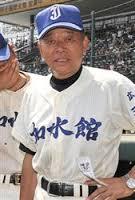
The veteran coach, Yoshinari Sakoda, is now 76 years old. He became the first manager of the up-and-coming Josuikan High School and quickly turned the team into a powerhouse in a short period of time. He also established "Hiroshima Sho Baseball" during his time as manager of Hiroshima Shogyo, and is a master of the game, having achieved numerous successes in the Koshien Tournament. He is most famous for his victory over Egawa of Sakushin Gakuin.
During his time at Hiroshima Commercial, he sometimes raised his hand, but he realized from that time that a coercive attitude would not do. By talking with the players, he would make them "realize" what they were doing. He realized the importance of this at the time, and was quick to put it into practice. I think that is a great achievement.
Sometimes he would personally offer snacks and other treats to the players. He would also take control of the players' feelings and motivate them. I don't think he did this in the past, but perhaps the secret of his success as a coach is that he still practices the kind of coaching that is suited to the children of each era and time through trial and error.
Director Sakoda's ideal team is "a team that does not look strong. He does not want a team that has a strong batting lineup that hits hard, or a team that has a super high school pitcher who throws hard, but a team that does not get scored on and wins 1-0. To achieve this, he tries to understand the strengths of each player and bring out the best in them. He also says that the most important thing is that all players have the same level of awareness. It is said that if even one player has a different level of awareness, it will affect the game. In this sense, I can understand why he places so much importance on dialogue with his players.
I believe that the reason why Mr. Sakoda has continued to coach for so long is the result of his efforts to face his players while gradually changing his way of thinking and approach, without putting aside his pride and ideas as a famous coach who became famous in the Koshien. I hope that many high school baseball fans will see that "Sakoda Baseball" is still alive and well. It is a great achievement just to be a representative of Hiroshima, a city with many strong teams, but I would love to see him again at Koshien. I can't help but think so.
Finally.
What do you think of these six coaches? The director himself never looks down on the players or gives one-way guidance, but rather tries his best to face the players and motivate them. The coach plays a supporting role, and the players are the main players. If the positions were reversed, it would be difficult to win. It is the players who do the work. I have taken the liberty of interpreting "director's heart" as "heartfelt love for the players, more than one's own immediate family. I am not sure if this is an appropriate expression, but I think it is the foundation of everything.
This is a book that puts the spotlight not on the players, but on the coaches who guide them. I believe that by reading this book, you will understand the interest and depth of high school baseball, and that it will become even more interesting. In addition to the six coaches introduced, the book also introduces the minds of other coaches such as Harada, manager of Ryukoku University Heian, and Miyashita, manager of Kagoshima Minoru. Why don't you take a look at the book?
