
Altarpieces developed in the north during the Renaissance in the 14th and 15th centuries.
The Ghent Altarpiece by Van Eyck is outstanding both in scale and technique.
The Ghent Altarpiece, commonly known as the "Ghent Altarpiece" by the Van Eyck brothers, is in the collection of St. Bavon's Cathedral in Ghent, a major city in Flanders.
At first glance, it appears to be a multi-part altarpiece with a complex composition, but at its core, it is a simple three-part altarpiece of the contemplative style with left-right opening and closing.
When open, it measures approximately 3.4m x 4.6m.
The inner paintings are masterpieces that influenced later Flemish painting with their luminous, clear, and exquisite brushwork and depiction.
Hubert van Eyck, the greatest painter of all, began this work, and his brother Jan, the second greatest painter of his art, completed this difficult task at the request of Jodokus Weidt. And now, in the light of what has been done, I invite you to this poem on the 6th of May (1432)."
This is the inscription written in Latin on the lower border of the lowest part of the altarpiece when it is closed.
The Ghent Altarpiece was commissioned by Hubert, the elder of the Van Eyck brothers, from Veit, a councillor in Ghent at the time,
The painting was completed by the younger brother, Jan, after the death of the older brother.
At that time, Christian churches were divided into a main altar and several secondary altars (chapels), depending on the size of the church,
Each sub-altar could be used and managed individually by the financier.
The altarpiece in Ghent was installed in the Veit Cathedral in the Cathedral of St. John of Ghent (renamed St. Bavon Cathedral in 1559) when it was completed.
It was installed in the Veit Cathedral.
With the altarpiece open
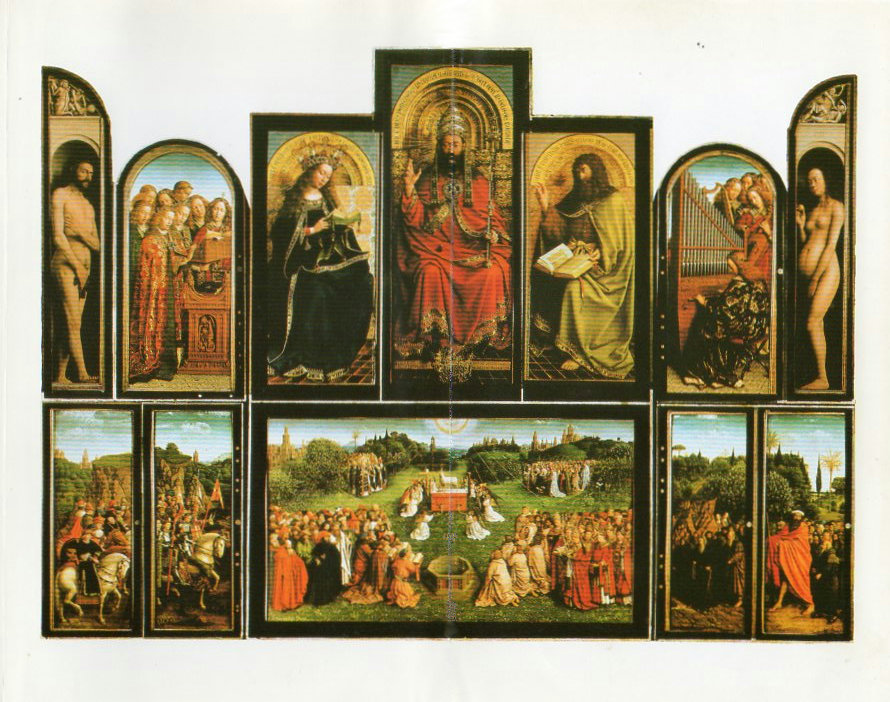
when unfolded
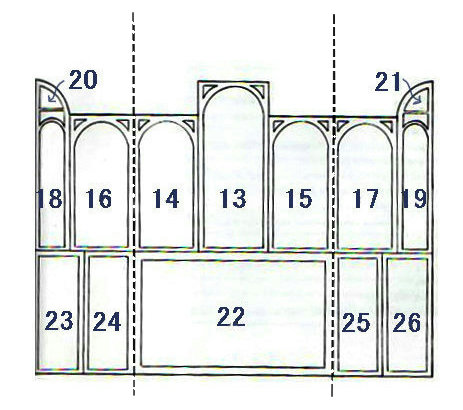
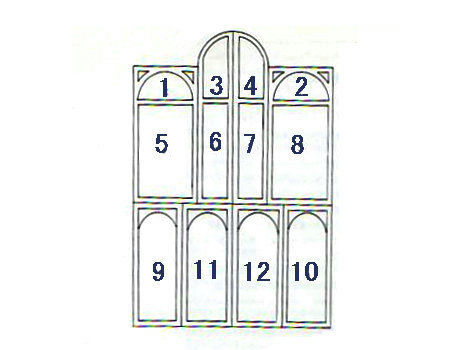
The altarpiece can be opened and closed contemplatively at the dotted line.
The left side facing you is called the "left wing" and the right side is called the "right wing.
The open/closed altarpiece is closed on weekdays, though, and is a somber door picture in grisaille (monochromatic to two-color painting),
On Sundays, Christian festivals, and anniversaries of the saints who are the subject of the altarpiece, the altarpiece is opened to reveal to the worshippers a world of glorious colors in the middle.
On Sundays when Mass is celebrated, Christian festivals, and anniversaries of the saints who are the theme of the altarpiece, the door is opened to reveal to worshippers a world of glorious colors.
It is like the Hare and Ke in Japan.
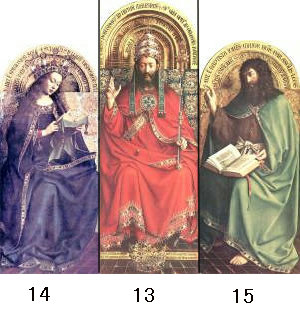
Upper center (13) Deesis (14) Mary as Queen of Heaven (15) John the Baptist
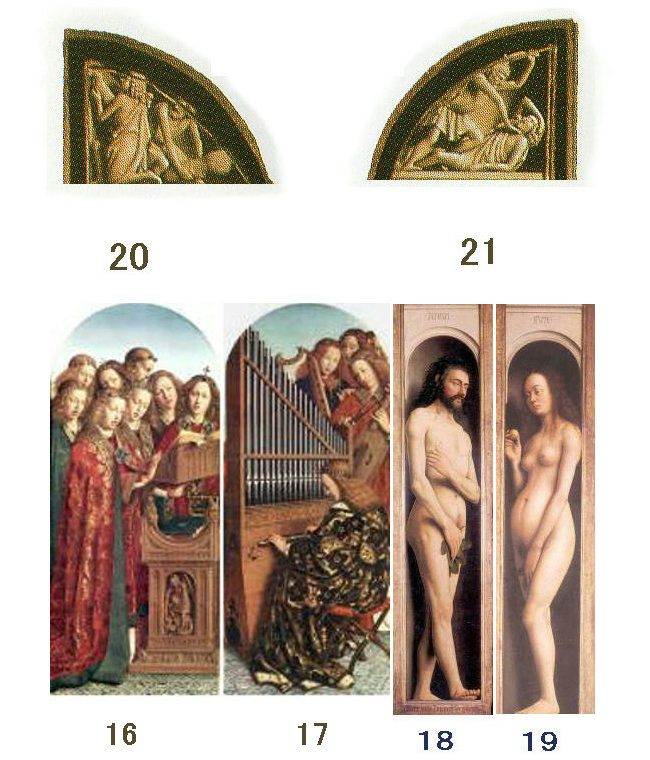
Upper both wings
(20) Sacrifice of Cain and Abel (21) Cain's killing of Abel
(16)Chorus angel (17)Musical angel (18)Adam (19)Eve
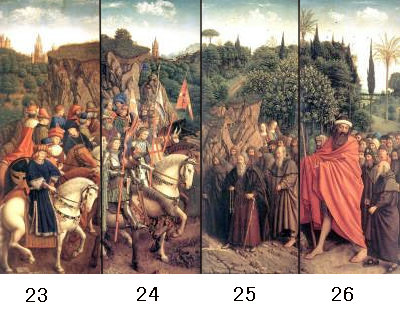
(23) Righteous Judge (24) Knight of Christ
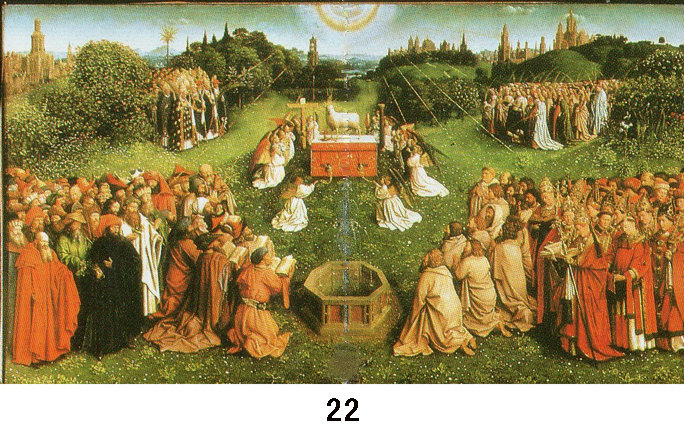
The Adoration of the Lamb."
Prophets, Chiefs, Apostles, and representatives of the Church
Fountain of Life in the lower center
Altarpiece closed
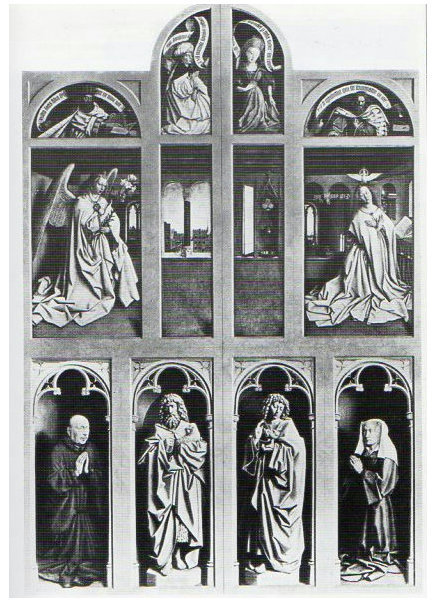
Closed (weekday)
Upper middle lower
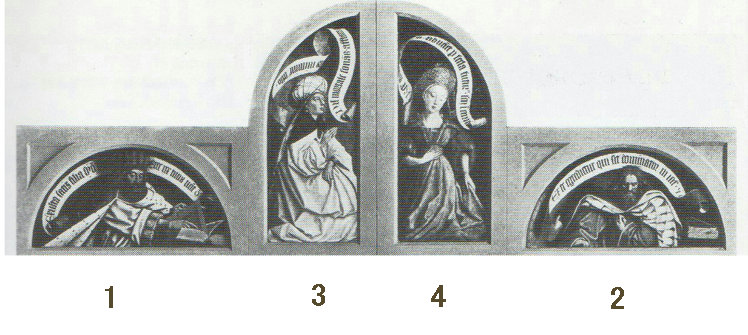
Upper row in closed state. (1) the prophet Zachariah, (2) the Eritrean priestess, (3) the priestess of Kumaea, and (4) Micah.
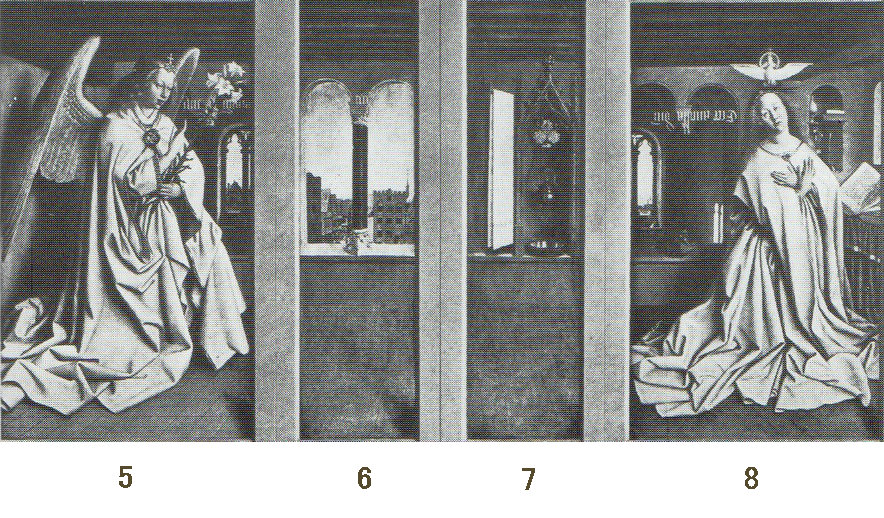
Middle section of the closed door. (5) Raphael and (8) Mary's Annunciation. It is a semi-grisaille.
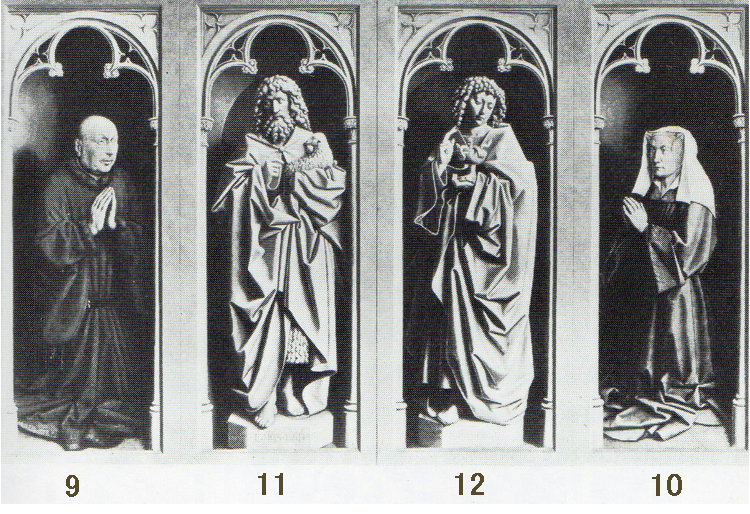
Lower part of the closed door section, four figures in the wall niche. From both sides, the donors (who ordered this altarpiece) (9, 10) colored images of Mr. and Mrs. Veit.
The middle two are grisaille images of (11) John the Baptist and (12) John the Evangelist.
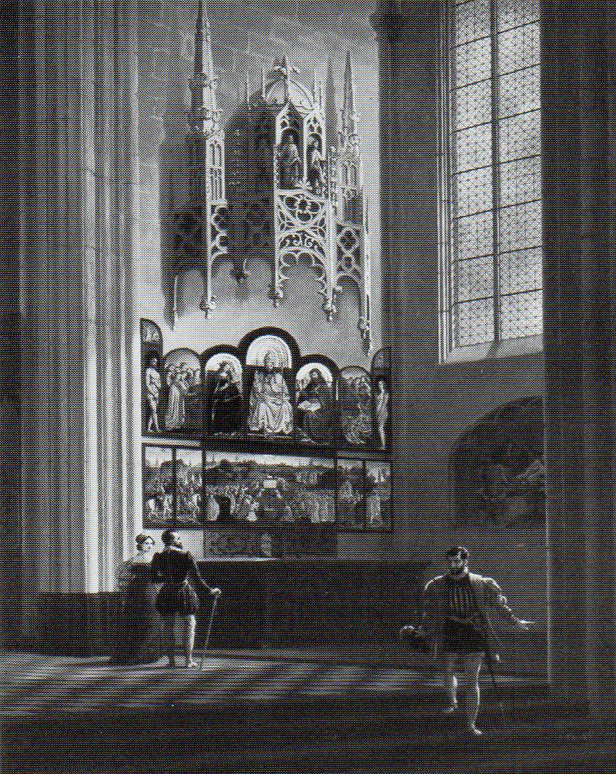
Pierre-François de Nothe
The Chapel of Yodox Veit.
Oil on canvas, 97 x 78 cm, 1829.
National Museum of Fine Arts, Amsterdam
