
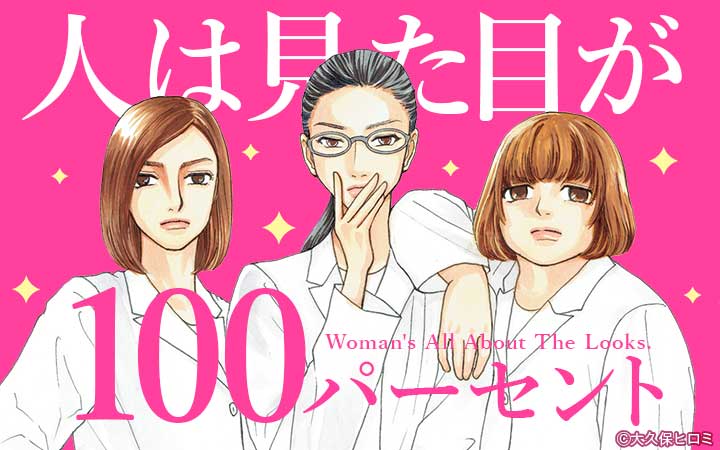
Hito wa Mukou ga 100 percent" is a comedy manga by Hiromi Okubo in which science-oriented women working for a paper manufacturing company struggle to make "beauty" the object of their research. Three female researchers, who are so absorbed in their work that they have never been associated with beauty or girl power, struggle to get rid of their "girl modesty" through research on fashion, makeup, and other aspects of appearance. It was serialized in Kodansha's "BE・LOVE" from issue #1 in 2014 to issue #23 in 2015 and published in five book volumes; in 2017, it was dramatized by Fuji Television and starred Mirei Kiritani, Asami Mizukawa, and Chiemi Bruzon.
Source: www.asahicom.jp
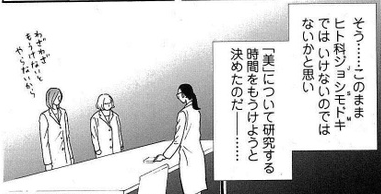
Feeling a sense of crisis that their appearance was being neglected, the three began researching beauty after work.
A word coined by combining the words "joshi" (girl) and "modoki," it appears many times in the work. It refers to women who, although they are girls, are far removed from girl power as they spend their days away from fashion and beauty. In the work, it is used by Jounouchi, Sato, and Maeda when they refer to themselves. Because they have little contact with the outside world in their work, their appearance has been neglected, and they are far removed from what is considered "Suteki" in the world, not knowing what is trendy. Feeling a sense of crisis, Jounouchi, Sato, and Maeda begin to quietly study beauty after work with the aim of becoming "girls" in terms of appearance.
negative ghost
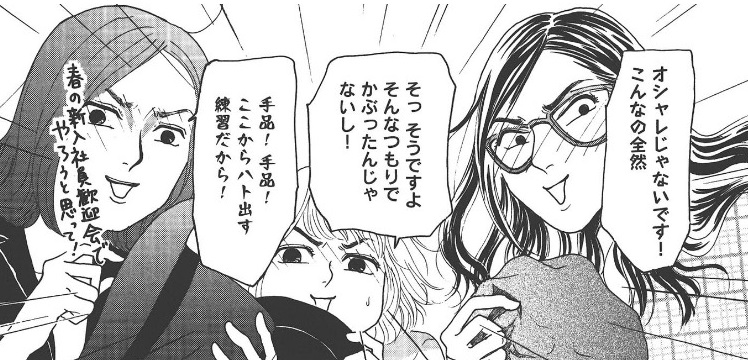
The three, who have the ghost of negativity living in the back of their minds, are embarrassed by the praise they receive and end up self-deprecating.
This is the negative mindset that nestles in the hearts of three people who have led lives far removed from girl power. Because they are not accustomed to being seen or praised by others, even though they have gone to the trouble of becoming beautiful as a result of their research, when they are praised, they turn to self-deprecation. When Kishine and Masuda, two of the nice girls in the general affairs section, appear on the scene, they are often dressed in a much higher level of perfection than they are, which sometimes makes him feel inferior compared to them. When they were asked to choose a perfume for the experiment in Vol. 3, Experiment 20, "Tell me it smells good," they could not choose a perfume because they thought it would smell like "grass" or "after a Buddhist memorial service" if they wore it.
Famous quotes, lines/scenes and scenes from "People Are 100 Percent".
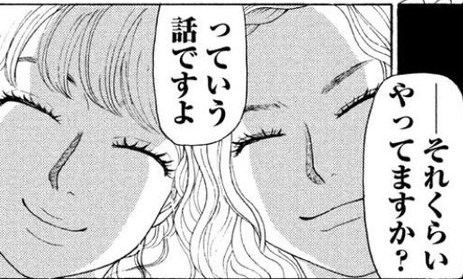
The girl from the General Affairs Department said, "Are you doing that much? That's what I'm talking about."
Source: pbs.twimg.com
Kishine (left) and Masuda (right), General Affairs Section girls, are always cute and fashionable. They smile even when they say harsh things, but their power is quite impressive.
In volume 2, experiment 10, "Hair Arrangement of the Tenkakekake! The three were researching trendy hair arrangements in the "Mere Old Man"; the three tried braiding, one of the popular arrangements, but gave up after not getting it right at all. In the end, they managed to complete a stylish arrangement using 100-yen goods. While the three were happy that their hair was cute enough, Masuda and Kishine from the General Affairs Section visited the laboratory to discuss their work. The two General Affairs Section members, who always enjoy dressing up and looking cute, had mastered the braided hair that the three had given up on, and Jounouchi and the others involuntarily meditated in the dazzling presence of these genuine fashionable girls.
Jounouchi boldly tried to learn the trick of braiding from the two from the General Affairs Section, but they replied that the trick of braiding is "getting used to it. In front of the two girls whose braided arrangements were so beautifully done, the three lab members, believing that there must be a reason other than "habituation," ask the girls if they have a dedicated stylist or a boyfriend who is good with his hands. The three girls' smiling faces gradually begin to wrinkle between the eyebrows of the usually smiling girls in the General Affairs Section.
Masuda and Kishine strongly and clearly state that the secret is "perseverance," and ask the three who are taken aback, "Aren't you just trying a little and saying, 'It's too hard, I can't do it'? He then asks the three puzzled participants, "Aren't you just trying a little and saying, 'It's hard, I can't do it,' and then throwing it away? Masuda and Kishine also had a time when they could not do braiding, and they had practiced repeatedly until they mastered it. Not only that, the girls revealed that they would sit in front of the mirror for an hour or two until they were satisfied with their work, researching everything from the right balance to the right styling products. When the three of them gave up before reaching that point, the two of them asked, "Do you do that much? They smiled and pressed on, saying, "Are you doing that well? Overwhelmed by this power, the three could only honestly admit their lack of effort.
The three were so overwhelmed by their power that they could only honestly admit their own lack of effort.
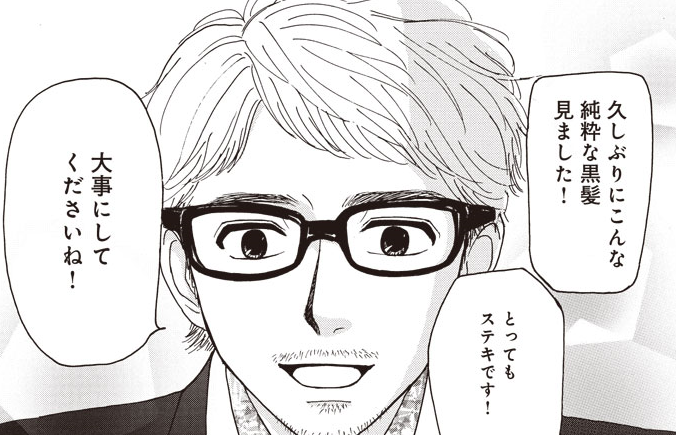
Inoue: "I haven't seen such pure black hair in a long time! It's very nice! Please take good care of it!"
Source: news.kodansha.co.jp
Inoue compliments Jounouchi's black hair, which has never been dyed, as beautiful.
When Jounouchi and Inoue first meet, Inoue compliments Jounouchi's hair. in volume 3, experiment 20, "Tell me I smell nice," Jounouchi attends his cousin Yuki's wedding and arrives at the after-party venue. Just then, he bumps into Inoue near the entrance of the venue. After apologizing to each other, Inoue asks Jounouchi if he has not dyed his hair, and Jounouchi is surprised at the sudden question. To Jounouchi, Inoue reveals that he is a hair stylist. Jounouchi is surprised and tries to run away, fearing that Inoue, who has never colored his hair, will make fun of him for his fashionable profession. However, Inoue compliments her on her "very beautiful black hair. Jounouchi stopped at the unexpected reaction, and Inoue said, "I haven't seen such pure black hair in a long time! It's very beautiful! Please take good care of it," he said with a smile.
Jounouchi, who had rarely experienced compliments from men before, was attracted to Inoue with these words and started going to his hair salon as a client.
After this, Jounouchi wrote down Inoue's words, "You have very beautiful black hair," on a piece of paper and kept it in her charm bag. Inoue's compliment became an important motivation for her to continue her beauty research.
Mochida: "Having someone clean you up is the most extraordinary and healing thing you can do.
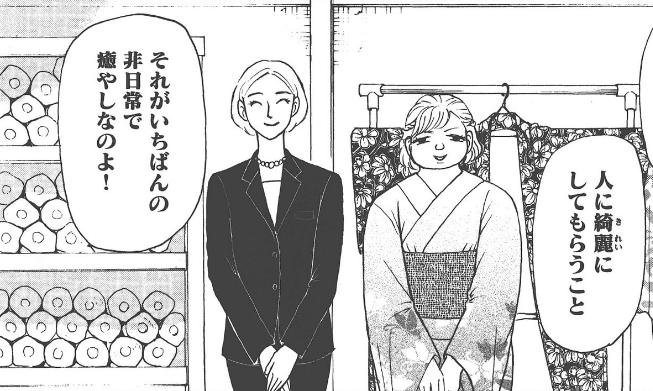
The fair-skinned Mochida (right) enjoys wearing kimonos. She becomes the savior of three people who were suffering from yukata troubles.
Mochida's words saved the three from having trouble with their yukata in Vol. 5 Experiment 37, "Your Yukata is 10000 Volts (Part 2). In Experiment 36, "Your Yukata is 10,000 Volts (Part 1)," the three spent two hours dressing themselves to go to a shrine festival. However, at the shrine they visit, they are overwhelmed by the cuteness of the other yukata girls. They are bumped by two men passing by in the crowd, and end up soiling their yukata with squid pancake sauce. They also see the men who bumped into them picking on the cute girls nearby without apologizing. The three of them are desperate because they have spent two hours dressing themselves, but their kimonos are falling apart and their feet hurt from the clogs.
Then Mochida appeared in front of the three in kimono and led them out of the shrine. Mochida had brought them to a yukata garden party being held at the hotel where his friend worked. The three were a little perplexed by the planners who made them wear yukata, but Mochida told them, "All you have to do is stand there. She went on to say that it was okay for them to ask others to give and spoil them, instead of thinking that they had to do it all on their own.
The three of them had worked hard to get dressed, and were impressed that the planners had even prepared geta for them, seeing their reddened feet, and had even fixed their hair and makeup. The three of them, now fully dressed in their beautiful yukata, felt comforted by the situation, which was not as painful as before. Seeing them in such a state, Mochida gave them a new insight: "To be made beautiful by others is the most extraordinary and healing thing.
After experiencing the joy of being made beautiful and the beauty of yukata, the three women, Mochida included, enjoyed a garden party at the hotel and spent a fulfilling evening.
The many failures that make us laugh.
Source: s.yimg.jp
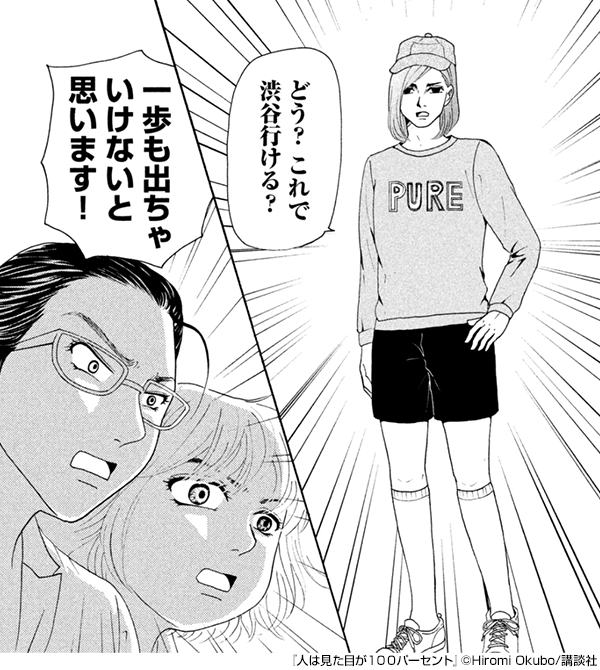
スウェットの研究の末、とても外に出られないコーディネートを身につけた前田(右)にツッコミを入れる城之内(左)と佐藤(中央)
The research of three people who are unfamiliar with the latest fashions is always accompanied by mistakes. In addition to the mistakes that beginners tend to make, such as using too much makeup or wearing the wrong clothes, there are also many mistakes that readers can't help but laugh at because of the comedic nature of the manga.
In volume 2, experiment 13, "On behalf of the rabbit, I'm going to punish you! In "Experiment 13," Jounouchi, who feels neglected by those around her because she works so quickly, studies how to apply makeup to give herself a rabbit's face. Jounouchi tries on pink cosmetics to give the impression that she cannot be left alone with her rabbit-like charm, but her male co-workers mistake her heavily-painted pink eyelids for conjunctivitis.
Maeda, who still draws on trends from his youth, studies how to wear stylish sweatshirts in Volume 1 Experiment 9, "Sweatshirt Equation," but ends up styling himself like an elementary school student. He asks Jounouchi and the others if he can go outside with it, but they butt in and say he mustn't even take a step.
Sato, who wants to get a boyfriend by doing easy research, is not happy with her research on umbrellas in Vol. 2, Experiment 11, "I, Sashimashin! in which she studies umbrellas, she witnesses a woman forgetting her umbrella and sharing an umbrella with a man. Imitating her boyfriend, she waited in the rain without an umbrella, hoping that someone would hold out an umbrella for her. However, even after waiting for a long time, no one lends her an umbrella, and finally it is not a young man but an old man who lends her an umbrella. Moreover, the umbrella he lent her was in tatters.
In the story, in some cases, their failures are just a passing phase, and in others, they end up doing well, and in still others, their failures become the punch line of the story. The many failures, which do not always go well, are great scenes that give a taste of the comedic aspect of this work.
The three are pleased with the results of their research.
Source: news.kodansha.co.jp
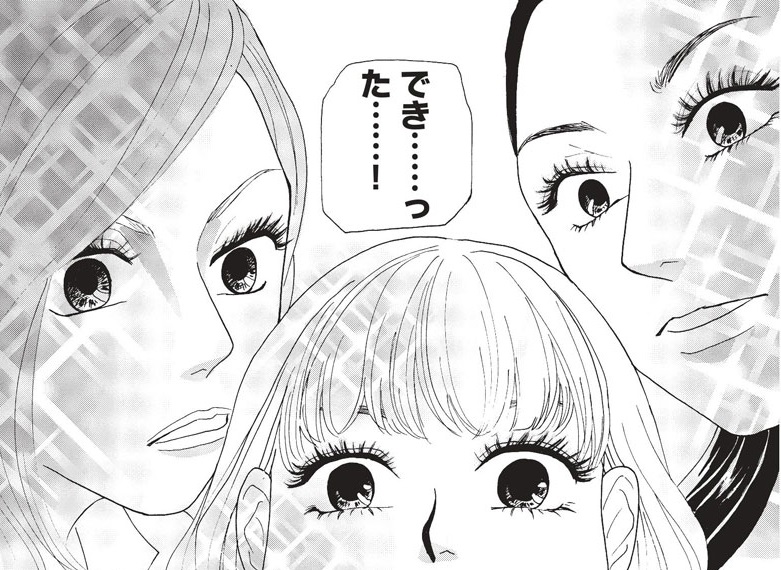
After much trial and error, the three succeed in conquering the false eyelashes and are surprised and pleased at the changes in themselves.
The three conduct research for each episode, but the road to success is long and tough because they do not know what the trends are. First, they try to wear the research subject at hand, but because they are beginners, they continue to fail. At times, they go out of their way to buy cosmetics and convenience goods they have obtained from the Internet, often going out of their way to buy them. The three of them spend a lot of time and effort, and through repeated failures, they gradually get the hang of it, and by the end of each episode, they manage to achieve success in their own way. The plain Jounouchi gets more glamorous, and the chubby Sato obtains a balance that makes the most of his physique. Maeda, who tends to be an anachronism, also manages to incorporate mature trends in a moderate way, and all three transform into lovely girls.
After achieving success, sometimes the story ends with the girls enjoying themselves as beautiful as they are, and other times they are embarrassed by the compliments they receive, and end up engaging in self-deprecation. Sometimes, despite their successful research, they revert back to the original three the next day. There is no end to the research of the three, who are not yet accustomed to maintaining their research results, but the transformation of the three through repeated trial and error is a great scene that readers can rejoice with them.
Backstories, trivia, and small stories/episodes and anecdotes from "People Are 100 Percent What They Seem.
Additional serialization of the original story due to the dramatization
Although this work is published in five volumes, it was originally finished in four volumes. After the series ended, it was decided to serialize additional volumes due to a drama adaptation, and the fifth volume was published. The author cites the fact that her manga artist friend Rokka Chiyot told her that she wanted to read a beauty manga as the reason for drawing this work. In the first volume, the author herself reveals that there was a time when she was so busy with housework, childcare, and work that she did not understand the trends in beauty and fashion.
Realizing that she was too busy to spend much energy on beauty, the author herself had the idea that "if I can read a manga and learn about beauty at the same time, I can kill two birds with one stone," which led to the creation of this work.

Tags
Contents
- Overview of "People Look 100 Percent.
- Synopsis and story of "People Look 100 Percent"
- Suteki Gyosha Kenkyu by Josimodoki
- Repeated trial and error
- Secrets of Sparkling Girls
- The turbulence caused by the desire to get married
- Jounouchi's anguish and faint love
- Laboratory swept up in Jounouchi's love affair
- What the three gained at the end of their research
- Argument and reconciliation among the three
- Realizations from the study
- Characters and characters in "People Look 100 Percent"
- Paper Company Laboratory
- Jun Jounouchi (played by Mirei Kiritani)
- Seira Sato (played by Chiemi Bruzon)
- Mitsuko Maeda (played by Asami Mizukawa)
- Paper Company People
- Kasumi Kishine / played by Rika Adachi
- Masuda
- Mochida.
- Dojima
- People outside the company
- yuki (var. of senbei)
- Inoue
- dramatic version
- Miyu Morimura (played by Sae Okazaki)
- Takuma Maruo / played by Keita Machida
- Motoki Misawa (played by Atsushi Tsutsumishita)
- Eiko Matsuura (played by Shigeru Muroi)
- Osamu Kunikida (played by Kosuke Suzuki)
- Keiichi Sakaki / played by Ryo Narita
- Kazuhito Okabe (Actor: Nobuki Nakao)
- Ryosuke Togawa (Motoki / played by Seiya Motoki)
- Terminology in "Hito ga hikake ga 100 percent
- Post-employment research
- JSM (Joshimodoki)
- negative ghost
- Famous quotes, lines/scenes and scenes from "People Are 100 Percent".
- The girl from the General Affairs Department said, "Are you doing that much? That's what I'm talking about."
- Inoue: "I haven't seen such pure black hair in a long time! It's very nice! Please take good care of it!"
- Mochida: "Having someone clean you up is the most extraordinary and healing thing you can do.
- The many failures that make us laugh.
- The three are pleased with the results of their research.
- Backstories, trivia, and small stories/episodes and anecdotes from "People Are 100 Percent What They Seem.
- Additional serialization of the original story due to the dramatization
- Viewer Opinion on Casting Appointments
- Kosuke Suzuki ad-libbed a lot.