
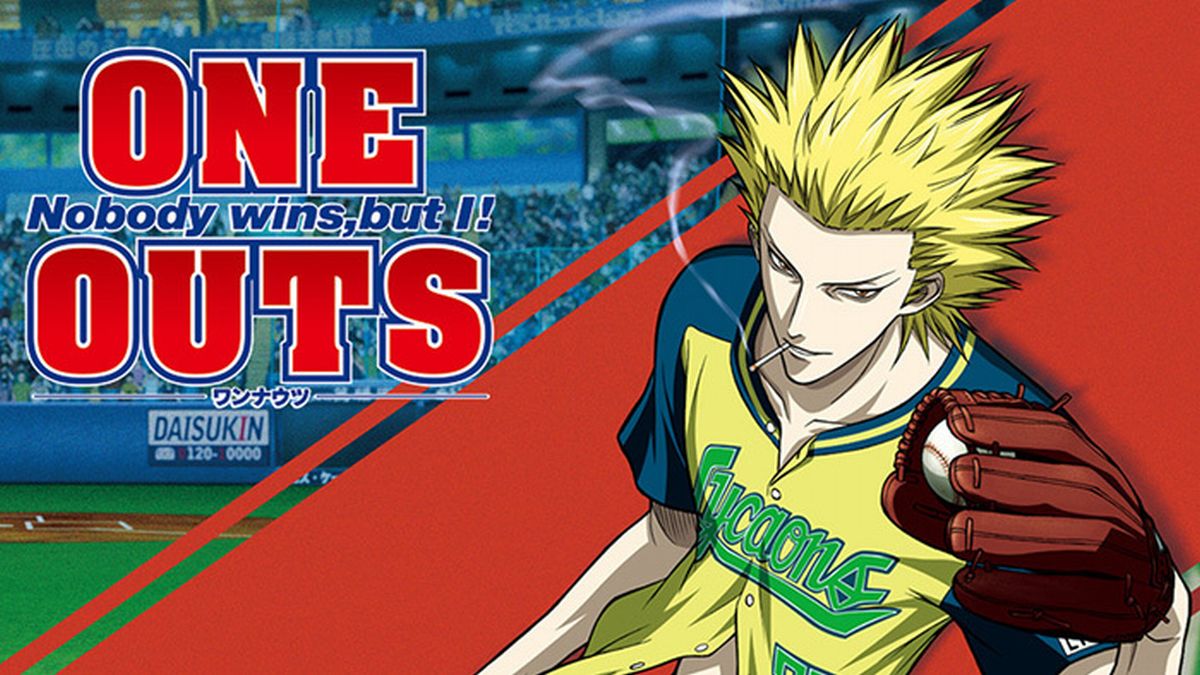
ONE OUTS" is a manga work by Shinobu Kaitani. It was serialized in Shueisha's "Business Jump" from 1998 to 2006. Even after its conclusion, the work still boasts strong popularity. In the story, Toa Watakuchi joins the team as the savior of the weak Lycaons baseball team, and he confronts the opponents and the owner by devising various plans and strategies to lead the team to the league championship. One of the charms of the work is that it depicts the aspects of elaborate and cunning "deception" and "mental games" in the royal road sport game of "baseball.
Famous quotes, lines/scenes and scenes from ONE OUTS
Toa Watakuchi: "The person who breaks the silverware buys the goldware and returns it. The president of a factory that emits a bad smell has a mansion right next to the chimney of the factory. That is taking responsibility.
While Imawano, the manager of the Mariners, is trying to claim that he has taken responsibility by simply bowing his head, even though he has caused great inconvenience to his team's pitchers and caused their performance to decline, Watakuchi explains what responsibility is: "A man who breaks a silver dish will buy a gold dish to return it. The president of a factory that stinks up the air has a mansion right next to the chimney of the factory. That's how you take responsibility," he told Imawano.
These words conveyed to us what it really means to take responsibility.
Tokuchi Toa: "To survive is to cross over the dead... it's not a beautiful thing, rather it's a cruel thing. If you still want to stand at the top, be a demon."
When Deguchi expressed his sympathy for the Mariners pitcher who was in shock after giving up the game-winning shot to Kojima, Tokuchi told him, "To survive is to cross the corpse...It's not a beautiful thing, but rather a cruel thing. If you still want to reach the top, be a demon.
These words show Tokuchi's attitude toward competition: "In the world of competition, I will use whatever I can use.
Tokuchi Toa: "Once it has passed, injustice It is no longer cheating or foul play, it is justice."
In order to warn the angry Lycaons members against the Bloomers' team-wide cheating, Tokuchi said, "Once it has gone through, it is no longer cheating or foul play, it is justice.
This line conveys the message that in order to truly confront injustice and cheating, one must be on the same playing field and outperform.
Toa Watakuchi: "When human beings make the most gap... it is when they are sure of victory."
When Johnson was out of the game due to a hidden ball, Bagaboos coach Jogaoka, who had been confident of winning until just before the game, said to him, "When a man makes the biggest gap... that's when he is confident of winning.
This line tells us that in the world of competition, one must never let one's guard down or feel secure.
Hiromichi Kojima: "The survival of a baseball team is not about the players staying, it's about the fans keeping their love for the Lycoming in their hearts.
When the team members were about to expel Watakuchi from the team after the contract with the Lycaons was revealed to them, Kojima said, "The survival of a baseball team is not about the players staying with the team, but about the fans keeping their love for the Lycaons in their hearts.
Kojima's statement is a great scene that should be seen by anyone who has ever faced the question of who they are fighting for and what they are trying to achieve their goals for.
Backstories, trivia, subplots/episodes, and anecdotes from ONE OUTS
Different one-nauts grades in manga and anime
The scene appears in the manga in volume 2, episode 11, and in the anime in episode 3.
When Ayakawa and Watakuchi, the owner of Lycaons, negotiate a contract, materials are prepared to convey past achievements, which Ayakawa looks over.
However, in the manga version, "one-nout 999 wins and one loss" is written in the achievements section, while in the anime version, "one-nout 499 wins and one loss" is written.
Author Shinobu Kaiya is the mentor of Eiichiro Oda of "ONE PIECE
Eiichiro Oda, the author of "One Piece," once worked as an assistant for about a month on the production of "Suiyama Police Gang," Kaiya's debut work in the series.
Oda was still a fledgling artist, but he showed many unprecedented aspects, such as refusing to serialize his work in "Monthly Shonen Jump". Seeing Oda like this, Kaitani felt that he would become a big name in the future.
When Kaitani and Oda had a "special master-disciple talk" in 2009, Kaitani said that he felt Oda was "just like Luffy" from their first meeting.
Theme song and insert song for ONE OUTS
OP (Opening): Pay money To my Pain "Bury
The opening theme for this film was performed by the Japanese rock band Pay money To my Pain, nicknamed "PTP," and is a beautiful song with vocalist K's soft voice and a melody that evokes a sense of sadness.
ED (Ending): TRIBAL CHAIR "Moment
The Japanese rock band TRIBAL CHAIR performed the ending theme for this film, and the song conveys a sense of melancholy that overflows from the slow rhythm.

Related Articles
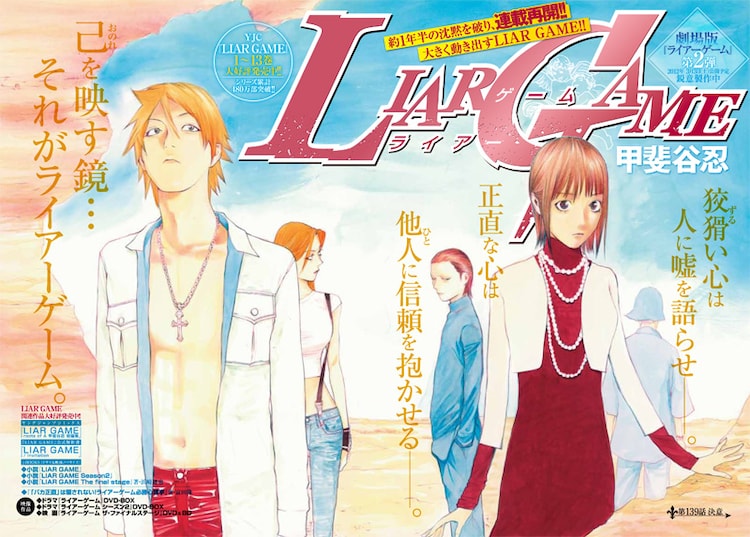
LIAR GAME Spoiler Commentary and Discussion Summary
LIAR GAME" is a suspense manga serialized in "Weekly Young Jump" by Shinobu Kaitani since 2005, and a TV drama based on it. The story is about a college student, Nao Kanzaki, who is called "Nao the Foolish and Honest," who gets involved in a game called "LIAR GAME," in which she and a genius con artist, Shinichi Akiyama, fight against each other for a huge sum of money. The series was dramatized on Fuji TV in April 2007, with season 2 airing in November 2009.
Read Article
Seven Gambler Manga
"I learned to play mahjong from this manga. "I got a glimpse of the depth of the gambling world. I have compiled a list of manga that could be a bible for those who want to start gambling.
Read Article
Contents
- Outline of "ONE OUTS
- Synopsis and story of ONE OUTS
- Okinawa, Wanouto Edition
- One Nautical Contract Edition
- Contracts and VS Owner Opening Edition
- VS Mariners
- VS Bagaboos
- VS Blue Mars
- New One-Nauth Contract Edition
- Rebuilding the baseball team - championship edition
- All-Star Edition
- Characters in ONE OUTS
- Lycaons players
- Tokuchi Toa
- Hiromichi Kojima
- Satoshi Ideguchi
- Hajime Kurai
- John Mulwaka
- Genzo Sugadaira
- Recallons' Management and Supervisory Team
- Tsuneo Saikawa
- Mitsuo Oikawa
- Yuzaburo Mihara
- Chiba Mariners
- Takami Itsuki
- Brooklyn
- Thomas.
- Nobumitsu Kira
- Yoshiro Imawano
- Osaka Bagaboos
- Dennis Johnson
- Katsuro Shirooka
- Kobe Bloomers
- Pedro Rodrigo
- Scott Williams
- Tetsuharu Tendo
- Takashi Shirooka
- fingers
- Junichi Kawanaka
- Taiyo Amami
- Go Kitaoji
- Yuichi Nishina
- Eagles.
- Shinji Mizuhashi
- Hitoshi Yoshida
- Other
- Big Mama
- Kaname Mitamura
- Tsuneyuki Tanabe
- Takanawa
- Terms for ONE OUTS
- Betting Baseball "One-Nouthing"
- one-now-two agreement
- Famous quotes, lines/scenes and scenes from ONE OUTS
- Toa Watakuchi: "The person who breaks the silverware buys the goldware and returns it. The president of a factory that emits a bad smell has a mansion right next to the chimney of the factory. That is taking responsibility.
- Tokuchi Toa: "To survive is to cross over the dead... it's not a beautiful thing, rather it's a cruel thing. If you still want to stand at the top, be a demon."
- Tokuchi Toa: "Once it has passed, injustice It is no longer cheating or foul play, it is justice."
- Toa Watakuchi: "When human beings make the most gap... it is when they are sure of victory."
- Hiromichi Kojima: "The survival of a baseball team is not about the players staying, it's about the fans keeping their love for the Lycoming in their hearts.
- Backstories, trivia, subplots/episodes, and anecdotes from ONE OUTS
- Different one-nauts grades in manga and anime
- Author Shinobu Kaiya is the mentor of Eiichiro Oda of "ONE PIECE
- Theme song and insert song for ONE OUTS
- OP (Opening): Pay money To my Pain "Bury
- ED (Ending): TRIBAL CHAIR "Moment