
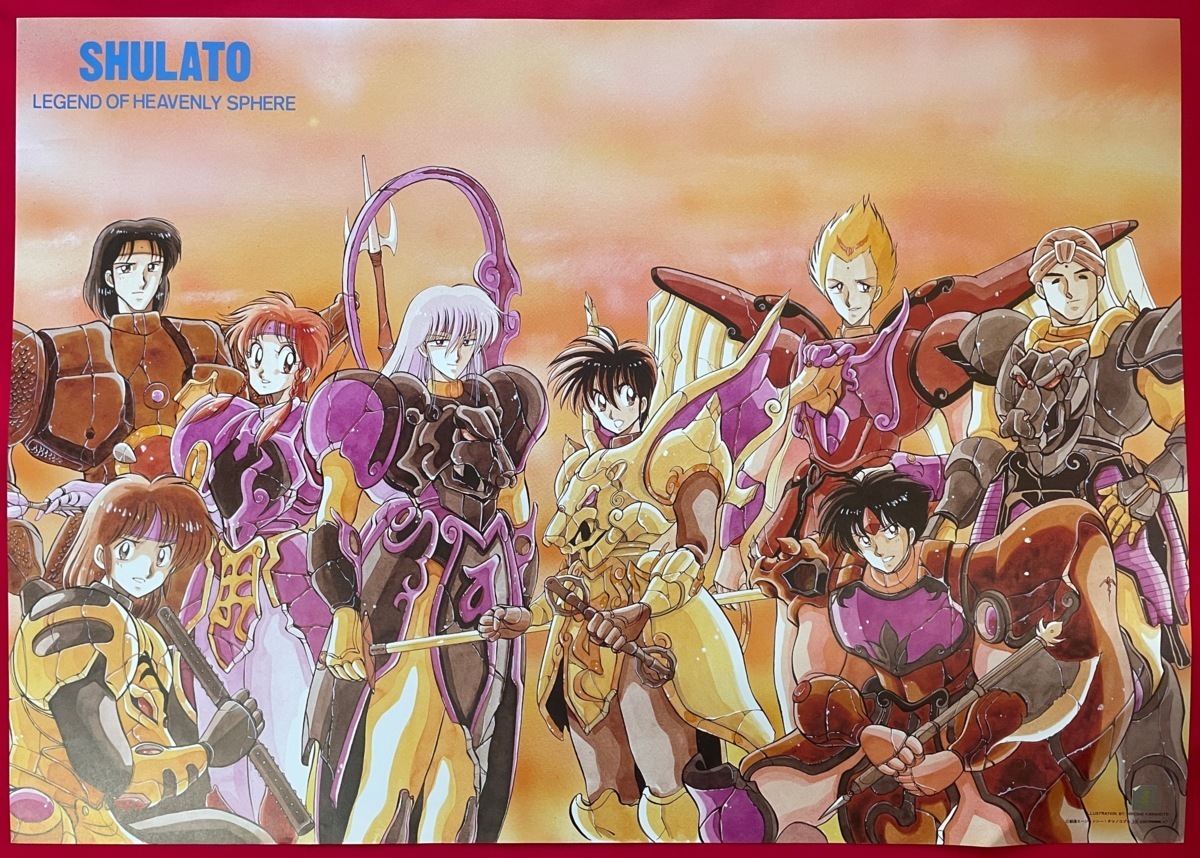
Tenku Senki Shurat" is a fantasy anime based on Indian mythology produced by Tatsunoko Productions and broadcast from April 1989 to January 1990. Set in the "Tenkukai," an alternate world similar to Indian mythology, the story is about a boy named Shurat, Akia Hidaka, who is the reincarnation of Shura-O, one of the "Hachibushu," a warrior group that protects the Tenkukai, and is summoned to the Tenkukai to get involved in a conspiracy that is brewing in the background. This is one of the "Armor" series, in which beautiful boy characters wear armor and fight, influenced by the manga "Saint Seiya".
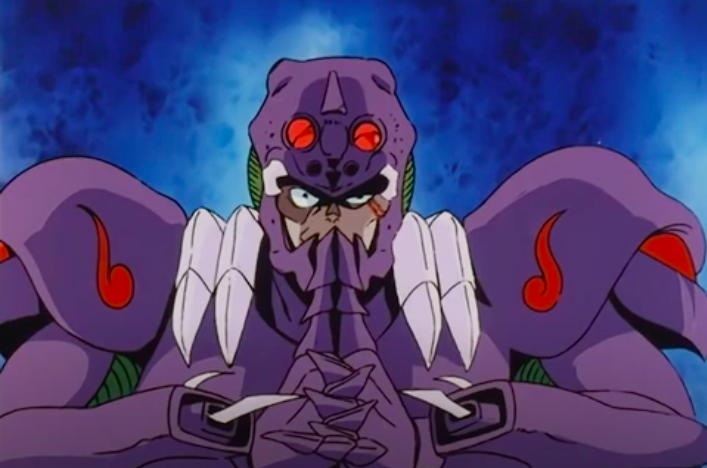
CV: Shin Aomori
Belongs to one of the "Sixteen Great Guard", an artillery unit of the Deva God Army, and belongs to the Four Beast Emissaries.
Appears in episode 5. Under the order of Indra, he becomes Gai's direct subordinate and sets out to eliminate Shurat.
He is a brutal character, and has slaughtered many celestial beings in the secret stone chamber in the basement of the Sky Hall.
He wears divine armor with a spider motif. He manipulates spider threads and uses quick coordinated attacks by five other spiders of the same shape to taunt and hunt down his opponents. As the name "Puppet Master" suggests, the other four are puppets. The puppet itself returns to normal instantly after being destroyed, but if the main body is damaged, even the puppet is affected. The puppet also has a special move called "Kali Heat Death Wave," in which soma is poured into the spider's threads and burns the opponent to death. He hunts down Shurat, but is defeated by Shurat, who is aided by Reiga.
Dhara & Mhura (Kumaraten)

Moolah is on the left and Darla is on the right.
CV: Nobuyuki Furuta (Dara) / Takumi Yamazaki (Moola)
Appearing in episode 6, these two are a rare pair of "Hatomaraten," or divine generals. Dhara is a large man with an appearance reminiscent of a wild beast, while Moola is a small, elderly man with a shabby appearance.
Under orders from Guy, they set out to eliminate Shurat and his men under Renge's command. He showed his overwhelming power against the four Shurat and his men, and although he was able to corner them, he was ultimately defeated by a coordinated attack by Shurat and Hyuga.
He wears divine armor based on the motif of a hundred pairs of legs. Dara wears the main body of the 100-footer, and Moola wears the tail of the 100-footer.
Hato-maraten is derived from the name of Skanda, the war god in Indian mythology, who took refuge in Buddhism.
Marishiten Marici
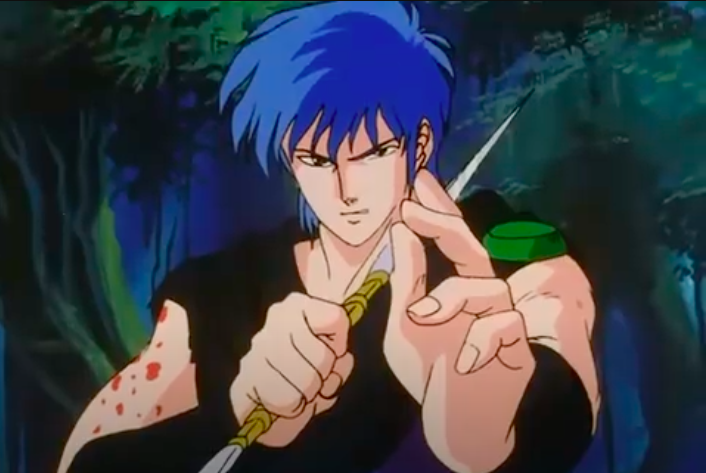
CV: Yasunori Matsumoto
Belongs to the "Twelve Heavenly Saints," a defense force of the Deva God Army. He is a blue-haired young man.
He has a grinning, slightly oblique personality. He is a childhood friend of Hyuga's, and he and Hyuga are brothers-in-law. He had feelings for Renge, but his heart breaks when he learns that she has chosen to become a warrior and that she is in love with Indra. He is worried about Hyuga, who is now being chased from the sky world, and is looking for him. She enters the scene of the battle between Shurat and Renge and uses her illusions to rescue Shurat and his friends. He describes Shurat as "just like the old Hyuga.
He had been infected with the red spot and had very little time left to live. He fought Renge with his last strength and eventually defeated her, but she took care of him and he passed away.
He wears black divine armor with a black panther motif. He is a master of magic and is known as the "Warrior of the Sunflame. His weapon of choice is a dokkosho.
Marishiten is derived from a goddess in Indian mythology, who is a goddess of the sun and flames. In Japan, she is worshipped as the guardian deity of samurai. The name Marici also means "shimmering flame" in Sanskrit.
Rasetsu Ten (Rasetsu Ten) Niri Hari
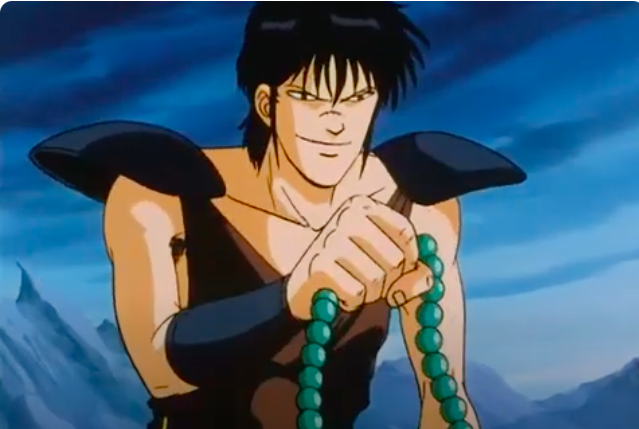
CV: Hideyuki Umezu
Belongs to the "Twelve Heavenly Saints," a defense force of the Deva God Army. He is the captain of the defense force of Tenkuden.
Appears in episode 8. He is a despicable character who will stop at nothing to save his own skin, and believes that there is no right or wrong in this world, but only the one who wins. He is also skilled at using his own tricks, and has been harshly criticized by Leyga for being "good at nothing but getting in other people's business. He and Reiga have a history and do not get along well. Not only Reiga, but also Kuuya and Dan do not think well of him. He knows that Indra is the one who petrified Vishnu, but out of self-defense, he takes Indra's side.
On Indra's orders, he stands in front of Shrath and the others, divides the group, and takes Laksh hostage. Using illusionary techniques, he torments Shurat with visions of Ngai and Reiga with visions of Vishnu. However, he is ultimately defeated and extinguished by the fury of the two men.
He wears gray divine armor. His weapon is a bead.
The origin of Rajaten is the demon god Rakshasa, a devotee of Buddhism who protects the southwest.
Gentei Mitra
Appears only in the novelized version.
He is one of the Twelve Rajasthan Emperors. He is a legendary military strategist who led the Devas to victory in a battle 10,000 years ago.
After the battle 10,000 years ago, he went into a long sleep, but was awakened by Mayuri's call. He supports Shurat and his men in the shadows. He is a master of magic, and is capable of holding his own with Indra.
Vritra, the water emperor
Appears only in the novelized version.
He is one of the Twelve Rajas. He was the commander-in-chief of the Deva army during the great war 10,000 years ago.
His name, Vritra, comes from the giant serpent monster that appears in the Indian mythology of the Rig Veda.
Mukitei (Mutei) Mechira
Appears only in name in the novelized version.
One of the Twelve Rajas, he was a general in the Deva army 10,000 years ago.
Great General Myoo (Taegen Myoo-oh) Athabhaka
Appears only in the novelized version. He is the second-ranked senior general of the Deva God Army, and leads 120,000 troops of the Kinki Heavy God Army.
He looks like a stern old man. He has served Vishnu for many years.
The origin of Daishonin Myoo is Daishonin Myoo, the Great General, who leads the Four Heavenly Kings and the Eight Divisions.
Zocho Tensho, Virudhaka
Appears only in the novelized version.
He is one of the "Four Heavenly Kings," four generals in the Deva God Army. He is in charge of the Southern Army of the Deva Gods.
In the novelized version, he is ordered to intercept Shurat and his group on their way to the sky tree, and he mobilizes the entire southern army of 200,000 men to stand in front of Shurat and his group. He uses a tactic that relies on numbers, but is defeated. Later, Ryoma's attitude and Guy's heinous remarks cause him to have doubts about Indra.
General Zocho-ten originates from Zocho-ten, one of the Four Heavenly Kings and the god who protects the southern part of the country.
Right Tian Wang Paju
He is supposed to be a close associate of Vishnu, but in the novelized version, he appears as a close associate of Indra.
In the novelized version, he is a pawn in Indra's game and has renounced all emotions through training. He stands in front of Shurat and his friends together with Indra.
He wears divine armor based on the motif of a winged bird.
Left Tenno Pani

Tags
Contents
- Overview of "Shurat the Sky Warrior
- The story of "Shurat the Sky Warrior
- Shura King Awakening
- the eight legions (devas, nagas, yaksas, gandharvas, asuras, kimnaras, mahoragas
- Battle of the Sky Hall
- The God of Destruction is back!
- Meaning of the battle
- Characters from "Shurat the Sky Warrior
- key people
- Shurat Hidaka / Shurat Shurao
- Guy Kuroki, Guy Insulator
- laksh
- Warriors of the Eight Divisions
- Karurao Leiga
- Tennou (Heavenly King) Huga
- Ryoma the Dragon King
- Nala-oh (Nala-oh) Renge
- Hiba-Ou Dan.
- King Gandharva (Dapa-Ou) Kuya
- the eight hereditary titles (designated by Empe
- Residents of the sky world
- Vishnu, the God of Harmony
- Raitei Indra
- me
- SATY.
- An old man in the village of Sati
- levy
- Kuya's brother
- minced beef
- naga
- agree
- Arabian jasmine (Jasminum sambac)
- Seishiten (Seishiten) Parvati
- Warriors of the Sky World
- Saras, Benzaiten (Benzaiten)
- Uususama myoou, Mayuri
- Hokumenshi Takushaka
- Nanreishi Lamban
- Kali the puppet player
- Dhara & Mhura (Kumaraten)
- Marishiten Marici
- Rasetsu Ten (Rasetsu Ten) Niri Hari
- Gentei Mitra
- Vritra, the water emperor
- Mukitei (Mutei) Mechira
- Great General Myoo (Taegen Myoo-oh) Athabhaka
- Zocho Tensho, Virudhaka
- Right Tian Wang Paju
- Left Tenno Pani
- Asra's army of gods
- Shiva, God of Destruction (Hakaishin)
- Fudo Myoo (Acalanata)
- Tri-Law of the Three Descending Kings
- Kundalini, Kundali Myoo
- Mei Tei (Mei Tei) Bikara
- Japanese Imperialists (Nichitai) Antera
- Moon Emperor (Gektei) Santera
- Fire Emperor Kubira
- Haila, the earth emperor
- Fuu-tei (Wind Emperor) Basara
- Other Gods
- Brahma, the Creator God
- Harmonious God (Chowashin) Scrimmages
- Key Personnel Involved
- Yutaro Hidaka
- father of Shurat
- Kiriko Hidaka
- Yumiko Hidaka
- Mina Kuroki
- Chinese Kempo Master
- Terms for "Shurat the Sky Warrior
- Related to Hachibu
- Hachibu Shu
- Divine Armor (Shakti)
- Protection (Vedic)
- Varda.
- mandala formation
- Mandala formation for the king of beasts
- Mandala formation in the sky
- Shifu Mandara-jin
- Houjyu Mandara-jin
- Wisdom mandala formation
- Vajra mandala formation
- Hachibusyu-Sanrenkou
- Sky Realm Related
- The Sky Realm
- Sky Tree
- Genbuden
- Seiryuden
- Byakkoden (White Tiger Hall)
- Suzaku-den (Suzaku Hall)
- Tenkuden
- Moonlight Cave
- Mount Horai
- Soma Fountain
- Devas
- Deva Divine Army
- divine generals
- amrita
- Thermal calendar
- Koryu (Soma)
- Black Soma
- Lost water
- Erythrocystic Plaque
- Phantom Dreams
- eight great wisdom kings (Acala, Hachidaimyoo, Hachidaimyoo, Hachidaimyoo, Hachidaimyoo)
- Twelve Heavenly Saints
- Sixteen Great Protectorate (16th Great Protectorate)
- The Four Heavenly Kings
- The Twelve Rajasthan Emperors
- Related to Asra's Divine Army
- Transfer Palace
- The Devil's General
- Three Beastly Fangs (Juga Sanninshu)
- Myouou Gakushin (Myououou Gakushin)
- Mt. Shumisen (Mt. Sumeru)
- Divine Armor of Brahma, the Creator God
- Famous quotes, lines, scenes, and scenes from "Shurat the Sky Warrior
- Tragic love warrior, Narao Renge
- The miracle of friendship between Shurat and Guy.
- Hidaka Akitaka / Shurao Shurat: "We're not that abandoned. Neither are we."
- Backstory, Trivia, and Small Stories/Episodes/Anecdotes of "Shurat the Sky Warrior
- The problem of collapsed drawings, which cannot be left out when discussing the work
- The voice cast as Shurat Laksh Leyga, who also co-starred in the Tatsunoko film "Red Light Bullet Girion".
- CLAMP, a group of manga artists who have worked on the doujinshi and illustrations for this work
- Theme song and insert song for "Shurat the Sky Warrior
- OP (Opening): "SHINING SOUL" by Sakitoko Shimizu (Episodes 1 - 26)
- OP (Opening): "Truth" by Sakitoko Shimizu (Episodes 27 - 40)
- ED (Ending): Sakitoko Shimizu "Suna no Maze" (Episodes 1 - 26)
- ED (Ending): "Caravan Friendship" by Sakitoko Shimizu (Episodes 27 - 40)
- Insert Song: "SET THE FIRE" by Sakitoko Shimizu
- Insert song: Shinichi Ishihara "On Sula Sowaka