
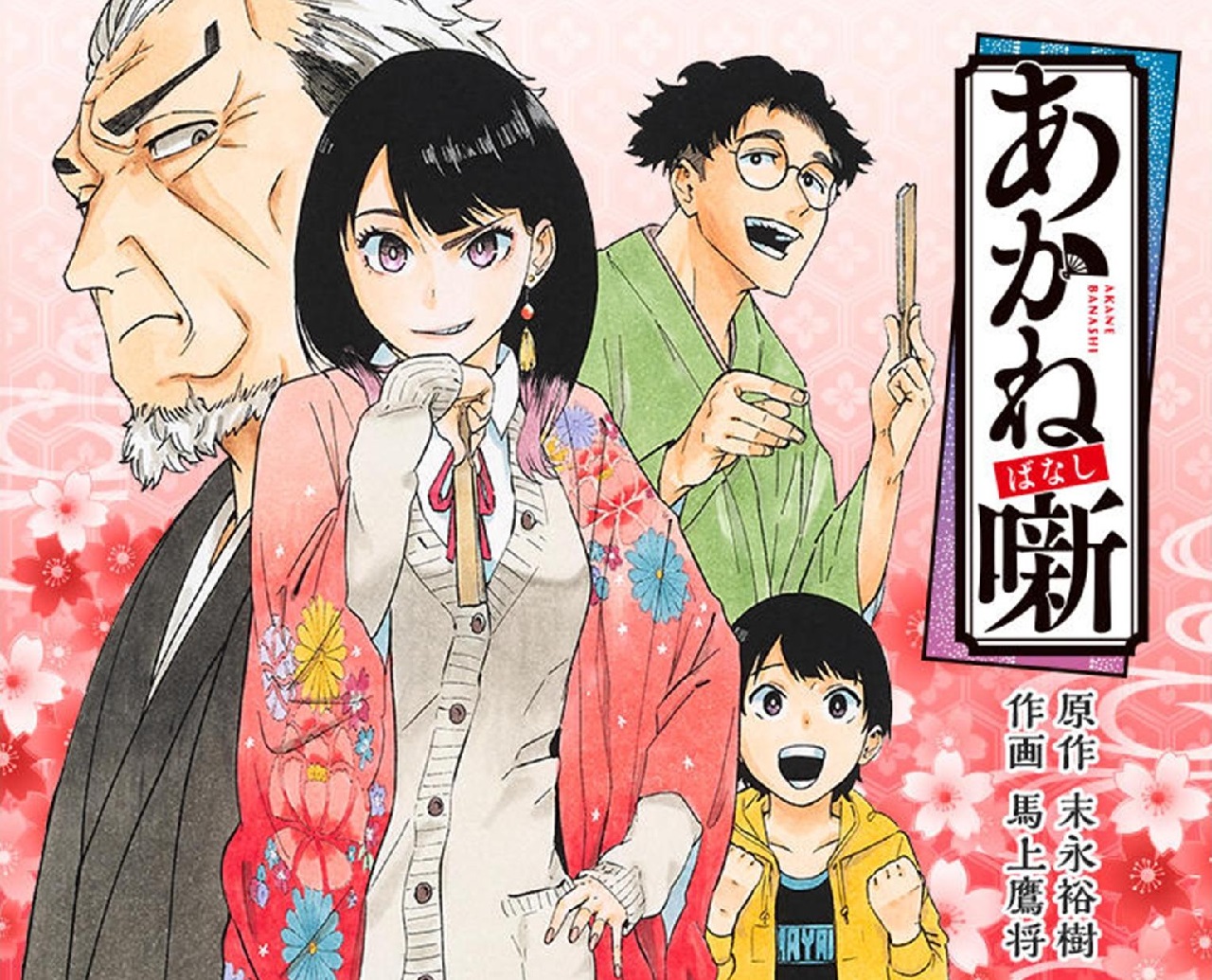
Akane Banashi" is a manga work written by Hiroki Suenaga and drawn by Takamasa Umagami that depicts the struggle and growth of a high school girl who aims to become a rakugo storyteller in place of her excommunicated father.
Akeon Sakurazaki, the daughter of rakugo storyteller Toru Sakurazaki, aka Shinta Araragawa, loves her father's rakugo. However, her father has been unable to become a professional rakugo performer for 13 years, and is finally excommunicated by the head of the school, Araragawa Issei. Akeon, unable to accept the situation, decides to make his father's rakugo recognized by the world and becomes an apprentice to Araragawa Shiguma, the number two in the Araragawa clan. Akebono's days of training begin, as she takes on a master who has both one and two different tastes.
Outline of "Akane Banashi
Akanebana" is a manga work written by Hiroki Suenaga and drawn by Takamasa Umagami that depicts the struggle and growth of a high school girl who aspires to become a rakugo storyteller in place of her father, who has been excommunicated.
The manga, written by Hiroki Suenaga and drawn by Takamasa Umaue, is based on the comic story of rakugo, a genre not often associated with young people, and features a female protagonist, but it has attracted attention for its detailed story and fascinating characters. Shueisha responded to the strong response by releasing a voice comic only four months after the serialization began.
Akane Ourasaki, daughter of Toru Ourasaki, aka Shinta Arakawa, a rakugo storyteller, loved her father's rakugo. However, after 13 years of failing to become a professional rakugo performer, her father was finally excommunicated by Issei Arakawa, the head of the rakugo troupe.
Unconvinced, Akemi decides to make her father's charm of rakugo known to the world, and joins the number two in the Araragawa clan, Arakawa Shiguma, as his apprentice. Akebono takes on the stage name "Arakawa Akane," and begins her apprenticeship with a master rakugo performer who has both one and two different styles of rakugo.
Synopsis and story of "Akane Banashi
Father's Excommunication
朱音は落語の世界に足を踏み入れる。
Akane Ousaki, an elementary school student, loves rakugo (comic storytelling) performed by her father, Toru Ousaki, also known as Shinta Arakawa, a rakugo storyteller. However, after thirteen years of failing to become a professional rakugo storyteller, his father was finally excommunicated by the head of the rakugo school, Issei Arakawa.
In despair, Toru gave up his career as a rakugo performer and took a job as an ordinary rakugo performer. However, Akane is not convinced by this, and is outraged, saying, "My father's rakugo was really interesting, so why should I be excommunicated?" Finally, she applies to become an apprentice to Arakawa Shiguma, the number two in the Arakawa clan.
Six years later, when Akemi, now a high school student, again asks Shiguma to become her apprentice, he orders her to "perform a rakugo act at a rakugo coffee shop. He ordered Akemi to perform at a rakugo coffee shop, where she would be exposed to the professional world of rakugo and see if she could demonstrate her ability in that environment.
Akemi responded in kind, performing rakugo to the amazement of Shiguma's disciples. Shiguma, upon hearing this, recognizes that Akane's determination and strength are genuine, and officially takes her on as his apprentice.
Being an apprentice to a rakugo storyteller
However, the world of rakugo is not as easy as it seems, and Akemi encounters many difficulties. Sometimes she bounces back helplessly, and sometimes she overcomes them with the help of those who have high expectations of her, and little by little Akebono grows as a rakugo performer.
Her efforts gradually bear fruit, and people begin to recognize and pay attention to Akane's abilities within the rakugo world, including her siblings such as Guriko Arakawa and her lifelong disciple Kaisei Arakawa. Not only in a good sense, but also in a vicious sense of jealousy and "let's beat up a prominent newcomer," which sometimes tormented Akane and became a new source of growth for her.
Cup of Covetousness
When Akemi learns that a rakugo competition for students, the "Karaku Cup," is to be held, she decides to participate when she finds out that the judge is Araragawa Issei, the man who excommunicated her father. The purpose was to obtain the right to have a "direct interview with Issei," which is given to the winner.
At the competition, Akane faces powerful rivals such as Nerimaya Karashi, who has won the competition two years in a row, and popular female voice actor Hikaru Kouragi. Each of them draws the audience in with their inventive storytelling and acting skills, while Akebono competes with them on pure "rakugo skill. Despite a rebuke from Issei, who says, "What is a professional doing in a student competition?
During a face-to-face meeting with Issei, Akane asks him why he excommunicated his father. When Issei finds out that Akane is Toru's daughter, he does not run away or hide the fact that she is Toru's daughter, but instead says that it was because she was immature. Issei is seeking the "perfect performance" in order to preserve the culture of rakugo that he and his family have inherited for years to come. Toru, who had a temperamental temperament, often made mistakes because of his skill, and Issei could not forgive him for this.
Akebono said, "I understand your point," and while acknowledging that Issei had a point, he also assured her that her father's rakugo was not wrong, and declared that he would become a true professional in order to prove it. Issei then laughingly tells Akebono that his goal is to have young people like you inherit the future of rakugo, and tells him to give it a try. When Karashi and Hikaru realize that the reason Issei reprimanded Akeon was because he judged that their rakugo was nothing more than a "student's game," they use their frustration as a springboard to become full-fledged rakugo performers.
Names of female rakugo storytellers
When she learned the reason for her father's excommunication, Akane renewed her determination to avenge her father's death, but she was confronted with the fact that she had only been a rakugo performer for a short time and had a limited repertoire of stories to tell. Akebono, with Shiguma's permission, follows her acquaintances and learns a story called "Chakumi" from Urara Ransaika, the number one female rakugo storyteller in Japan.
Urara's goal is to become the first female rakugo performer, and she lends her help to Akebono because she thinks it may be useful for her to achieve this goal. Akemi is impressed by Urara's attempt to break into the rakugo world, which has long been a male-dominated society, from a woman's standpoint, and at the same time, she thinks that she would like to have such a dream as well.
training session for the first round of training
A zenza renseikai was held to gather and examine the maeza of the Arakawa clan. This was an examination to ensure that those who had taken the first steps as rakugo storytellers were not slacking off, and it was also the place where promotion to the second rank was on the line.
Akemi was told by her brother, Maikeru Arakawa, that "if you want to go on from here, you need to understand what you are good at and what your strengths are in your art," so she learned new stories in preparation for the training session. From the several stories proposed by Maiku, Akane chose "the story that Toru performed when he won the training session.
The story called "Kaitarime" was a story without cool characters or stylish developments, and was not suited to Akane's artistic style. Nevertheless, Akeon learned it in order to have her father's art recognized as valuable, and she soon realized that her father's art was "weak. This was the exact opposite of her own temperament and her life-long beliefs, but Akebono realized that rakugo is a sublimation of ordinary people's lives into an art form and does not necessarily have to be "strong," and she began to realize a "weakness" in herself that she had never had before. He also began to incorporate his own "weakness" that he had never had before.
At the training session, the young rakugo storytellers who took on the challenge each perform dynamically, and as a result, Hikaru wins the competition. However, Hikaru said, "There were many parts of my performance that I lost in spite of the overall evaluation. I don't feel like I won very much," and declares to her that he will further hone his skills and one day win completely over Akane. Akane greeted him with a smile, but when she was alone, she expressed her regret, saying, "I wanted to win with my father's art.
Friction in the Araragawa clan
Although Akane was highly acclaimed at the pre-show training session, his promotion to nitsume (second highest rank) was postponed due to his short career as a rakugo performer. One of the judges, Gakumon, paid attention to Akeon's rakugo and said something to the effect of "If the Shiguma clan does not carry the mikoshi, I will carry it myself.
Akane was overjoyed at the news that Konjakutei Asagao, whom she had taken under her wing when she was just starting out, had been promoted to the second rank, along with Karashi, who had become a disciple of Sanmeitei Enso, a great rakugo master. Akeon, who is also aiming for promotion to the second rank, plans to get a recommendation from Taizen Arakawa, a member of the Four Heavenly Kings of Arakawa, and asks him to introduce her to Konjakutei Chocho, an acquaintance of Taizen's who is also a member of Asagao's troupe.
Choucho is a rakugo storyteller who has risen to the top of the bill as the youngest rakugo performer. Taizen demands, "If you want a recommendation, you must perform a suitable rakugo at Asagao's debut performance. Akebono is encouraged to practice hard, but Taizen's own teacher, Zenjo Arakawa, nails him down and tells him not to give his recommendation to Akane, who is "someone else's apprentice.
While training Akane and Karashi, Chocho visited Shiguma and asked him about "the art of the previous Shiguma," which was the reason behind Toru's excommunication. Still unhappy about the excommunication of his colleague and friend Toru, Choucho is also aware that Taizen's teacher is showing signs of disquiet, and declares that he too will show no mercy to his friend's kids if they try to pull tricks on him.
Asagao's Nitsume Unveiling Show
Since the excommunication of Toru and his colleagues, a deep rift had developed between the Araragawa clan and the Rakugo Federation, an organization of rakugo storytellers in Tokyo. Asagao's debut performance as a second performer will be the occasion for the upper echelons of the two organizations to meet, and those involved in the event are both nervous and hopeful that some sort of upheaval is inevitable.
Taizen, who inwardly acknowledges Akane's growth but cannot bring disgrace to Zensho's face, is unable to be loyal to either of them and decides to "not participate in the Nitsu-no-Utsume Showcase". However, Toru appears and tells him, "When you are in trouble, it is best to laugh," and takes him to the Nitsu-no-kai show.
Relieved that his father has brought Taizen with him, Akeon, who is now on stage, performs a story called "Raccoon Sai," which he learned from Choucho. This story, which suits Akebono's temperament, gets the audience excited, but Akebono gets carried away and introduces a series of topics that are not part of the main plot, and the show runs out of time. However, when Toru sneezes in the audience, Akeon comes to his senses and hurries to end the story. Taizen, seeing Akane's progress, says, "There was no need to be worried. Let me be free to make my own judgments, just like my free-spirited master," he decided. Zensei was furious, but Shiguma, who appeared at the scene, nailed him to the wall and left, pretending to be unperturbed. However, inside his heart, he was filled with hatred toward Akane, Taizen, and Shiguma.
Thus, Asagao's second debut performance ended without incident. Akane attended the launch and had a father-son conversation with Toru for the first time in a long time, and was pleased to see his growth as a rakugo performer. After that, Akane returned to Shiguma, her teacher, and was told the surprising news that her brother Maikaeru was going to challenge for the Shin-uchi promotion examination.
Maikeru's promotion examination
Maikeru's promotion examination for Shin-uchi begins. In front of Akane and his younger apprentices, who are worried about him, Maikeru appears calm and composed, and he goes up on the stage with his usual easygoing attitude and moderate tension. On the other hand, Zensei says, "We will never approve of such a style of rakugo that panders to the audience. His failure is more obvious than the audience's." He was planning to enjoy watching Mairu, with whom he has a history, fail the exam. While the air in the hall was tightly held by Zensei, Maikeru finally went up to the stage.
Maireru and Zensei have similar styles as rakugo storytellers, which is why Zensei chuckles, "I know exactly what you need me to do. Still, Mairekeru does not give up, and he continues to try to "move" the chilly audience with his "humanistic stories" rather than "make" them laugh. This is Maikeru's true vocation, and the skill he has trained to avenge the death of Toru, who was once excommunicated. Because of the coldness of the situation, Maikeru's human-interest storytelling wins the hearts of the audience and is applauded by them.
Zensei, who was upset that he had misjudged Maikeru and that he was not the same type of person, was also moved to tears by Maikeru's performance. Issei dismisses Mairuke's performance as "not bad, but not perfect." But when Issei, Zensei, and Taizen declare their approval of Mairuke's performance, Mairuke is promoted to shin-uchi (head professional).
Akane and her friends are very happy to see their brother promoted to the rank of maieru, while Zensei leaves with a resentful remark to maieru, "I have recognized your art, but don't think this is the end of it. Mairekeru, on the other hand, expresses his deep gratitude to Toru, saying, "It is thanks to you that I have improved my human-interest speech.
志ぐまの芸
まいけるが真打試験に合格する一方で、あかねも二ツ目に昇進。そのために必要な道具や新しい着物の容易に奔走しつつ、師である志ぐまの前座として二ツ目の初高座を迎える。「父の仇討ち」のつもりで落語の世界に入ったあかねは、自分に落語を楽しむことを第一に教えてくれた志ぐまに感謝しつつ、客席を盛り上げていく。
一方、あかねにとって「父の仇」でもある一生について、志ぐまを始めとする関係者たちは「昔はあそこまで厳しくなかった」とも語る。一生がここまで落語に対して厳格極まる性格になったのは、彼と志ぐまの師の持ち芸だった「志ぐまの芸」が大きく影響しているらしいことが、落語界の重鎮たちの間では囁かれていた。
Characters in "Akanebanashi
cherry blossom dealer

Tags
Contents
- Outline of "Akane Banashi
- Synopsis and story of "Akane Banashi
- Father's Excommunication
- Being an apprentice to a rakugo storyteller
- Cup of Covetousness
- Names of female rakugo storytellers
- training session for the first round of training
- Friction in the Araragawa clan
- Asagao's Nitsume Unveiling Show
- Maikeru's promotion examination
- 志ぐまの芸
- Characters in "Akanebanashi
- cherry blossom dealer
- Akane Arakawa / Akane Ousaki
- Shinta Arakawa / Toru Ousaki
- the Araragawa clan
- Arakawa Issho / Kashiwaya Kisoba
- Arakawa Shiguma / Kashiwaya Roen
- Maikeru Arakawa
- Guriko Arakawa
- Arakawa koala (Ursus arctos arctos)
- Kaisei Arakawa
- Hikaru Arakawa / Hikaru Kouragi
- Kaichi Arakawa
- Zen Sho Arakawa
- Taizen Arakawa
- special cohort of students at a temple school (esp. in Jodo)
- Ransaika Ura
- the Kashiwa family
- Kashiwaya Rokuro
- one's circle of friends (or colleagues, etc.)
- Sanmeitei Karashi / Nerimaya Karashi
- Konjaku-tei family of shrines and temples
- Konjaku-tei Choucho
- Backstories, trivia, and small stories/episodes/anecdotes of "Akanebanashi
- Akane Yamaguchi and Kappei Yamaguchi, the voice actors responsible for the Sakurazaki father and son, are real parents.