
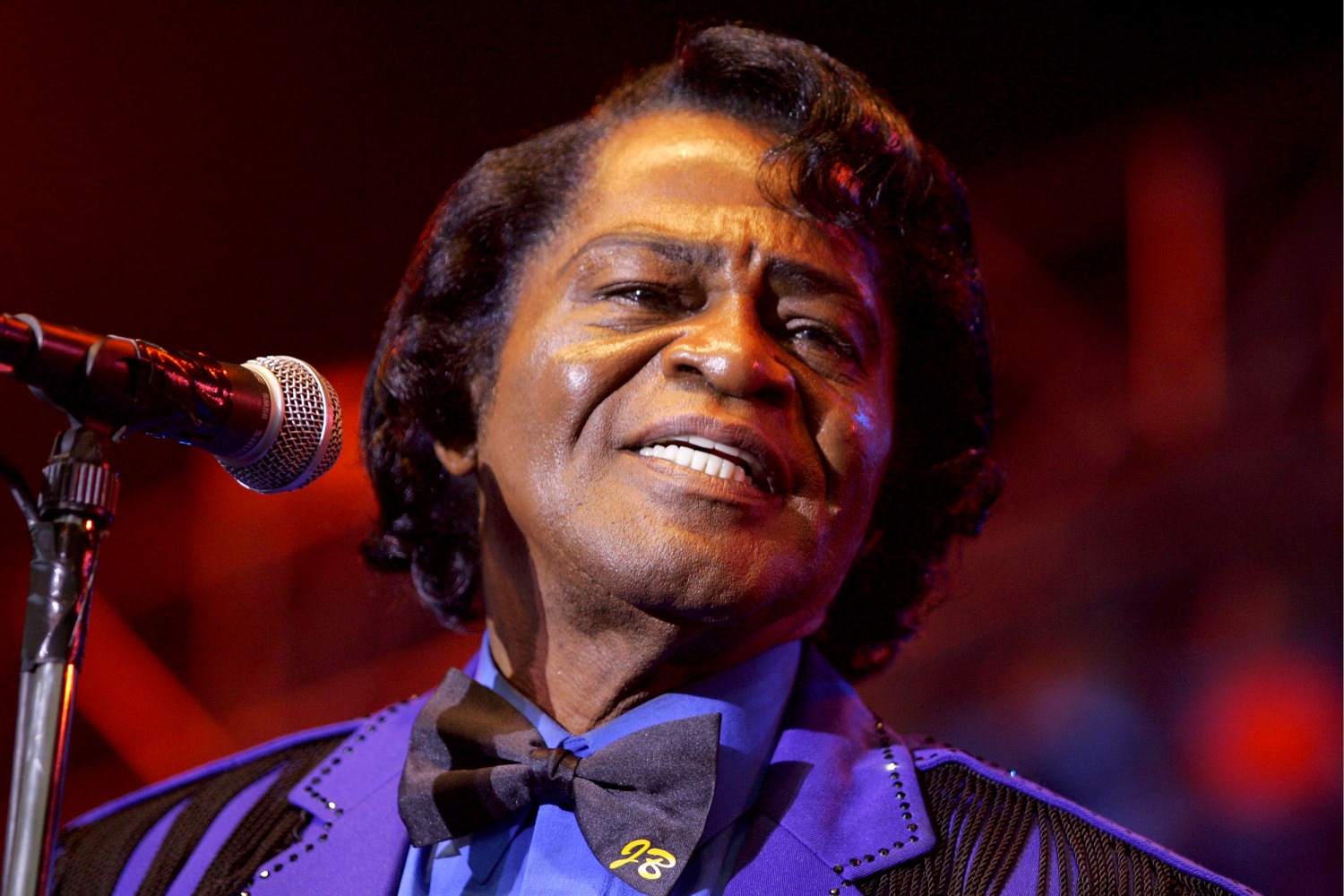
James Brown is an American soul singer, dancer, and music producer.
Influenced by blues, gospel, and rhythm & blues (R&B), he released many hit songs after his debut in 1955. He is a leading musician of the music known as "soul" and created the music known as "funk. In addition, as a dancer, he greatly influenced future musicians such as Michael Jackson.
James Brown Overview
James Brown is an American soul singer, dancer, and music producer.
Influenced by blues, gospel, and rhythm & blues (R&B), he released many hit songs after his debut in 1955. He is a leading musician of the music known as "soul" and created the music known as "funk. In addition, as a dancer, he greatly influenced future musicians such as Michael Jackson.
His nicknames include "Mr. Dynamite," "Soul Brother Number One," "Godfather of Soul," "Funky President," and "The Hardest Working Man in Show Business.
He has received numerous awards, including 10th place on Rolling Stone's 100 Greatest Singers of All Time, 7th place on Rolling Stone's 100 Greatest Artists of All Time, and 37th place on Q Magazine's 100 Greatest Singers of All Time.
James Brown's career
From childhood to becoming a musician in a teaching hospital.
James was born on May 3, 1933 in Barnwell, South Carolina, USA.
He was born unconscious in a small cabin in the woods outside of the city, and was resuscitated by his aunt who was present at his birth.
His father was of Native American Apache descent and his mother was of African American and Asian descent.
His father made his living in the forest by collecting resin for pine oil. But struggling to eat, James was sent to live with his aunt in Augusta, Georgia.
His aunt's family ran a brothel, but it was not prosperous, and James helped out by picking cotton and shining shoes to make ends meet. During this time, he got closer to the world of music, learning to play the guitar from one of the store's regular customers, who gave him an organ to start playing.
James, however, was not yet interested in becoming a musician. He was also passionate about baseball and boxing, and while his friends encouraged him to become a professional baseball player, his own dream was to become a professional boxer.
As he grew older, he began shoplifting and stealing for his clothes, and one day, at the age of 15, he was caught red-handed by a police officer while trying to steal a coat and other items from a car with his friends. He was sentenced to 8 years if he repented and 16 years if he did not. He was sent to a reformatory in 1948.
While in prison, he formed a gospel group with his fellow inmates while enduring bullying by the white guards. He quickly became a popular figure in the hospital. He received the nickname "Music Box" and finally found a chance to make a living as a musician.
Hit "Try Me"
Three years after his incarceration, he was given a chance for parole. This was thanks to the positive impression his serious attitude toward life, cheerful personality, and his success as a gospel musician had made. However, he was not allowed to return to his hometown of Augusta, but was required to live in the town of Tocoa, Georgia, where there was a parochial school. There, he was able to obtain a home and a job through Bobby Byrd, whom he had met through gospel music. Bobby and I would spend many years together in the music business.
In 1953, he was working other jobs during the day and performing live at night. It was during this time that he met Little Richard. Richard had yet to have a big hit, but he was the number one draw in the area. Richard recommended the Flames to his own firm. James and his friends began to earn a steady income from then on.
Then one day, Richard suddenly left for the West Coast, and James and his team were given the opportunity to take his place. Gradually, they expanded their activities from Georgia and gradually became well known. Finally, a record company approached them. It was King Records, based in Cincinnati, Ohio.
After the band's debut song was a hit, but they had no more hits, the management company suggested that they change their name to "James Brown & The Famous Flames. The purpose of this was to clarify the band's star, but the other members rebelled against this. They all returned to their hometown of Tocoa.
James was at his wits' end with the disappearance of the band, but a helping hand came from an unexpected source. Little Richard, who was on tour in Australia, suddenly announced his retirement, saying, "I'm going to give my life to God. He enrolled in Oakwood, Alabama, to study theology and become a pastor. To fill the hole left open by that tour, James was called in on short notice to work with Richard's backing band. James then formed a new band consisting of members of this band and the returning Flames. They decided to record a single song. The song "Try Me," which was released on this last chance, was a big hit and rose to number one on the R&B charts.
On February 4, 1956, the Famous Flames entered the studio for the first time to record a record. Their memorable debut song was the original "Please, Please, Please. However, when King Records president Sid Nathan heard the song, he was furious: "What's the point of just repeating 'Please'? What's the point? The scout who recommended them was fired, and the song was released on Federal, a minor label under King, without any publicity.
They had no choice but to take their records with them to the radio stations in the towns they toured, and steadily promoted their songs by handing them out to DJs. Little by little, the record began to sell, and as a result, it became a million-seller.
The Civil Rights Movement and the historic classic "Sex Machine"
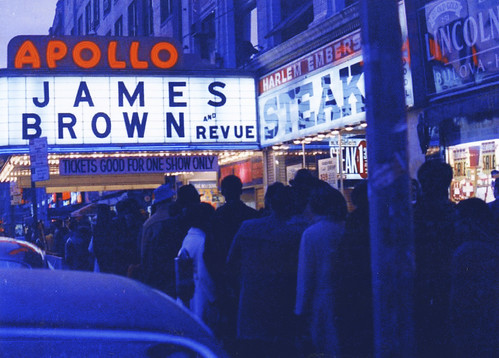
Exterior view of the Apollo Theater in the 1960s from the film "Mr. Dynamite: James Brown, King of Funk".
James released the single "Sync" in May 1960. It became a million seller.
Finally, in 1962, he ventured to New York City. He released an album recorded live at the Apollo Theater. At that time, a live album was nothing more than a studio live performance with clapping over it, and it was impossible to hear the audience's voices. When Sid Nathan heard about the project, he opposed the production, so James recorded the album at his own expense. After hearing the finished product, Nathan gave his permission to release it, but suggested that he choose a single song from it. James, however, did not dare to do so. As a result, "Live at the Apollo" sold well in 1963 without a single single song, and some radio shows even played the entire album in one sitting. The album sat on the charts for 66 weeks. This led the music industry to emphasize the LP unit.
After the success of the live album, "Out of Sight," considered the first funk number, was released. He followed it up with "Papa's Got a New Bag," "I Got You (I Feel Good)," and "Cold Sweat," which cemented James' popularity.
In the late 1960s, he became a permanent member of the NAACP (National Association for the Advancement of Colored People) and supported the civil rights movement from a non-violent standpoint. He began operating a radio station to improve the status of blacks and to help them secure jobs and develop their skills. He also became friends with Dr. Martin Luther King, Jr.
When Dr. King was assassinated on April 4, 1968, riots broke out in more than 120 locations across the United States. Immediately after the assassination, James went on his radio station and appealed to the public to honor Dr. King by maintaining calm. He also dared not cancel a concert in Boston the day after the incident, but instead broadcast it live on television to keep people outside. The live broadcast was replayed many times, and no incident occurred in Boston at all.
James' success pleased the U.S. government, and he was invited to perform at the White House dinner. He also went to Vietnam to perform live concerts as a consolation prize.
However, this was seen as a betrayal by anti-war and civil rights activists. He also began to receive threats from radical activist groups.
Against this backdrop, the group released "Say It Loud (I'm Black and I'm Proud)" in 1968, which spent six weeks at number one on the R&B charts and climbed to number ten on the pop charts. However, this powerful declaration of support for Black Power quickly lost white fans.
James, who was wavering between power and anti-power, was uncompromising in his music. In 1970, on the day of a concert in Columbus, Georgia, all band members demanded a pay raise. At 6:00 p.m., when they had not withdrawn their demands and were not ready to perform, James fired them all. However, the concert could not be canceled, so he hastily used a group of young men who had been working as a session band for King Records as James' new backing band, the "JB's." The JB's were born. The first result of the JB's was the historic song "Sex Machine.
Grammy Awards and tumultuous later years
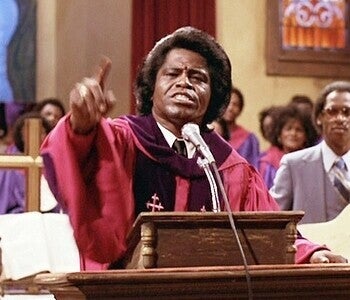
In the late 1970s, a disco boom began. James' popularity went downhill with it, but in 1980, actors and comedians John Belushi and Dan Aykroyd asked him to appear in the movie "The Blues Brothers. The film was a huge hit and triggered an R&B boom that brought James back into the spotlight. Later, "Living in America," which he sang in the movie "Rocky IV," became a hit, and James was back in show business.
In 1984, he performed with one of the founders of hip-hop, Africa Bambaata. He gained respect from young hip-hop musicians.
He received a Grammy Award for Best R&B Male Singer in 1987 and a Special Achievement Award at the same awards in 1992.
In his private life, however, he had a tumultuous last years, as he was arrested in April 1987 for assaulting his wife, and in September 1988 he was arrested for running away after ignoring a police officer's question about his duties.
On December 25, 2006, he passed away due to worsening symptoms of pneumonia.
James Brown Profile/Personality Profile
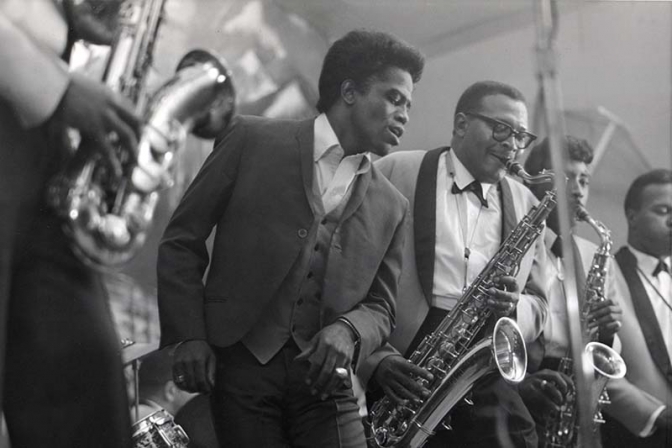
Mr. Dynamite: James Brown, King of Funk
He was born to a Native American father of Apache descent and a mother of African-American and Asian descent. His name at birth in Barnwell, South Carolina was James Joseph Brown, Jr. but he changed it to James Joseph Brown as an adult.
His family was very poor, and Brown was raised by relatives. As a child, he helped with the family's finances by packing cotton and shining shoes, and sang well enough to win a local music competition; at age 15, he was arrested for car theft, and at age 16 (as an adult) was given a discriminatory conviction of 8 years if he was remorseful, and 16 years if he was not. He was then incarcerated in a teaching hospital from 1948. While in prison, he formed a band and developed a passion for music.
James Brown Discography
Top 10 Singles
1956: Please, Please, Please (R&B #5)
1959: Try Me (R&B #1, U.S. #48)
1960: Think (R&B #7, U.S. #33)
1961: Baby, You're Right (R&B #2, U.S. #49)
1961: Bewildered (R&B #8, U.S. #40)
1961: I Don't Mind (R&B #4, U.S. #47)
1962: Lost Someone (R&B #2, U.S. #48)
1962: Night Train (R&B #5, U.S. #35)
1963: Prisoner of Love (R&B #6, U.S. #18)
1965: Papa's Got a Brand New Bag - Part I (R&B #1, U.S. #8)
1965: I Got You (I Feel Good)] (R&B #1, U.S. #3)
1966: Ain't That a Groove Pts. 1 & 2 (R&B #6, U.S. #42)
1966: Don't Be a Drop-Out (R&B #4, U.S. #50)
1966: It's a Man's Man's Man's World (R&B #1, U.S. #8)
1966: Sweet Little Baby Boy - Part 1 (U.S. #8)
1967: Cold Sweat - Part 1 (R&B #1, U.S. #7)
1967: Let Yourself Go (R&B #5, U.S. #46)
1968: I Can't Stand Myself (When You Touch Me) (R&B #4, U.S. #28)
1968: I Got the Feelin' (R&B #1, U.S. #6)
1968: Licking Stick - Licking Stick - Part 1 (R&B #2, U.S. #14)
1968: Say it Loud - I'm Black and I'm Proud - Part 1 (R&B #1, U.S. #10)
1968: There Was a Time (R&B #3, U.S. #36)
1969: Ain't It Funky Now (R&B #3, U.S. #24)
1969: Give It Up or Turnit a Loose (R&B #1, U.S. #15)
1969: I Don't Want Nobody to Give Me Nothing (Open Up the Door, I'll Get It Myself) (R&B #3, U.S. #20)
1969: Let a Man Come in and Do the Popcorn - Part One (R&B #2, U.S. #21)
1969: Mother Popcorn (You Got to Have a Mother for Me) Part One (R&B #1, U.S. #11)
1970: Get Up (I Feel Like Being Like A) Sex Machine (Part 1) (R&B #2, U.S. #15)
1970: Santa Claus is Definitely Here to Stay (U.S. #7)
1970: Super Bad - Part 1 & Part 2 (R&B #1, U.S. #13)
1971: Escape-ism - Part 1 (R&B #6, U.S. #35)
1971: Get Up, Get Into It, Get Involved - Pt. 1 (R&B #4, U.S. #34)
1971: Hot Pants (She Got to Use What She Got to Get What She Wants) ? Part 1 (R&B #1, U.S. #15)
1971: I'm a Greedy Man - Part I (R&B #7, U.S. #35)
1971: Make It Funky - Part 1 (R&B #1, U.S. #22)
1971: Soul Power - Pt. 1 (R&B #3, U.S. #29)
1972: Get on the Good Foot - Part 1 (R&B #1, U.S. #18)
1972: King Heroin (R&B #6, U.S. #40)
1972: Talking Loud and Saying Nothing - Part I (R&B #1, U.S. #27)
1973: Down and out in New York City (R&B #13, U.S. #50)
1973: I Got a Bag of My Own (R&B #3)
1973: Sexy, Sexy, Sexy (R&B #6, U.S. #50)
1974: Funky President (People It's Bad) (R&B #4, U.S. #44)
1974: My Thang (R&B #1, U.S. #29)
1974: Papa Don't Take No Mess - Part I (R&B #1, U.S. #31)
1974: Stoned to The Bone - Part 1 (R&B #4, U.S. #58)
1974: The Payback - Part I (R&B #1, U.S. #26)
1976: Get Up Offa That Thing (R&B #4, U.S. #45)
1985: Living in America (R&B #10, U.S. #4)
1987: How Do You Stop (R&B #10)
1988: I'm Real (R&B #2)
1988: Static, Pts. 1 & 2 (with Full Force) (R&B #5)
Main Albums
Please Please Please (1959)
Try me (1959)
Live at the Apollo (1963)
Cold Sweat (1967)
Super Bad (1970)
Sex Machine (1970)
Get on the Good Foot (1972)
The Payback (1973)
Hell (1974)
Hot (1975)
In the Jungle Groove (1986)
Gravity (1986)
Please Please Please
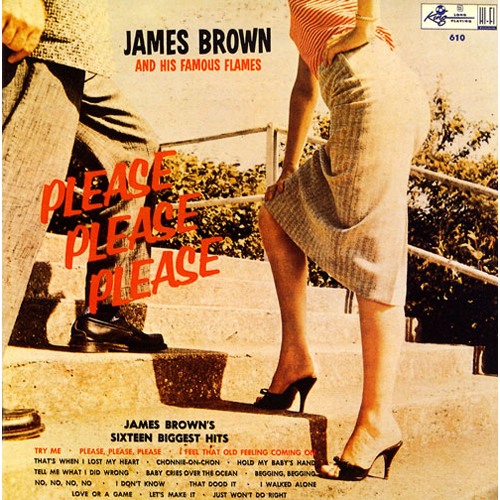
Please Please Please
1. please, please, please
2. chonny on chon
Hold My Baby's Hand
I Feel That Old Feeling Coming On
Just Want Do Right
Baby Cries Over The Ocean
I Don't Know
Tell Me What I Did Long
Try Me
That Wouldn't Do It
Begging, Begging
I Walked Alone
No, No, No, No
That's What I Lost My Heart
15. let's make it
16. love or a game
Released in 1959. Collection of singles from '56 to '58, including the title track of their debut single.

Tags
Contents
- James Brown Overview
- James Brown's career
- From childhood to becoming a musician in a teaching hospital.
- Hit "Try Me"
- The Civil Rights Movement and the historic classic "Sex Machine"
- Grammy Awards and tumultuous later years
- James Brown Profile/Personality Profile
- James Brown Discography
- Top 10 Singles
- Main Albums
- Please Please Please
- Live at the Apollo
- sex machine
- James Brown's most popular songs and music videos (MV/PV)
- Please Please Please
- Papa's Got A Brand New Bag
- Out of Sight
- It's A Man's Man's Man's World
- Say It Loud,I'm Black and I'm Proud
- Sex Machine & Super Bad
- Living in America
- James Brown Quotes and Statements
- We called it the rhythm hold. That's exactly where soul started.
- I believed in human rights, not civil rights."
- James Brown Episodes and Anecdotes
- The "Cloak Show," the biggest showcase of James' live performances