
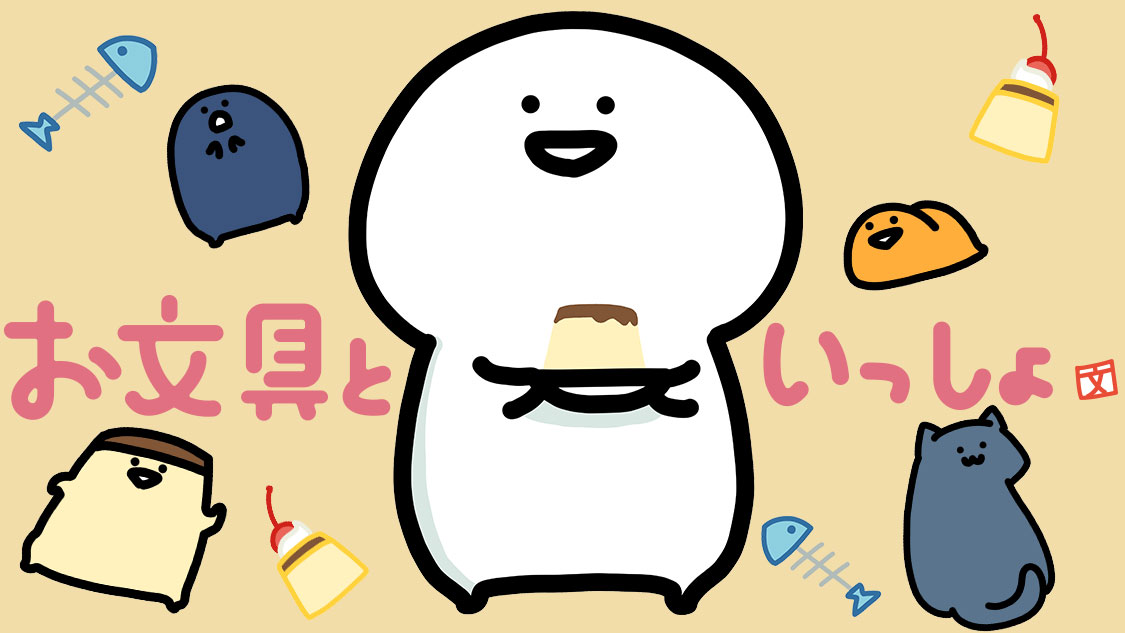
The "With Stationery" is a four-frame comic strip posted on Twitter by the author, "Stationery @imoko_iimo". The white, round stationery character spends his days with his friends in a relaxing atmosphere, and became popular when he posted it on YouTube on January 15, 2020. Videos with a wide range of content, including travel, routine introductions, challenges to super-spicy cup yakisoba noodles, and work-related videos, are posted every Wednesday, Friday, and Sunday at around 8:00 pm. He has also published a book by Kodansha, which contains his works on Twitter, plus newly written pieces.
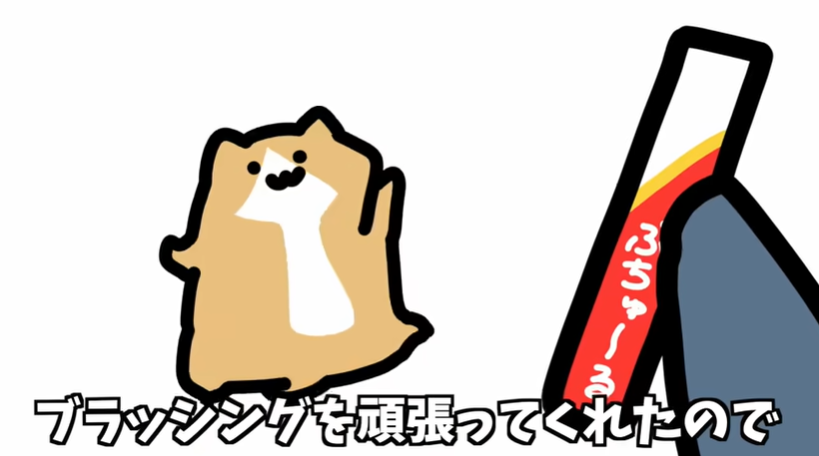
As a reward for her brushing, the kitten receives "puchuu."
It is a paste-like cat snack similar to Churu.
It is a snack that a cat often gives to a kitten, and in "Ke Ga Hane," the cat gave it to the kitten as a reward for holding back brushing. Kitten always puts "puchuru" in his mouth like a cigarette and eats it while pretending to take a breath. Kitten's seemingly adult-like gesture often surprised the cat.
Words, Lines, Scenes, and Scenes of "With Stationery"
Cat: "When your heart is full, let's fill your stomach."
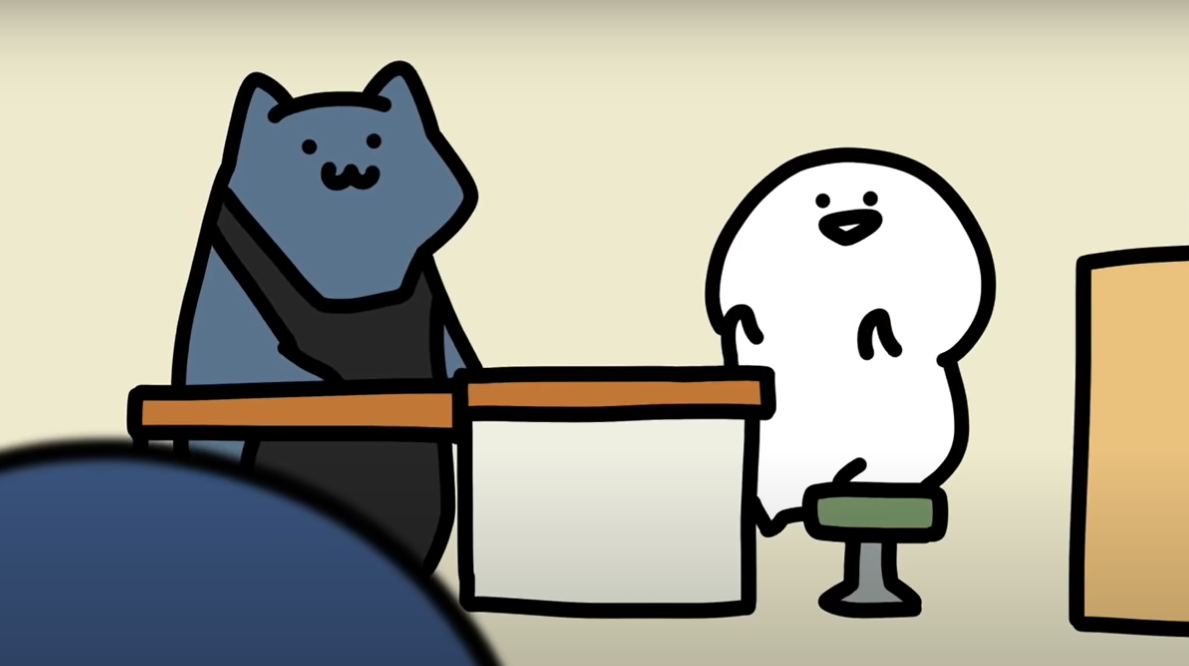
To get rid of his melancholy, the nameless man went late at night to the coffee shop run by the cat, where, despite midnight, freshly baked bread was prepared.
In "I don't want anything to come tomorrow," a cat spoke to a nameless person.
On Sunday night, the nameless man lay on the sofa, thinking of tomorrow. Dark feelings rushed in one after another. The body wanted to sleep, but the heart could not. The nameless man who was attacked by his own but not his own senses had no choice but to devote himself to the time that would pass for nothing.
I received a message from the cat saying, "It's this time of the day, but I baked bread. Are you coming to eat?"
With enough energy to go out, I reached a coffee shop run by the cat, where there was a stationery shop.
When the two, a nameless man and a stationery man, spread bread on their cheeks, the cat said, "When you are full, let's fill your stomach."
The nameless person who was a little relieved to hear the words gradually regained the vitality for tomorrow.
The Cat's lines are not intended to comfort, encourage, or find something out. They are the words that come out of a listening posture that just tries to be close to the exhausted person. The words that express the importance of being close to others without listening to anything attracted many fans and became a masterpiece.
Mr. Stationery: "You don't have to think about getting things done. You don't have to think about failure all the time."
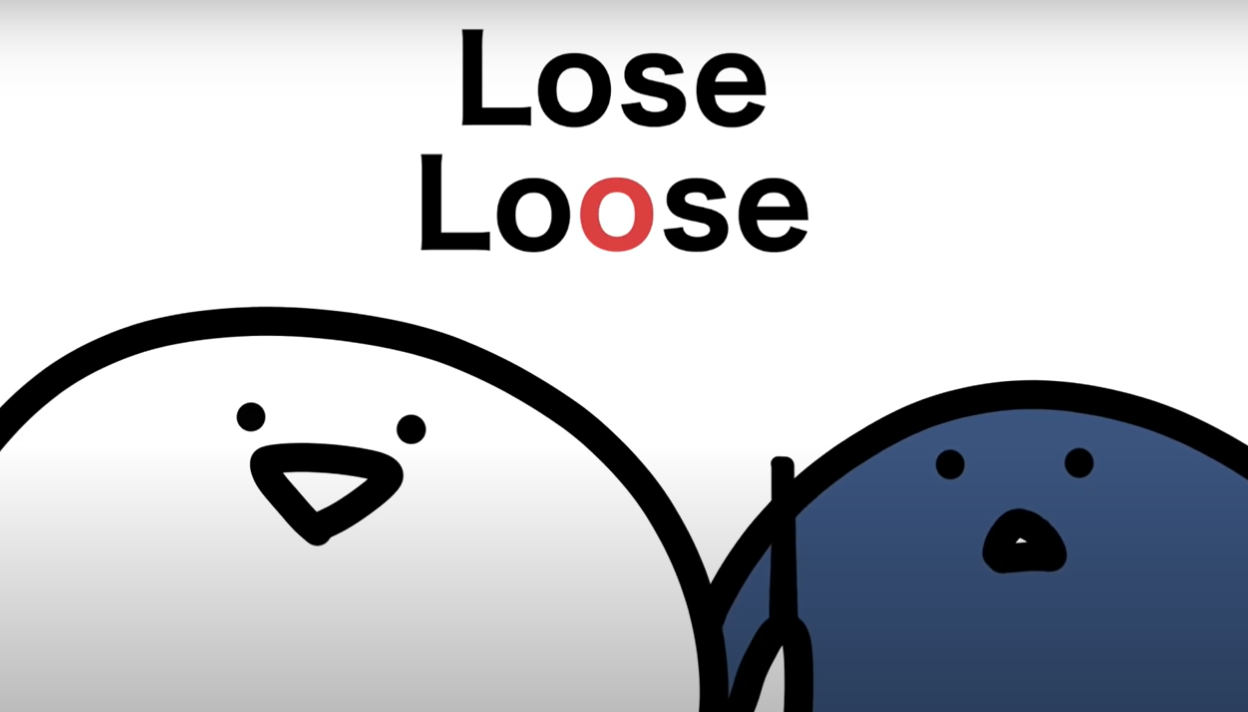
A stationery worker advises a nameless person to add one more 0.
In "To You Who Are Afraid of Failure and Cannot Proceed," a stationery shop said to a nameless person.
Mr. Anonymous, who had recently lost track of what he was doing his work for, had a dark and heavy feeling of anguish.
It's hard for me to go to work tomorrow. What on earth is work? Why am I working?
The same thing happens every day, and I don't even feel the time.
It was supposed to be "tomorrow" with "bright day" written on it, but the nameless person thought that the bright day would never come to him again.
"You don't have to think of trying to get things done. You don't have to think of making mistakes." said the stationery worker to the nameless person who was depressed and didn't want him to come again tomorrow.
The stationer advised the nameless to look at "Loose" instead of "Lose". Impressed by the change in meaning from "failure" to "slow" just by adding one more circle, the nameless gradually calmed down.
The stationer added a circle to "Lose" and changed it to "Loose." The scene in which he urged the nameless man, who was stuck in fear of failure, to "Take your time and be all right," is the most famous scene in the story.
STATIONERY MAN: "There may be fads and wanes, but I'm a wanderer of things."

"I want to see my husband again." A discarded robot. Exhausted and unable to move, a stationery shop takes him somewhere.
"I Am the Popular Robot" begins with a scene from 20 years ago where a robot wanders alone.
The robot thinks of itself as "I'm popular," but it's already been thrown away. It doesn't understand the fact that it's an obsolete old device that people are no longer looking at. It only recognizes being put in a garbage bag as "your husband put a plastic bag on you," and continues to believe that you'll be picked up some day. It's been ten years since it was thrown away, and now it's time to face reality.
The robot had been traveling aimlessly with memories of her husband in her heart, but one day she finally ran out of steam. The moment she went to sleep, hoping to "see her husband for the last time at least," a stationery shop appeared out of nowhere. The stationery shop held the robot and took it somewhere.
The robot was disassembled, and the parts were recycled and reused in the smartphone. The smartphone was delivered to the husband who once owned the robot, and the robot was able to return to the husband.
Seeing the robot enjoying the long-awaited reunion, the cat asked the stationer, "Is it good that it might be thrown away again?" The stationer quietly answered, "There may be trends and trends, but things are also' people' that go around."
In modern society, where new devices are appearing one after another due to advances in science and technology, things are discarded in a short cycle. This episode, in which he urged viewers to reconsider their ways of dealing with things by telling them to "use only what they need carefully and with care," became a famous scene representing a stationery shop.
Behind the Scenes, Trivia, and Small Stories / Episodes and Anecdotes of "With Stationery"
Works created to heal tired members of society
"Stationery and Company" was created with the idea of healing the many working people around the author who were tired from work. The animation production started when the author purchased a MacBookPro, and the first video was posted on YouTube on January 15, 2020.
The stationery model is a salamander, Upalupa
The stationery is designed to look like a salamander or an Upalupa, and the tone of her voice and her actions reflect her own.
Author who was rumored to be a man
In "O-Stationery and Company" (Kodansha), several O-Stationery masters and their salary-like young men appear. The author has publicly stated on Twitter that "The gestures and tone of the O-Stationery masters are modeled after me," and as a result, the number of fans who identify the author with the work has gradually increased.
Under such circumstances, there was a consideration that the personality and life of the author were actually reflected on the salary-like man himself who appeared in "Stationery and Company," and the theory that' the author was a man' spread.
In addition, the author introduces himself as' an office worker and illustrator,' but fans who advocate the theory that' the author is a man' support this theory by claiming that' a woman should call herself an office lady.'
The author is a woman from Kyoto born in 1996.
The author of' O-Bungu' does not reveal most of his background.
For this reason, there were quite a few fans who suggested that the author was a male. However, it turned out that the author was a female after only appearing on TV.
Also, his Twitter profile lists his birthday as March 10, 1996. Fans agree that this is the author's birthday.
As for his place of birth, he tweeted on December 18, 2018, "The author is from Kyoto." Videos posted on YouTube often showed the intonation of the Kansai region. At first, there was a theory that he was from Osaka, but it became clear that he was from Kyoto after a fan who went back to the previous tweet confirmed the part in question. In the video, there were scenes that seemed to be based on "Wednesday How is it?" (a local program in Hokkaido that was broadcast from 1999 to 2002) and the pronunciation of words that sounded like the intonation of Shizuoka, so there was a period when the Hokkaido and Shizuoka theories were advocated. This is the only point that the author clearly stated about his origin.

Tags
Contents
- Outline of "Together with Stationery"
- Outline and story of "With Stationery"
- "Anime that I want people who are working too hard to watch"
- "Finger Videos" series
- "Finger Video"
- "Using Your Fingers to Watch Video 2"
- "Using Your Fingers to Watch Video 3"
- "Using Your Fingers to Watch Video 4"
- "Using Your Fingers to Watch Video 5"
- "Using Your Fingers to Watch Video 6"
- "Video 7: Using Your Finger to Watch It"
- "Using Your Fingers to Watch Anime"
- "An anime where you put your finger on it"
- "Finger on the Screen"
- "Hands-On Video"
- Morning Routine
- Stationery's Morning Routine
- Pudding's Morning Routine
- Cat's Morning Routine
- Jell-san's Morning Routine
- "Minnade Onsen Tabi e"
- "Study / Work Videos"
- [Jazz BGM for Study and Work] Would you like to listen to the stationery music together?
- [Study and work cafe BGM] Let's work together with Purin.
- [Video for the Sleepless] Why not sleep with stationery?
- Characters in "Stationery and Together"
- main characters
- Stationery
- Mr. Purin.
- Nameless person (namo-san)
- Kitty.
- Mr. Jello.
- Kitty cat.
- Subcharacter
- Hanako-san in the
- Vampire
- Sadako.
- Guest character
- Tsubu-mame
- WRINKLE
- The term "with stationery"
- Safe Non-defective / Buji Non-defective
- PIKEA
- [[PDEFINE ~ RFFS _
- Words, Lines, Scenes, and Scenes of "With Stationery"
- Cat: "When your heart is full, let's fill your stomach."
- Mr. Stationery: "You don't have to think about getting things done. You don't have to think about failure all the time."
- STATIONERY MAN: "There may be fads and wanes, but I'm a wanderer of things."
- Behind the Scenes, Trivia, and Small Stories / Episodes and Anecdotes of "With Stationery"
- Works created to heal tired members of society
- The stationery model is a salamander, Upalupa
- Author who was rumored to be a man
- The author is a woman from Kyoto born in 1996.