
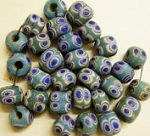
Tombo dama, a traditional Japanese craft. Today, artists who have refined their skills are pursuing the world of sparkling beads based on their rich ideas, while also studying glass crafts all over the world.
Handmade glass jewelry
Tonbo dama (glass beads) began long ago with the birth of glass crafting.
Many glass beads have been excavated from historical sites around the world, along with gold, silver, and other metal ornaments.
Many dragonfly beads have been excavated from historical sites around the world, along with gold, silver and other metal ornaments.
The Japanese name "dragonfly beads" is thought to have originated from their resemblance to the eyeballs of dragonflies,
In other countries, they are mainly called "glass beads.
In ancient Mesopotamia and Egypt, glass dragonfly beads were made around the 15th century BC,
By the Roman period, elaborate mosaic beads and human-shaped beads were being made, which were quite elaborate.
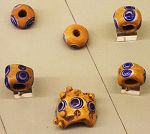
Dragonfly beads from the Celtic (Hallstatt) culture (circa B.C. 450).
Excavated from Hallstatt, southeast of Salzburg, Austria, 1846.
Reveals an advanced culture prior to the Romans.
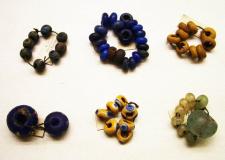
Celtic nobles apparently threaded strings through dragonfly beads to make them into ornaments.
Tombo dama are made of rod-shaped glass, melted and shaped by a burner flame.
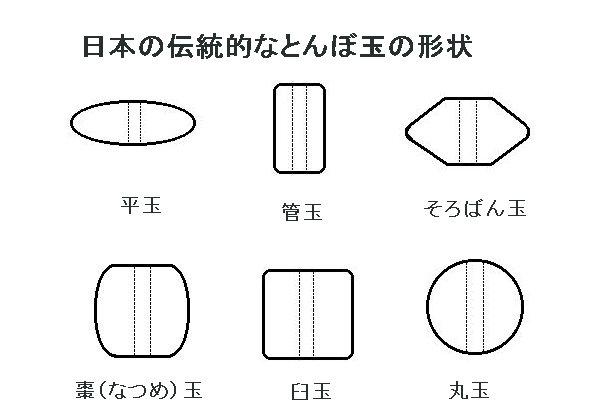
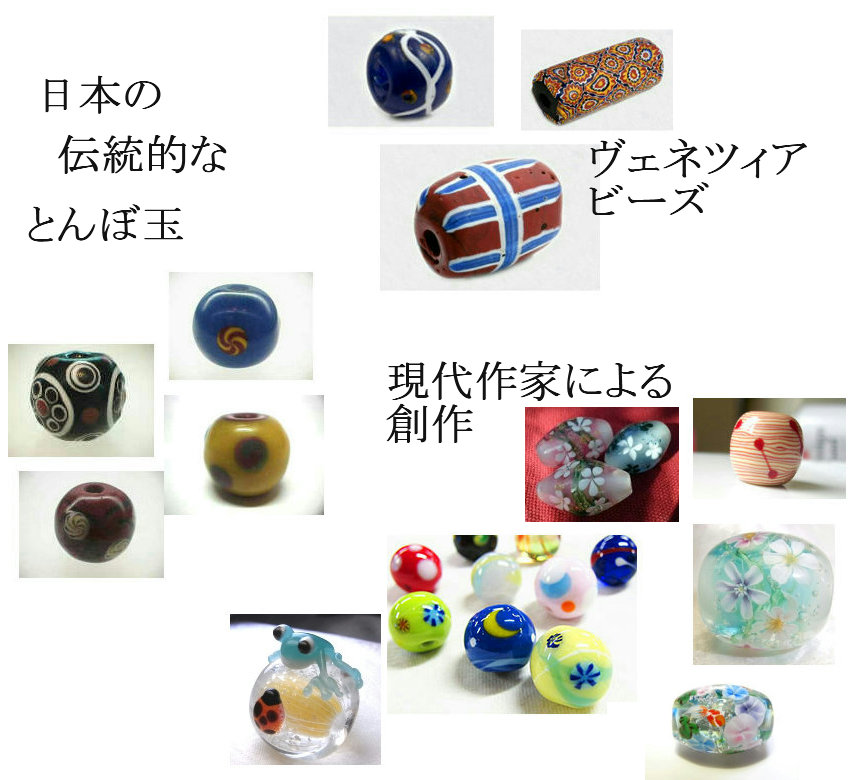
The basic overall shapes include round, date, tubular, and mortar-shaped, with various characteristics depending on the region,
The pieces can be made into necklaces or earrings by threading a string through a hole in the center, or into ornaments by threading a stick through the center.
The basic patterns include simple concentric circles, marbling, and twisting,
It is interesting to note that each region has developed its own preferred patterns.
The oldest glass beads in Japan are magatama (勾玉), which were intended to replace precious stones such as jade,
They began to be made around the middle of the Yayoi period (710-794).
In the Edo period (1603-1867), highly skilled glass crafts were imported from Europe, along with their techniques,
Tombo dama, also called "Dutch dama," were used as ornaments for kanzashi (ornamental hairpins) and netsuke,
They were used as ornaments for ornamental ornaments such as kanzashi (ornamental hairpins) and netsuke (ornamental hairpins), and became popular among the general public.
There are basic patterns such as simple concentric circles, marbles, and twists,
It is interesting to note that each region has developed its own preferred patterns.
The glass beads are made by decorating the basic glass ball with glass of different colors and transparencies.
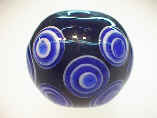
Tombo dama with a traditional Japanese concentric circle pattern
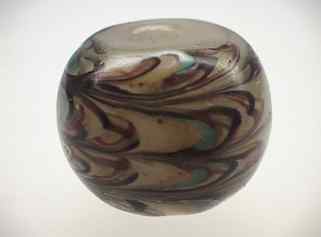
marble
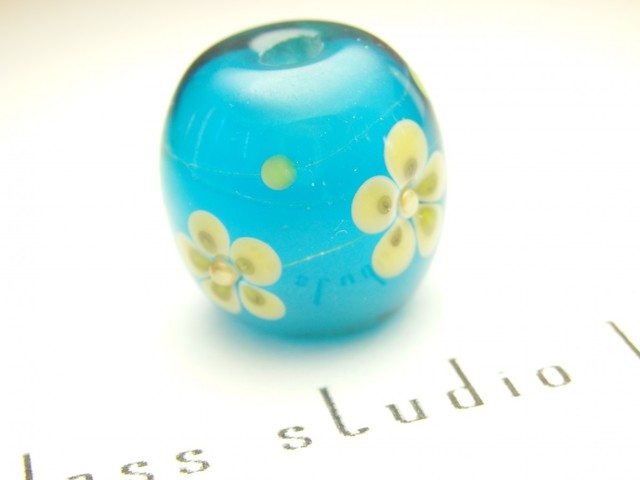
The world of just a few millimeters to a few centimeters
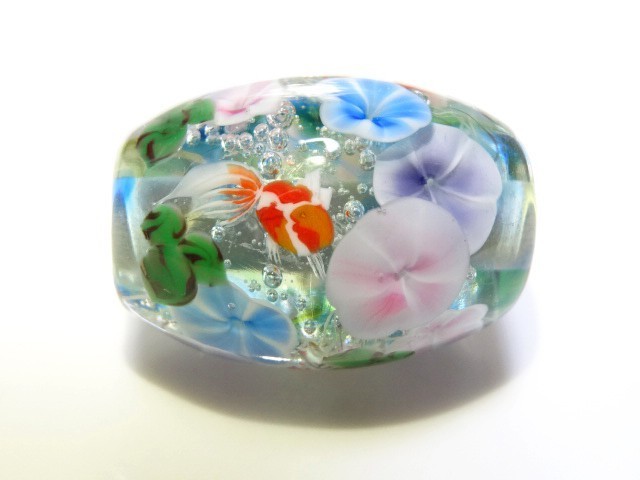
Goldfish and flower petals are made of different glass, and then air bubbles are placed in the transparent glass,
The goldfish and flower petals are made of different types of glass, and air bubbles are placed in the transparent glass to create an underwater scene. The accumulation of historical glass craft techniques and the long experience of the artisans create an amazing landscape of beauty in a minuscule world.
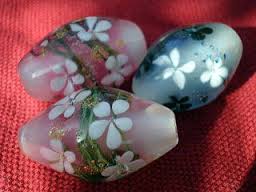
Today, the craftsmen use gold, silver, and other powders, as well as multiple spheres that are melted and attached together,
The craftsmen's delicate and intricate ingenuity and techniques have led to a new development from simple glass beads to complex fusions with glass crafts,
The craftsmen's delicate and intricate ingenuity and skill have led to a new development.
How to make tonbo dama, burner work|Introduction: Making basic tonbo dama
making.tonbotama.com
Basic dragonfly bead making and burner work is introduced.
damselfly
homepage1.nifty.com
Tombodama began with the birth of glass and was passed down through generations of people who wished to wear beautiful jewelry.
In ancient Japan, they began as simple objects like katadama, and in the Edo period,
many techniques and crafts were imported from Europe,
In the Edo period (1603-1867), many techniques and crafts were imported from Europe, and they became popular among the common people as familiar ornaments such as kanzashi (ornamental hairpins) and netsuke (ornamental hairpins).
100 Dragonfly Beads Exhibition 2015
www.lampwork.org
Soro's handmade tonbo dama experience|Studio Relight
www.studiorelight.com
Why don't you make the world's one and only dragonfly beads with Sorro?
T00449-01 Dragonfly Beads - Kuchibashi Shoten, seller of dragonfly beads, antique beads and trade beads
www.kuchibashi.com
List of handmade dragonfly beads iichi Handmade, Crafts, Handicrafts for sale and purchase
www.iichi.com
iichi is a marketplace for handmade goods. You can safely list, sell, and buy handmade goods such as sundries, accessories, wallets, bags, cases, clothes, etc. by artists.
