
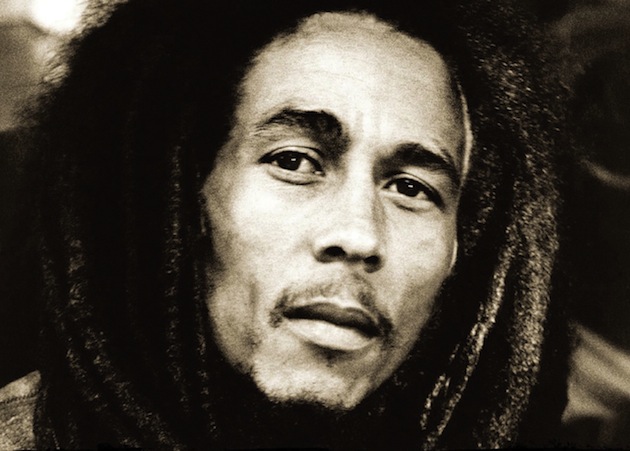
Bob Marley (1945-1981)
Jamaican reggae musician. He has been called "The God of Reggae," "The Rebel of Souls," and "The Shouting Messenger of Peace.
Bob Marley - One Love
One Love, a song that everyone knows.
Episodes and Anecdotes
On February 6, 1945, Bob Marley (real name Robert Nesta Marley) was born in Nine Miles, St. Ann Parish, on Jamaica's north coast, to a white Royal Navy Captain father and Jamaican mother. His father, then 61, and his 18-year-old mother separated after Bob's birth, and Bob spent his childhood with his mother in Nine Miles. His father disappeared soon after Bob's birth.
He is a mixed-race child. Therefore, he was treated as an outsider by both the white and black communities, and he experienced a deep sense of loneliness as a boy.
He experienced a deep sense of loneliness in his childhood. This was a strong motivation for him to continue to appeal to people around the world to transcend differences in skin color and live together as human beings.
My husband (Bob) had been torn between two worlds since he was a boy. That is why I sought my roots in Africa, the place of human origins, and put a message in my songs that transcended religion and race.
When he was 10 years old, his father died. With his father's financial support gone, the family moved to a slum in the suburbs of Kingston in search of work. He was given the nickname "German" because of his different appearance from the blacks around him, and he sometimes painted his face with shoe polish because he hated it. It was here that Bob began his musical career with Bunny Wailer, dropping out of school at the age of 14 to concentrate on music.
At 17, he passed an audition and made his debut as a solo musician, living in Trench Town since the age of 18, where six of his musical friends formed The Wailers. Their first debut single was a hit, but the record company and music producer took almost all the royalties. The Jamaican music industry was centered on radio, and musicians had no way to earn income from live performances as Western bands did.
Bob and his friends, although nationally prominent, were in constant financial straits, and without jobs, they turned to crime.
They shared the same frustrations with society as the urban youths who were out of work and turning to crime. *Bob is living on the street at this time.
Rastafarianism
When he was 19 years old, he awakened to the religion of "Rastafarianism," which advocates a return to Africa. The followers of Rasta religion (Rastaman) dream of one day returning to their mother land of Africa, the birthplace of mankind. The reason they wear dreadlocks, which look like a rope, is because of the commandment not to touch their bodies with blades. So dreadlocks are not a fashion but a sign of Rasta followers.
In Bob's song, he describes you and me as "I & I." There is no "you" in the Rastaman's expression. There is no "I" in Rastaman's expression because there is no "You" in Rastaman's expression, no separation of self and others.
The Rasta colors of red, yellow, and green also have their own meanings. Red represents burning blood, yellow represents the shining sun, and green represents the rich earth. All are strict vegetarians, rejecting materialism.
*Not all reggae musicians have dreadlocks on their heads. Only the Rastas among them have dreadlocks. In Japan, you often see young men with dreads eating "hamburgers" as they walk down the street, but to a real Rasta man, this is a blasphemy of his religion (vegetarianism), and he would not complain if he were found half dead or even killed in half.

Three raster colors. Red, Yellow, Green.
At the age of 21, Bob worked as a welder while pursuing his music career, and married his girlfriend Rita.
Around this time (the late 1960s), the political situation in Jamaica began to become extremely unstable. The political strife between the right and left parties developed into an armed conflict between the supporters of each party, in which not only machine guns but even tanks appeared. The cycle of hatred spawned one riot after another, killing many people and making the capital the most dangerous area in the world. Kingston was transformed into a city of tragic violence and disorder.
'Whenever there are political riots in Jamaica, the youth are always fighting each other. "Whenever there is a political riot in Jamaica, young people are always fighting each other, for the politicians. It pisses me off. It really makes me sick. The youth fight against hunger and unemployment. It really pisses me off that young people are killing each other for them, when it is the politicians who are making it hard for them.
At the age of 30, Bob's song "I Shot the Sheriff," covered by Eric Clapton, reached No. 1 in the United States. Bob Marley's name quickly spread around the world. In the same year, the album "Nutty Dread" was released. It was critically acclaimed by rock magazines in the U.K. and the U.S. The following year, "No Woman, No Cry," released as a single, was also a huge worldwide hit. Bob came to be called a superstar representing the Third World.
In 1976, political tensions in Jamaica reached a peak. Bob planned a free "Smile Jamaica Concert" in an attempt to create an opportunity to restore peace. In doing so, he became embroiled in the rivalry between the two major political parties, and on December 3, he was shot and seriously wounded. Still wounded, he performed at the free concert on December 5 and defected to the Bahamas the next morning.
Legendary Concerts
In 1978, Bob returned to Jamaica...with a plan in his heart. Shortly after his return
Bob performed at the "One Love Peace Concert", which is still a legend among music fans.
The concert was so large that Kingston was filled with people all day long. Many foreign press crews were there, and in the front rows of the auditorium were invited prime ministers, members of parliament, judges, and others. Bob's plan was to have the leaders of the ruling and opposition parties, who had been engaged in a bloody struggle for years, shake hands on stage!
It was around midnight when Bob, dressed in jeans and linen, took the stage. Bob's appearance, which had been a long time coming, sent the audience into a frenzy.
At the climax of the song, Bob asked both party leaders
"Please come up on stage and shake my hand in front of everybody!"
Bob called out through the microphone to both party leaders. The two party leaders were at first a little apprehensive, but with the crowd watching them, they reluctantly went up on stage.
As the two party leaders stood beside Bob and shook his hand, Bob took their hands and lifted them high in the air for the entire crowd to see. Bob closed his eyes as if in prayer....
The concert then closed with the famous song "One Love".
Here is that precious video.
Many musicians, both old and new, have worked to influence society to change the world, but this was the decisive incident in which music visibly and concretely moved politics!
Two months after this event, he had an experience that would become a wonderful memory for the rest of his life. He was awarded the Third World Peace Medal by the African delegation to the United Nations!
