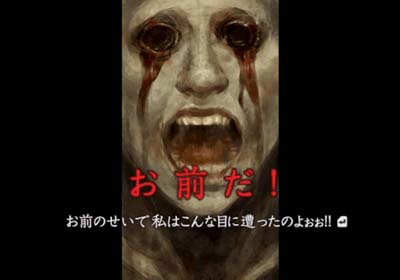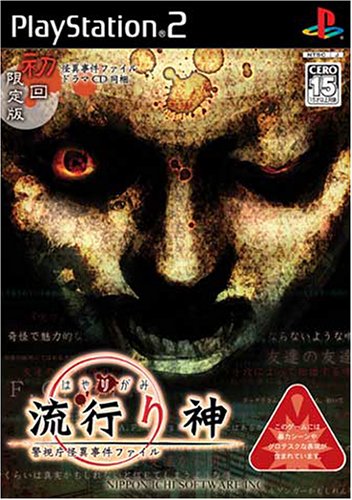
The Ryuukagami was released in 2004, and sequels have been released up to 4. This time we introduce the first one. It is an adventure game with many branches and challenging elements.
Horror adventure game / Epidemic
The protagonist, a detective with the Metropolitan Police Department, solves strange cases based on urban legends such as "Cockroach," "Red Cloak," and "Satoru-kun. The game is a text adventure game with a horror flavor, in which text and pictures are displayed, and the player must solve the mystery of the case by deducing and selecting the appropriate choice from among the options that appear at key points in the game. One of the most distinctive features of the game is the scenario format, which allows the player to choose between a "scientific" investigation and an investigation that allows for "occult" elements.
Source: ja.wikipedia.org
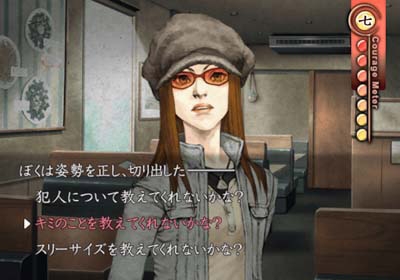
Game screen.
The dark colors of the picture well represent the shadows of the characters' hearts.
Although the game is based on an urban legend, it does not lead directly to an occult solution, but can also be clarified scientifically. This is done through a system called "self-questioning," which allows the main character to change course during the investigation. The overall mood of the game is dark and indescribable. The game is characterized by the possibility that the solution may not necessarily make all parties involved happy.
Interesting game system
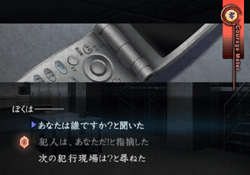
Courage Points
Players are awarded a fixed number of Courage Points, or "courage," for each scenario.
In the game, there are times when a "Courage Required Action" with a red hexagon appears as an option, and choosing this option consumes one point.
Source: ja.wikipedia.org
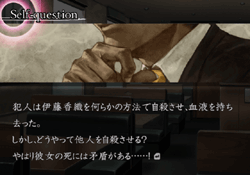
Self-Questions
At key points in the game, there are "self-questions," in which the players sort out the situation up to this point, and their reasoning will affect the direction of the scenario and their evaluation (rank) at the end of the game. In particular, choosing a choice that contradicts the facts will lower your rating, and the conclusions you draw will often lead directly to game over.
Source: ja.wikipedia.org
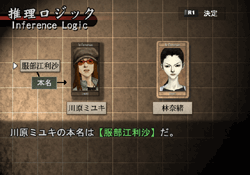
Deduction Logic
A scene in which keywords obtained in the game are applied to a character correlation chart to create a complete picture of the case. It appears at the climax of the episode or at any other time, and the choice of keywords here will greatly affect the evaluation. Some keywords can only be obtained after certain choices have been made, and a single keyword may fit into multiple frames, so it is not possible to solve the puzzle by brute force alone.
Source: ja.wikipedia.org
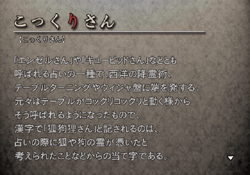
Database
This is a dictionary where supplementary explanations are registered when the titles of urban legends, words that require occult knowledge, and technical terms used by police agencies appear in the games.
Each game has 200 words, and the 200th word in each series is "F.O.A.F." ("Friend of a Friend").
Source: ja.wikipedia.org
How about a horror game that has nothing to do with moe once in a while?
The characters are not particularly beautiful or anything, so there is no moe factor at all. Although horror games have nothing to do with moe in the first place, this game has a particularly wonderful worldview created by Ken Sugawara. It is a good game with a dark worldview and storyline, with each occult and scientific route presenting a completely different storyline. It is a recommended game that you should take the time to work on.