
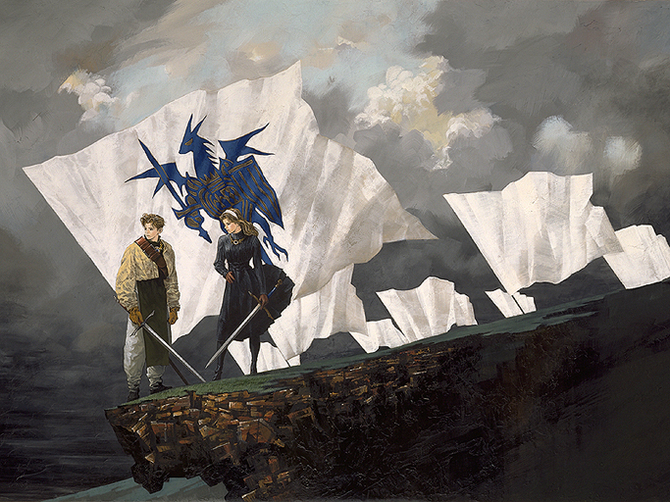
A simulation RPG extraordinaire, recently reimagined for the PSP! Tactics Ouga is summarized.
What is Tactics Ouga?
Tactics Ogre: Let Us Cling Together (タクティクスオウガ: Let Us Cling Together) is a simulation RPG for the Super Nintendo Entertainment System (SNES), originally released on October 6, 1995, by Quest Co. The game has also been ported to the Sega Saturn and PlayStation (see below for details), and has been available on the Wii Virtual Console since February 10, 2009, and on the Wii U Virtual Console since March 12, 2014. Portable remake "Tactics Ooga: Wheel of Fortune" was released on November 11, 2010.
The development representative, planner, and scenario writer is Yasumi Matsuno, who later worked at Square (now Square Enix) on "Final Fantasy XII", "Final Fantasy Tactics", "Final Fantasy Tactics Advance", and "Beygranth Story".
This is the second work released in the series bearing the "Ooga" name, following "The Legend of Ooga Battle," but the entire Ooga Battle saga was conceived as chapters 1 through 8, with this work being positioned as chapter 7. In addition, there is little connection between the game system and the previous work.
In this work, the warfare caused by the ethnic conflict between the Wolsta, Gargastan, and Bakram on the Valerian Islands in the fictional world of Zeteguinea is depicted from the perspective of Denim, a Wolsta boy from the island's ethnic minority. The game features a multiple storyline and multiple endings.
The game is played by controlling the main character Denim and the unit he leads, and clearing battle events that occur in various locations. Battles are fought on a map using the quarter-view method, which was still a rarity at the time[citation needed].
Source: ja.wikipedia.org
game system
The game progresses through a series of battles in which players move from base to base on a macromap depicting the Valeria Islands, the setting of the game, and win or conquer a base on a designated battle map (scenario battle). In all battles, without exception, victory conditions are set. There are two types of victory conditions: "defeat the enemy leader" and "destroy the enemy. On the other hand, the defeat condition (game over) is also set: "Denim's death" (forced sortie) in scenario battles, and "all allied units' annihilation" in random encounter battles when Denim is not in the battle.
In bases with multiple stages, the player cannot return to the map until the base is conquered, and the player must fight in a series of battles via the formation screen only, with consumed HP being transferred to the next map (in "Wheel of Fate" all HP is restored).
In the previous work, The Legend of Ogre Battle, a group of characters was treated as a single "unit" (capable of actual action), whereas in this work, each character is treated as an independent unit, and the concept of a group corresponding to a unit in the previous work is positioned as a "union. A union (the unit to which a player belongs) led by Denim can hold up to 30 units (including the player himself), and on a single battle map, up to 10 units can basically be sent out as an attack team (up to 2 L-size units). Units that are wounded on the battlefield and have zero HP are treated as "war dead. However, it is possible to revive the dead with items or the magic "Resurrection" only during that battle map. As an exception, undead units such as skeletons, ghosts, etc. do not apply to this theory, since they are classified as immortal units that can be revived many times after death.
In "The Wheel of Fate," L-size units can also go out as one unit with a maximum of 12 players (although the maximum number of players varies depending on the map), and the maximum number of units in a union has been expanded to 50. In addition, the life element was introduced, with players losing HP during battle and losing a life if left unattended. The conditions for a unit's death were then relaxed, such that losing three lives would result in the unit's death. In addition, a system of skills, similar to Final Fantasy Tactics' abilities, was introduced as a way to direct a unit's personality.
Source: ja.wikipedia.org
This game system was so revolutionary that it makes me groan to think that the hardware at that time was SFC.
A complete simulation RPG had been created by this time.
This was due to the use of a game engine developed by Quest, which was responsible for the production of HERMIT.
This is an engine that automatically generates graphics very quickly from data such as height differences and the type of panel the character is standing on.
It is said to be able to create a three-dimensional map with a very small amount of data.
Why is it called a masterpiece?
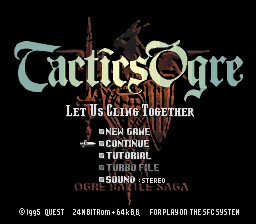
One of the reasons why this game is called a masterpiece is its "precision.
The dots on the characters and the text in various places.
The game's key element is the "precision" of the characters' dots, text in various places, abilities and growth rates for each class (occupation), and so on.
However, the greatest appeal of Tactics Ouga is the depth of the story.
The story's worldview includes ethnic groups, religions, economies, and so on,
The reasons why wars and conflicts occur are carefully incorporated into the story's worldview.
In addition, at various points in the story, the protagonist is forced to make important choices.
The storyline that the protagonist follows will differ depending on the choices he or she makes, which was also a novel technique at the time.
Ported and remade versions
Sega Saturn version December 13, 1996 (River Hill Software)
As an additional specification, a voice actor's voice was used for the events of the main characters that appeared in the game.
PlayStation version September 25, 1997 (Art Dink)
The PlayStation version's save feature allows the player to resume the game as many times as he/she wants from the saved point with an interrupted file, making it easier to conquer the maps (especially the Palace of the Dead) in a series of battles. The game does not include the soundtrack of the Saturn version mentioned above.
Wii Virtual Console version: Available from February 10, 2009. 800 Wii Points required (Square Enix)
Tactics Ooga: Wheel of Fortune PlayStation Portable November 11, 2010 (Square Enix)
A remake of the game was announced for the PlayStation Portable on July 22, 2010, and was released under the above title on November 11 of the same year. The game was developed by the original development staff, including Matsuno, a member of the original Quest-era development team. The game was released by Square Enix, the company that took over the game software development division from Quest, to which the main developers of the game were transferred.
Wii U Virtual Console version available from March 12, 2014 (Square Enix)
Source: ja.wikipedia.org
This is a teaser trailer for the PSP version.
Finally.
The game Tactics Ouga is deep, if I may say so in a monthly phrase.
You can't see all the events just by playing once.
And each event is worth seeing.
The story spun in such a way is still very popular, and there are constant calls for a sequel.
It is not often that a game attracts people so much.
