
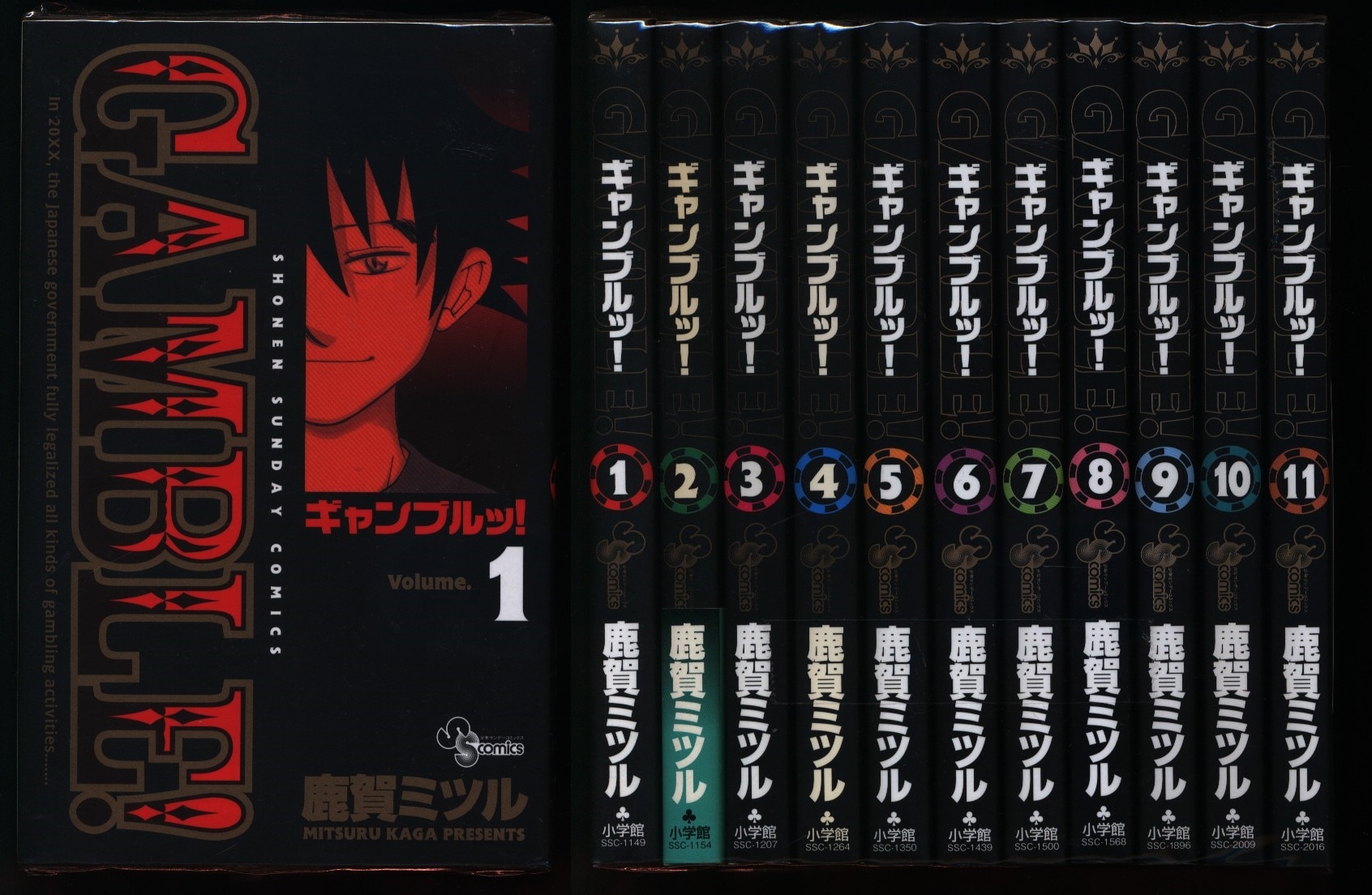
Gambling! is a gambling manga by Mitsuru Kaga. The story takes place in Japan in the year 20XX, when gambling has been completely banned. In a city where everything in the world is steeped in gambling, gambling genius Kyomoto Masaru and his best friend Jean aim to become the world's best gambler in order to find his missing father. Masaru's overwhelming luck and his ability to play games. Together, they rise to the top in the world of gambling and search for their father.
Appeared in the fifth episode. The duel between Masaru and Mare at the casino "TOKYO CASINO". Masal challenges Baccarat by being invited by the boss who expects Masal's talent. However, Masal's money is "600000 yen", which is too small to play Baccarat, so he plays Mini-bar Baccarat.
Baccarat is a game between two players, a banker and a player, in which the player bets on the winner.
In Baccarat, the cards are usually squeezed by the "player" or "banker," but in Mini-bar Carat, the customer cannot touch the cards, they are all opened by the dealer, and the bet is the same as in Baccarat: "player wins," "banker wins," or "draw."
In this match, Murre always puts importance on balance, but Masaru is not afraid to make a bet, ignoring the probability. Murre became frightened by Murre's fearlessness, and Murre gave up the match, so Masaru virtually won.
The rules are the same as for regular baccarat, except that the casino will exchange 10 times the amount of money it has worked with, with a minimum of 10,000 yen and a maximum of 1 million yen.
For example, if A bets 10,000 yen and wins the casino side, A can take 100,000 yen from B. If it loses, A pays 100,000 yen to the other party. If they bet on the same side, they exchange the difference.
Choboichi
Appearing in episodes 9 to 12, Sota and Takeshi compete on the roof of Minami Elementary School. After that, Sota and Takeshi confront each other on the advice of Masaru.
After losing a bet against Takeshi every day, Sota consults with Masaru, and Masaru agrees to lend 500000 yen to Sota. If he wins against Takeshi, he will return 500000 yen to Masaru, and if he loses, he will return the double amount of 1 million yen. Sota Ushirogusa works at a part-time job introduced by Masaru and learns "how hard it is to get money". Without knowing that, Sota feels ashamed of himself, who has been fighting and losing for a long time. Sota comes to seriously think that he wants to "win" against Takeshi, and goes to the rematch against Takeshi with Masaru.
In Choboichi, prepare a dice and a piece of paper or cloth divided into 6 equal parts. Write the number from 1 to 6 on the 6 divided pieces of paper.
After the parent is decided by the size of the dice, the child places a chip on the part where the number from 1 to 6 is written.
If all the children put their chips down, the parent throws a dice. The person who bets on the prize will be the winner and will receive four times the number of chips bet on the prize. The rest of the people will forfeit all the chips they have bet on. They also change parents according to how much they have.
The rules in this volume were set as' If you win, it is 5.5 times,'' The lower limit and upper limit are from 10,000 to 100,000 yen,' and' There is no upper limit for the skyrocketing in a rematch.'
Casino War
Appeared in episodes 13 and 14. A fight between Masaru and Jean at a certain casino. Jean, who believes in mathematics, fights with Masaru to decide which is better, luck or calculation.
Casino War is a simple game in which the winner is the player who has more cards than the dealer who has more cards than the player who has more cards than the dealer who has more cards than the dealer who has more cards than the player who has more cards than the dealer who has more cards than the dealer who has more cards than the dealer who has more cards than the dealer who has more cards than the dealer who has more cards than the dealer who has
The player tips the card and the dealer presents it face up. The dealer then pulls the card face down and flips it face up. He compares the number of cards between the player and the dealer. The winner is the one with the highest number.
If a player wins, the player's tip is doubled and refunded; if the player loses, the player's tip is forfeited; if the game is tied, the player has the choice of continuing or ending the game.
The strength of the card is "A, K, Q, J, 10. 3, 2" in this order, and A is stronger.
Oar
Appeared in episodes 15 to 19. Appeared when Masaru and Jean confronted a frog in the warehouse district.
After being asked for help by Ichiyo, Masaru and Jean challenge Gaeru as a substitute for Ichiyo's father. If the Masaru side wins, Ichiyo's father's debt is written off. If they lose, the Gaeru adopts Ichiyo as an adopted daughter. The match begins with an agreement that the Masaru side pays 30000 yen for participation.
An "All" wins if it draws between two cards that have been dealt to it.
In each round, each parent and child is given two cards, and if they think they can draw a number of cards between the two, they place a bet on a different number of cards within the range of the total number of cards in the round. Then, they declare that they will win by the amount of money.
If you pull well, you win, and you get your winnings from the Aunts gathered on the field. If you don't pull between two cards, you lose, and you put your winnings on the field. The number of Aunts you put out in each round gradually accumulates.
If you are not confident or are not in time to draw the two cards that have been handed out, you get off. If you are going to fight with all the presents gathered at the place, you declare' all'. If you win, you will get all the presents from the place, and if you lose, you will take all the presents from the place where you bet.
The rule of this series is' the cards to be used are two sets of 104 cards excluding the joker.' As a special rule, there is a rule that' if you draw a card with only one interval, you will receive 10 times as much as the Anti you bet on.'
Indian Poker
In the first round of the Bariturd, Masaru and Kamata compete against each other.
The rules are the same as in regular Indian poker: you take a card from the deck and put it on your forehead so that it is invisible to you, and your opponent can see your card.
A card strength of 13 is the strongest and 1 the weakest. If you think your card is stronger than your opponent, you bet. If you think your card is weaker than your opponent, you get off. For a simple game, psychological warfare is very important.
Therefore, KAMATA pointed out Masaru who had' sinister jinx' and' losing jinx' and tried to shake him mentally. However, Masaru responded to the jinx. KAMATA recognized the talent of gamblers who did not feel the fear and admitted defeat by himself.
The minimum and maximum points are 10,000 yen and 1 million yen, respectively, until one of them surrenders.
Blackjack
In the second round of the Bariturd, Masaru and Kagawa compete against each other.
The rules were normal, with casino dealers handing out cards to themselves and to players, with the winner being the one with the total number of cards in hand close to 21.
With a minimum of 100,000 yen and no maximum. With a 2-hour limit, the winner is the one with the most money. If Masaru loses, Kagawa declares,' I will take over the supermarket where Masaru's mother works part-time.' If he loses, he further threatens,' I will turn my hands around and make them stop working anywhere.'
As a result, he was soundly defeated by Masaru who gained a flow of luck. Kagawa's bad personality was known to his trading partners and he self-destructed.
It is also a showdown event between Masaru and Date in the third round of Bariturd.
The rules are as usual. Starting with the same amount of money, the winner is the one who makes money in a given time.
However, at Date's request, they were allowed to form a team and compete at a casino with more than 10 tables. This was all a ploy for Date to win, including competitive events.
In the end, Masaru found out the strategy of Date, and Masaru won the battle with more ability than Date.
Keiba (horse racing)
It is a showdown between Masaru and Karaga in the fourth round of the Ballitud.
Horse racing is a type of gambling in which a jockey predicts the order of arrival of the horse he is riding.
Masal and Karagher began their day at a racetrack with a total of 12 races, starting at 10 million yen. There is no limit on the "amount of money to bet, the way to bet, or the number of points to buy" per race. You can also choose not to buy.
At the end of all 12 races, the winner is the one with the most money. As a special rule, if Masaru wins, he is given an additional 30 million yen from Karaga.
To the father of a long-distance truck driver, Masaru turns his eyes to Romeo, a boy who is about to buy a truck. In anticipation of Romeo, who is fighting with a pure spirit that does not look at odds, Masaru bought the betting ticket as Romeo directed, and he was making good progress.
But in the last race, when Romeo was blinded by the odds ratio, Masaru watched the race without buying a ticket, and still beat Karagher by what he had won.
Russian Roulette
It was a showdown between Sawajiri and Bistrov in the fifth round of the Ballitud.
This Russian Roulette uses the 8-pack Revolver "Smith & Wesson 327TRR8". The loading and rotation of the bullets are done by a third party, and the first move is decided by a coin toss. After that, the order is alternated.
Each player pulls the trigger once, and if the shot doesn't come out, it's safe. Both players can get off at any time, and if they do, the prize money will come out of the Bistro according to the number they have pulled so far. Incidentally, the prize money will be "10 million at one time, 50 million → 100 million → 200 million → 500 million → 1 billion after that. If it's perfect for seven times, 3 billion yen".
It is carried out until one of them dies.
The Bistrophs, who always succeed in the Russian Roulette, are like "gods" who recognize themselves and others. However, the reality is that they have been touching the gun for many years and only know where the bullets are now. In other words, it is a game in which the Bistrophs win from the beginning.
Sawajiri sees it and immediately grasps the feel of the gun and the location of the bullets. And he wins over Bistrov, which is effectively a victory over Masaru.
Poker
A match between the Leuco gang, who kidnapped Masaru at the direction of Chris, and Masaru.
With dozens of tips, four players play five stud poker, and only the winner is told where Masaru's 100 million yen is.
Five stud poker is played with five cards. The first card is played face down, the second face up, and the low-card player is forced to make the first bet. The third face up, and the high-hand player makes the second bet. The fourth face up, and the third bet. The fifth face up, and the fourth bet. The winner is the person who makes a strong role in the game.
At this point, Masaru had the Leuco gang play a game of "Aren't you going to win and take 100 million yen for yourself?" and had them fight each other. While they were fighting, Masaru escaped from the hut where he had been kidnapped and survived.
It will also be in the quarter-finals against Masaru and Zabala.
The rule is to play five stud poker with 100 chips, each worth 500000 yen, as the principal. The winner is the one who tips the opponent to 0.
At the beginning of the game, Zabala took the lead because Zabala recognized Masaru's peculiarities, but Masaru's "habit of covering one's own peculiarities" prevented Zabala from detecting them, and Masaru won.
Nanko
The duel between Masaru and the baseball boy he met in the park. After being freed from the Leuco gang, Masaru signed a contract with Chris and met the boy in the park. The gambling that Masaru did as a play until the boy's mother came home.
The parent and child are decided mainly by a method such as rock-paper-scissors. The child turns his / her hand backward so that he / she cannot be seen by the other party, and grasps up to three sticks vertically in one hand. The child places his / her grasping hand on the Nanko board, and the parent also places his / her following hand on the board.
Each parent estimates the total number of sticks in each other's hands and declares the number, followed by the children who declare the number but must avoid the number chosen by the parent.
After both parties have declared, they display each other's sticks on the board and check the total number of sticks. If both parties are wrong, the parent and child are replaced.
By repeating this process, the winner is the one who wins by the prescribed number.
Since' Nanko' is originally a game played at a drinking party, it is not strictly a gamble, but it is treated as an event of gambling in the story.
Roulette
It is a competitive event between Sawajiri and Galas in the quarter-finals of Barituto.
Roulette is throwing a ball into a spinning disk and hitting it where it falls. In this game, an American-type roulette with "1 to 36" and "0 and 00" is used. Odds are as usual.
The prize is 500 chips, each worth 100,000 yen. The minimum bet is one chip, the maximum is none. The winner is the one who takes the opponent's chip to 0. Since this is not a match against a dealer, the winner only takes 50 million yen from the loser.
At Sawajiri's suggestion, the game started without turning the roulette wheel.
Galas skillfully used words to manipulate the dealer's mind, and won by guessing the number that the ball would fit in. But Sawajiri focused on the ball thrown by the dealer and the structure of the roulette wheel. With perfect kinetic vision, he knew where the ball would fall, and he gambled and won. In the end, Galas' psychological warfare was futile, and Sawajiri easily won.
Hanafuda (Flower Cards)
The match between Masaru and Wang Wei in the Ballitud semi-final is played by the rule of trotting.
The rule of of Hanafuda is a rule that a player makes a role with a hand and the player who has more total points of the roles wins.
If the first player sees a card in the field and has the same' Hana / Tsuki' as the one in hand, he can take it out from the card in hand and acquire two cards,' Scene card and Hand card.' If there is no card that can be taken out from the card in the field and the card in hand, he can take one of the cards in hand and put it in the field.
Next, if you flip one card from the yama-fuda and it has the same' Hana and Tsuki' as the one on the stage, you can win two cards,' the card you flipped and the one on the stage.' If the card you flipped isn't on the stage, you leave it on the stage, and it's your turn to play the next player. Repeat this process until each player has a role.
At that point, the player can choose whether to continue or not.
If you End "is selected, the total number of points is calculated based on the number of roles played. The total number of points is calculated and added for each play. This process is repeated until the player with the larger total number of points becomes the winner.
The scores for each role are' Goko. 10 points,'' Shiko. 8 points,'' Ame no Shikko. 7 points,'' Sanko, Hanami zake, Tsukimi zake, Inoshikacho, Aosatsu, Aosatsu. 5 points,'' Tane, Tan, Kasu. 1 point,' and' Teshi, Kutsuki. 6 points.'
He has 50 million yen, and the rate is 100,000 yen per point. Each time he jumps, his points double.
Wang Wei had kidnapped and imprisoned Jean to make sure he won. Using that as a story, he threatened Masaru before the game started.
At first, Masaru used Hanafuda to inform Kamata that' Jang was abducted.' After Jang was rescued by Kamata, Masaru showed his true ability. Wang Wei himself only practiced Hanafuda on the Internet, and as he did not have much ability, Masaru won an overwhelming victory.
Chohan


Tags
Contents
- Overview of Gamble!
- Outline and story of "Gambul!"
- 12-year-old gambler Masaru Kyomoto
- To a tournament to decide the best gambler in Japan
- The Final Battle and Japan's Best Gambler
- Masaru in junior high school
- Fictional character from "Gambul!"
- Key person
- Kyomoto Masaru (Kyomoto Masaru)
- Jan
- Kazuha
- Sawajiri Shunsuke
- Enemy
- Mui no Bakemono (undefeated monster)
- Boss
- Mare
- Frog
- Kamata
- Yakuza
- Yuichiro Kagawa
- Satoshi DATE
- Calaga
- Misha Bistrov
- Martín Zabala
- F. Galas (Francis Galas)
- Wang Wei (one way)
- Chris Okami
- Leuco taste
- Leucos
- アヅミ
- Ken
- Family
- Akira KYOMOTO
- Mother of Masaru
- Jean's father.
- Classmate
- Sota
- Takeshi
- Other
- Wakamori Natsuki (with Kamori)
- Kakimoto
- Gallery of the Kagawa school
- Koji FUKUDA
- Romeo
- Falkan
- Gambul! term
- Gambling in the story
- Tehonbiki
- Cee-lo
- Baccarat Mini-bar
- Choboichi
- Casino War
- Oar
- Indian Poker
- Blackjack
- Keiba (horse racing)
- Russian Roulette
- Poker
- Nanko
- Roulette
- Hanafuda (Flower Cards)
- Chohan
- Location
- Kuritsu-Minami Shogakko Elementary School
- "Club Snake", a club run by the boss
- Other
- Special Act on Gambling
- Gambling Baritud
- Smith & Wesson 327TRR8
- Words, lines, scenes and scenes of "Gambul!"
- Jan: "The probability of becoming an Aiko in rock-paper-scissors is 33.3%. the probability of continuing an Aiko twice is about 11%!"
- Akira KYOMOTO: "Cheer up, Masaru!"
- Masaru KYOMOTO:' There are ten million coins in this bag.'
- Masaru KYOMOTO' As long as I don't lose my gambling, I won't say even if I get killed.'
- Martyn Zabala. "I'm an idiot."
- Sawajiri Shunsuke: "I CAN COMPETE WITH YOU NO MATTER WHAT!"
- Behind the Scenes, Trivia, Small Stories / Episodes and Anecdotes of "Gambul!"
- Color cover of a book that the person in charge repeatedly instructed to rewrite
- Work for 48 hours in a row due to move and deadline
- Mitsuru Kaga tears when he meets a fan of "Gambul!"