
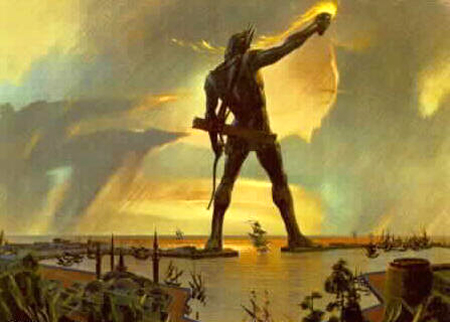
Those who get excited about lost civilizations, technology, and even the continent of Mu, what a word, should definitely take a look. Words with romance attract and fascinate people. That may be the way of the world. In other words, as long as you know it, you are likely to be very popular. Even impure motives can become a desire for knowledge once in a while. So, let's look at them one by one.
Colossus of Rhodes
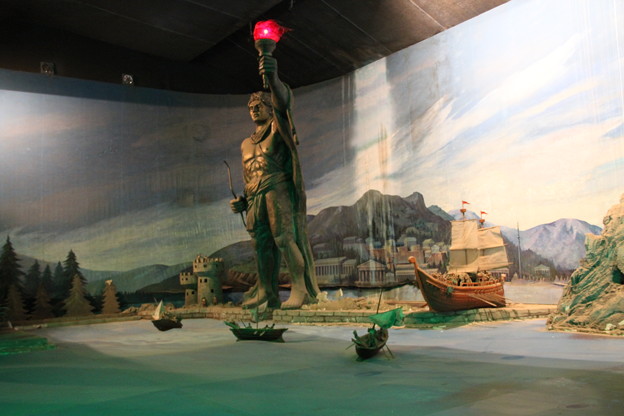
This one was made in miniature, but you can see how big it is compared to the ship
The Colossus of Rhodes is a statue (colossus) in the shape of the sun god Helios, built on the island of Rhodes in the southeastern Aegean Sea by Kares of Lindos (English version) around the 3rd century BC. It is one of the Seven Wonders of the World.
It is 34 meters long. Including the pedestal, the statue was about 50 meters long, comparable in size to the Statue of Liberty in New York today. Helios is also called the Colossus of Apollo because it was confused with Sol and Apollo (Roman name: Apollo), who are also sun gods.
The Japanese rendering of the statue varies, and it is often referred to as the Colossus of Helios, the Colossus of Rhodes, or, since the island of Rhodes is often referred to as "Rhodes Island" (see Rhodes Island#Name), also as the Colossus of Rhodes, the Colossus of Rhodes, and so on. The Japanese title of an American film produced in 1961 was "The Fortress of Rhodes Island.
Source: ja.wikipedia.org
Can you understand that it is super huge?
Including the pedestal, it is 50 meters, which is about the size of three giant Buddhist statues in Nara.
Great Pyramid of Giza

It is much larger than the colossus above. It is truly a wonder.
The Great Pyramid of Giza is the "Pyramid of King Khufu," considered the pinnacle of pyramid architecture. It was built in Giza, Egypt. It is the only surviving structure of the Seven Wonders of the World. The pyramid is believed to have been built around 2540 B.C. over a period of more than 20 years as the tomb of King Khufu, a pharaoh of the 4th dynasty of Egypt. At 146.6 m tall when completed, it was the tallest structure in the world until the Lincoln Cathedral was completed in the 14th century.
Source: ja.wikipedia.org
It is not clear. Dr. Sakuji Yoshimura theorizes that it is not a tomb.
Hanging Gardens of Babylon

It is amazing. From the looks of it, it looks like it cost a lot of money.
The Hanging Gardens of Babylon is a rooftop garden, one of the "Seven Wonders of the World" structures selected by the ancient Greek mathematician Philon.
Although the name suggests a garden floating in the air, defying gravity, it is actually a garden built on a raised platform.
Source: ja.wikipedia.org
I can't say for sure since it is only an imaginary drawing, but it must have been quite a challenge to actually create and maintain something of this magnitude.
Temple of Artemis
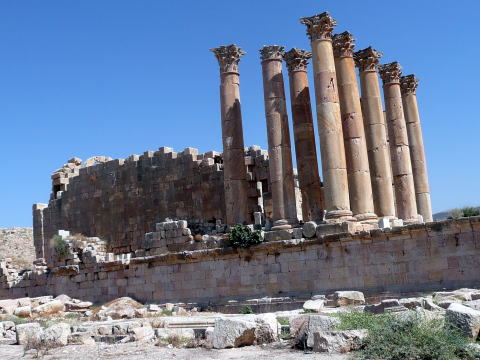
There is no trace of them anymore, but they used to be great.
The Temple of Artemis (R. ναός της Αρτέμιδος, R. Artemisium) is an all-marble temple dedicated to Artemis that existed in Ephesus (modern Turkey) from the 7th century BC to the 3rd century AD.
It is listed as one of the Seven Wonders of the World, but is no longer in its original form.
Below are the words left by Philon of Byzantium
I have seen the walls and hanging gardens of Babylon, the statue of Zeus at Olympia, the Colossus of Rhodes, the great pyramid of the Great Pyramid, and even the mausoleum of Maussollos. But all other wonders were overshadowed when I saw the temple of Artemis at Ephesus, soaring in the clouds.
The Temple of Artemis at Ephesus is the only home of the gods. One look and you will know that this is no ordinary place. Here, the heavenly world of the immortal gods is placed on earth. For the giants, the sons of Aloeus, in their attempt to ascend to heaven, piled up the mountains and built not a temple but Olympus.
Source: ja.wikipedia.org
It seems that it was quite sacred and was a place where criminals would flee to.
Mausoleum of Maussollos
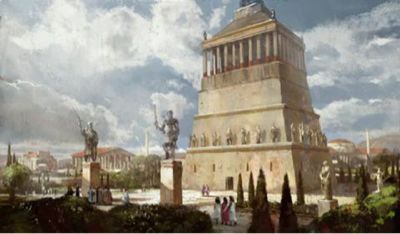
The Mausoleum of Mausolus (Tomb of Mausolus) was built to enshrine the bodies of Mausolus and his wife Artemisia. It was designed by the Greek architects Pythios and Satyuros and decorated with a frieze (sculptural band) by four renowned sculptors, Skopas, Leokales, Bruaxis, and Timotheos. Because of its magnificence, it has been selected as one of the Seven Wonders of the World. The word "mausoleum" (generally meaning a huge tomb, English: mausoleum) used in European countries is derived from this mausoleum.
Mausolus established the capital of Caria in Halicarnassus (present-day Bodrum, Republic of Turkey) and brought the surrounding areas under his control. It is said that Queen Artemisia built this mausoleum for her husband after Maussollos' death, but it is actually believed that construction of the mausoleum began during Maussollos' lifetime. It is said to have been completed in 350 B.C., three years after the death of Maussollos and one year after the death of Artemisia.
Source: ja.wikipedia.org
Some of the parts still exist today, and the British Museum has sculptures of lions and horses.
The Great Lighthouse of Alexandria

They say the top is an observation deck. I want to see it, but I'm scared!
The Great Lighthouse of Alexandria (Lighthouse of Alexandria) is a lighthouse built on the island of Pharos in the Gulf of Alexandria, Egypt, around the 3rd century BC. It is also called the Great Lighthouse of Pharos or Pharos of Alexandria.
Faros is separate from the island of the same name in the Adriatic Sea (present-day Hvar), which was a small island at the end of a peninsula created by artificial reclamation at one end of the Alexandria harbor. It is one of the Seven Wonders of the World. It was completely destroyed by two earthquakes in the 14th century, but it was the second longest-lived of the Seven Wonders, after the Great Pyramid of Giza.
Source: ja.wikipedia.org
There was a rumor that a huge treasure was hidden under the lighthouse, and it was destroyed.
