
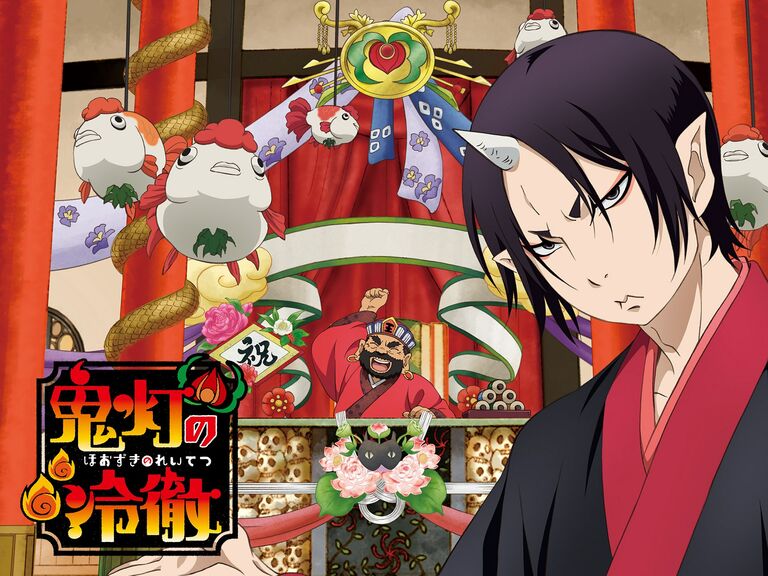
Onikan no Chitetsu" is a black comedy manga series by Natsumi Eguchi centered on the inhabitants of a Japanese hell, which was adapted into an anime in 2014 and aired its second season in two separate two-cour installments in the winter of 2017. Set in Japan's hell, the manga features numerous characters based on Japanese mythology, fairy tales, and yokai. The main character Onikan is a demon god who serves as the first assistant to King Enma, the king of hell. The story centers on Onikan, a charismatic, brilliant, but domineering character, and depicts his daily life in Hell. The straightforward statements made by the Dosu Onikan have become the talk of the town, with many quotes that one can empathize with.
"In hell, you are strong and weak. Ogres have no mercy!"
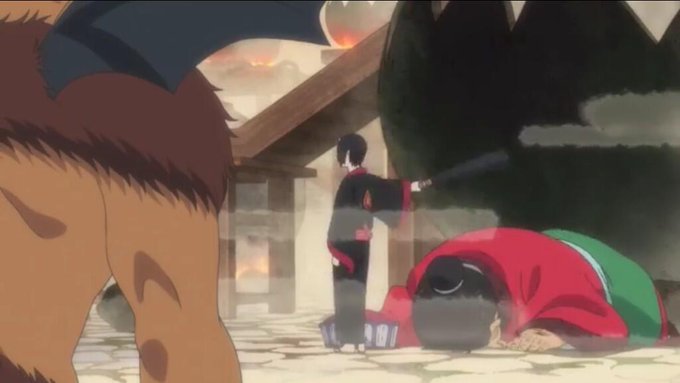
When Satan of EU Hell is touring hell, a Enma Daio accidentally falls into a cauldron. The lantern helps him. Next to him, a gourd is hurting the dead. The lantern's line warns him that the way he does it is lukewarm. He says, "This is it! Let's do it!" while beating Enma Daio with a gold bar and showing him an example. Satan is made to realize, "How strict you are with your boss! Demons are all good kids."
"Ogres should be reprimanded for their cruelty and cruelty. Leave such things to Buddha for mercy and forgiveness, and reprimand their sins thoroughly."
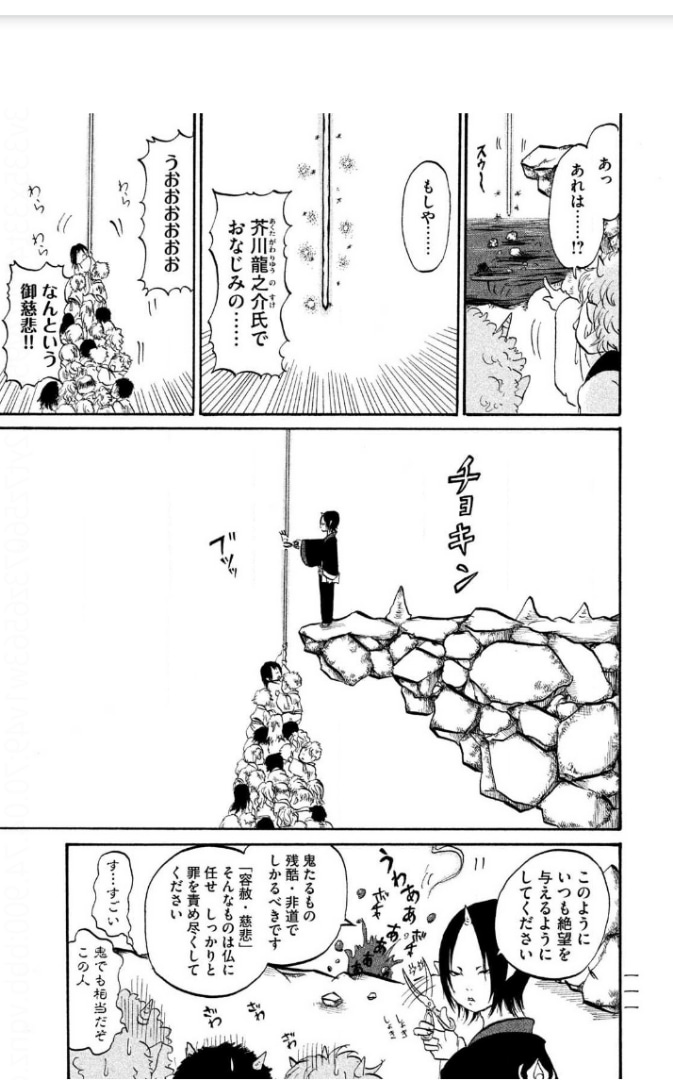
The spider's thread familiar from the novel by Ryunosuke AKUTAGAWA was also hung in Hell. However, since there was a lantern on the spot, the spider's thread was cut with scissors. This is a scene in which it is clearly understood that there is no mercy or mercy in Hell and only despair is given at any time.
"WHAT IS A SMALL LIFE? IT'S ALL THAT, IS N'T IT! IS THERE EVEN A BIG LIFE?"
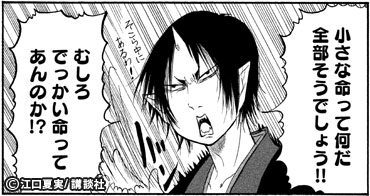
The phrase "Palm on the Sun" is accompanied by a lantern. Now that you mention it, it makes sense.
"Stay here, work here."
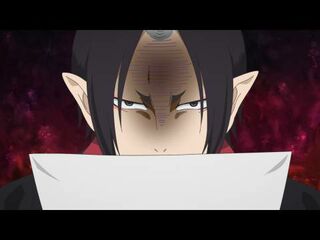
A Zen question and answer begins with "Somosan" and "Seppa." When asked where he was and where he was going, the Kito answers, "I'm here, I work here." The person who asked the Kito was Ikkyuu, or Ikkyuu Zenji. He was a famous person, but he felt that if he came and started the Zen question and answer without permission, it would only be a hindrance to his work.
"In this world, there seems to be private cars for safety, but in hell, it's a cardinal rule to protect yourself."
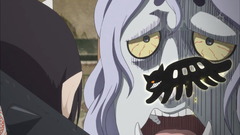
When Onito got into Oboro-guruma, the taxi of hell, Oboro-guruma asked,' Is this a normal taxi?' Oboro-guruma was surprised to see that Onito, who was a government official, was taking the same taxi as ordinary ogres. However, immediately after returning, Onito said,' This is for cost reduction.' This scene shows the difference between Utsushiyo and Hell.
"A Phalaenopsis growing in a greenhouse will die if the weeds grow too much."
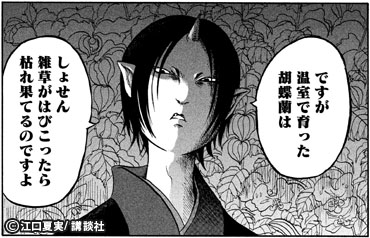
A scene involving a Beelzebub who was visiting a Japanese hell. The Beelzebub thinks he is a career, but the Onito pretends that he is not a career. Then, the Onito coldly says, comparing the Beelzebub to a Phalaenopsis who grew up in a greenhouse and himself as a weed, "Mr. Beelzebub is a career, isn't he? You are great. Phalaenopsis
"In a word, every teacher has at least one delusion."
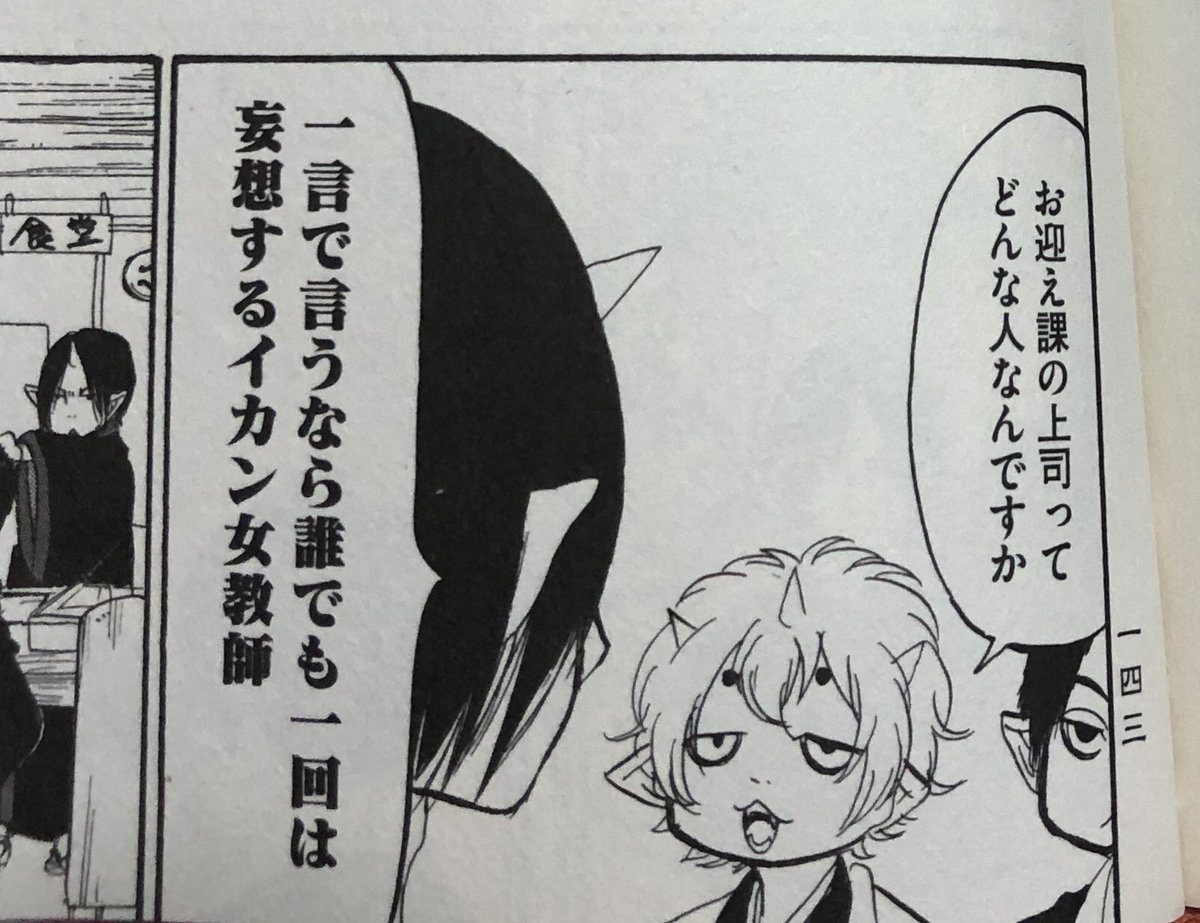
This is a line from the Onito (lantern) that was explained when asked about Dakini Dakini, who was in charge of the reception section and also served as Inari in this world.
Dakini is a woman wearing a Ama hood and glasses, and is a demon who approaches a dying person and eats his heart and blood.
"That one letter is dead or alive."
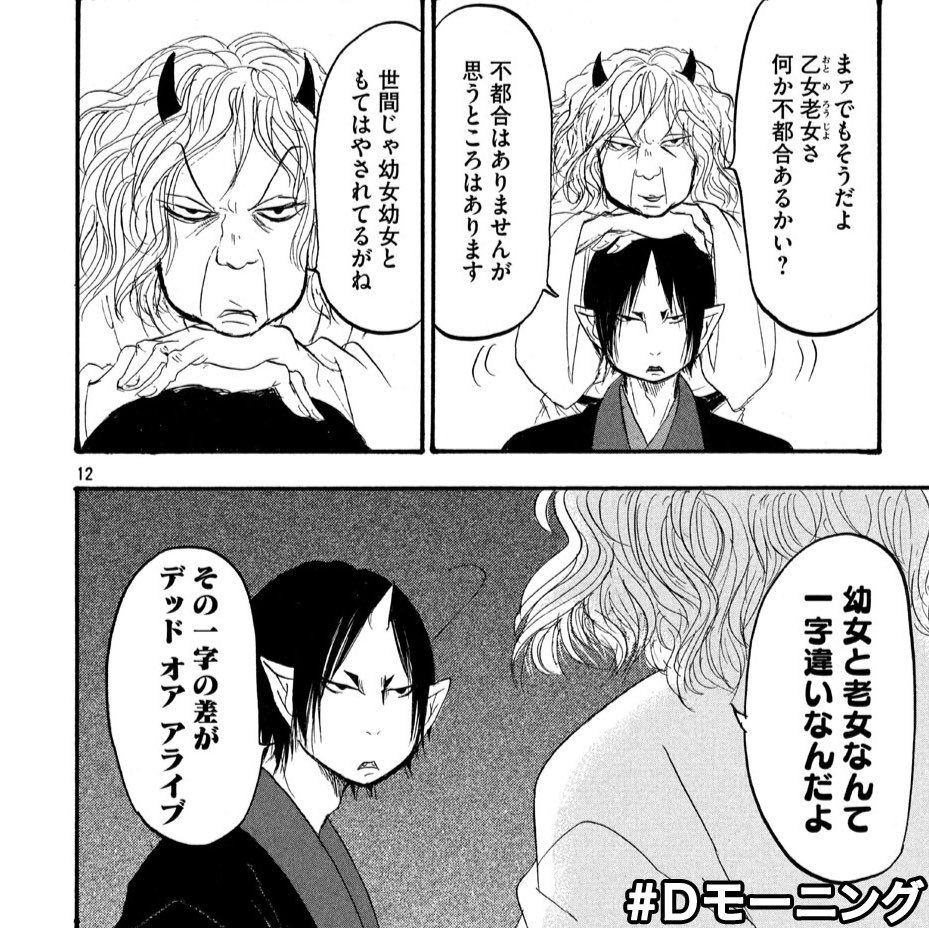
The demon's lamp that was talking with the Usagi Baba. The demon's lamp was thrusting at the words of the Usagi Baba, such as, "In the world, people are talking about young girls, but young girls and old girls are one word different."

Related Articles
Spoiler commentary and discussion summary of Onikan no Chitetsu (Onitoru).
Onikan no Chitetsu" is a manga work by Natsumi Eguchi that was adapted into an anime in 2014, with the second season airing in a two-cour segment in the winter of 2017. The story is set in a Japanese hell and features many characters based on Japanese mythology, fairy tales, and yokai. The main character "Onigami" is a demon god who serves as the first aide to the king of hell, Enma. The story depicts daily life in hell, centering on Onikan, a charismatic, brilliant, but domineering character.
Read Article
出禁のモグラ(江口夏実)のネタバレ解説・考察まとめ
『出禁のモグラ』とは江口夏実による漫画。2021年より『モーニング』で連載している。文学部の大学生、真木栗顕と桐原八重子は百暗桃弓木と名乗る仙人に関わり、今まで見えなかったものが見えるようになる。彼は刑罰としてあの世に行くことを禁じられている。あの世に行くためには道標となる“灯”を霊から集めなければならない。その行く先で彼らが不可思議な現象に出会う姿を描いた物語。登場人物の作り込みが細かく、人間の拗れを上手く描いている。地獄の存在が仄めかされているが、前作『鬼灯の冷徹』との関係性は不明。
Read Article
Contents
- Overview of Hozuki's Coolheadedness
- Kito no Meijin / Meiyo / Meisho / Meisho
- "AND SAKE, SAKE! AS LONG AS YOU DO N'T STOP DRINKING, YOU'LL KEEP GETTING HUNGRY!"
- "We is home! OTHER IS OTHER!"
- "So how many times do I have to tell you I'm not an S?"
- "We can't rest because the Japanese of this world don't take a rest! Rest up, Japanese! At least take a rest twice a week! Just make a law like Germany and take a rest!"
- "I am interested in you. When you see a person who is worthy of correction. it burns. I have no interest in women who are too mature. People who listen to you from the beginning are not interesting."
- "Barss!"
- "It's hell, so let's solve it with violence."
- "In hell, you are strong and weak. Ogres have no mercy!"
- "Ogres should be reprimanded for their cruelty and cruelty. Leave such things to Buddha for mercy and forgiveness, and reprimand their sins thoroughly."
- "WHAT IS A SMALL LIFE? IT'S ALL THAT, IS N'T IT! IS THERE EVEN A BIG LIFE?"
- "Stay here, work here."
- "In this world, there seems to be private cars for safety, but in hell, it's a cardinal rule to protect yourself."
- "A Phalaenopsis growing in a greenhouse will die if the weeds grow too much."
- "In a word, every teacher has at least one delusion."
- "That one letter is dead or alive."
- SHIRASAWA'S WORDS, LINES AND SCENES
- Since then, I have not drunk sake. Kiyohara no 涼我, I have not drunk sake, I have not drunk sake. (I have not drunk sake, please forgive me, I have not drunk sake.)'
- "I have never said to a girl' let's get married' in an irresponsible way. Even if she slapped me, I would say' please play with me' in front of her. I think that's what sincerity means."
- Eggplant Quotes / Quotes / Scenes
- "Wearing pants is the basis of morality, right? That's why I call pants morality."
- Satan's Words / Lines / Scenes
- "O my God! Lord, protect me only now!"
- Great Words, Lines, Scenes of Goldfish
- "Ogyaaa!"
- Peach Maki's Words and Lines / Famous Scenes
- "Yokai Manbiki Baba"
- "Momotaro is the one who helped cranes, wrestled with bears, and rode tortoises, isn't he?"
- Chinese Gourd's Words, Lines / Scenes
- "You don't blame me enough! I'm slimy! I mean, I'd like to ask you to do it, Miss Incense!"
- "SOMETIMES IT'S LIKE THE ADAMS FAMILY."
- Words and Lines of Mustard / Scenes and Scenes
- "Onore badger."
- SHIRO'S WORDS, LINES AND SCENES
- "No, we'll work at the Fuki-dokoro! The lantern! I got angry because of Momotaro! So we'll work at the lantern!"
- Kakisuke's Words, Lines / Scenes
- "Ahh. I wonder if there will be a time when all working people can sleep soundly."
- ルリオ's Famous Sayings, Lines / Scenes
- "If you start to think,' It's all right,' it's already your fat debut."
- Momotaro's Famous Words, Famous Lines / Famous Scenes
- "You look like Mr. Shirasawa, don't you? You have long, sharp eyes."
- "WHAT ARE YOU GOING TO DO WHEN THE SOUTH POLE PULLS THE SOUTH POLE! AND YOU FOUND A REALLY TALENTED GUY!"
- Miki's Words / Lines / Scenes
- "That's not true, Nyan. Every day is fun like an idiot, Nyan."
- "I'm tired, ォォォォ. I'm tired of this character, ォォォォォォォ."
- Enma Daio's Famous Sayings, Lines / Scenes
- "YOU'RE NOT KIND TO ME!"
- Beelzebub's Words, Lines, Scenes
- Battle of Beelzebub and the Lamp
- Famous Words and Lines / Famous Scenes and Scenes of Zashiki Warashi
- Zashiki Warashi no Yofuku
- Great Words and Lines / Scenes and Scenes of Rii-baba
- A nude photo album is published.
- Famous Words and Lines / Famous Scenes and Famous Scenes of Bull and Horse Heads
- A horse-headed dance in harmony
- Ten Kings' Words, Lines / Scenes
- Ten Kings of the Ten
- Words, Lines, Scenes and Scenes of Lady Lillis and Daji
- Lady Lillis: "Have you caught a good man recently?" Daji: "Well, there's no better man than 紂王 yet."
- Words and Lines of Spirits of Trees / Famous Scenes
- EVEN THOUGH IT'S A WOODEN SPIRIT
- Incense Words / Lines / Scenes
- "Kacchan, Tat-chan, don't fight!"
- Haruichi's Words / Lines / Scenes
- "Yes, moral."
- The Words, Lines, Scenes of Princess Iwa and Princess Sakuya
- Princess Iwa and Princess Sakuya are too different.
- Issunboshi's Words, Lines / Scenes
- Issunsun-boshi who is growing and dancing with the protruding mallet
- Oboro-guruma's words, lines, scenes, and scenes
- "What? Because when we think about it, we're a group of cat buses."
- Magical Marine Quotes, Lines / Scenes
- "For the time being, I'm single and Tinkerbell, so I belong to the proper Wizard."
- Yasha-ichi's Words / Lines / Scenes
- "If you are a senior, you should teach even if you are hated! It would be the most pitiful thing if a junior did a big hit somewhere else. That's our responsibility!"
- Chun's words and lines / scenes and scenes
- CHUN: "If I have to say,' I know how stupid I am when I'm being tricked, but I get pissed off.'" Demon Light: "I feel like this when I remove moisture from women's emotions."
- Takiyasha-hime's Words, Lines, Scenes
- "No, seriously, to be honest, even if your personality is a piece of, your face is all charred with that face. Oh, my God!"