
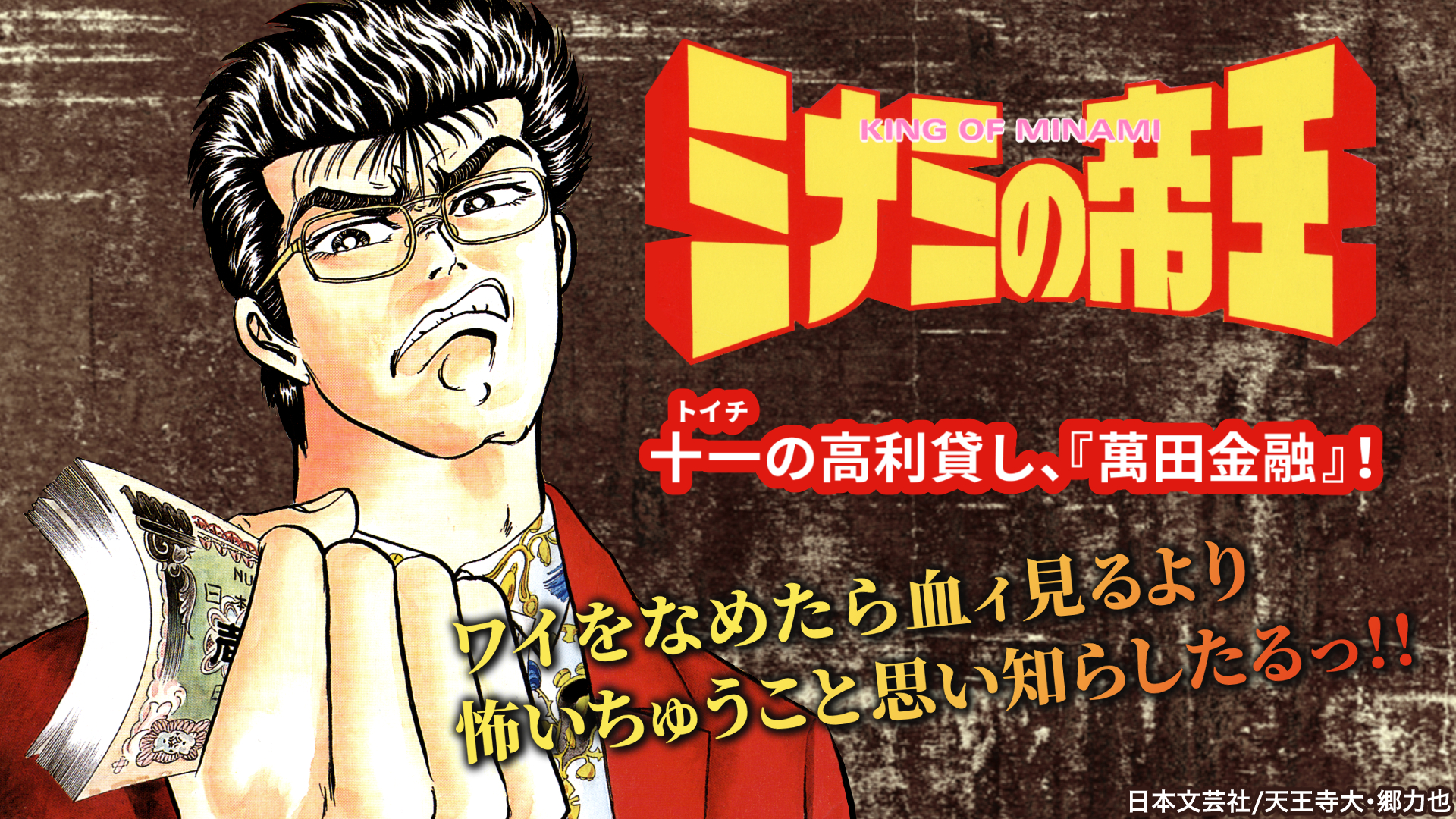
Namba Kinyu Den Minami no Teio" is a manga work written by Dai Tennoji and drawn by Rikiya Goh, and a series of works based on it. It is serialized in Weekly Manga Goraku. There is a live-action version of the manga, which is popular for its excellent performance by actor Riki Takeuchi.
The entire story revolves around Ginjiro Manda, the strongest moneylender in the history of Osaka's Minami district, and the "financial (zeni yoyaku) battle" that unfolds around him. The omnibus format allows players to enjoy "Zeni-related stories" woven by different characters in each scenario, with the exception of the main character.
Outline of "Naniwa Kyoden: The Emperor of Minami"
"Naniwa Kyoden: The Emperor of Minami" is a comic book written by Dai Tennoji and illustrated by Rikiya Go, and a series based on it.
It was serialized in "Shukan Manga Goraku" (Weekly Comic Goraku) in 1992, and gained great popularity because of its powerful style and the character of' Manda Ginjiro' (Manda Diary), the main character of the story, who was a moneylender like an ogre but had an Osaka-style sense of obligation and humanity.
There is also a live-action version of the film, cast by actor Riki Takeuchi, which is one of his most famous works.
The story is set in Minami, Osaka Prefecture, and features a full-length "Osaka Finance (Zeni Loan) Battle" centered around "Manda Ginjiro," the world's most powerful moneylender who goes to collect Zeni whether in prison or at the end of hell.
In addition, since the scenario itself is in the form of an omnibus, it is possible to enjoy' the story related to Zeni' interwoven by different characters in each scenario except for the main character.
One of the benefits of this omnibus style is that the work itself does not become obsolete over time (because current events such as financial troubles that are real problems can be used as hints for creation).
It adopts the so-called' Sazae-san Jikki' (Sazae-san space-time) in which the characters do not age even if real time passes.
However, because the world other than the characters advances according to reality, it is different from "Sazae-san" and "Doraemon," in which the world view of the mid Showa period continues forever.
"Golgo 13" can be cited as the work that expresses the most similar' feeling of the times.'
The main film adaptation of this film is a series of 60 live-action films starring Riki Takeuchi, produced by Toei.
While the story is basically based on the world view of the original, it is an original development. It is one of the representative works of Toei Movie.
However, only a part of the films were released in theaters, and most of them were released in' V cinemas' (films sold only by video and not released in theaters).
Therefore, the movie series of this movie should be collectively referred to as' the movie version' or' V cinema / movie version' instead of' the movie version.'
In addition, there is a TV drama version and a film version called "Shin Minami no Teio" (The Emperor of New Minami), which was produced after the film version, and it is a production of Kansai Television starring Chihara Junior.
Because the film had a strong image of Takeuchi as the leading actor, some fans were puzzled by Ginjiro performed by Chihara, but the original author Dai Tennoji highly praised Chihara's casting.
In addition, "Minami no Teio Zero" (The Emperor of Minami), which describes the period corresponding to the original edition by Young, exists as a production of Kansai Television starring Yutaka Kobayashi.
Outline and story of "Naniwa Kyoden: The Emperor of Minami"
The Manda Finance, which is run by Ginjiro Manda, is an extremely high-interest loan that pays 10 percent more than the principal in 10 days.
The Manda Finance, which ordinary people would never come up with ideas to approach, is attracting customers today as well.
They are "normal" people who are stuck in a situation where they can't even borrow money from a Ginjiro loan. Consumers also lend money to these people, even if the amount of money they lend is so large that major banks are reluctant to lend it to anyone they trust.
Manda Ginjiro looks like a god when he borrows money. But the interest is, as I said, first.
After only 10 days, the recovery of fear awaits.
If the Ginjiro can't even pay back the interest, he or she will recover the loan "by any means."
These means sometimes show the debtor the hells of the world, but strangely, they sometimes bring salvation.
It all depends on who rents Zeni, and on the flow of Zeni in this world.
Classic scenario of The Emperor of the South
Eleven Ginjiro
The first episode of the memorable original version.
Osaka Minami. Even today, there was a stupid man who had played in the store with only 10,000 yen and was beaten down by a yakuza.
He was a yakuza who was so violent that he thought he would die if he did more than this, but there was a way to stop him.
The owner of that hand is Ginjiro Manda.
He is such a big moneylender that even the Yakuza who had been butchering a stupid man earlier feared him.
There was a man named Tokunaga who borrowed money from such a Ginjiro and could not pay interest of 40000 yen.
He was deprived of his phone by a Ginjiro in exchange for interest, but he could not use it because it was in arrears. Enraged Ginjiro, however, tried to use it to make money.
"Because my cell phone didn't work, the negotiations went sour. I lost money from 5 million. Tokunaga-san, I'll have you pay for it. If you can't, I can take it from your daughter."
It was a hoax that the business deal went bust, but Ginjiro thought that Tokunaga would have to pay a lot of money if his daughter was taken hostage.
However, Tokunaga was beyond his imagination.
He said, "Do whatever you want," just because his daughter hasn't offered a penny since she came of age.
The Ginjiro couldn't hide his shock when he said something like "Oni-chikusho". Then, the money lender's heart was set on fire, saying, "Tokuei! Take it from me!"
As a result of Ginjiro's continuous investigation for collection, it was found that Tokunaga had a hidden account at a bank under the name of his daughter.
It was an account in her name that she did not even know existed. She had saved as much as 15 million yen.
When Ginjiro visited the house where his daughter lived, he told her about the situation (exaggerating the damage of 5 million yen as damage of 7.5 million yen) while showing the recording of the evidence, and he said, "I will give you half of it, 7.5 million yen, so I will collect the rest."
Then, the daughter, who was betrayed by her parents and got angry, cooperated with her.
The Ginjiro said,' Even if it is Tokunaga who is using the account, the name is my daughter's, so I can ask him to reissue the passbook and seal saying that I lost them,' and did so, and thus Ginjiro succeeded in obtaining 7.5 million yen from Tokunaga.
Black Funeral
One day, a man died in the hospital.
His father was the breadwinner of the family, and his wife and Koichi were the chief mourners.
Despite the grief of the two, the hospital left the Buddha to a designated funeral director to arrange the funeral. But there was a trap.
The hospital and the funeral company were working together, and Koichi, who knew nothing about the funeral industry, demanded 3.5 million yen in funeral expenses.
Although Koichi had originally chosen a funeral course of 700000 yen, he added five times the amount of money, with the plausible reason that the return gift and meal expenses for the funeral guests were not included.
Under Japanese law, there is no need to hold a funeral: only direct delivery (cremation) is required by law. In that case, the amount required is about 200000 yen.
Koichi could not prepare 2 million yen out of 3.5 million yen, so he had no choice but to rely on Ginjiro.
When I was young, I used Manda Finance when I needed 30000 yen for a pachinko loss, and I knew that Manda Finance would lend me not only 30000 yen, but any amount of money.
Along with reporting his father's death, Koichi asks his Ginjiro to borrow 2 million yen.
However, the first response that came back was the Ginjiro's comment, "Koichi, you've been ripped off."
Ginjiro lends 2 million yen to Koichi while explaining to him that the funeral industry is a world where there is no market price and there are many donburi accounts.
After that, Koichi got angry when he found out about the evils of the funeral industry, and if that was the case, he decided to establish a funeral company with clear accounting.
According to Ginjiro, the funeral industry is a world where the big companies can hardly monopolize the market with capital, and new companies have a good chance of winning.
It is estimated that he will need about 10 million yen in working capital to make a profit. Koichi applies to the Ginjiro for this debt, but the Ginjiro gently turns down the offer, saying, "There is a possibility that it will collapse due to interest." He then asks, "Are there any other places I can borrow money?" and encourages them to look for money.
As the Ginjiro said, Koichi searched where the money was and discovered that his father's life insurance policy was 30 million yen.
Using the 30 million yen as working capital, Koichi set up a funeral home and won the first client, using his clear accounting and management policy of "sincerely listening to the feelings of the bereaved family."
Then, he gained word of mouth with the novel idea of making his beloved four wheel drive car, which he loved, into a hearse.
Looking at his back, Ginjiro concluded, "-- Funeral fees. It's a world where a tremendous amount of money is being spent."
Scenario of the masterpiece of "Minami no Teio Young hen" (original version)
Concession airport
It was more than 10 years before "Minami no Teio" (The Emperor of the South) was published.
The story begins when Ginjiro Manda, the man who will be called' Emperor of Minami' (Emperor of Minami), steps down to Osaka-minami.
Ginjiro was penniless at this time.
When he was asked to pay 220000 yen at the Bottokuri bar, he couldn't pay it and said, "Do whatever you want."
However, Sawaki (who later became the leader of Sawaki-gumi and became a sworn friend of Ginjiro) who happened to be present at that time and was a member of the Sanshita Yakuza, helped Ginjiro.
Of course, he did not replace the money, but he went on a rampage like a yakuza and ran away from the store with Ginjiro.
However, Sawaki could not go against his brother and was beaten with a blunt instrument because he could not pay the deposit.
Sawaki is aiming to become the number one yakuza in Japan, but he says, "The yakuza has changed. What the yakuza will need from now on is the ability to make money on zeni!" It seems that because he doesn't have that ability, he hasn't been able to rise from the San-Shita Yakuza.
Ginjiro had an eye on Sawaki. He certainly didn't have the ability to make money, but instead he was popular enough to be known all over Minami.
The news of trouble between the administration and local residents over the purchase and sale of land for the construction of the airport was timely.
Ginjiro saw this as' a chance to raise the land,' and decided to raise the land with Sawaki.
However, Sawaki got angry because the Yakuza who had been the previous customers were forcing unreasonable demands on the residents residents of the land raising area, and Sawaki killed all the Yakuza who had been the previous customers.
Sawaki's actions earned the trust of local residents.
As a result, he finally got a concession on the land of the airport where hundreds of millions of dollars flowed.
"Naniwa Kyoden: The Emperor of Minami" (movie version) masterpiece scenario
Sweet trap
The screenplay for the fifth film, a particularly popular episode.
His son, Shigaki, who had mortgaged his parents' property and was still in debt, conspired with his mother, who was an acquaintance at a bar, to cheat Hanae, who was an okama, and paid him 10 million yen. However, he still could not repay his debt, and the building he had mortgaged was put up for auction.
On the other hand, Ginjiro also lent a large amount of money to Shigaki.
If Shigaki were to seize the building, he would not be able to collect it. For Ginjiro, it was necessary to prevent the building auction.
Ginjiro finds out that Toyo Finance, which is trying to win the bid for the building in Shigaki, is a dummy company of KYOEI Enterprise and a malicious building re-seller.
Before the building was seized, the Ginjiro took out a short-term rental agreement and had Shigaki sign it.
The contents were "Rent: 100 yen per month, three year contract". It was a dream contract for the existing residents of the building, and it is obvious that no one will move out.
Unaware of this fact, Toyo Finance won the bid for the building and attempted to resell it.
However, the Shigaki building, for which a short-term rental contract was signed, had become a burden that only required huge maintenance costs because of the law that allowed residents not to move out even if the building owner changed. Of course, resale becomes virtually impossible.
Panic-stricken, Ginjiro approached Toyo Finance and offered to sell the contract for the building in Shigaki for 100 million yen, and it was a great success.
Ginjiro, who earned a zeni like this, goes to Minami with his friends tonight.
"The New Emperor of Minami" (TV drama version) masterpiece scenario
Protect the flavor Ginjiro loved!
For some reason, a Ginjiro who was a loan shark had a customer who continued to pay a small amount of interest. The name is TAKEDA Hanao. He manages his father's legacy restaurant "Bistro Bamboo" along with his wife's apricot.
The Flower Man's purpose is Ginjiro himself.
In order to collect the interest, the Ginjiro came to the restaurant every ten days and tasted the food deliciously. This appearance was the highlight of Hanao's business.
Since then, bistro bamboo has prospered thanks in part to apricot's business acumen, but the pandemic has hit the world.
The city of Minami will also suffer serious economic damage.
Still, a few years after overcoming the crisis, Bistro Bamboo seemed to have regained its former liveliness.
One day, however, Bistro Bamboo was suddenly forced to close. The Takeda couple were grieving, but there was real estate investment behind them. Hanao was caught in this scam, and the closure was an effect of it.
Before long, Hanao faints from anxiety.
This brings to light the fact that many other stores in Minami were also victims of the same real estate investment. The architect is Kawakami.
When Ginjiro learned of this, he instigated an acquaintance, Hiroshi Madoka, who was a TV personality, to tell Kawakami that' Toyotomi Hidden Treasure' actually existed, and had him purchase the land for a large sum of money. The' Ukeko' at the time of purchase was Mr. and Mrs. Takeda.
The money went entirely to the victims, except for the amount of the Ginjiro's repayment.
In this way, Kawakami lost all her money at once, and Zeni's counter-punch was hammered into her.
"Shin Minami no Teio THE KING of MINAMI" (The New Emperor of Minami)
One day, Nashimoto (Kanji unknown), who is under pressure from Ginjiro to pay back his debts, is approached by Yabuta, who calls himself an aspiring management consultant.
Yabuta offers to cover Nashimoto's interest.
Nashimoto and Yabuta, however, are not close friends. They had never been friends before. Yabuta's actions were unprofitable, and Ginjiro wondered why Yabuta would do such a thing.
Later, Ginjiro meets Yabuta again in a shopping district in Minami. Yabuta seemed to be lending money to the Minami locals, just as he had done to Nashimoto.
At the same time, Ginjiro is asked by Uemura, who runs a Japanese sweets shop, to lend him money. Uemura says that he cannot close his store, which has been in business for 300 years, although his business has been suffering due to a series of unforeseen circumstances. In response, Ginjiro decides to provide the loan.
However, Uemura's wagashi shop is subsequently forced to shut down due to slander.
The culprits are two high school girls, Yuka and Mizuki, to whom Manda had previously lent money. They had repeatedly slandered Uemura's wagashi shop through an Internet site.
What was their purpose? Ryuichi, Ginjiro's younger brother, tried to get to the bottom of it, but Yuka and Mizuki insisted that it was journalism.
However, he soon discovers that the people involved in the land grab are in contact with Yuka and Mizuki.
The man behind all the commotion is a man named Yabuta.
There were plans to build a shopping mall on the land where Uemura's Japanese confectionery shop is located and the surrounding area. It comes to light that the people who own land in the Minami shopping district were, in essence, being lent money by Yabuta to evict them from their land.
However, Uemura was the only one who did not take a firm stance against eviction, so he was subjected to a malicious scheme using the Internet as described above to force his way out.
However, Uemura eventually relented, and Yabuta's goal was seemingly achieved.
Yuka and Mizuki's misdeeds (the destruction of the wagashi shop) also became public knowledge, and the two were punished by being slandered on the Internet, just as they had done in the past, by leaving the city of Minami.
However, Ginjiro did not intend for this to be the end of it. Ostensibly, he was afraid that Yabuta would only take his customers away from him if he continued. However, his words and actions reveal his true desire to protect the city of Minami and its people.
So Ginjiro introduces Yabuta to a man named Kubo. Kubo is a landowner in Minami.
Kubo is in cahoots with Ginjiro. Kubo offers to sell the land he owns to Yabuta, and Yabuta takes him up on the offer.
The real purpose of the project was to build a casino resort.
Yabuta was also connected to politicians.
However, Kubo appears before Yabuta, who is proceeding with the casino resort construction plan, and says that the land is still unsalable, just as he and Ginjiro had planned.
At the same time, Ginjiro confronts Yabuta with evidence that he has been illegally raising land (using Mizuki and Yuka to slander him), which he stole from Yabuta's office, and forces Yabuta to withdraw his plan to raise the land.
Mizuki and Yuka are also provided with an opportunity to apologize to Uemura through Ryuichi's arrangement, and are forgiven for their previous conduct by Uemura himself, who asks them to sample his new product.
Peace returns to Minami.
"Minami no Teio ZERO"
A TV drama produced by Kansai Television, starring Yutaka Kobayashi.
It was produced around the same time as "Shin Minami no Teio" (The Emperor of the New Minami), and as a world view, it describes an era equivalent to that of the original Young edition.
When Ginjiro was a child, his father, Koichiro, who ran a construction business, committed suicide due to a vicious financial scam by Akuto Shoji.
As a result, Ginjiro, who could not go on to high school, eventually became a thug who wandered around the South, and fell into a position where he could earn a daily living at a gambling house.
However, his fate changed drastically because he had a daughter of the president of Akutsu Shoji Co., Ltd., who was the victim of the incident disguised as a hitter.
Ginjiro uses his daughter to plot revenge against Akutsu Shoji.
After many twists and turns, Ginjiro learned a lot of knowledge, and eventually became famous as a management consultant. He approached Akutsu Shoji, pretended to help the company, and took revenge by forcing it to go bankrupt.
However, due to his actions until then, Ginjiro realized that' he could no longer enter the outside world,' and temporarily disappeared from Minami.
A few years later, Ginjiro appears again in Minami.
It was the image of Ginjiro Manda, who was the president of Manda Finance and feared as the demon of Minami.
"The Emperor of Minami" (OVA version)
An animated version of the original.
The story traces a period of the original version and is identical.
It is completely hidden behind the live-action version as a visualized work, and the opportunity to watch it is limited due to the lack of software.

Contents
- Outline of "Naniwa Kyoden: The Emperor of Minami"
- Outline and story of "Naniwa Kyoden: The Emperor of Minami"
- Classic scenario of The Emperor of the South
- Eleven Ginjiro
- Black Funeral
- Scenario of the masterpiece of "Minami no Teio Young hen" (original version)
- Concession airport
- "Naniwa Kyoden: The Emperor of Minami" (movie version) masterpiece scenario
- Sweet trap
- "The New Emperor of Minami" (TV drama version) masterpiece scenario
- Protect the flavor Ginjiro loved!
- "Shin Minami no Teio THE KING of MINAMI" (The New Emperor of Minami)
- "Minami no Teio ZERO"
- "The Emperor of Minami" (OVA version)
- Characters from "Naniwa Kyoden: The Emperor of Minami"
- Original version
- MANDA Ginjiro
- Ryuichi SAKANOUE
- Tatsuya SUGIMOTO
- Daiki SAWAKI
- Takei Yoko
- Chisato KUROSAKI
- Live-action
- MANDA Ginjiro
- Ryuichi SAKANOUE
- Tatsuya KANEKO
- Junpei TADOKORO
- Ryota
- Takuya Mizushiro
- Kohei SHINJO
- Makoto
- Ryo Misaka
- Hideo Sawaki
- Shoichi HIROSE
- Terminology of "Naniwa Kyoden: The Emperor of Minami"
- Manda Finance
- Zeni
- Kiritori
- Words, lines, scenes and scenes from "Naniwa Kyoden: The Emperor of Minami"
- Ginjiro "Everytime ~!"
- Ginjiro "DO N'T BOTHER ME."
- Ginjiro "I'll tell you that I'm lending money in Minami."
- "Naniwa Kyoden: Minami no Teio" (Naniwa Finance Story: The Emperor of Minami): Behind-the-Scenes Stories, Trivia
- "Emperor Mina" is a fantasy work
- Riki Takeuchi called "Gin-chan"
- Theme song and insert song of "The Emperor of Minami"
- OP (opening): Kanji Saito "Opening main theme"
- Theme song: "City of Desire" by Riki Takeuchi
- Theme song: "Kingu-king" by sensory piero