
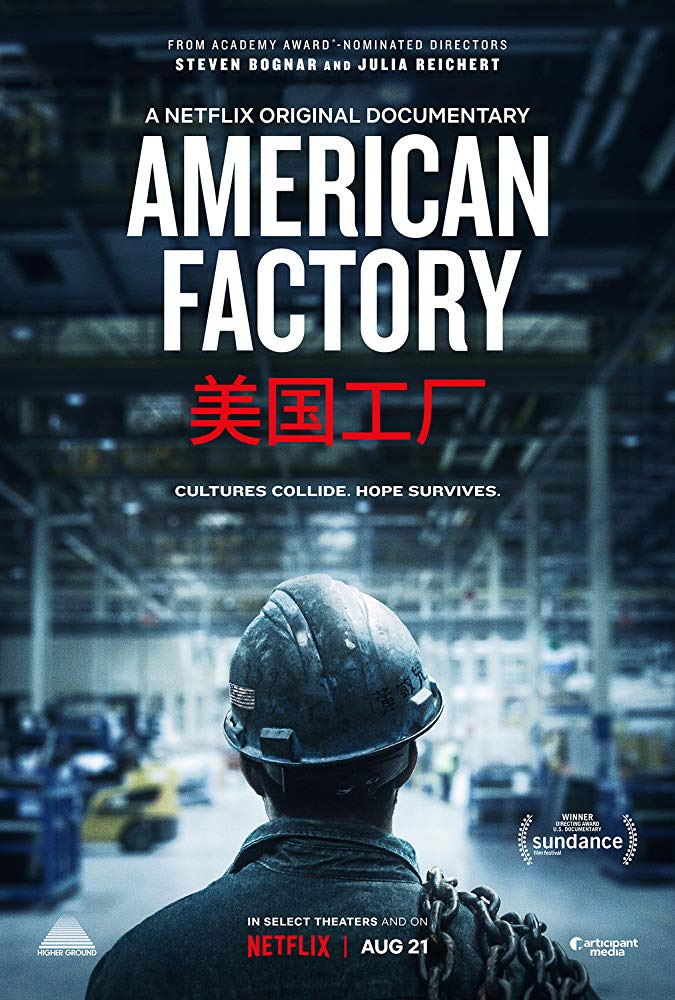
American Factory is an American documentary film. It is about an automotive glass manufacturing plant in Dayton, Ohio, U.S.A., operated by the Chinese company Fuyao, which acquired the former General Motors plant. It is the first film from Higher Ground Productions, the production company of Barack Obama and his wife Michelle, and was distributed by Netflix. A Chinese company moves into the site of a closed factory and reopens the plant, but the cultural differences and values between the locally hired Americans and the headquarters employees from China bring up a variety of problems.
Overview of American Factory
American Factory is a 2019 United States documentary film, the first film produced by Higher Ground Productions, the production company of Barack and Michelle Obama. The film is directed by filmmakers Stephen Bogner and Julia Reichart, who are known for their realistic portrayal of the lives of working class people and others living on the margins of society, and won the 2020 Directors Guild of America Award for Best Director.
The film also won the Academy Award for Best Documentary Feature, the River Run International Film Festival's Best Documentary, the Los Angeles Film Critics Association Award, and the Gotham Independent Film Award for Best Documentary.
The film premiered at the 2019 Sundance Film Festival, followed by distribution on Netflix on August 21, 2019.
The film tells the story of the redevelopment of a declining industrial area in the U.S., where Chinese money has come in and closed factory sites are acquired by the Chinese after the recession hits. In this film, the actual events that took place in Dayton, Ohio, where the General Motors plant was located, are seen as an opportunity to rehire Americans in order to reopen the plant. The film depicts the process in which the local residents are happy about it, but the harsh working conditions demanded by the Chinese management gradually cracks the relationship between the two sides.
The documentary received a high 97% rating on Rotten Tomatoes, a website that compiles reviews by film critics.
The town of Dayton, Ohio, was originally home to a General Motors (GM) plant that employed many of the local residents, but when the plant closed due to poor performance, the employees lost their jobs. Many GM employees were unable to find new employment, but in 2015, Fuyao, a Chinese automotive glass manufacturer, invested heavily to establish an American plant, bought the former GM plant in Dayton, and the former plant is now operating as Fuyao America Glass. In the early part of the film, the inauguration of the new plant is well received by the local residents, who are looking forward to a bright future as they are able to find work again after being unemployed since the closing of the GM plant. The American employees gradually get to know their Chinese colleagues, even if awkwardly, and warm-hearted exchanges take place outside of work, such as invitations to home parties. However, as time goes by, the differences between the Chinese and American cultures and mentalities gradually widen the gap even in the work scene. They have fundamentally different ideas about work and the company. Troubles began to arise one after another. Finally, the workers and the management were at loggerheads over union membership, and demonstrations were held inside and outside the factory.
The cause of the rift between the workers and Chinese management was the Chinese management's refusal to understand the cultural differences and their imposition of Chinese ways on Americans. Employees were paid far less than the average American salary, and the work was so demanding that they were unable to take time off. Workplace accidents occurred frequently, and the level of work was at a level that would be recognized as a black company in the American way of thinking. The Chinese management believed that the Americans were treated better than the employees at the Chinese headquarters, and they hoped that by hiring them with better treatment, there would be no conflicts with the management and productivity would increase. To the Chinese, a worker is someone who works hard for the company, and they could not understand Americans who work only 8 hours a day, 2 days a week.
In order to improve the company's deteriorating performance, the American supervisor was invited to the Chinese headquarters for training, but the American was stunned by the Chinese employees he saw there. The way they lined up and shouted at each other in the morning meeting was like an army. The Chinese New Year party, which was attended by all employees, was grandly held in the factory, and at the party, several couples were married. It was an international situation that transcended the company, clearly highlighting the difference in national character between the democratic U.S. and communist China. However, as a company, we could not afford to say such a thing. The two sides needed to cooperate and work together somehow, but it was not going well. After the training in China, an American supervisor returned to Dayton and tried the Chinese morning ritual, but it did not go well.
The Chinese held seminars and workshops to get to know the Americans, but it was not enough to repair the deep rift between the two sides. Another problem was labor unions. In the U.S., labor unions were important organizations that protected workers' rights, but the Chinese side was completely uninterested in labor unions, saying that they were only a negative factor in the company's development. China has labor unions, but unlike American labor unions, Chinese labor unions are there to protect the company. Fu Yao was so thorough that he hired a union-avoidance consultant to hold seminars for employees.
The chairman of the board, Tsao himself, is a pious man who fondly remembers his poor but happy childhood and is not a bad guy, but as a manager, he has to adopt a cold-hearted approach when he tries to generate global profits.
Before shooting "American Factory," Stephen Bogner and Julia Reichardt had also shot "The Last Truck," a documentary about the closing of a GM assembly plant at the same plant that was an advance on the Huayao America plant. This documentary film about what happened to Dayton has a political message about the reality of rapid globalization in the U.S., where manufacturing has come back to town, but not in the same way as in the past.
Outline and story of "American Factory"
GM plant closure
On December 23, 2008, a meeting was held in a snow-covered square in Dayton, Ohio, for Dayton residents worried about their future.
On this very day, the GM factory, where local people had been working to support the city for many years, was closed due to the recession. The closure of the GM factory left 10,000 people unemployed and most of them unable to find a new job.
Around 2010, Chinese companies began to invest in manufacturing in the United States and to reopen closed factories. On the other hand, glass factories in China are still operating at full capacity as they continue to finish glass through automation.
Entry of Chinese companies
In 2015, a young Chinese couple who had just arrived in the United States sat shoulder to shoulder, looking at the city and talking. They were sent from the Chinese company Phu Yao, which is newly entering the site of a GM factory in Dayton.
Phu Yao, a Chinese automotive glass manufacturer, purchased the site of the GM factory and immediately held a job fair for local Americans.
Phu Yao is a giant with a 70% market share in the automotive glass industry. Since the aim is to fuse two different cultures by entering the United States, they also employ Americans at the top.
Phu Yao, a Chinese company, was steadily getting ready to start work, and the day had come for hired employees to enter the factory. Hired American employees were very happy to be able to work again.
High expectations for Phu Yao
The city of Dayton has named the road where the factory is located "Phu Yao Avenue" to mark the factory's inauguration.
Chairman Huyao and Chairman Tsao, who visited the plant, declared that they would bring more equipment to the vacant lot in the plant and increase production by the end of the year.
At the beginning of the plant's reopening, the relationship between Tsao and American employees was good, but from this point on, Tsao had no good impression of Americans.
During his tour of the plant, Tsao gave instructions, saying, "Americans are slow at work. Maybe it's because their hands are big. From now on, make a pair of Chinese and Americans, and let the Chinese keep an eye on the Americans and let the Americans do their real work." The Americans were not aware of Tsao's thoughts and expected a bright future.
After completing his tour of the plant, Tsao goes to see the site of the ground-breaking ceremony. For the ground-breaking ceremony in October, the American executives suggest a roof for the rainy weather, but Tsao insists that it is unnecessary and goes to see the outside of the plant.
Time of Phu Yao
The purchase of the factory by the Chinese was widely reported in the newspapers. Phu Yao operates under the policy of not forming a labor union. The whole of America was watching Phu Yao's future.
After Tsao's speech, Ohio Senator Sherrod Brown greets the ceremony.
However, Senator Sherrod said in his speech, "This plant should join the union, just like other American plants," and declared, "Whether to join or not should be decided by voting." The Chinese side became angry and disgruntled when they heard this story, because they brought up the story of the labor union that Tsao denied in public.
At a press conference after the ground-breaking ceremony, Tsao will refrain from responding to a question about the labor union that Sherrod mentioned, and executives will seek ways to address the issue.
At a management meeting held after the meeting, Tsao declared that he had no intention of forming a labor union that could have an impact on production or damage companies. Tsao went so far as to say that if he formed a labor union, he would close the plant.
However, Tsao has not calmed down yet. He continues, "The labor union is hindering my production and gradually increasing the company's losses. If the current president, John, wants to protect his post as president, listen to my advice carefully."
A small crack
At the site, the person in charge said, "Every piece of glass is one piece. Each piece of glass is delivered to the customer at a high quality and reasonable price, and this leads to trust. That's why you should produce each piece with all your heart."
On the production line, however, there was a problem, and the glass that came out shatters to pieces. On this day, a Honda employee was visiting the factory, and the incident in front of the inspection team.
Jimmy, the Chinese vice president, says that production volume and speed are the most important things. A long-time factory worker says, "The quality control department and the Chinese production department don't agree, and we stand between them."
In the factory, John, who is in charge of safety management, measures temperatures at various places with a thermometer and checks them. There are some departments that are far from the safety line, and he judges that a solution is necessary.
While touring the premises with Tsao, Tsao asks Jimmie if there are any complaints from Americans. Jimmie explains that there are complaints from employees working at high temperatures and says he will do as much as his budget allows.
"Each Chinese must make some kind of contribution to their country," Tsao said at a meeting of Chinese employees. "Now is your chance. The American employees are not capable enough, and if the union intervenes, it will be even worse for the company." Tsao returned to Beijing.
Visit to Chinese headquarters
American supervisors from various departments of the Phu Yao factory visit Phu Yao, China. After a joint meeting with the head office, they take a factory tour of the head office. The American supervisors enthusiastically observe and video the work of the Chinese people.
During the afternoon tour, Americans were stunned by the Chinese employees' roll calls and greetings. They stood in a row and shouted, "What a surprise!"
A local Chinese employee and an American employee Kurt are talking about the problems in the American factory. First of all, the Chinese are talking about the differences in working arrangements.
In the United States, there are 8 holidays a month, but in China, there are only 1 or 2 holidays a month, with a 12-hour shift. An American employee who heard this said the problem was still working for money.
Then came the day of the big Chinese New Year event. The big venue was filled with singing performances and dance performances. Thus, the event ended with great success.
A deepening trench
At the American factory, complaints from American employees gradually built up. Curt returned to America after completing his inspection in China. Curt immediately changed his pre-work meeting to the Chinese style of standing. However, the meeting was not as disciplined as it was in China, and it was completely different.
In the U.S. factory, there were many problems related to safety, such as the fact that there was no emergency exit and that the safety of the workers engaged in transportation was not considered.
At the factory, people were gathering to demonstrate that they should join a labor union. On the other hand, an American union avoidance consultant from China is giving a lecture on the negative points of labor unions.
In the midst of all this, Chairman Tsao came to the American plant from the Chinese factory. He said, "In order to avoid this kind of problem, we have appointed Americans as managers and supervisors. But what's going on?" and left.
At the plant, Chairman Tsao has been holding meetings with Chinese employees. He says the new management structure will be realized in order to make profits positive. He introduces Jeff Liu as the new president.
Tsao abandoned the American management team and replaced it with a Chinese management team.
At a Christmas party held at the plant, the new president, Jeff Liu, urged everyone to join forces and work as one, and Tsao was also present.
The walls of culture were thicker than I had expected. Chinese employees attend seminars on American culture and how to use Americans well.
American employees were getting more and more frustrated, and even Chinese employees were being blamed for being called foreigners by the Chinese even though they were working in America, and for instructing them to work without taking a lunch break.
When American employees gathered together to exchange opinions about the company, the two sides remained at the same level. However, demonstrations of labor union participation are spreading day by day.
Because the relationship with the American employees is not going well, the Chinese side has another meeting, but they instruct the Chinese employees to raise any problems each time.
Conflict over trade unions
The discontent on the American side was getting bigger and bigger. One day, many American employees were attending a meeting of the United Auto Workers in Dayton for Phu Yao employees. Participants reported the current situation of the working environment in Phu Yao.
As he reported, his complaints went on and on. He insisted that he had to join a labor union to protect his employees' rights. The American employees were determined to continue this fight until they won.
In the end, the Chinese management decided to compromise by raising the salaries of all employees by $ 2, but the American employee looked coldly at it, saying, "They are calling for union membership instead of pay increases, but the management doesn't know anything."
Outside the factories, labor union demonstrations continue to heat up. They say it's their right, but Chinese don't even look at it.
However, some American employees were less interested in unionizing, so there was a split among American employees.
Tsao was forced to go to the United States unexpectedly due to the heated labor union issue. Even so, Tsao insists that the factory is an American company and will operate according to American culture. Outside the factory, pro-labor union protesters were still holding placards.
Finally, a vote was held to vote for or against the union. As a result of the vote, participation in the union was rejected by a majority. The Chinese employees were pleased with the result with a fist pose, and the American employees were lowering their shoulders.
The Path of Phu Yao
The day after the union vote, Jeff Liu, president of Phu Yao, spoke at a gathering of all Phu Yao employees, urging them to work together to restore America to its former glory.
Tsao visited Chinese temples and reminisced about his childhood, when he suffered from poverty but was happy.
At the Phu Yao plant in the U.S., Chairman Tsao came to inspect the plant again. He said the plant was being automated. By firing workers one after another and replacing them with machines, there would be no stress associated with the work.
The narration begins. "By 2030, 375 million people around the world will need to find jobs in different types of jobs due to automation. How governments, companies and employees cope with this dramatic change will be key."
"Finally," he concluded, "the Phu Yao factory in America has been in the black since 2018. But salaries are still $ 14 an hour. There are now 2200 Americans and 200 Chinese working at the factory in Dayton."
American Factory characters
Chinese side
Chairman: Tsao Durwan

Contents
- Overview of American Factory
- Outline and story of "American Factory"
- GM plant closure
- Entry of Chinese companies
- High expectations for Phu Yao
- Time of Phu Yao
- A small crack
- Visit to Chinese headquarters
- A deepening trench
- Conflict over trade unions
- The Path of Phu Yao
- American Factory characters
- Chinese side
- Chairman: Tsao Durwan
- Jeff Liu, President
- Vice President Jimmy Wang
- American side
- Early President John
- Dave Burrows, Executive Vice President
- American employee Bobby
- American employees ショニー
- Jill, an American employee
- Chinese Employee Won
- Rob, an American employee
- Term "American Factory"
- Twinkie
- UAW local 696 Hall
- General Motors
- Dayton
- "American Factory"'s words, lines, scenes and scenes
- Seminar instructor: "You can make people laugh by using the president as a story."
- Chairman: "When in Rome, do as the Romans do."
- Former President John: "Every single piece of glass is a single piece of glass. Each piece of glass is delivered to our customers at a high quality and reasonable price, and this leads to trust."
- "We are genuine Chinese. No matter where we die or where we are buried, we are Chinese."
- John Lahr Pierre: "We are part of one great planet. We are separated for some reason, but the world is one."
- "American Factory" Inside Story, Trivia, Small Story / Episode, Anecdote
- Interview with the Obamas and Steven Bognar & Julia Reichert
- Obama's Instagram Tweets
- About Production
- Difficulties in filming documentary films