
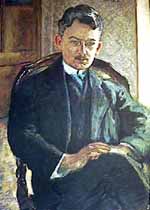
This page summarizes the color values necessary to determine the three-dimensionality of a work of art. Color value sounds difficult?
Don't worry. I was one of those people, but I came to understand it while making this summary.
So I think you will get the gist of it after reading this.
What is color value?
An art term referring to spatial composition through interrelationships and contrasts of [color] in a painting.
Source: artscape.jp
The visual intensity of one color compared to another in relation to the colors on the screen, expressed as a higher or lower color value (also known as valure in French).
Source: kotobank.jp
It's kind of a difficult story.
It is also useful to remember the concept of valure (color value), which originated as a technique for adding depth (thickness) to a painting.
Source: hiroce.net
I see. That makes it easier to understand.

It seems that the famous mark can also be explained by color value.
For example, the following jigsaw puzzle, which is also on the top page of Wikipedia, is a good example.
←This is a spherical jigsaw puzzle (globe jigsaw),
If each piece of the puzzle is colored red, blue, yellow, green, orange, and so on
Even if the puzzle pieces are colored red, blue, yellow, green, orange, and so on, they appear to be spheres,
The puzzle appears to be spherical (i.e., each color does not look uneven).
"The rules are correct (i.e., the rules are not crazy)".
Do you understand what I mean?
Source: earth2010.exblog.jp

From the color value page mentioned earlier.
In other words, the Wikipedia flower above looks rather flat because of its low color value, but this flower looks three-dimensional because of its strong color value.
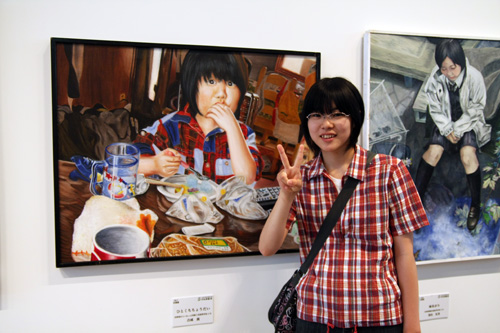
There are, of course, two-dimensional works that appear three-dimensional because of their high color value.
For example, the painting in this image.
It does not look less three-dimensional than the person reflected in the image.
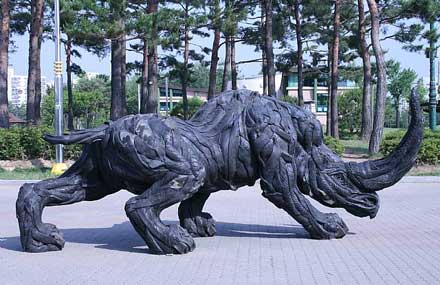
A competition of three-dimensional objects (nature and sculpture). Which looks more three-dimensional to you?
For me, the sculpture that occupies a larger percentage of the foreground and has clear dark/light areas looks more three-dimensional.
I was surprised that I could not understand the color value at first, but now I can understand it by unraveling it in this way.
By controlling the color value, even a three-dimensional object can become flat. I found it interesting that even two-dimensional objects can be made three-dimensional.
Also, sculptures are not so colorful, but rather white or light-colored, so the impression that the color value is low may tend to prevail.
