
The SCP Foundation is an occult shareworld set in a secret organization, the SCP Foundation, whose purpose is to "secure," "house," and "protect" goods, objects, places, phenomena, and concepts that cannot be explained by modern science, away from the eyes of ordinary humans. It is compiled on an official wiki in the form of reports detailing "SCP objects," which are anomalous entities, numbering more than 10,000 worldwide. The "headquarters" is located in the United States, the birthplace of the SCP Foundation, and there are "branches" all over the world, including Japan.
The object class currently attached only to the SCP object, often representing a change in the object class as a result of changed as a result of an abnormality in the SCP object that has affected the entire report. Well-known examples include' A winged mummy that grows wings from the back of someone who stays near it and becomes a person who blindly believes in the resurrection of angels. The object class is Beautiful (SCP-2690 Angel's Tongue)' and' A small squid that forces people who are nearby or know about it to think that it is a very friendly and friendly person. The object class is BFF / Zuku-tomo (SCP-2790 Squid Friend).'
No Object Classes
There is an SCP object whose object class is "None" or "N/A" because it is not an object, it cannot be assigned an object class due to an abnormality of the object, it is distinguished as not being an object class, it is a special report in which the reader decides the object class, or there is no item to which an object class is assigned because it is not a report of a foundation in the first place.
Removed Object Classes
Decommissioned (デコミッションド)
An SCP object that is intentionally destroyed or killed by a foundation, for example, because it "does not make sense to keep it". The number of the destroyed SCP object is followed by the letter -D (for example, SCP-083-D).
In fact, this object class, which was heavily posted in the early days of the SCP Foundation, was an object class for SCP objects deemed uninteresting by readers, such as monotonous and boring objects, rip-offs of existing SCP objects, and simple vampires with no twist, and was an extremely disgraceful object class for the creator. However, a short story posted by a certain person, "Foundation employees work hard to destroy SCP objects of the Decommissioned class," became popular, and many people intentionally posted SCP objects of poor quality in response to a request to "destroy their own SCP objects," so the Decommissioned class itself has been removed.
Anomaly Classification System / Anomaly Classification System (ACS)
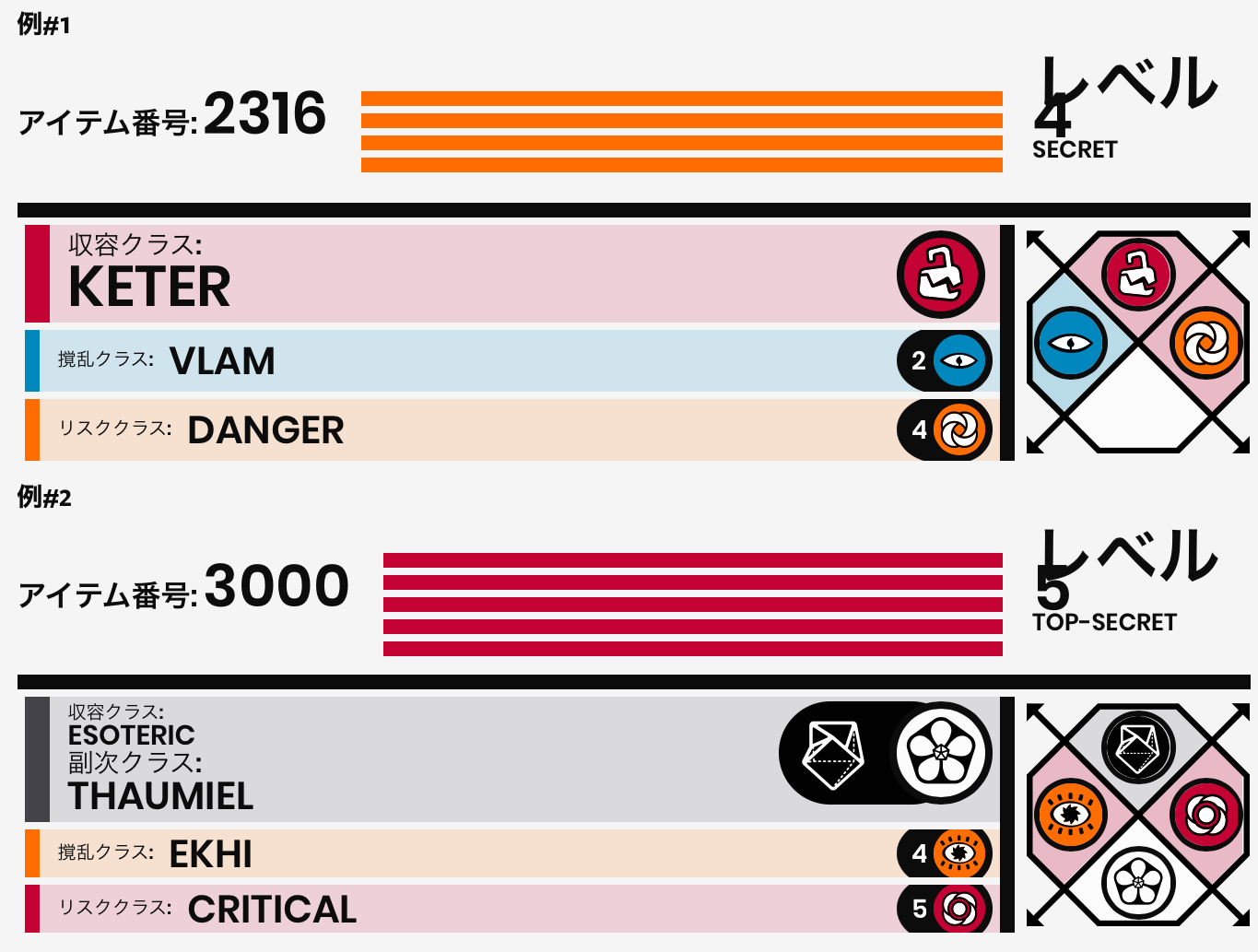
An Example of an Anomaly Classification System (ACS)
The "Anomaly Classification System (hereinafter referred to as ACS)" is a method of classification different from the conventional object classification method, which is mainly used for some SCP object reports in the 3000 and 4000 series. Originally, only two pieces of information, "item number and object class," are listed at the top of the report. However, the report using ACS has five pieces of information, "clearance level, accommodation class, disturbance class, risk class and subsidiary class," and more detailed information than before can be confirmed at a glance. However, many people say that it is "difficult to understand" due to the large amount of information at a glance.
Clearance level
SCP Object Indicates the extent to which the report can be viewed. A clearance level is set for each employee of the SCP Foundation, and the information that can be disclosed and viewed differs according to the level. The maximum clearance level is 5.
The following elements are described.
・ Level 0: official use only
The lowest level of information that is permitted to be disclosed to all foundation employees.
Level 1: Internal confidential information
Information that the administrator or janitor of the foundation must know.
Level 2: Minimum level of confidentiality
Information that can only be viewed by personnel at clearance level 3, or by persons authorized to do so by personnel at clearance level 3. Personnel at clearance level 3 include researchers objects.
・ Level 3: Confidential
Information available only to personnel at Clearance Level 4 or authorized by such personnel. Clearance Level 4 personnel include high-level personnel, such as the director of the facility or members of the foundation's administrative staff.
・ Level 4: Top Secrets
Only members of the O5 Council (an executive body composed exclusively of clearance level 5 officials) are allowed access to this information. Officials at lower clearance levels are prohibited from attempting to access this information.
・ Level 5:Thaumiel
Information about the SCP object of the Thaumiel class. Only O5 can access this information.
Accommodation class
Of the SCP Foundation's principles of "securing, housing and protecting," the difficulty level of "housing" is shown. Major object classes such as Euclid and Keter are used.
The following elements are described.
・ Safe
An object for which safe accommodation has been established.
・ Euclid (Euclid / エウクリッド)
An object that is not predictable, but is reasonably contained.
・ Keter
An object that is extremely difficult or impossible to contain.
・ Neutralized (ニュートラライズド)
An object that has lost its abnormality for some reason.
・ Explained (Explained)
An object that is no longer considered abnormal.
Disturbance class
Indicates the degree of difficulty of "secure" in the SCP Foundation's philosophy of "secure, house, and protect," indicating how much there is a risk of exposure and exposure to the public if an SCP object escapes and becomes unhoused. In some reports, it is treated as a "destruction class" rather than a disturbance class.
The following are the listed elements, all of which are related to' brightness':
- Dark
When an object becomes uncontained, the impact is small enough that it is not worth considering, so foundations can easily be rehoused or the impact can be faked.
・ Vlam
When an object becomes uncontained, it can affect a localized area. The name Vlam comes from the Dutch word "flame."
・ Keneq (ケネック)
If an object becomes unhoused, it can affect an entire city, and the foundation will have a hard time rehousing it. The name Keneq comes from the アリュティーク word "campfire level fire."
・ Ekhi
When an object becomes uncontained, it can have an impact at the national level, and since it can of course be known to the whole world, it is quite difficult to rehouse or neutralize it. Ekhi is derived from the Basque word "sun".
- Amida
If an object becomes uncontained, it could affect the entire universe, let alone the world. The origin of Amida comes from "immeasurable light" which is also the origin of the name of Amida Nyorai.
Risk class
Indicates the degree of difficulty of "protection" from the SCP Foundation's philosophy of "securing, accommodating, and protecting" and indicates the degree of danger of the object itself.
The following elements are described.
・ Notice
An object with a level equal to no risk.
・ Caution (caution)
An object that is not without danger, but is safe if handled with care.
- Warning
An object that is close enough to have a slight influence.
・ Danger
An object that is highly dangerous to approach.
- Critical
A dangerous object with an unrecoverable level of impact. According to the author who invented ACS, it is better to be able to die.
Subclass
Indicates a secondary object class that is not the primary object class, including the so-called special object classes. In addition, the Thaumiel class is treated as a secondary class in ACS.
The following elements are described.
・ Apollyon (Apollion)
An object that not only has the power to destroy the world, but is "too late" to be secured, housed, or protected. Apollyon is derived from the Greek word for "destroyer" and from the Hebrew theology for "Apollyon", which stands for Abaddon, the Fallen Angel connected to Hell.
・ Archon (Alcorn)
An object that can be accommodated but is not intentionally accommodated due to an abnormality in the object. Archon is derived from the Greek word for "ruler," a title given to the highest consul in ancient Greece.
・ Cernunnos (Kernunnos)
An object that can theoretically be accommodated, but that cannot be accommodated because there is a problem with the way it is accommodated. It is a provisional object class, and the object class is changed as soon as it is accommodated. Cernunnos is derived from the names of the god of hunting and the god of the underworld in Celtic mythology.
・ Hiemal (Himaru)
An object that must be housed separately because several interrelated objects are suppressing each other's anomalies. Hiemal is derived from the English word "Hiemal," which means winter weather.
・ Tiamat
Apollyon An object that is said to be one step short of danger, but still has ways to deal with it. Tiamat is derived from Tiamat, the god of the sea in the Mesopotamian myth.
・ Ticonderoga
An object that cannot be accommodated but does not need to be accommodated, indicating "between accommodated and unaccommodated." A provisional object class that is immediately reclassified as Keter if something goes wrong. Ticonderoga is derived from the Native American Iroquois word for "between two lakes."
・ Thaumiel (タウミエル)
Although it is a major object class, it is classified as a minor class in ACS. An object that can override or disable a Keter-class dangerous object. It is the foundation's last card, and only a few people within the foundation know about its existence. The name of Thaumiel comes from タウミエル, the name of the devil at the top of the evil tree that is paired with Ketel, the devil at the top of the tree of Sephiroth in Christian mythology.
Representative SCP object of the SCP Foundation
SCP-173 Sculpture - Original
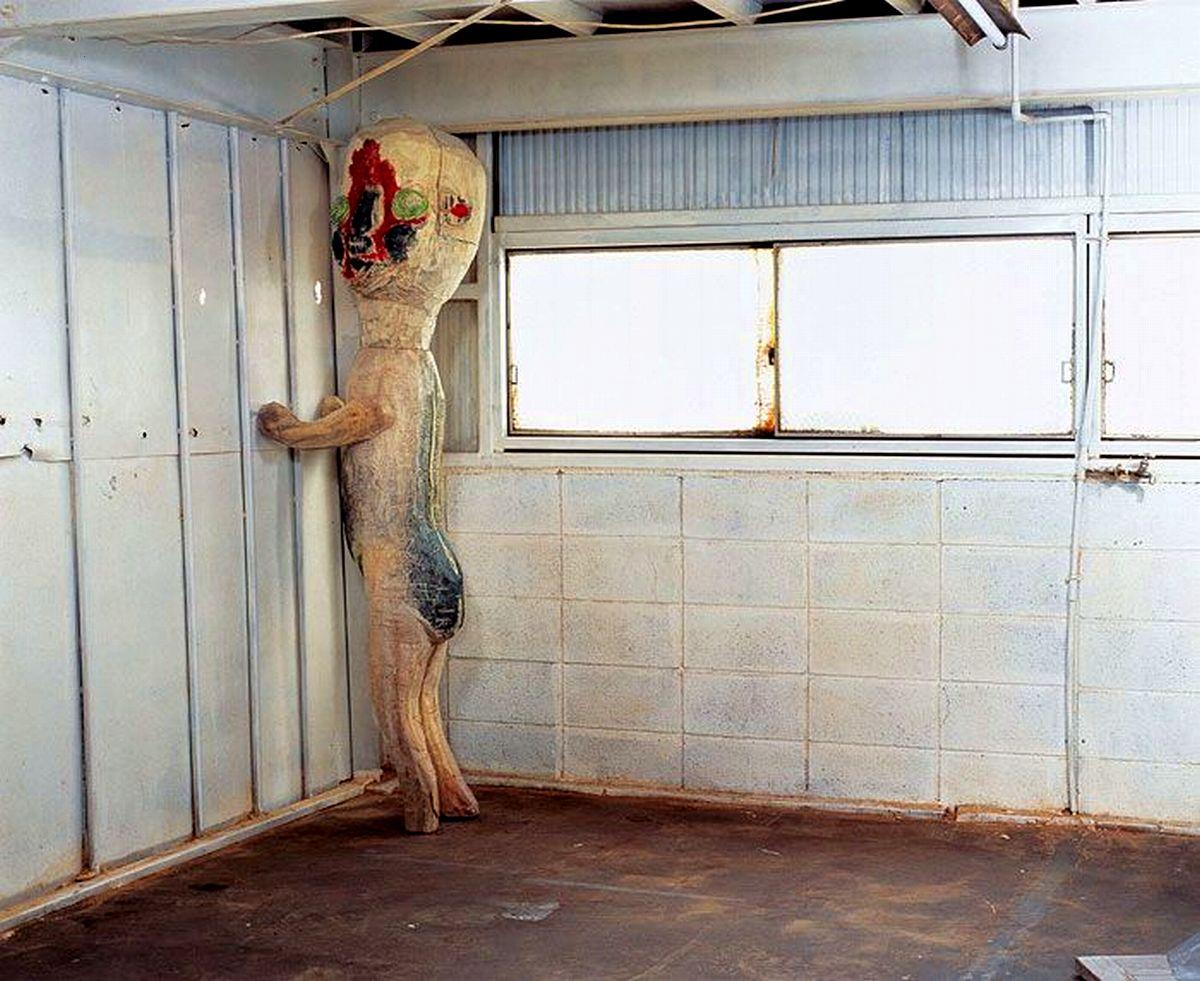
SCP-173
Object classes: Euclidean
It is a sculpture made of ferroconcrete, but it is alive and has something like its own self. If you look away from this sculpture even for a moment, it moves at a high speed and kills the person who looks away by bending the neck. It does not move at all while looking straight, but it moves at a high speed even when you blink, so it is unpredictable. The SCP-173 is dripping a mixture of blood and excrement and must be cleaned regularly inside the container in which it is housed. At all times, three staff members enter. While one person is cleaning, two staff members look directly at the SCP-173 and give a signal when they blink.
SCP 173 is the first SCP object to be written. It has many features that make it easy for SCP beginners to understand, such as easy-to-understand abnormalities, eerie images, and short sentences. Since it is an SCP object created in the early days of the SCP Foundation, it does not fit the current writing style (the word "foundation" does not appear, there is no experimental record, etc.), but it remains because it is the first SCP object.
SCP 682 The Immortal Reptile

Related Articles
Recommended SCPs at my own discretion, Part 5
I changed the title a bit, but it continues. SCP refers to objects, places, and organisms that are beyond the reach of human knowledge. The existence of SCPs is kept secret and managed by an organization called the "SCP Foundation. The existence of SCPs is kept secret and they are managed by an organization called "SCP Foundation", to which they are assigned a code in the form of "SCP- (number)". (SCP stands for "Secure, Contain, Protect.")
Read Article
Recommended SCPs selected by my own judgment and prejudice No. 6
SCP refers to an object, place, or organism that is beyond the reach of human knowledge. The existence of SCPs is kept secret and managed by an organization called "SCP Foundation. The SCPs introduced here are all animal-shaped SCPs. They are SCPs, but don't you think they are cute...?
Read Article
Did you know... the charm of SCP, part 1?
Have you ever heard of SCP? SCP refers to objects, places, and organisms that are beyond the reach of human knowledge. Their existence is kept secret and managed by an organization called the "SCP Foundation. They are then assigned a code in the form of a "SCP- (number). SCP stands for Secure, Contain, Protect.
Read Article
SCP's Attraction for Trial Readings Part 3
SCP refers to objects, places, and organisms that are beyond the reach of human knowledge. Their existence is kept secret and managed by an organization called the "SCP Foundation. In this issue, we will mainly introduce SCPs, which are paranormal beings.
Read Article
Attraction of SCP Part 2
SCP refers to objects, places, and organisms that are beyond the reach of human knowledge. Their existence is kept secret and managed by an organization called the "SCP Foundation. We would like to introduce mainly artifacts.
Read Article
There is more to SCP, Part 4.
SCP refers to an object, place, or organism that is beyond the reach of human knowledge. The existence of SCPs is kept secret and managed by an organization called the "SCP Foundation. This time, there are many parts of the SCP that I personally recommend in particular. Please take a look through it!
Read Article
Tags
Contents
- Overview of the SCP Foundation
- Object classes used by the SCP Foundation
- Main object classes
- Safe
- Euclid / エウクリッド
- Keter
- Neutralized (ニュートラライズド)
- Thaumiel (タウミエル)
- Secondary object classes
- Explained (Explained)
- Apollyon
- Anomalous Item (アノマラスアイテム)
- Special object classes
- No Object Classes
- Removed Object Classes
- Decommissioned (デコミッションド)
- Anomaly Classification System / Anomaly Classification System (ACS)
- Clearance level
- Accommodation class
- Disturbance class
- Risk class
- Subclass
- Representative SCP object of the SCP Foundation
- SCP-173 Sculpture - Original
- SCP 682 The Immortal Reptile
- SCP-871 Good Business Cake
- SCP 2000 Clockwork God
- SCP-3519 Quiet Days
- SCP 4999 What watches over us
- SCP-8900-EX Blue, blue sky
- Representative SCP object of the Japan branch of the SCP Foundation
- SCP-040-JP Cat. Nice to meet you.
- SCP-268-JP Never-ending heroic tales
- SCP-280-JP shrinking space-time anomaly
- SCP-444-JP ■ ■ ■ ■ (Access Denied)
- SCP-587-JP Not a corpse
- SCP 1475, target North Carolina.
- SCP-2000-JP Courier
- Representative SCP objects from SCP Foundation branches in other countries
- SCP-CN-994 I found it.
- SCP-101-FR Private Place
- SCP Foundation's leading caution group
- World Occult Association
- The Factory
- Dr. Wandersteinmeint.
- Church of the Broken God / Mecanite
- Snake Hand
- Marshall Carter & Dark Co., Ltd.
- Prometheus Laboratories, Inc.
- Are We Cool Yet?
- Mana Charity Foundation
- Surkick Cult
- Gamers Against Weed
- Shark punch center
- Chaos インサージェンシー
- University of Alexylva (University of Alexandre)
- Federal Bureau of Investigation, Unusual Case Division
- Ambrose Restaurant
- Anderson Robotics
- Arcadia
- Black Queen
- Chicago Spirit
- Second Church of Hytus
- University of Deer
- Fifth Church
- "P" Department, General Intelligence Directorate, General Staff of the Russian Federation Armed Forces
- Herman Fuller's creepy circus
- Boundary initiative
- Extraordinary Case Investigation Bureau of the Empire of Japan
- "Nobody."
- Islamic Artifact Development Office (ORIA)
- オネイロイ Collective
- Parawatch
- Three Months Initiative
- Wilson's Wildlife Solutions
- Representative Organizations of the SCP Foundation's Japan Branch
- Japan Soc. of Bioagricultural Sciences
- Shushuin Temple
- "Doctor."
- Meitegai (Drunken Street)
- Sekiryu Club
- Kisaragi Komuten
- East Japan Heavy Industries
- 犀賀 School
- Special Medical Unit of the Imperial Japanese Army (Dainjapanese army special medical unit)
- Iwanaga Beauty Association
- The Peace, Amity and Friendship Treaty Organization of Japan
- Yumemi Technology
- Trismegistos Translation & Transportation ((Ttt)
- Koi 昏崎 Shinco., Ltd.
- Maboroshi Island Alliance
- Special Affairs Division, Public Security Department, Metropolitan Police Department
- Yami-zushi
- Mujingetsu Doshu
- Elma gakyō
- Kamikeshi Ichizoku
- Life raft
- Imaginanimal (イマジナニマル)
- Tono Yokai Sanctuary
- Employees of the SCP Foundation
- Researcher / Doctor
- Field agent
- Mobile unit
- Class D staff
- "Administrator"
- Site Administrator
- O5 Council
- Ethics Committee
- K-Class scenario from the SCP Foundation
- AK-Class: End-of-World Scenarios
- CK - Class - Rebuild Scenario
- GH-Class: "Dead Greenhouse" scenario
- IK-Class: Scenario of the collapse of world civilization
- NK-Class: End-of-World Scenarios
- SK-Class: Dominance Shift Scenario
- XK-Class: End-of-World Scenario
- YK - class: end-of-world scenario
- ZK-Class: Real-life failure scenarios
- LV-zero: Rolled Veil Scenario
- Ω K-Class: End-of-life scenario
- SD-class: "shutdown" scenario
- SCP Foundation Terminology
- Abnormal presence
- Special accommodation protocol
- Cover story
- Security clearance
- End
- Fume value
- Scranton real anchor
- Edited / Deleted /[████]
- Recognition disaster
- Information disaster
- Meme disaster
- Anti-meme
- Foundation Tale
- Series
- UV/NV/DV
- SCP Foundation's Inside Stories, Trivia, and Small Stories / Episodes and Anecdotes
- The image used in "SCP 173 Sculpture - Original" is a work of art by a Japanese sculptor.
- The SCP Foundation holds regular contests to determine the best SCP object report.
- A light novel based on the SCP Foundation has been released in Japan.