
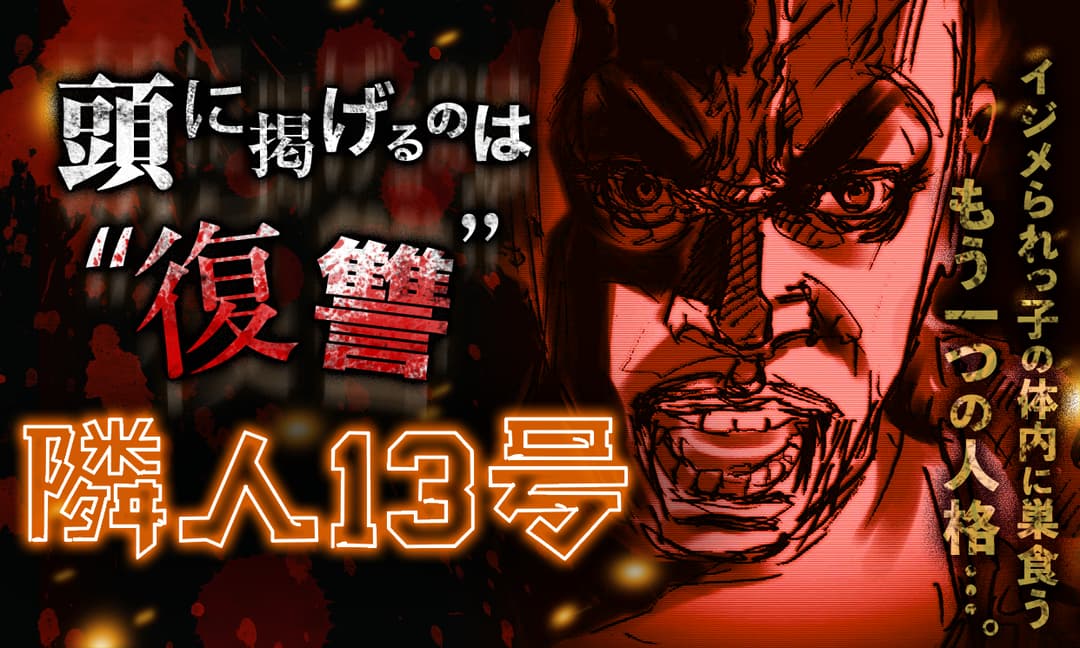
Neighbor 13 (Tonari 13)" is a Japanese psychological horror manga written by Santa Inoue. It is commonly known as "Neighbor 13 (Rinju-san). It is based on the themes of bullying and dissociative identity disorder (dual personality), and is characterized by its caricatured drawing style and unique supporting characters. It was later made into a live-action film starring Shun Oguri (Juso) and Shido Nakamura (No. 13). Construction worker Juzo Murazaki was bullied in elementary school. His classmate Toru Akai poured sulfuric acid on him and burned his face. From that moment on, the cowardly Juzo gave birth to a ferocious new persona, "No. 13," who plans to take revenge on Akai.
In the movie version, Akai said, "That's too much!" to No. 13, who had been bullying and avenging her when she was in elementary school. Akai made this line to No. 13, who said that Akai was certainly bullying Juso when she was in elementary school and that the revenge was not enough only for the death of her son. It seemed that No. 13's personality, which was born from hatred rather than revenge, was running out of control. As a result, No. 13 killed many people but could not touch Akai himself.
No. 13, "Salmon Pink? Salmon Pink? Salmon Pink?"
This is the line that No. 13 said while beating and killing the character of Akai in the animation of the movie version. In the movie version, when Juso told Seki about the existence of No. 13, it was expressed in this animation. The animation is an illustration drawn by Seki. While explaining about No. 13, Juso also confessed that he had a grudge against Akai. When the character who seems to be Akai appears, No. 13 says, "What color is your brain?" and continues to beat him. Then, No. 13 repeatedly says, "Salmon pink? Salmon pink? Salmon pink?" describing the color of the brain. This seemingly comical and crazy scene became a topic of conversation.
Scene in which Thirteen's real face was revealed
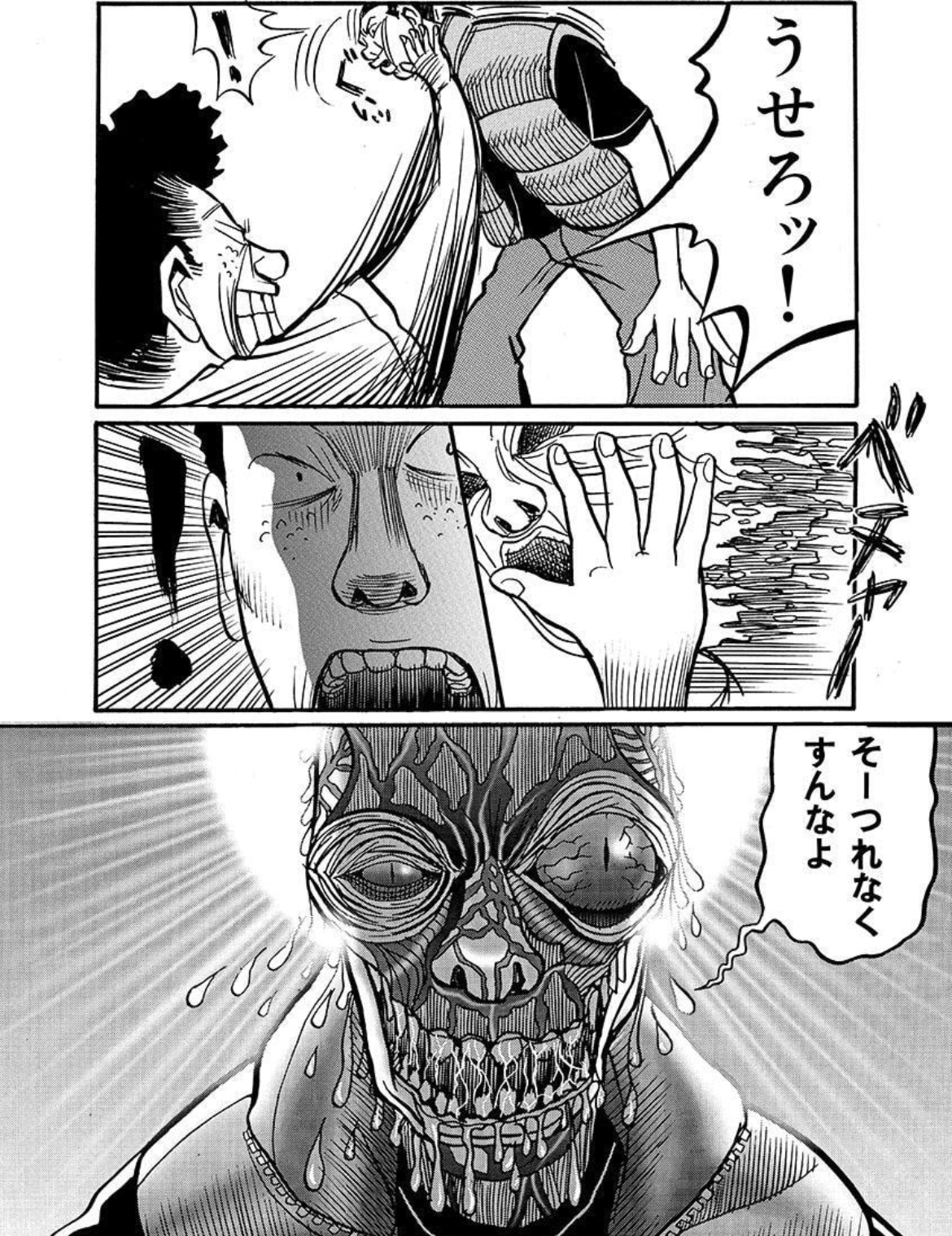
The mask of No. 13 fell off by Akai's hand.
No. 13's face, melted with sulfuric acid, is hidden in a mask that usually looks normal from anywhere. However, when Akai pushes back the face of No. 13, it is peeled off. It is not clear whether this figure is really a real face or a hallucination. After this, No. 13, which Akai apologizes for, breaks like a stone.
Behind the Scenes, Trivia, and Small Stories / Episodes and Anecdotes of "Neighbour 13"
The movie's description of the cabin is the mental world of Nos. 13 and 13.
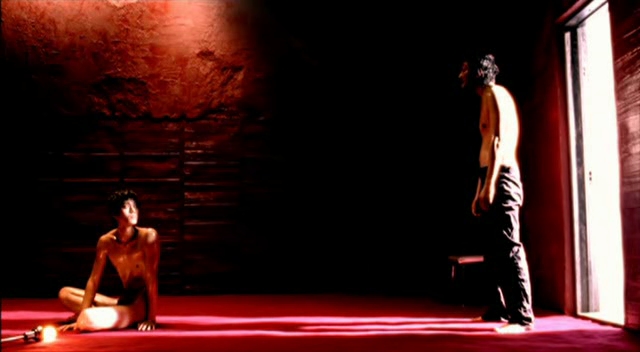
There are always only two naked people in this world.
The movie often features something like a dug-up hut, a world in which only thirteen and thirteen exist, representing the mental world of two people sharing a body.
The Movie "Neighbour 13" Is A Picture of 13 Futures
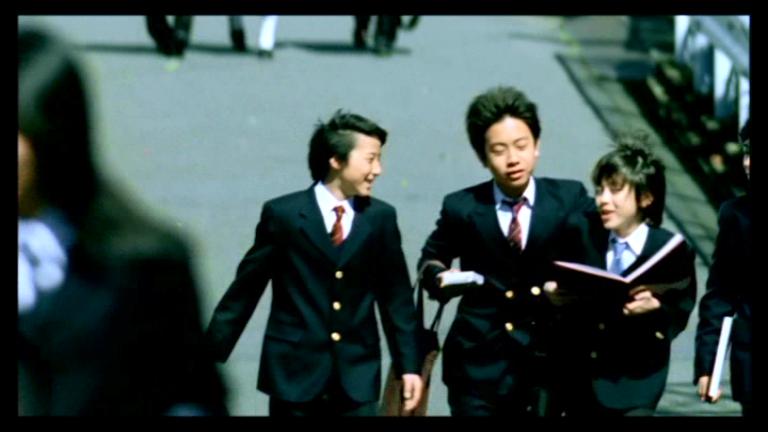
Thirteen (left) and Akai (middle) return together with a smile.
At the end of the movie "Neighbor No. 13," an epilogue was added after the apology and disappearance of No. 13.
There, Juzo, who was about to let Akai eat cockroaches, pushed Akai back and forth. Since he was absent from the primary school graduation ceremony, Juzo, who was supposed to photo, took a group photo with everyone. Juzo, who became a junior high school student, left school happily with Akai and other classmates. In front of Juzo was the demolished "Heiwaso". From room 13, No. 13. 13 was looking at Juzo with a face that he couldn't say anything about.
From this ending, it is said that Juso was indeed being bullied, but there was no fact that he had been subjected to sulfuric acid, and everything that happened after that was delusional. Juso, who had been bullied and had shut himself up in his shell, created a character called No. 13 and made a story of revenge against Akai. However, in reality, Juso fought back against Akai, and the bullying ended when he defeated Akai. It is said that the story of the movie was Juso's prediction of the future, "If I continue to be bullied,"
Since there is no such description in the original, only the movie version is considered.
Neighbor No. 13 is a true story.
"Neighbour 13" is a story based on the real experience of the author Santa Inoue.
Inoue, who lived alone in his 20s, was living on the second floor of his apartment at the time, and sometimes had a stone thrown at his window by a resident living on the lower floor. The resident had a financial trouble with a person living next to him, and he was attacking his room, probably because he was in the wrong room. One day, the window was finally broken, and Inoue, who felt it was dangerous, was allowed to live in his friend's house until the situation calmed down. After a while, Inoue returned to his home and saw the badly destroyed entrance door. Seeing the iron door broken by something hard like a metal bat, Inoue felt something like a person's grudge. He consulted with the police, but they did not intervene in civil affairs. He also went to a real estate agency, but he was told that he could not do anything unless he went to a mental hospital. When he consulted with the police again, he was told, "If there are 1,000 people, 1% of them will say so (abnormal people)." This is the line that Akai said to Hokurota. Akai's response, "Is that really all?" is a line that seems to speak for Inoue's words. Inoue was devastated by the reality that there was an object of fear near him and he might be killed by misunderstanding.
Inoue, who had no choice but to move, moved to the city of Fujisawa, where his relative, cartoonist Taiyo Matsumoto, lived. But once he experienced fear, over the next few years he became frightened by the slightest sound. The story of Inoue's newspaper extension at that time was based on his actual experience, and Heiwaso was modeled after the apartment where he actually lived.
Theme song and insert song of "Neighbour 13"
ED (ending): Hirakawachi Itchome "Hagareta Yoru"
This is a song composed by the brothers duo Hirakawachi Itchome (Chiichchoume HIRAKAWA). Hirakawachi Itchome was dissolved in 2008, but after a 10-year live performance since its dissolution in 2018, it was reestablished in 2019. By the way, their place name Hirakawaji exists in Shizuoka, but their address' 1-chome' does not exist.

Contents
- Overview of "Neighbour 13"
- Outline and story of "Neighbour 13"
- The Thirteenth and Thirteenth Revenge Programs
- Longing seniors
- The End of Revenge
- Characters from "Neighbour 13"
- Protagonist
- Juzo MURASAKI / Actor: Shun OGURI, Jun OGASAWARA (in his childhood)
- 13 / Performance: Shido NAKAMURA
- People related to No. 13
- Thor AKAI / Actor: Hirofumi ARAI, Masashi TANAKA (in his childhood)
- Nozomi Akai / Performance: Yumi Yoshimura
- AKAI Yūki / Actor: NAKAJO Tomobō
- Hajime Seki / Actor: Tomoya Ishii
- Chasers of No. 13
- Shinigami / Actor: Minoru Matsumoto
- Balloon
- Bidet
- Hide
- Hokurota (mole)
- Nikaido / Actor: Mitsuru MURATA
- Kitsune
- Other people
- Kaneda / Performance by Takashi Miike
- Newspaper extension
- Joji
- Term "Neighbour 13"
- Hirawasou
- Fujisawa Police
- Okunaka Komuten
- Yasuragi-no-Ie
- Daigo Elementary School
- Racing Team "Dog"
- Bidet's log.
- Sulphuric acid
- Dissociative identity disorder
- Words, lines, scenes, and scenes of "Neighbour 13"
- 13. I'm 13.
- AKAI "YOU'VE GONE TOO FAR!"
- No. 13, "Salmon Pink? Salmon Pink? Salmon Pink?"
- Scene in which Thirteen's real face was revealed
- Behind the Scenes, Trivia, and Small Stories / Episodes and Anecdotes of "Neighbour 13"
- The movie's description of the cabin is the mental world of Nos. 13 and 13.
- The Movie "Neighbour 13" Is A Picture of 13 Futures
- Neighbor No. 13 is a true story.
- Theme song and insert song of "Neighbour 13"
- ED (ending): Hirakawachi Itchome "Hagareta Yoru"