
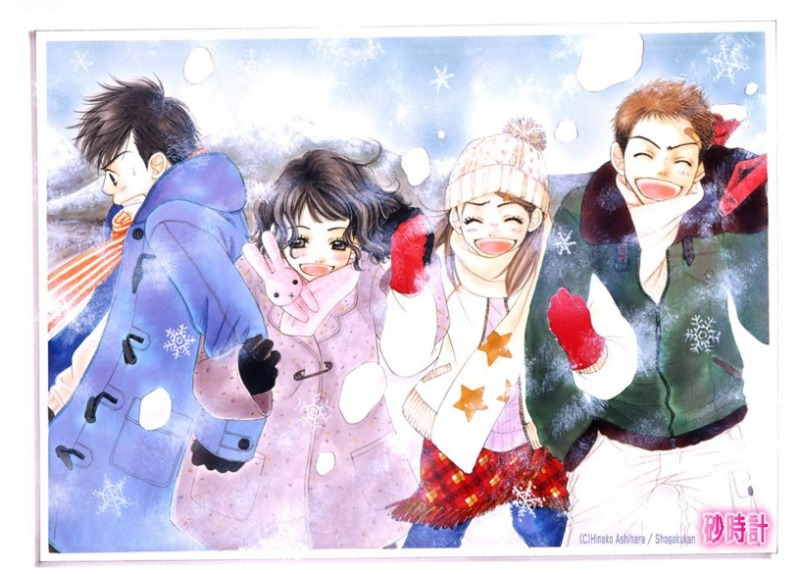
Hourglass" is a girls' manga by manga artist Hinako Ashihara, as well as a drama and movie based on the manga. It consists of 10 volumes in book form and 5 volumes in paperback. The main story is up to volume 8, while volumes 9 and 10 are omnibus collections.
This girls' manga depicts a sad 14-year long love affair between the main character, Anzu, who moved to Shimane after her parents' divorce, and Daigo, who grew up in Shimane. The story takes place mainly in Shimane and Tokyo, and after a long-distance relationship, the two are reunited and tied together once again.
The work has been made into a drama, a novel, and a movie, and can be seen in various forms. The dialect of Shimane is impressive and has sparked a dialect boom.
Hiroko Kitamura
Drama version: Yoko Oshima
Film version: Ryoko Tateishi
Daigo's mother. She is a high school classmate of Anzu's mother, Miwako, and is a member of the chorus club. She is a member of the chorus club. She is gentle and mild-mannered, but strict with Daigo.
Drama summary of "Hourglass
A total of 60 episodes were broadcast on TBS from March to June 2007. The theme song was "Hito Koi Meguri" by Kou Shibasaki.
Differences from manga regarding development
In the manga, Anne's mother's suicide makes Anne emotionally ill and leaves her traumatized throughout the work, but in the drama, the main focus is on love. Therefore, her mother's suicide is depicted as one episode. The second half of the drama is a story that does not differ from the manga.
The manga begins with a scene in which 26-year-old Anne prepares to follow her fiancé, Keiichiro Sakura, on his overseas assignment, while the drama is depicted as moving back and forth between the past and present.
Differences from the manga regarding characters and setting
Characters: In the drama, an original character named Akane Shindo, Daigo's fiancée, appears.
How Anzu's parents divorced: They are portrayed differently: in the manga, it is a divorce by mutual consent; in the drama, the father leaves the divorce papers and disappears. Therefore, when Miwako commits suicide, the fact is delayed until later when it is conveyed to her father.
Daigo's parents' house: In the manga, it is an ordinary house; in the drama, it is set as the focal point and is a hangout for everyone.
Ayumi Narazaki and Daigo: In the manga, they go to different high schools; in the drama, they go to the same high school, Ayumi Narazaki transfers schools, then returns and they meet again.
Fuji's place of residence: Fuji left his parents' house during high school and moved to Tokyo. In the manga, he is staying at a relative's house. In the drama, she lives alone.
Death of Miyoko, Anzu's grandmother: In the manga, there is no death of Anzu's grandmother Miyoko.
The Hourglass Film Overview
The film, starring Natsuho as Anzu in her middle and high school years and Nao Matsushita as Anzu as an adult, was released nationwide in April 2008. The film is based on the original story with the catchphrase, "I always wanted to be with you. is the catch copy of the original story.
The theme song was "Katekitakitakatta yo" by Ikimono Gakari.
Differences from the manga regarding characters and setting
Characters: The characters have been drastically cut down; Ayumi Narazaki, her father's remarriage partner Kaede Kuroki, their daughter Seni, and Anzu's Tokyo friends do not appear in the story.
Time frame: The manga is set up as a 14-year love story that begins at the age of 12, but because of the W cast, the story is a 12-year story that begins at the age of 14.
Hourglass parable: The story comparing an hourglass to life is told by grandmother Misayo in the manga, but by mother Miwako in the film.
Anne and Daigo's encounter: In the manga, Anne and Daigo meet outside, but in the film, Daigo's father calls out to Anne from inside his truck and they meet inside the truck.
Mother Miwako's suicide: Miwako collapses at her place of work and kills herself shortly afterwards, but in the manga, the scene is depicted as a New Year's celebration.
Broken hourglass: In one scene, Anzu breaks the hourglass that was left behind after her mother Miwako's suicide. In the manga, Daigo buys a new hourglass and gives it to her, but in the movie, he fixes the broken hourglass and gives it to her.
The hourglass given to Daigo: In the manga, Anne keeps the hourglass Daigo gave her until she turns 26, but in the movie, Anne gives it to Daigo before she moves to Tokyo with her father, and Daigo keeps it instead of Anne until she turns 26.
Anne and Daigo's reunion: After their breakup, they meet again once in the manga when they are 20 years old. In the movie, they do not meet again once until they are 26.
Fuji's adulthood: Fuji does not appear in the movie after she becomes an adult.
Famous quotes, lines, scenes and scenes from "Hourglass
Daigo: "Don't try to erase the feelings you cherish. I'll be with you forever."
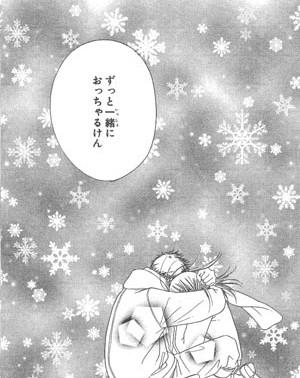
Anzu's mother, Miwako, commits suicide, and out of grief and a sense of regret at not being able to support her, Anzu throws her mother's hourglass, a memento of her mother, at her mother's remains, and Anzu breaks it. Later, at the Nima Sand Museum, Daigo buys the same thing and gives it to Anzu.
It became the most heartbreaking scene, and coupled with the dialect, it stuck in readers' minds.
Fuji: "It's called 'first love' because there will be a second and a third time! Don't end it once and for all!
Even after Anzu broke up with Daigo, she was still pulling on Daigo, whom she had liked and loved. Fuji, who had been thinking about Anne for a long time, confessed his feelings for her. With this, the two begin dating.
It is a line that he says to the protagonist, who is dragging his first love behind him, as if to look at himself, and it is the number one line that Fuji-kun fans would like to hear him say.
Anzu: "The end of the story will surely come, but still, with you, I want to believe in eternity.

The suicide of Anzu's mother, Miwako, leaves a deep scar on Anzu's heart. Even in such a situation, she was overflowing with feelings toward Daigo, who supported Anzu.
Anzu knows that things come to an end because of her mother's suicide, and that is why her words come out. They are supported by those who want to support Anzu and Daigo.
Asa-chan said, "Did you know? The capacity of the "love boat" is just two people. If you bring in anything extra, it will sink."

Anzu and Daigo are in a long distance relationship when Anzu moves to Tokyo to live with her father. Fuji, who has a crush on Anzu, moved to Tokyo to be near Anzu since she went to school in Tokyo from Shimane. Her best friend in Tokyo, Asa-chan, asks Anzu about her problems in this situation.
Words that resonate with those who are troubled by the distance between friends of the opposite sex.

Related Articles

Spoiler commentary and discussion of Piece (Her Memory)
Piece" is a manga series written by Hinako Ashihara and serialized in "Betsukomi" (Shogakukan) from 2008 to 2013. The series was originally titled "Piece: Her Memories" and was published in 10 volumes. The theme was "Don't think, feel! It won the 58th Shogakukan Manga Award for Girls in 2013. After receiving news of the death of her former classmate Haruka Origuchi, Mizuho Suga, who is now living at university, begins to trace her past. The story depicts Mizuho's growth as a person as she confronts her own memories in the process.
Read Article

Spoiler commentary and discussion of Sexy Tanaka-san (manga and drama)
Sexy Tanaka-san" is a TV drama that aired on Nippon Television in October 2023. It is based on a manga work by Hinako Ashihara. It stars Haruka Kiminami, with appearances by Airu Ikumi and Ken Yasuda. One day, Shuri Kurahashi, a temporary office worker, stops by a restaurant to watch a belly dance performance and is fascinated by a belly dancer. She then realizes that the woman is Kyoko Tanaka, who works at the same company. This leads to a friendship between Shuri and Kyoko, who have never had any contact with each other, and a bond develops between them. This popular work has sold more than 1 million copies in book form, and its live-action drama has become a hot topic.
Read Article
Tags
Contents
- Outline of "Hourglass
- The story behind "Hourglass
- Anne and Daigo meet
- Meeting with Wisteria and Shiika
- Mother's suicide
- Anne's love interest
- Reunion with Father
- Farewell to Daigo
- 16 years old, summer vacation
- Fuji and Anzu, Daigo and Shiika
- Wisteria's Disappearance
- Discovering Wisteria
- Anzu and Daigo
- The Truth about the Tsukishima Family
- End of first love
- Preparedness for apricot
- Daigo and Fuji
- I want to be strong.
- 20 years old, winter
- Meet Keiichiro Sakura
- Mother's shadow
- piece of the puzzle
- I'll make you happy.
- Characters in Hourglass
- protagonist
- An Uekusa
- lover
- Daigo Kitamura
- Friends you meet in Shimane
- Tsukishima Fuji
- Shiika Tsukishima
- Anne's relatives
- Miwako Uekusa
- Masahiro Minase
- Misayo Uekusa
- Kaede Kuroki / Kaede Minase
- Chie Minase
- Other
- Rika Asada
- Michiko Hirakawa
- denuded soil
- Yosuke Sonoda
- Ayumu Narasaki
- Keiichiro Sakura
- Mariko Tsukishima
- Shizuyo Tsukishima
- Kyoichi Takasugi
- Hiroko Kitamura
- Drama summary of "Hourglass
- Differences from manga regarding development
- Differences from the manga regarding characters and setting
- The Hourglass Film Overview
- Differences from the manga regarding characters and setting
- Famous quotes, lines, scenes and scenes from "Hourglass
- Daigo: "Don't try to erase the feelings you cherish. I'll be with you forever."
- Fuji: "It's called 'first love' because there will be a second and a third time! Don't end it once and for all!
- Anzu: "The end of the story will surely come, but still, with you, I want to believe in eternity.
- Asa-chan said, "Did you know? The capacity of the "love boat" is just two people. If you bring in anything extra, it will sink."
- Anne: "There are as many people as there are stars, and I pass countless people every day, but there is no one with such gentle hands, no one who cares for me so much, no one who can care for me so much, absolutely nowhere."
- Anne's grandmother: "If you meet someone down the road, think about whether or not you'll be able to work hard and painlessly for them."
- Backstories, trivia, and anecdotes about "Hourglass
- Hourglass" setting and filming location
- Nima Sand Museum
- Hane Station
- Lychnis ssp.
- Omorimachi
- Hourglass" consists of 10 volumes, but the main story ends in volume 8, and volumes 9 and 10 are omnibus collections.
- The author actually visited the "Nima Sand Museum
- Theme song and insert song for "Hourglass
- Drama version theme song: "Hito Koi Meguri" by Kou Shibasaki
- Movie version theme song: ikimono-kari "I want to go home".