
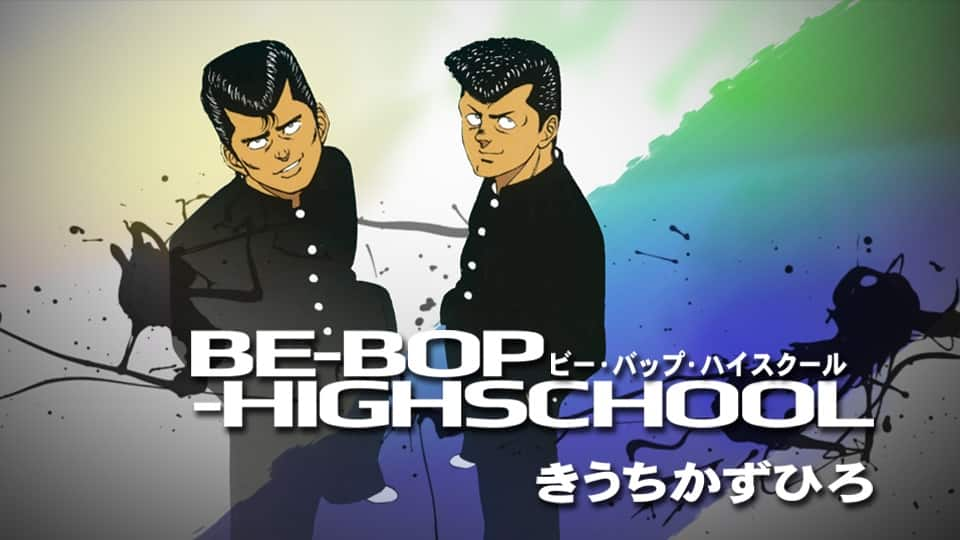
BE-BOP-HIGH SCHOOL" is a manga by Kazuhiro Kiuchi, serialized in "Weekly Young Magazine" from 1983 to 2003. There are 48 issues in total. It is a representative work of yankee manga depicting the lives of Hiroshi and Toru, a pair of delinquent high school students, who spend their days fighting and falling in love, and has sold more than 40 million copies in total. In 1985, the manga was made into a live-action movie starring Kojiro Shimizu and Toru Nakamura, which became a big hit, followed by a total of six more movies.
Tetsu (kingdom in China during the Spring and Autumn Period and the Period of the Warring States Period)
CV: Koji Tsujitani
A student at Kado Agricultural High School and Bakagyu's younger brother. In a fight, he quickly pulls out a knife and stabs himself in the buttocks. Toru calls him "Shigeru" because he has a "Shigeru face.
Eisen High School
Manzaburo Kamei
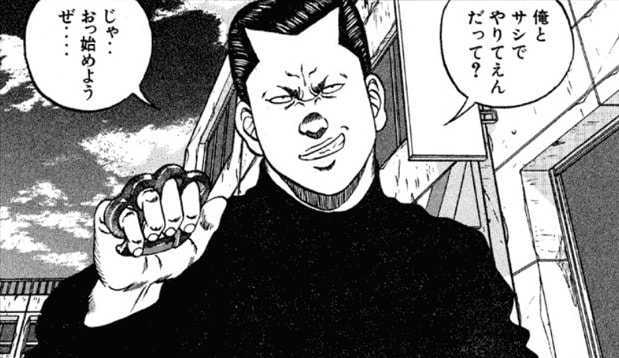
CV: Hideyuki Hori
He is the number one student at Eisen High School, and his nickname is Turtle Man. He is a strong fighter and has a rather cowardly personality. He wears a long-sleeved shirt over his uniform. He is taunted by Toru as a "seven-third split fuku-suke bastard," and was beaten by Maki when she took his brass knuckles and punched him in the nose.
Other
Matsuzawa
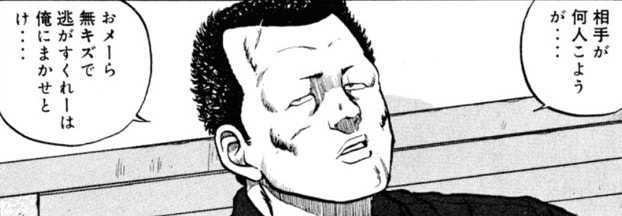
He is called "Matsuzawa-kun" by the "tsuppari" (the street thugs) and is feared in the town. He is a man of many legends, such as killing eight people half dead by himself in high school and returning to his hometown after severely injuring a large number of yakuza. He is a yakuza. He recognizes Hiroshi and Toru, and when he heard that Toru was about to drop out of school, he came to scout for him in his own gang.
Onijima
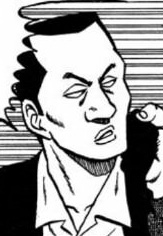
Actor: Takeo Jii
He is a detective in the Juvenile Division, nicknamed Onijima because of his nickname "Oni no Shimazaki" (Oni means "Demon Shimazaki" in Japanese). It is rumored that he was transferred from Maruboshi to the Juvenile Division because of his ties to the yakuza, and he himself dresses like a yakuza. He is feared by all the delinquents in town, including Hiroshi and Toru.
Terms for "Be Bop High School
unsatisfactory
It is a yankee term meaning something like "not good-looking enough to be a tsuppari," "dase," or "you don't have guts. It is used by delinquents to agitate their opponents, and appears frequently in this film as well. It is said to have spread quickly after it was used in "Be Bop High School". Another related term is "Shabba Monk," a term used by tsuppari to refer to serious students and gutless tsuppari who make fun of them.
delinquent youngster
A term used in the 1980s to describe a boy whose behavior is delinquent. The term came to be used because of the boy's proclivity to stand up against the rules of adults and adult society. They took pride in going against the rules of society, or "tsupa," and they themselves were proud to use the term. They would engage in acts that went against school rules and laws, such as smoking, shoplifting, and altering school uniforms. Incidentally, yankee, like tsuppari, refers to juvenile delinquents. The term "yankee" has been used throughout Japan since the late 1990s.
baggy pants, worn by construction workers and juvenile delinquents
After the late 1960s, some university cheering squads began to wear long, versatile student uniforms and pants with a thicker waist for ease of movement, and this trend, along with the hard-core image of cheering squad members, spread nationwide, giving birth to a typical deformed style called "bontan. By the mid-1970s, when school violence began to become a social problem, the "bontan" uniform was seen as a sign of delinquency, and students began to wear the deformed school uniform as a way of showing off their delinquent status. In the late 1980s, the school side began to change to blazer-type uniforms in response to the change to blazers for girls' uniforms and for other reasons, including the influence of "Be Bop High School" and other "zappari" style cartoons and dramas. The boom rapidly subsided in the latter half of the 1980s, as schools began to change to blazer-type uniforms in response to the trend toward blazers in girls' school uniforms and for other reasons.
pull up (e.g. ridges on a tree)
To withdraw from things out of fear and trepidation. It derives from the fact that when pulling on a vine to harvest satsuma imo, the body naturally retreats. It is also used in this work as in "don't pull back imo" against someone who is scared or afraid of the other party.
Aitoku Private High School
Until a few years ago, it was one of the most advanced schools in the prefecture. It is coeducational, with 1026 students (602 boys and 424 girls). Deviation scores range from 49 to 74, and have dropped significantly in recent years as a result of admitting a wide range of students in order to secure a decreasing number of students. The number of students expelled from the school in the previous year was 12. The school is commonly known as the "academic caste system. Hiroshi and Toru are the real strongest, but traditionally there is no such thing as a watchdog; the two say that Futoshi (Nobuo) Facesaki is the watchdog.

Contents
- Overview of "Be Bop High School
- Synopsis and story of "Be Bop High School
- Conflict with Joto Technical High School
- Conflict with the Joto expulsion group
- Conflict with Hakusan High School
- Shoko's Encounter
- Characters from "Be Bop High School
- Aitoku High School
- Toru Nakama
- Hiroshi Kato
- Nobuo Kaneko
- Jun Kawabata
- Hitotaro Omae
- Shinpei Kuroda
- Junko Miharayama
- Kyoko Izumi
- Masahiro Mizusaki
- Ginichi Yokohama
- Tadaharu Akagiyama
- Kenji Kido
- Hirotake Iwamoto
- Eri Yoshiyuki
- Maki Honjo
- Masaji Maruno
- Shinichi Kanie
- Tachibana Commercial High School
- Junichi Kikunaga
- Minoru Go
- Ito (Ito)
- North High School
- Shingo Maekawa
- Kudo
- Megumi
- Sanae
- Joto Technical High School
- Toshimitsu Yamada
- Teruo Fujimoto
- Tsuyoshi Ikeda
- Ishikawa
- Former Joto Technical High School
- Shibata
- West
- Totsuka Fisheries High School
- Naoki Kishi
- Neko Tsugi and Hebi Tsugi (Torao Nakamura and Tatsuo Nakamura)
- Sakuragaoka High School
- Tetsuya Hattomaki
- Yumi
- Fifth Junior High School
- Shoko Kisaragi
- Second Middle School and High School
- Ryo Mochida
- Hakusan High School
- Eda
- Oosugi (Japanese cedar)
- Matsumoto
- Takagi
- Tenpo Technical High School
- Hajime Kajiya
- Park.
- Kado Agricultural High School
- Masaaki Yano
- Tetsu (kingdom in China during the Spring and Autumn Period and the Period of the Warring States Period)
- Eisen High School
- Manzaburo Kamei
- Other
- Matsuzawa
- Onijima
- Terms for "Be Bop High School
- unsatisfactory
- delinquent youngster
- baggy pants, worn by construction workers and juvenile delinquents
- pull up (e.g. ridges on a tree)
- Aitoku Private High School
- Totsuka Fisheries High School
- Famous quotes, lines/scenes, and scenes from "Be Bop High School".
- Tell: "I'm wearing your bon-ton, but it's all shabby."
- Naoki Kishi "I'm going to kill you!"
- Toshimitsu Yamada "You have yellow teeth!"
- Tell: "I've got a little more guts than I did back then!"
- Backstory, trivia, subplots/episodes, and anecdotes from "Be Bop High School".
- The model high school for "Be Bop High School" is located in Fukuoka Prefecture.
- Pirated copies of "Be Bop High School" exist.
- The original work is not yet complete.
- Special baton used in a movie sold too well, causing complaints.
- There was a special clause in the film cast's contract prohibiting fighting.
- Theme and insert songs for "Be Bop High School
- Film theme song: Miho Nakayama "BE-BOP-HIGHSCHOOL