
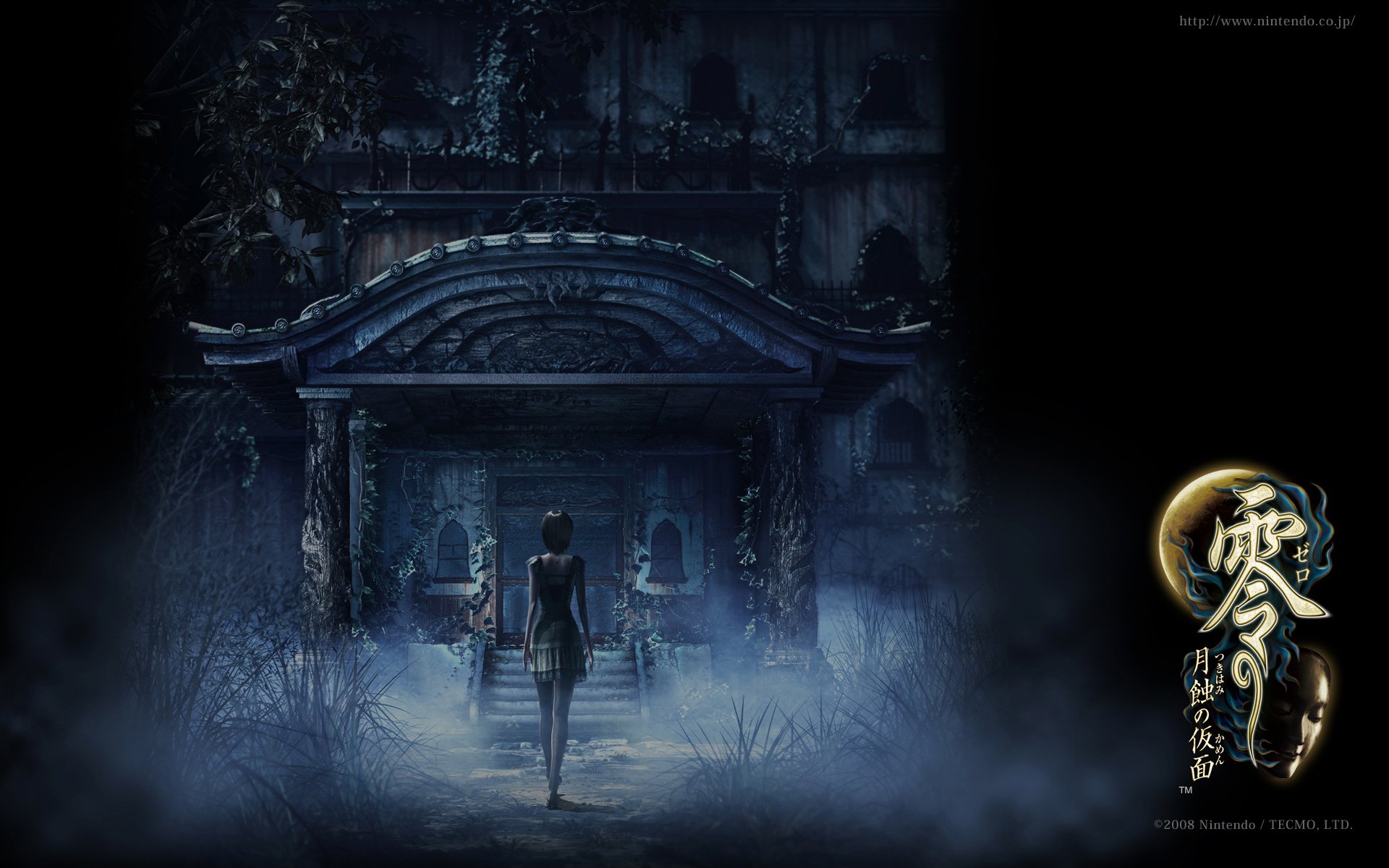
Zero: Mask of the Moon" is the fourth installment in the "Zero" series of Japanese horror games. The game's catchphrase is "Experience the horror. is the catch copy. The game takes place in Japan in the 1980s. The game consists of 12 chapters and is played from the viewpoints of four characters: Ryuka Minazuki, Umisaki Aso, Enka Tsukimori, and Choshiro Kirishima. The setting is a remote island called Oborozukijima. The main focus is on exploration of a decaying, abandoned hospital and a Japanese-style mansion, as well as battles with ghosts.
San-no Eclipse, Wasurebi
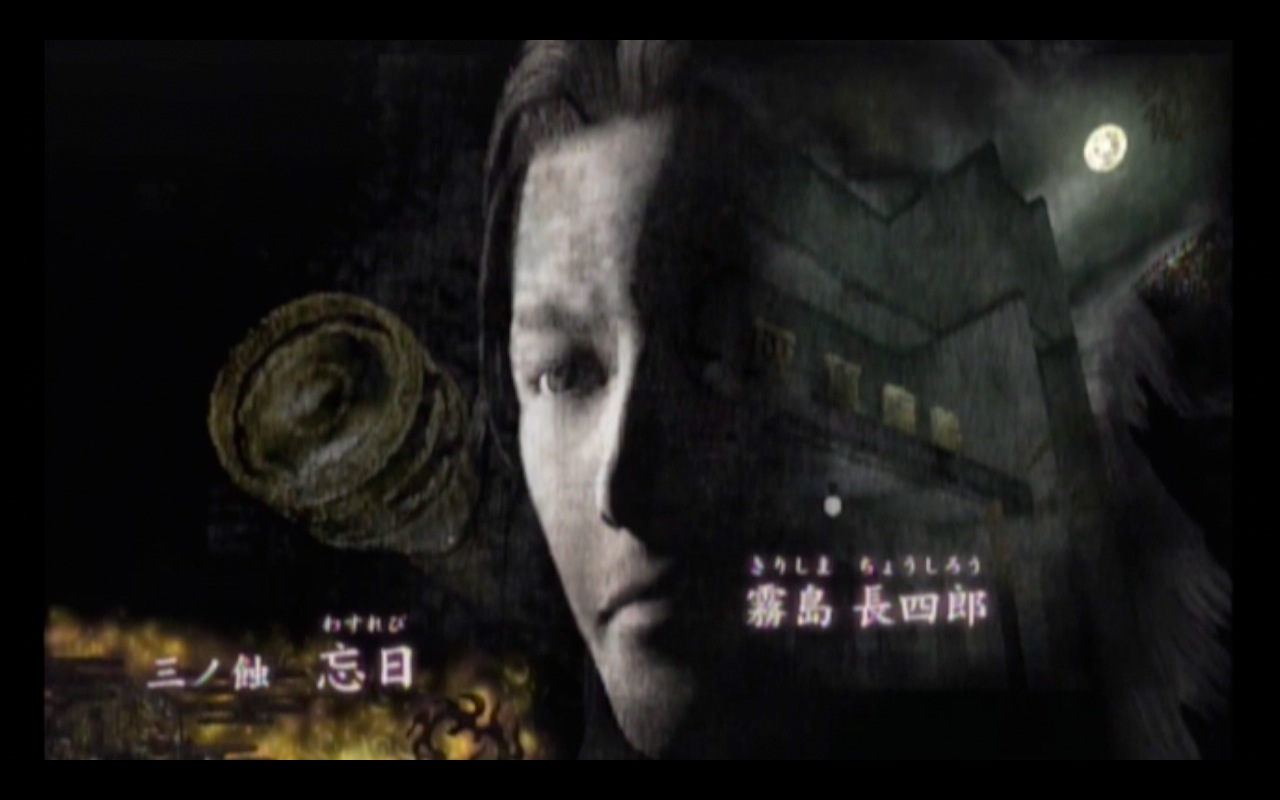
Still from the beginning of "San-no-shoku: Wasurebi" (The Three Nocturnal Eclipses: Forgetting the Day)
Private detective Choshiro Kirishima is asked by Ryuka's mother, Sayaka, to protect her daughter who has crossed over to Rougetsu Island.
Ten years ago, Choshiro, who was a detective, was in pursuit of a person named Yoh Haibara. Yoh Haibara was the eldest son of Shigeto Haibara, the director of Haibara Hospital, and a brilliant doctor who ran the Haibara Medical Clinic in Tokyo, but he was wanted after it came to light that he had caused the deaths of several hospitalized patients through human experiments. Kirishima learns that the father, Shigeto, is a powerful man on Rôgetsu Island and has been providing large sums of money to his son's hospital. He visits the suspect's hometown, believing that Haibara will also show up at the Rôgetsu Kagura festival held on the island.
During this visit, a case of mysterious disappearance occurs, and Choshiro, who assisted in the search, discovers Ryuka and the others in the basement of the hospital. Since then, he has been concerned about the illness of Sayaka, whom he met as a result of this incident, and they form a friendship.
When his recollections are interrupted, Choshiro is lying in the corridor of the Haibara Hospital. Although puzzled by the muddled memories of the events before and after, Choshiro sees Haibara, whom he has sought for many years, and proceeds to follow his thinly smiling and provocative figure. With Ryuka's protection in mind, Choshiro makes the decision to pursue his nemesis as the persistence of a former detective.
In the course of his search, with occasional battles with the spirits that roam the hospital, Choshiro obtains memoirs and pieces of paper and learns several new facts. The final symptom of patients suffering from Getsuyū Disease is "empty body," in which they lose all memory and are left in a state of absentmindedness that is very close to death. There are also three stages of the moon sickness: "budding," "empty body," and "blooming. When a budding patient dies, he or she "blooms," and in this state, his or her face appears distorted to others. Since blooming is equated with a calamity that will bring about the end of the island, it was customary to cut off the face of a patient with Getsuyū Disease when he or she died.
Choshiro goes to the underground passage where he found Nagare and his friends ten years ago, but he cannot find her. There, his memory resurfaces and he remembers that when he found Ryu-ka, she had a Noh mask-like expression and muttered the mysterious words "Kiraigo.
The four nocturnal eclipse
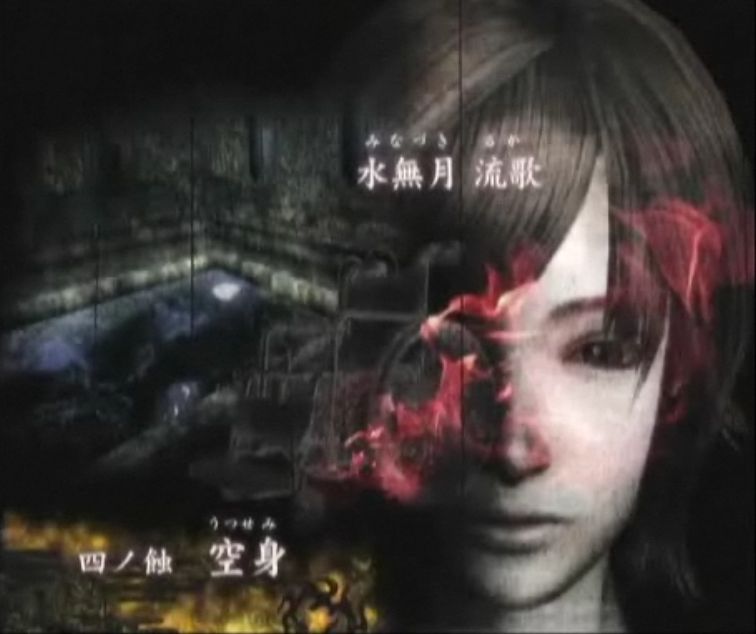
Still from the beginning of "Utsusemi" (The Four Nocturnal Eclipse)
After fighting off Enka, Ryuka looks in the mirror and is shocked to see her face distorted.
She is shocked, but at the same time, cracked music starts playing from the speakers, arousing her lost memories. What Ryuka remembers anew is her father.
Ryuka's father, Soya Yomotsuki, was a mask-beater on Rōtsuki Island, who had been a mask-beater for special ceremonies on the island for generations. One of the symptoms of the moon sickness is the inability to recognize one's own or others' faces, but in order to complete his masterpiece, Soya experimented on his daughter by putting various masks on her, who was afraid of what would happen if she bloomed.
Ryuka returns from her recollection and finds a piece of a memo at the place where Enka was. On it were the words "We were gillyweed.
The ceremony that Ryuka's father was involved in was called "Kiraigo," the original form of Rōgetsu Kagura, which has been popularized for sightseeing. The kiraigo ceremony required a dancer and an instrumentalist to play musical instruments, and the Ryukas of ten years ago had been chosen to play the roles of the instrumentalists.
Enka remembered everything, but the burden of the truth was too much for her and she became sick at heart.
Ryuka sees a note tied to the bed with the words "Heya e mae suru" (I will go away) and heads to her room, hoping to see her this time, but she finds nothing but a notebook on her bed. The notebook is empty, and there is only a notebook left on the bed. The notebook contains what could be a suicide note, saying "I'll shut it while I still have my ego left.
Ryuka, who continues her search, learns that a special kind of music has the power to cure moon sickness and that Yayoko, the only survivor of the mass disappearance of Rougetsu Island residents that occurred after the mysterious disappearance, was transferred to a hospital on the main island. Yayoko died of a debilitating illness six months later, and her last words were "Okaasan .......
Ryuka, who remembered her father the moment she actually heard the music, decided to obtain the sheet music of the broadcast song in search of further clues. She finds the sheet music in the room next to Yayoko's, and visits the room of the boy whose stealing habit had been a problem in the room next to Yayoko's, but there is nothing there. In fact, the next room was a misread, suggesting a hidden room that existed in Yaako's hospital room.
Ryuka gets a sheet music and tries to play on the grand piano in the cafeteria, but suddenly the phone rings. The caller is Enka, who tells her "Don't come" and herself "Enough" and hangs up.
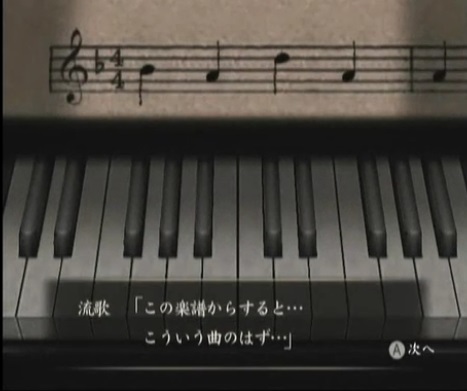
Ryuka reproduces the score on the grand piano in the cafeteria.
Ryuka reproduced the melody of the score on the piano and recalled a memory of traveling somewhere in an elevator in the hospital. As soon as she got to the elevator, she saw the spirits of a patient in a wheelchair and a woman pushing him, and they seemed to be sisters.
Following them to the courtyard pool, Ryuka sees a wheelchair and a figure with a twisted neck by the pool. Reflexively, she reaches out her hand, but the spirit of the woman pushing the wheelchair grabs her wrist and refuses, saying, "Don't touch me. For whatever reason, these sisters seem to have confused each other.
After the poolside battle, Ryuka obtained the key to the power distribution room that had fallen on the spot and moved to the basement. She goes through a storeroom and activates an elevator in the power distribution room, but when she opens a door further in, it leads to a different space called "Aruhinomichi," where she engages in battle with Sakuya, the daughter of Shigeto Haibara, a Kiraigo-no-Miko priestess, who is waiting for her. Ryuka somehow manages to escape, obtains the materials of the Abominable Shrine, which mourns the dead whose masks have been cut off, and rides the elevator to the hospital room where she was originally hospitalized.
The fifth eclipse, the two faces
Kaizaki regains part of her past through a chance encounter with the black girl.
While continuing to search in Ayako's room, the black girl points him to a hidden room. After entering the hidden room, Umisaki obtains Ayako's note and learns that her moon sickness has progressed since she met someone. Also in the hidden room are a man's suit and a black notebook, which show traces of the adult man that Sayoko had been hiding.
During her stay in the hospital, Kaizaki had a "special someone" who supported her emotionally. However, she was unable to recall the details of that person. In parallel with her search for Enka, Umizaki pursues clues to her "special someone" and obtains a reel of film, which she plays on the projector in the cafeteria, hoping that the images will bring her memories back to life. When she sees the image of Rōtsuki Kagura on the screen, Umizaki feels a sense of déjà vu. Ten years ago, while wearing a mask and watching a Rôgetsu Kagura performance, Umizaki was taken away by a hand reaching out from behind her.
Near the end of the film, she notices Enka standing in front of the screen. Although obscured by the light from the projector, Enka's face was distorted with foreboding as she approached. After defeating Enka with the projector, Kaizaki reads her last letter, which had fallen after she disappeared.
There, Enka accused him of using her as a toy instead of "that girl," and lamented that he would have been happy if he could have forgotten her.
Why don't we die together?"
The letter ended with a dismissive remark that could have been read as a declaration of insulation. Enka had always feared that she would lose Umizaki to the black girl.
When a dejected Enka returned to his hospital room, the girl in black was waiting for him. She remembers that this girl is her "precious person". The girl leads Umizaki to read the nursing diary and other materials, and gradually her past begins to come back to her.
She is a medium by nature, and the progression of her moon sickness is very fast, and the presence of the black girl is essential to stabilize her mind. Another patient with mediumship was also hospitalized on the fourth floor. The moon sickness has many uncertainties, and when mediumship is added to the mix, it is even more unpredictable. In some cases, patients become violent as the disease progresses. The hospital was concerned that contact between the two patients might unnecessarily accelerate the progression of the disease, so they were separated from each other in principle.
It turns out that the patient with mediumship who was admitted to the fourth floor is Shigeto's daughter, Sakuya, and that the other moon sickness patients were merely experimental subjects to cure her. However, Sakuya's symptoms continued to worsen, and the doctors and nurses couldn't help but remember her face, calling her "the person without a face.
Picking up materials and reconstructing her past, Umisaki recalls Sakuya's face from a bygone era.
Rokuno-shoku Tsukimori-uta
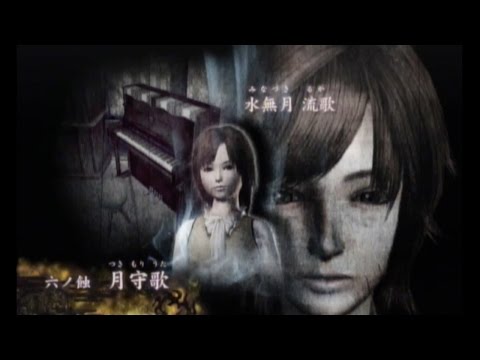
Still from the beginning of "Tsukimori-uta" (The Six Nocturnal Eclipse)
Returning to her hospital room, Ryuka is reminded of her past again by the melody of a music box there.
Ryuka's maiden name was Shikata Tsuki on her father's side. Mizunazuki was the surname of her mother, who had separated from her father. Soya was an excellent mask-wearer who devoted himself day and night to creating the ultimate mask, the mask of the lunar eclipse. The mask of lunar eclipse was a mask with a special spiritual power to return the wearer's memory to zero, or nothing, and evoke the sight of the Zero Zone, where the soul returns. Ryuka developed the Getsuyu Disease as a result of putting the prototype masks on her daughter one after the other. Because of this unfortunate history, Ryuka could not remember her father's face no matter how hard she tried. It was Shigeto, the director of the Haibara Hospital, who commissioned Soya to make the masks, and the lunar eclipse masks were an indispensable part of the ceremony of return to the island, but Sayaka, unable to forgive her husband's treatment of her own daughter, divorced him and left the island.
In her diary, which was found in Ryuka's hospital room, she wrote of her regrets for not being able to stop her husband's outburst, as well as her concern that her daughter might bloom if she regained her memory.
She is reminded of her father's indifference to her daughter and her mother's grief-stricken cries, and recalls the piano piece that she had practiced repeatedly at her mother's urging. The piece that Saya-no-uta had made her daughter play was an effective cure for tsukiyou-disease. Saya-no-uta's diary also contains a map to the ritual site of Koraiwai, and Ryuka follows the map to the elevator to the basement.
The underground passageway was filled with many floating spirits and an eerie atmosphere, but Ryuka went to her destination with a look of relief on her face, as if she had returned to her mother's womb.
The Seven Eclipses of Muku
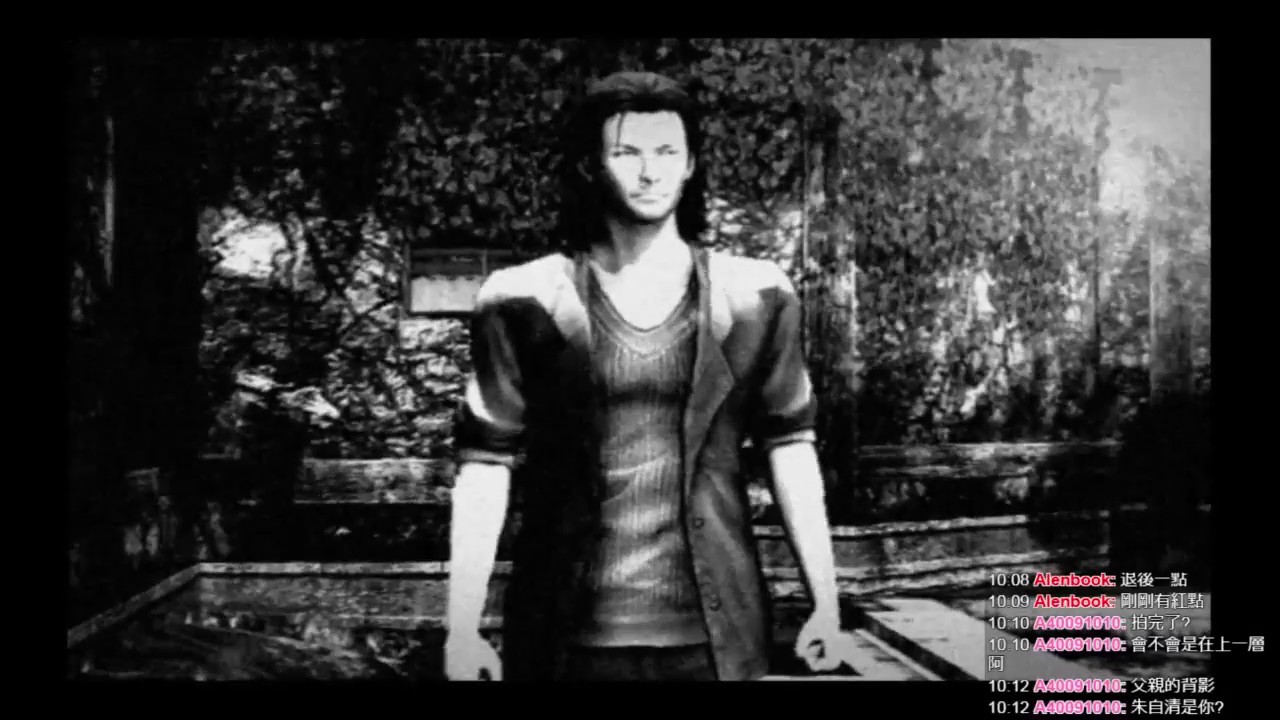
Choshiro, standing in the hospital courtyard, finds Haibara on the roof.
Standing in the underground passage, Choshiro chased after Haibara, but he was forced to take the elevator back to the first basement floor.
While searching the basement floor, Choshiro learns that a nurse named Tono, who was a dancer in the Rôgetsu Kagura performance, died during the performance. The Kiraigai and Rôgetsu Kagura are two sides of the same coin, and the anomalies of the backstage festival have affected the front. Choshiro goes through the hall to the incinerator at the back entrance and discovers a burned letter from a friend who worked as a doctor at the Haibara Hospital. This friend was also the reason for Choshiro's passionate investigation.
As Choshiro reminisces about his friend, the ghost of Tono, a nurse, appears before him and leads him to the cemetery. Upon reaching the cemetery, Choshiro obtains Tono's diary and learns that she was from outside the island and that she liked the warm personalities of the residents of Rôgetsujima. A hard worker, she accepted a major role in Rôgetsu Kagura in an attempt to fit in quickly on the island, but this was a conspiracy by the Director to pursue a correlation between Rôgetsu Kagura and Kuraigai.
Shigeto Haibara and Yoh's father and son, who wanted to save Sakuya, selected her to be the vessel for the Kuraigake, and five girls who were hospitalized at the time were made to play the roles of performers to perform the ritual at the underground altar, but Sakuya's mask broke and she failed, turning her into a dead woman.
Choshiro returns to the hospital from the cemetery, and on his way there, he uses a reel of film he obtained on the way to the hospital to project a film onto a projector in the cafeteria, but at that moment, the spirits of the islanders rush in. He manages to fight them off and examines the back of the screen, where he discovers a cassette tape of his past investigative recordings.
After playing the cassette tape, Choshiro learns that the painter Kyokugi, who is hospitalized on the fourth floor, has a clue to the case, and goes to his hospital room. He is also suffering from Getsuyu Disease, but he is not pessimistic like the other patients, and even his illness can be the subject of his paintings, and he is energetically working on his creative activities. After defeating the spirit of Kyokugi, Choshiro examined a painting he had left on the floor before his death and recalled that the investigation of Haibara had been terminated after the mysterious disappearance, that he had resigned from the police force and revisited the island, and that he had been present at the time of the disappearance of a large number of islanders.
At the time of the incident, Choshiro had witnessed someone coming up the stairs leading from the courtyard to the abominable shrine. It was Sakuya, who had finally bloomed. Choshiro looks around the noisy surroundings and spots Haibara on the roof of the hospital and tries to catch him this time.
Hachino Eclipse Sakuya
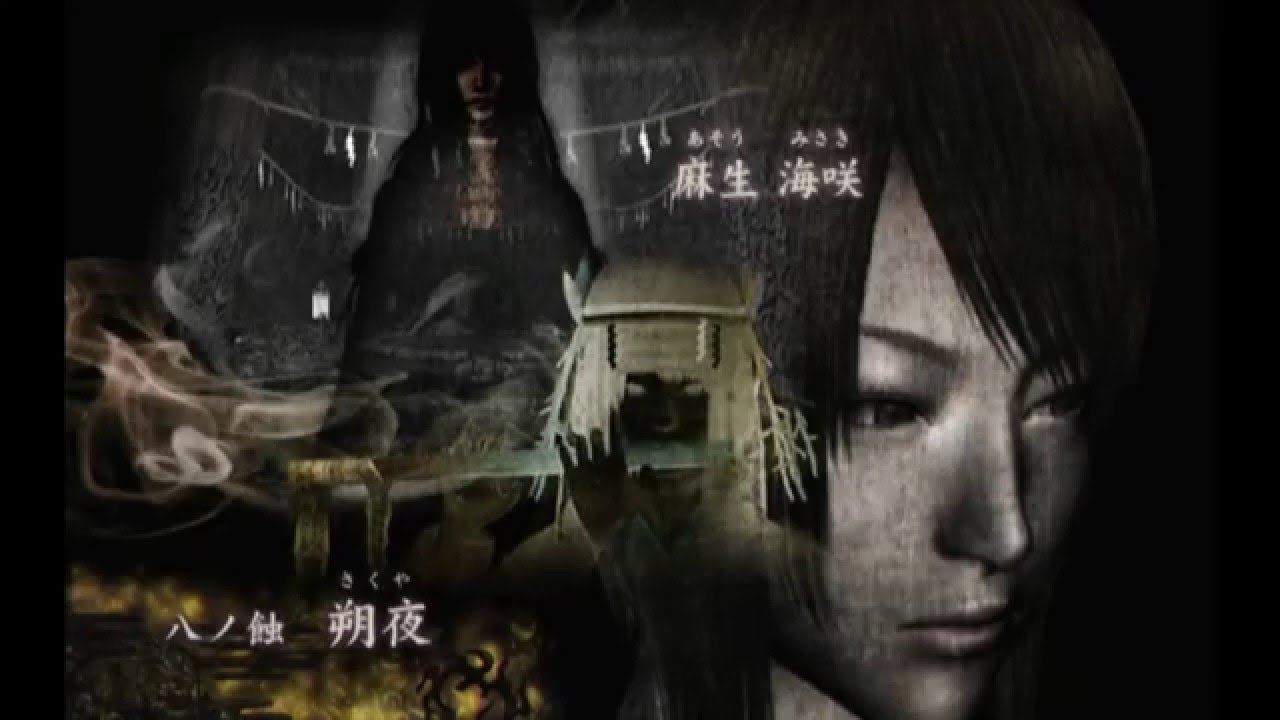
Still from the beginning of Sakuya, the Eight Nocturnal Eclipse
Continuing her search, Umisaki gradually remembered Sakuya.
Although it was forbidden to meet Sakuya in person, Umizaki sneaked out of the hospital room and went to see Sakuya. Sakuya was a kind and beautiful woman who loved Umizaki like a younger sister. A girl in black led Umizaki down to the hospital's underground passageway, where she was accompanied by Yoh Haibara, who reminded her of the fact that she had taken a moonlight bath in a place called the Moon Well. The five of them, including Umisaki, were made to become Kanade through the schemes of the hospital director and Yoh, and were qualified to become Kanade by being chronically exposed to the moonlight, which has an affinity with the moonlight disease.
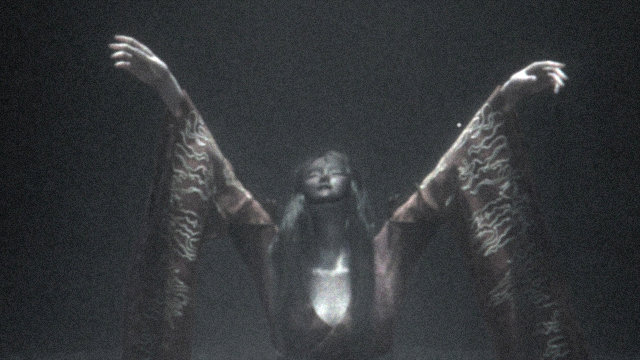
Sakuya dances divinely in the light of the moon at Koraihyo.
The altar where the ceremony was held was located further ahead, and on the day of the Kamikaze incident, Umisaki remembers that Sakuya, who was masked by Haibara and played a musical instrument and could no longer see him because of his worsening condition, was dancing as a vessel.
The ritual in which Umisaki played the role ended in failure when Sakuya fainted in agony and the entire mask of lunar eclipse exploded and bloomed.
After returning from the remembrance, Sakuya's grudge spirit attacked Umisaki. After fighting it off with a projector, Umisaki picks up a doll lying around after Sakuya's disappearance, which looks very much like the girl in black.
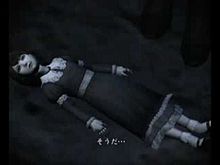
Kaiya's true identity was a doll.
People with a mediumistic constitution progress very quickly, and they needed something to hold them together as a deterrent. Sakuya, in her younger days, projected herself onto a doll and conversed with it to keep her spirit from collapsing day by day. When she finally reached the final stage, she entrusted the doll to Sakuya, who named it "Umiyo" after herself and Umizaki. Umizaki cherished Umiya, who could be said to be Sakuya's memento, and poured her heart into the doll, imitating Sakuya, who had been so dear to her. However, on the day of Rōtsuki Kagura, Umizaki was kidnapped by Haibara and dropped Umiya in an underground passage.
When she finally finds Umisaki, she embraces Sakuya in a sobbing hug, and the vision of Sakuya disappears in her arms. Immediately afterwards, Umisaki falls into a coma, and the gates of the ceremonial place of welcome and return close to contain her.
Nine eclipse of the eclipse Return to Kiraigou

Related Articles
Zero - Nurekasuno Miko (Fatal Frame V) Spoiler Commentary and Discussion Summary
Zero: Nurekasunomiko" is the sixth title (ninth in total) in the "Zero" series of Japanese horror games released by Nintendo. The catchphrase of the game is "Mountains of death, ghostly weddings, and godforsakenness, all connected by water." . The three characters are Yuri Furikata, Fukaha Hinasaki, and Ren Housho. The story takes place on Mount Nikkoue, a sacred mountain where water is worshipped as a deity. Yuri is in pursuit of a missing benefactor or client, Fukahane is in pursuit of her mother, and Ren is in pursuit of mourning photos of the dead. The beautiful graphics and gloomy atmosphere of the film have attracted fans.
Read Article
Zero - Red Butterfly and Zero - True Red Butterfly (Fatal Frame II) Spoilers and Discussion Summary
Zero - Red Butterfly" is the second title in the "Zero" series, a Japanese horror game released by Tecmo in 2003 for the PlayStation 2. While the game utilizes the strengths of the previous title "Zero", such as the ability to repel spirits by projecting them onto a projector and solving mysteries from a folkloric perspective, the setting has been changed from a single mansion to a single abandoned village, giving the player a wider scope for action. Many of the characters have ties to the previous work, and the setting of the previous work, which is revealed in this work, is also a highlight of the game.
Read Article
Zero - The Tattoo (Fatal Frame III) Spoiler Commentary and Discussion Summary
Zero: Shisei no Shouhou" is the third title in the "Zero" series, a Japanese horror game released by Tecmo in 2005 for the PlayStation 2. In this game, the player must use a "projector," a camera with spirit-removal capabilities, to solve the mystery of a curse that gradually prevents the player from waking up from sleep, while traveling between the real world and a haunted house in a dream. The main characters from the first and second films in the series also make appearances in the film, and the film is a highlight of the film as we learn what happened to them afterwards.
Read Article
Zero - ZERO (Fatal Frame / Project Zero) Spoiler Commentary and Discussion Summary
Zero" (Fatal Frame / Project Zero) is the first title in the "Zero" series, a Japanese horror game released by Tecmo in 2001 for the PlayStation 2. The game gained popularity due to its game system in which the player must face the object of his/her fear, and enemies, who are spirits, can be repelled by projecting them onto a "projector," which has a special ability. The game's detailed setting is also one of its charms, with mysteries to be solved from an ethnographic point of view, and each enemy's spirit is carefully crafted.
Read Article
Zero - Murasaki's Diary (Psychic Camera - Possessed Notebook) Spoiler Commentary and Discussion Summary
Zero - Murasaki no Nikki (Diary of Murasaki)" is a game software for 3DS released by Nintendo in 2012. The game is based on an urban legend that anyone who has seen the impossible words in a "purple diary" will be found dead with their face shaved off. The game uses the 3DS as a projector and the AR notebook as the purple diary, blurring the boundary between the real world and the game and allowing the player to experience the invasion of fear.
Read Article
![ZERO series] Images of beautiful and pretty characters [FATAL FRAME, PROJECT ZERO].](https://renote.net/files/blobs/proxy/eyJfcmFpbHMiOnsiZGF0YSI6NTQwMjY0LCJwdXIiOiJibG9iX2lkIn19--84ef9f54b1baedb89020578c35416c662b8f16be/zero6-23-5.jpg)
ZERO series] Images of beautiful and pretty characters [FATAL FRAME, PROJECT ZERO].
The "Zero series" is a survival horror action-adventure game that has continued since the first game "Zero zero". The "Zero" series is characterized by a system in which the player can see and hear the past and expel spirits by shooting them with a projector, a camera that can capture impossible objects. In the "Zero" series, the main character is often a young girl, and we can see the dainty girls boldly stand up against the ghosts of their past.
Read Article
Internal Affairs or Warfare? Summary of recommended titles of "Nobunaga's Ambition" by gamer type [Event or character-oriented?
A popular work that has appeared in several titles, "Nobunaga's Ambition" has various characteristics for each title. This summary divides gamers' tastes into four categories: those who want to play internal politics, those who want to fight wars, those who focus on events, and those who focus on characters, and introduces titles that can be recommended for each type.
Read Article
A selection of recommended horror games to enjoy slowly
A variety of horror games available for play in Japan. They are all wonderful. Among them, we would like to introduce mainly horror games with action elements.
Read Article
Selected horror games compilation! Includes masterpieces such as the ZERO series, SIREN, Ao-oni, and more!
Here we have compiled a list of selected masterpiece horror games & free horror games. We have introduced only the best of the best, such as "Zero" series, "Siren" series, and "P.T.", which are well known as masterpieces of horror games, and "Aoki" and "Ib" from free horror games distributed on the Internet.
Read Article
Contents
- Outline of "Zero - Mask of the Lunar Eclipse
- Synopsis and story of "Zero - Mask of the Moon Eclipse
- Preface: Blooming
- The Eclipse of Ichino
- Nino-shoku (The Eclipse of the Two Eclipses)
- San-no Eclipse, Wasurebi
- The four nocturnal eclipse
- The fifth eclipse, the two faces
- Rokuno-shoku Tsukimori-uta
- The Seven Eclipses of Muku
- Hachino Eclipse Sakuya
- Nine eclipse of the eclipse Return to Kiraigou
- Ten No Eclipse (Zan'o)
- The eleventh lunar eclipse
- Final Eclipse Reiki
- normal end
- hard end
- Game System of "Zero: Mask of the Moon
- basic system
- Finder Mode
- Shooting Point
- FATAL FRAME
- CloseShot
- MaxShot
- ZeroShot
- BoostShot
- DoubleShot
- TripleShot
- SurpriseShot
- JustKill
- OverKill
- SpecialKill
- DoubleKill
- TripleKill
- ShutterChance
- FatalTimeKill
- RorschachShot
- EscapeShot
- Toughened Lens
- "Late."
- "Pressure."
- "Time."
- "Zero."
- "Shoot."
- "kan"
- "Perish."
- "seal"
- "caught"
- "Moon."
- "En Yan."
- Items from "Zero - Mask of the Lunar Eclipse
- Manyoushuu Maru
- water for washing or moistening one's hands
- mirror foundry
- film
- type XIV (blood, influenza, hepatitis, etc.)
- six sense organs (eyes, ears, nose, tongue, body, and mind)
- type 90 (blood, influenza, hepatitis, etc.)
- zero expression
- Characters in "Zero: Mask of the Lunar Eclipse
- key people
- Ruka Minazuki
- Misaki Asou
- Madoka Tsukimori
- Kirishima Nursing
- minor characters
- Jumoe Nanamura
- Marie Shinomiya
- Sakuya Haibara
- Yoh Haibara
- Shigeto Haibara
- Shoji Katagiri
- Ayako
- Sayaka Minazuki
- Soya Yomotsuki
- Sea night
- Camellia japonica (Camellia japonica Tono)
- Himiko Kirimiya
- Terms for "Zero - Mask of the Moon Eclipse
- Reiko
- Fatal Frame
- filament
- film
- Projector
- ghost hand
- flashlight
- cassette tape
- tape recorder
- ghost rock radio
- Reiseito (stone lantern)
- Oborogetsu Island
- Getsuyu Disease
- bud
- vacant body
- bloom
- Mukuno-no-hi (Day of No Suffering)
- Mask of the lunar eclipse (Tsukihami no Kamen)
- Rougetsu Kagura
- Kiraiwa (name of a Japanese restaurant)
- Tsukimori Uta
- Tsukimori no Mikiko
- Moon Player
- Zero area
- Iminomiya
- Reiko
- Oni Lantern Dolls (Hozukini Ningyogyo)
- Famous quotes, lines, scenes, and scenes from "Zero: The Mask of the Lunar Eclipse
- Your mother asked me to come. You're safe now."
- And the game of tag was pretty fun too."
- Dad!"
- Backstory, trivia, subplots/episodes, and anecdotes of "Zero: The Mask of the Lunar Eclipse
- Playful Hidden Costumes
- Yayoko guest stars in "Makeno no Butterfly" "Haunted House Mode".
- Enhanced lens "En" can be obtained by photographing all the demon dolls.
- Taxidermy in the shed changes to eagle and peacock depending on the number of lapses.
- Theme song and insert song for "Zero - Mask of the Moon Eclipse
- Theme song: "Zero Tuning" by Tsukiko Amano
- Ending song: Tsukiko Amano "NOISE