

The "Mermaid Series" is the collective name for the manga series that Rumiko Takahashi began serializing irregularly in Weekly Shōnen Sunday in 1984, which revolved around the theme of immortality in the form of mermaid flesh, and the OVA, TV anime, novel, and radio drama works based on the series. Yuta is a fisherman who has become immortal after eating mermaid meat. While traveling for about 500 years in search of a way to return to normal human life, he meets a girl named Maio, who was raised by a mermaid. This serious work depicts the folly of human beings who are tossed about by the eternal life and youth of the mermaid legend, and the sadness of people caught up in greed.

Under the influence of eating mermaid flesh, Ogan lost his mind and went berserk.
He even attacked Maïo, the only person he had allowed himself to trust, but Yuta was able to stop him, and in his final moments, Maïo said to him, "I'm here, sleep tight.
The last words that Maïko said to Daikan, who had been forced to live alone for so long as a failure, were "I'm here, sleep tight.
Mao said, "When I thought that Yuta was alive, I cried because I was so happy."
Yuta and Maïo were on their way again after the commotion at the Shinjin's mansion was over.
The two were waiting for Yuta, whose heart had been stopped by Majin, to recover, and when he saw that Yuta's heart had started to beat, he burst into tears.
When he saw that Yuta's heart had started to beat, he burst into tears. Was it scary? I cried for the first time." "Yes, I cried for the first time." "When I thought that Yuta was alive, I was so happy that I cried. I wondered why. I was so happy.
Masato: "If people like us fall in love with people all the time, it's just too much..."

Yuta (left) and Masato (right)
In order for Masato to live as a child, he was trying to find someone to be his protector and make him immortal like him.
Yuta yells at him, asking him how many people he has fed mermaid flesh to in the 800 years that Manato has lived.
When asked by Yuta whether he felt nothing for having turned so many people into a nobody, he replied, "If people like us fall in love with people all the time, it's just too much..." He was a mermaid who had to continue to live alone.
This is a comment that reminds us of the loneliness of mermaids who have to continue to live on their own.
Backstories, trivia, and small stories/episodes/anecdotes from "The Mermaid Series
R-expression
In the second series of TV Tokyo's "Rumiko Takahashi Theater" (Rumiko Takahashi Theater Series 2), a total of 11 episodes were broadcast in the late-night slot from October 4 to December 20, 2003, as "Rumiko Takahashi Theater: Mermaid Forest".
The TV anime adaptation was subject to so many restrictions on expression, such as nudity, bloodshed, dialogue, and impersonations, that there were many calls for a pay-per-view broadcast of all the episodes or an OVA, as well as for an anime adaptation of "Yasha no Hitomi," the only episode not adapted into an anime.
The 12th and final episode has not been broadcast because of the cruelty of the content and the difficulty of adapting it for broadcast on TV.
The fourth DVD and the rental version of the fifth DVD are rated R15 for junior high school students and younger.
The Mermaid Forest (OVA), released in August 1991, has its own unique setting that differs from the original.
Mermaid's Wound (OVA), released in September 1993, contains some cruel expressions, but unlike the TV version, it is not designated R.
The OVA version was difficult to obtain because it was out of print, but DVD rentals began in 2008.
About the "Mermaid Series" designation
Mermaid Forest is the title of the third individual work in the series.
Before being published in book form, the series' works were collected in a large-format book called "Rumikku Ward Supesharu," a collection of short stories.
The book has a gorgeous binding with mother-of-pearl colored ink on the cover, color manuscripts, and new drawings by Rumiko Takahashi.
Works included in "Rumiku Kuwarudo Suppesharu
Mermaid Forest, published April 1988
Mermaids Never Laugh" (1984), "The Village of Fighting Fish" (1985), "The Mermaid's Forest" (1987)
The Mermaid's Wound (December 1992)
The End of a Dream" (1988), "The Promised Tomorrow" (1990), "Mermaid's Wound" (1992), "Princess Shari" (1992)
Later, when the series was published in book form, "Mermaid's Forest" was chosen as the title of the first volume of the series based on the editor's decision to "cite the title of the work that best represents the content of the collection as the title of the short story collection. This method was used thereafter, and the title of the second volume of the series became "Mermaid's Wound," the title of the sixth book in the series, rather than "Mermaid's Forest 2" or some other volume number.
Released in 1988, "The Mermaid's Forest" won the Nebula Award in 1989. However, this caused a number of production companies to unify their series titles with "Mermaid's Forest. As a result, it became the generic name for a series of mermaid-themed readings by Rumiko Takahashi.
Simply using "Mermaid's Forest" does not make it clear whether it refers to the title of the third work in the series, the first book volume, the series itself, the first OVA, or the TV anime.
Officially, in recent years, it is customary to refer to the manga series as the "mermaid series.
Rumiko Takahashi Mermaid Series
Mermaid Forest" published in October 2003
From "Mermaids Never Laugh" to "The Mermaid Forest
Mermaid's Wound" published November 2003
Mermaid's Wound" from "The End of a Dream
Yasha no Hitomi" published December 2003
The Last Face" from "Princess Sharihime
Although 26 years have passed since his last published work, "The Last Face," the "Mermaid Series" has been published irregularly in "Weekly Shōnen Sunday Extra" and "Weekly Shōnen Sunday," and is still considered ongoing.
Theme and insert songs for "The Mermaid Series
Mermaid Forest (OVA)
Insert song: "Toki no Bleaching" by Junko Hirotani
Lyrics: Hanasaku Matsumoto / Arrangement: Kenji Kawai
ED (Ending): Eri Fukatsu "Through the forest-Born to love you
Lyrics: Hiroshi Yamada / Composition: Kenji Maseno
The Mermaid's Wound (OVA)
Insert song: Akino Arai "Eien no Tears
Lyrics: Kazuki Matsumoto / Composition and arrangement: Norihiro Tsuru

Related Articles

Summary of Inuyasha and the half-demon Princess Yasha's love relationships, couples, couplings, married couples, and lovers.
Inuyasha" is a popular manga and anime series written by Rumiko Takahashi, and "Han'yo no Yasha Hime" is an original anime work created as a sequel. The sequel depicts the story of Inuyasha and his children's generation in their quest to find a piece of the Four Souls Ball, centered around the half-demon Inuyasha and the junior high school girl Kagome. The love affairs of the characters and characters are intricately intertwined, especially the love triangle between Inuyasha, Kagome, and Kikyo, which is a timeless love story between ex-lovers and current lovers.
Read Article

Spoiler commentary and discussion of Half-Demon Yasha Hime: Chapter One (Inuyasha sequel anime).
Han-yo no Yasha Hime Ichino Sho (半妖の夜叉姫 一の章) is an anime work that depicts the world of Rumiko Takahashi's manga "Inuyasha" more than a decade later. More than ten years after the great adventure of high school girl Kagome Higurashi and half-demon boy Inuyasha, who travel back and forth between the present day and the Sengoku period, their niece, Towa, is reunited with her twin sister Setsuna, who was separated from her as a child, but has lost her past memories due to a youkai called Dream Butterfly. Moroha, the daughter of Kagome and Inuyasha, joins them, and the three of them embark on a great adventure, moving back and forth between the present day and the Sengoku period, just as their parents had done in the past.
Read Article

Spoiler commentary and discussion of Mezon Ikkoku (Rumiko Takahashi)
Mezon Ikkoku" is a love comedy manga by Rumiko Takahashi. It was serialized in Shogakukan's "Big Comic Spirits". It is a very popular work that has been adapted into an anime, live-action movie, live-action drama, video game, pachinko/pachislot, and other media mixes. The story depicts a love affair between Yusaku Godai, a worldly-wise ronin who lives in the rundown apartment Ichikokan on Clock Hill, and Kyoko Otonashi, a beautiful widow who suddenly arrives as the apartment's caretaker. Rumiko Takahashi's unique rhythmic and comical style makes this work a delight to read.
Read Article

Spoiler commentary and discussion of Half-Demon Yasha Hime - Chapter 2 (Inuyasha Sequel Anime)
Half-Demon Yasha-hime: Chapter Two" is a sequel to "Half-Demon Yasha-hime," an adventure story about a young girl of mixed human and yokai blood set in the modern and Sengoku periods. It shares its worldview and some characters with "Inuyasha" written by Rumiko Takahashi, and that work is the prequel to this one. Towa Higurashi, her sister Setsuna, and Moroha, a bounty hunter, are contracted by the spirit of the tree of the ages, which has the power to travel through time, to take down Kirinmaru, a great demon who is plotting to destroy the world. As they begin a new journey in search of the power to defeat Kirinmaru, a girl named Rion, who claims to be the daughter of Kirinmaru, appears before them.
Read Article

Inuyasha (anime and manga) spoiler commentary and discussion
Inuyasha" is a boys' manga by Rumiko Takahashi and an animated TV series based on it, serialized in "Weekly Shōnen Sunday" from 1996 to 2008, and animated from 2000 to 2004 by Yomiuri TV and Sunrise Production. Kagome Higurashi, a junior high school girl preparing for an entrance exam in the present day, travels back in time to the Warring States period through a well in her parents' house that has a legend attached to it. Together with Inuyasha, a half-demon boy who is half yokai and half human, she finds herself in a battle over a ball of four souls that is said to grant any wish. This work won the 47th Shogakukan Manga Award.
Read Article

MAO spoiler commentary and discussion summary
MAO" is a time-slip fantasy manga by Rumiko Takahashi, serialized in Weekly Shōnen Sunday (Shogakukan) since 2019, about the adventures of a girl living in the present day and the Yin-Yang masters living in 900 years. Nanaka, a young girl who lost her parents in an accident, stumbles into a mysterious world as soon as she sets foot on a shuttered street. Suddenly, she is attacked by a monster. There she meets a man named Mao, who is accompanied by a boy. The two meet by chance and have something unexpected in common. Thrills, intrigue, and a faint feeling of love make this an appealing dark fantasy.
Read Article

Ranma 1/2 (manga, anime, drama) spoiler commentary and discussion
Ranma 1/2" is a Chinese-style slapstick romantic comedy written by Rumiko Takahashi that was serialized in "Weekly Shōnen Sunday" (Shogakukan) from issue #36 in 1987 to issue #12 in 1996, with a new edition published from 2002 to 2003 and a Shōnen Sunday Special edition from 2017 to 2018 Shōnen Sunday Special editions were published from 2017 to 2018, respectively. The manga is a hilarious comedy manga featuring a number of unique characters centered on Ranma Saotome, who becomes a woman when covered in water, and his permitted marriage, Akane Tendou.
Read Article

Spoiler commentary and discussion of RINNE of the Boundary (manga and anime)
RINNE of the Boundary" is an occult comedy manga by Rumiko Takahashi that began serialization in "Weekly Shōnen Sunday" in 2009, focusing on the interaction between a high school girl who can see spirits and a boy who is a Shinigami. Sakura, a high school girl who can see spirits, learns by chance that her classmate Rinne is not a human but a Shinigami (a god of death), and she begins to help him solve the various disturbances that spirits cause on a daily basis. Although the story is about ghosts and evil spirits, it is drawn with a heartwarming comedic touch, and one of the charms of the work is a faint love story in which Rinne is somehow attracted to Sakura, who is unfazed by anything that happens to her.
Read Article

Inuyasha: The Dream Castle in the Mirror (film) spoiler alert and discussion summary
Inuyasha: Kagami no Naka no Yumegenjo" is the second movie released in 2002, based on "Inuyasha," a time-slip manga by Rumiko Takahashi that was serialized in "Weekly Shōnen Sunday" from 1996 to 2008, set in the Sengoku Period and featuring the half-demon Inuyasha and the junior high school girl Kagome. Inuyasha and his friends finally defeat their old enemy, Naraku. From that day on, a strange phenomenon occurs in which the full moon continues for days, and a woman who calls herself Kaguya appears before Inuyasha and his friends. When the five treasures of "Taketori Monogatari" are all gathered together, the seal is broken and "Dream Castle" appears, ruled by Kaguya, tearing Inuyasha and Kagome apart.
Read Article

Inuyasha: Beniren no Horaijima (The Movie) Spoilers and Discussion Summary
Inuyasha: Beniren no Horaijima" is a movie based on the manga "Inuyasha" serialized in "Weekly Shōnen Sunday" by Rumiko Takahashi, which was released in 2004. It is the fourth and last film version of "Inuyasha". Inuyasha" is a fantasy manga about Inuyasha, a half-demon living in the Warring States period, and Kagome, a junior high school girl who travels back in time to that era. Horai Island, a phantom island that appears once every 50 years, is ruled by the four fighting gods. In order to save the remaining half-demon children on the island, Inuyasha and his party set out for Horaijima, where a heated battle ensues.
Read Article

Inuyasha: A Thought Beyond Time (movie) Spoiler Summary
InuYasha: Transcending the Ages" is the first film based on the time-slip manga "InuYasha" by Rumiko Takahashi, serialized in "Weekly Shōnen Sunday" from 1996 to 2008, about the half-demon InuYasha and the junior high school girl Kagome, set in the Sengoku Period. Agamemaru is the son of the leader of the continental yokai army who crossed over to Japan with the great Yuan army from the continent when it invaded Japan a long time ago. He was aiming for Inuyasha's sword, Tetsu Shattered Fang, with the goal of a complete resurrection. In a fierce battle, Inuyasha and Kagome are torn apart and are in mortal danger.
Read Article

Inuyasha: Tenka Hado no Ken (The Sword of the High Road) (movie) Spoilers and Discussion Summary
Inuyasha: Sword of the High Road" is the third movie released in 2003, based on "Inuyasha," a time-slip manga by Rumiko Takahashi that was serialized in "Weekly Shōnen Sunday" from 1996 to 2008. The story is set in the Sengoku Period and is about a half-demon, Inuyasha, and a middle school girl, Kagome. There was once a great dog demon that ruled the western part of Japan. The two sons of the dog, the elder brother Sesshomaru and the younger brother Inuyasha, are the blood descendants of the dog. In addition to the swords "Tetsu Shattered Fang" and "Tensei Fang," which were given to them by their father, there was a third sword called "Murakumo Fang.
Read Article

Spoiler commentary and discussion of Urusei Yatsura (manga and anime)
Urusei Yatsura" (Urusei Yatsura) is a manga work by Rumiko Takahashi. It is an epic and outrageous love comedy centering on a flirtatious boy and an alien girl, set from a Japanese high school to the edge of the universe. Moroboshi Ataru wins a game of "chase" for the future of the earth against Rum, a girl from a demon planet, but his words are misunderstood and she treats him as her fiance. The womanizing Ataru runs away from Ram, who does not even try to hide his ardent love and jealousy, but he forms a strong bond with her as he deals with a succession of unusual visitors who keep coming and causing unwanted incidents.
Read Article

Summary of Weapons and Special Moves of the Half-Demon Yasha Hime
Half-Demon Princess Yasha" is an anime work that depicts the world of Rumiko Takahashi's manga "Inuyasha" more than a decade later. More than ten years have passed since the great adventure of Kagome Higure, an ordinary junior high school girl, and Inuyasha, a half-demon boy, who travel back and forth between the present day and the Sengoku period, and their niece, Towa, is reunited with her twin sister Setsuna, who was separated from her in childhood, but has lost her sleep and past memories due to a yokai called Dream Butterfly. Moroha, the daughter of Kagome and Inuyasha, also joins them, and the three of them, just as their parents once did, travel back and forth between the present day and the Sengoku period as they pursue the great yokai Kirinmaru in their adventures.
Read Article

Summary of Inuyasha's special moves, sorcery, and illusions
In "Inuyasha" (Inuyasha), an adventurous tale of consultation between humans and yokai over a ball of four souls that grants all kinds of wishes, numerous techniques and arts appear. The "Wind Scar" is a typical special move of the main character, Inuyasha. Kagome Higurashi's "Breaking Arrow," which is highly effective against evil youkai. Maitreya's trump card, "Kaze-no-ana," which swallows all things and annihilates them. Coral's "Flying Bone," which has been strengthened over the course of the story. The holy ward of Shirushin Shonin, which is said to destroy even the final boss, Nara, in an instant. Here, we introduce the special moves, sorcery, and illusions that colored the story of "Inuyasha".
Read Article
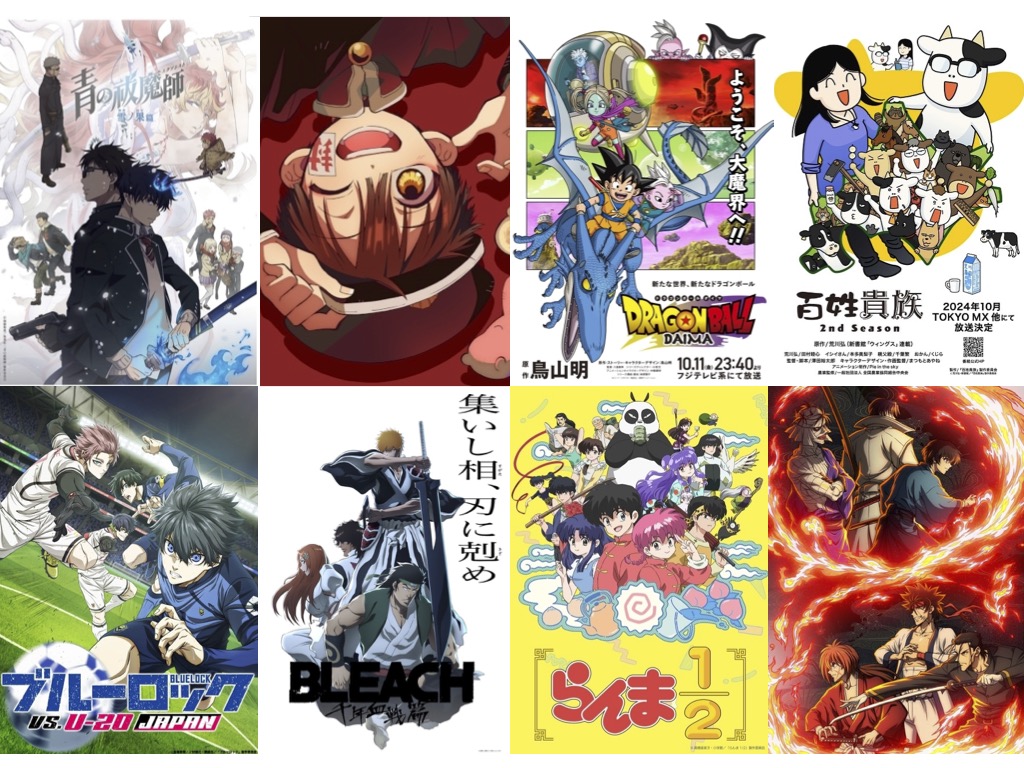
2024年10月秋アニメ(今期アニメ)まとめ
2024年10月期に放送される秋アニメを50音順に紹介する。2024年10月秋アニメは、有名シリーズの新作が多数ラインナップされている。アニメの放送情報や配信情報、声優・スタッフ、あらすじなどの情報をわかりやすくまとめた。
Read Article

Major contracted black cats in "RINNE of the Boundary
The anime "RINNE of the Boundary," in which Rikudou Rinne, who is of human and Shinigami blood, struggles to help ghosts become spirits. The Shinigami who appear in the anime all have contracts with black cats that provide support. In this issue, we will introduce the main black cats.
Read Article

Inuyasha's OP/ED Theme Songs and Insert Songs
Inuyasha" is a Japanese fantasy manga by Rumiko Takahashi and a media mix of anime, film, and stage productions based on it. This article introduces the opening and ending theme songs and insert songs used in the "Inuyasha" anime.
Read Article

Must-see for Kimono Lovers! About manga with attractive kimono illustrations and characters
Although Western-style dresses with gorgeous decorations are enchanting and wonderful, it is the illustrations with a traditional Japanese feeling that are most relaxing to look at. In this issue, we have compiled a list of illustrations of characters wearing kimonos. Please note that I am biased due to my own tastes and preferences.
Read Article

A summary of the voice actors shared by "Detective Conan" and "Ranma 1/2"! Shinichi Kudo and Ranma Saotome are both voiced by Kappei Yamaguchi!
Here is a list of voice actors who have appeared in both "Detective Conan" and "Ranma 1/2". We introduce a number of voice actors along with their characters and characters, including Kudo Shinichi and Yamaguchi Kappei, who plays Saotome Ranma, and Hayashibara Megumi, who plays Ai Haibara and the female version of Ranma.
Read Article
![Atsumori] My Design is an amazing reproduction of uniforms of anime and manga characters! My Design IDs](https://renote.net/files/blobs/proxy/eyJfcmFpbHMiOnsiZGF0YSI6MzQ4NjQyLCJwdXIiOiJibG9iX2lkIn19--6b9017f8436aaac6e9e35323d63d4af5bbeebed3/SID0034755.jpg)
Atsumori] My Design is an amazing reproduction of uniforms of anime and manga characters! My Design IDs
Atsumare Animal Crossing", the Nintendo Switch exclusive version of the popular "Animal Crossing" game series, features a "My Design" function that allows users to design and create their own clothes and tiles, which has become very popular. My Designs, which recreate clothing from popular cartoons, are often the talk of the town on the Internet, and since My Designs are freely available on the Switch online, you can even become your favorite character. Here are some of the most popular MyDesigns from various popular anime and manga.
Read Article

Unusual Swords & Swords Feature
There are even games in which swords are personified. So, I would like to talk about swordsmen who appear in various works of art, or rather, about a slightly different kind of "sword" or "katana".
Read Article

Top 20 recommended anime from the 80's that are highly acclaimed even overseas!
Anime is a major culture that Japan is proud of. Japanese anime has a reputation for its detailed storylines and character settings, as well as its high level of drawing techniques, and is especially highly acclaimed in foreign countries. There are even cases where anime broadcast in Japan is newly produced in other countries. This article introduces 20 titles of 80s anime from Japan that were highly acclaimed overseas.
Read Article

Ten animated films from 1986, which celebrates its 30th anniversary this year.
This year, 2016, marks the 30th anniversary of "Saint Seiya" and "Dragon Ball". It can be said to be the golden age of Shonen Jump, including anime. On the other hand, it was also a time when the anime boom centered on real robot anime was over, original works were waning, and anime magazines such as "The Anime" and "My Anime" were going out of business. We have selected 10 works that represent such an era.
Read Article

Summary of Swordsman Characters in Manga and Anime
It is no exaggeration to say that the sword is the most orthodox weapon that appears in manga and anime. The sight of a sword cutting down an enemy with a single stroke while wounded is extremely popular, and many works have been created on the theme of swords. Here we introduce a collection of swordsmith characters who appear in manga and anime.
Read Article

What is the white fluffy thing you wear when you wear furisode at the Coming-of-Age Ceremony? Some people call it "Kakushomaru.
Many people may remember the white fluffy fur that they wore when they wore furisode (long-sleeved kimono) on their coming-of-age ceremony. However, the official term for that fluffy fur has surprisingly not taken root, and some people even call it "Kesshomaru" in reference to the fur worn by the character "Kesshomaru" in the manga "Inuyasha" (Inuyasha).
Read Article
![Momoiro Clover Z] Tetsuo Hara's illustrations of celebrities, manga characters, and characters from the manga series "Urusei Yatsura" are very cool.](https://renote.net/files/blobs/proxy/eyJfcmFpbHMiOnsiZGF0YSI6ODUzNjYzNSwicHVyIjoiYmxvYl9pZCJ9fQ==--bb191940bdd89e90fcc6e592dcba34d7ff509b05/DfASAL3V4AAkv9j.jpg)
Momoiro Clover Z] Tetsuo Hara's illustrations of celebrities, manga characters, and characters from the manga series "Urusei Yatsura" are very cool.
Tetsuo Hara is famous as a manga artist who drew "Fist of the North Star" and "Fist of Souten". In fact, Mr. Hara has drawn many illustrations of other manga characters and celebrities. In this article, we have collected illustrations created by Hara-sensei. In his hands, any character can be transformed into something cool, sexy, and sexy! It's really wonderful.
Read Article
Contents
- Outline of "Mermaid Series
- Synopsis and story of "The Mermaid Series"
- Mermaids never laugh
- home of the fighting fish
- Mermaid Forest
- The End of the Dream
- Promised Tomorrow
- Mermaid's Wound
- bonesetter
- eyes of a nightingale
- Last face
- Characters from The Mermaid Series
- key people
- Yuta
- Mana
- Mermaids never laugh
- grandmother
- sweetfish (Plecoglossus altivelis altivelis altivelis)
- Japanese fluvial sculpin (Cottus pollux)
- home of the fighting fish
- scale (i.e. of a fish)
- sand
- father of one's scales
- The head of a man with hair on his head
- Mermaid Forest
- Towa Kannagi
- Sawa Kannagi
- Shiina
- The End of the Dream
- Big eyes (big eyes)
- Promised Tomorrow
- Seedlings
- Eijiro
- Sokichi
- Mermaid's Wound
- Masato
- Misa
- Yukie (snow branch)
- bonesetter
- jujube (species of bush, Ziziphus zizyphus)
- daddy
- Buddhist priest
- eyes of a nightingale
- Shingo Oniyanagi
- Akiko Oniyanagi
- Oniyanagi widow
- Sugiko
- Last face
- Nanao.
- mother of seven
- Nansei's grandmother
- Nansei's father
- Terminology for "Mermaid Series
- mermaid
- mermaid flesh
- failure
- Famous quotes, lines/scenes and scenes from "The Mermaid Series
- Yuta: "Trying to live until you give up isn't so bad, is it?
- Yuta: "I couldn't live and die with him."
- Mao "I'm going to look for you all the time, all the time, all the time."
- Mao "I'm here. Sleep well."
- Mao said, "When I thought that Yuta was alive, I cried because I was so happy."
- Masato: "If people like us fall in love with people all the time, it's just too much..."
- Backstories, trivia, and small stories/episodes/anecdotes from "The Mermaid Series
- R-expression
- About the "Mermaid Series" designation
- Theme and insert songs for "The Mermaid Series
- Mermaid Forest (OVA)
- Insert song: "Toki no Bleaching" by Junko Hirotani
- ED (Ending): Eri Fukatsu "Through the forest-Born to love you
- The Mermaid's Wound (OVA)
- Insert song: Akino Arai "Eien no Tears
- ED (Ending): Maki Mochida "Beads of Tears
- TV animation "Rumiko Takahashi Theatre: The Mermaid's Forest
- OP (Opening): Chiaaki Ishikawa "Like an Angel
- ED (Ending): kayoko "Puddle