
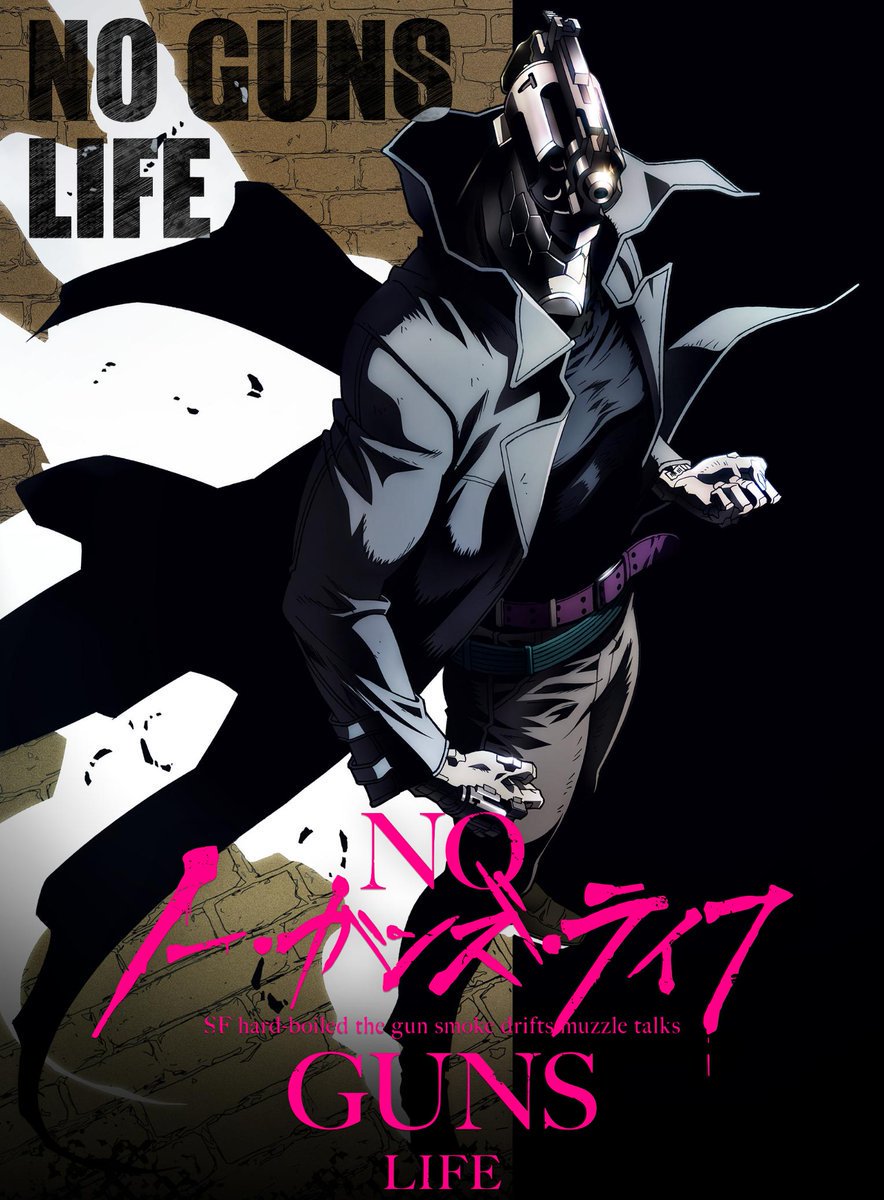
No Guns Life" is a science fiction manga work serialized in Ultra Jump by Karasu Matask. The work was serialized in 2014 after two read-throughs.
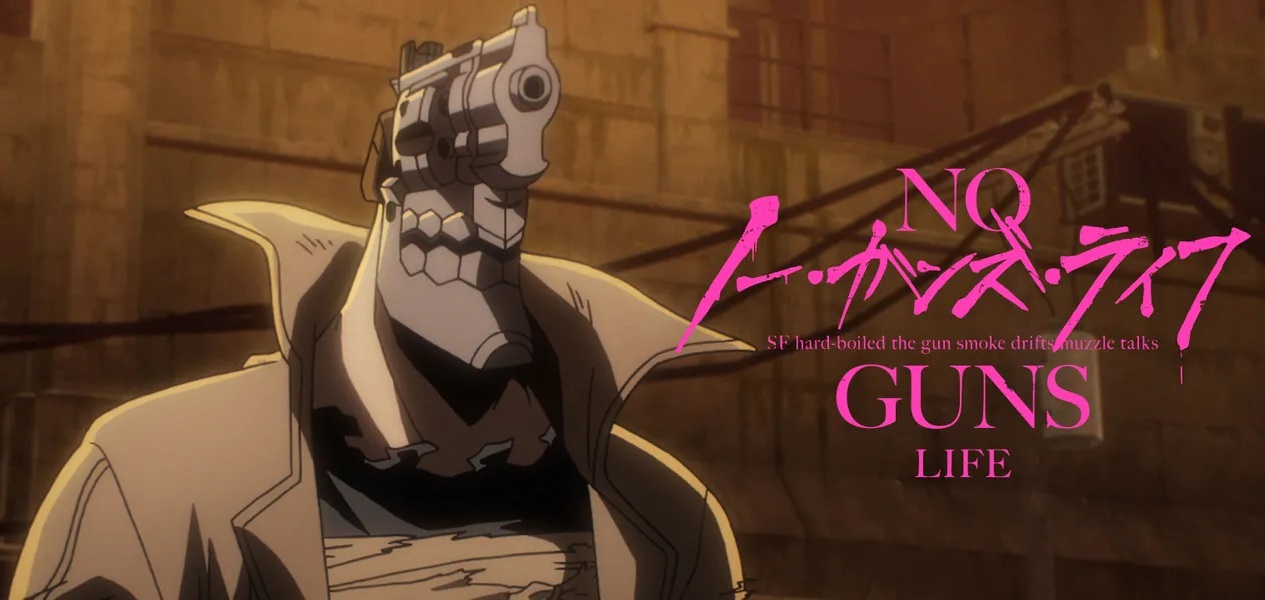
The main character is Inui Juzo, a cyborg known as the "Expanders" in the work. Juzo runs a troubleshooter in town called "Processor" and is a rather odd looking character with a gun on the top of his head.
In this old-fashioned detective story, the hard-boiled lines uttered by this iron-fisted, martial man are memorable.
Overview of "No Guns in My Life"
No Guns Life" is a science fiction manga about a cyborg protagonist, Juzo Inui, called "Extended," whose entire body has been transformed into a mechanical body.
The author of this work, Karasuma Tasuku, made his debut in 2006 in Monthly Shōnen Ace with the manga "Kamihogi," followed by "Shangri-La" in the same magazine and "Dolls' Folklore" in Monthly Shōnen Rival, and in 2014, he began serializing the science fiction manga "No Gun's Life The first serialization of "No Guns Life" was published in the same magazine.
The story beginning of this work always begins with Juso's one-man narrative.
"-I'm Inui Juzo. In this town, which is full of people who have had their bodily functions expanded after the war, I make my living by "handling" problems related to the expanded people.
As you can tell from the one-man narrative, which is like a novel written by Raymond Chandler, this film is a science fiction, but also a hard-boiled story.
The word "hard-boiled" means "hard-boiled egg," and a hard-boiled novel is a story featuring a tough man who is not influenced by his surroundings and who sticks to his own way of life, just like a hard-boiled egg that has hardened to the yolk. The term also refers to works that are described in an objective and concise style, such as the novels of Ernest Hemingway. (For example, Dashiell Hammett, famous for "The Maltese Falcon," uses a report-like style to describe it.) ) This work, too, is a manga with many complicated settings, but the background and settings of the story are told with pictures and dialogues as much as possible, without any explanations other than Juso's one-person narrative, and the manga is well expressed with a concise expression that eliminates waste, which is a characteristic of hard-boiled literature.
Another characteristic of hard-boiled literature is that many of the stories are set in an obscene urban society, feature characters with one or two quirks who live there, and deal with crime as a theme. The main character solves the crimes that they cause (or are involved in).
The main character, Jyuso, was treated as a weapon during the war and has lost all memory of his life. He is called "Overextended" in the film because of his large physique and the revolver pistol on the top of his head.
Thirteen was an extension of the "Gun Slave Unit," and a single blow from the muzzle of his head had the power to transform the battle situation. And when the "Hands," the partners who control the Gunslave Unit's power, allow it to release its power, they can use further weapons housed in its body.
Some extenders simply supplemented their lost bodies with machines, while others were fitted with special functions or, like Thirteen, became over-extenders whose entire bodies were made into extended bodies for the sake of the war, taking on an unusual form with weapons built in. In the film, the war is over, and the dilated people who have found neither a place to go nor a way to live are causing various incidents that have become a social problem. Thirteen runs a troubleshooter called a "processor" in a town where expatriates and immigrants gather to handle disputes between such expatriates and non-expatriates. He gets caught up in the intrigues of a large corporation, Belewren, with a mysterious boy, Tetsuro Arahabatoki, who has the power to hack into the bodies of the "Harmonie" expansions who later become his partners, and a talented expansion engineer (an engineer who specializes in handling the bodies of expansions), a girl named Mary.
Belewren, the mastermind behind this film, is a huge corporation that has developed expansion technology during a war that occurred ten years ago, and after the war has developed to the point where it reigns as the ruler of the city. Moreover, Belewren has been conducting inhumane experiments in secret, such as using many orphans to conduct illegal experiments on augmented bodies, and its purpose and principles of action are shrouded in mystery. At the beginning of the story, we learn that one of the main characters in the film, Tetsuro Aratake, is carrying Harmonie.
Despite being the son of Soichiro Aratotsu, the CEO of Beleuren, Tetsuro Aratotsu was severely beaten, including having the tendons in his arms and legs cut and his vocal cords crushed, and he was also implanted with Harmonie. When Tetsuro escaped from Belewren's facility, Belewren began to search for him with bloodlust. The biggest mystery of the film is what secret is contained in the Harmonie and what Belewren is planning to do with it.
This film has a unique worldview. The city in which it takes place has an Asian atmosphere like Hong Kong or Taiwan, with huge buildings, pipes running through narrow alleys and walls, and signs written in Chinese characters scattered throughout the city. On the other hand, the design of telephones, cars, etc., looks like that of Western countries in the early 20th century. Some of the characters are of Japanese descent, such as Tetsuro, while others are of Anglo-Saxon descent, such as Mary and Olivier, so it is not clear whether the country in which the story takes place is Asian, European, or American. In addition, there are no specific place names or scenes that depict the city from a bird's eye view, so it is not clear in which country and in which place the city is located. This contributes to the worldview of a classic hard-boiled novel, in which a man is caught up in an incident caused by a group of residents who live in a chaotic and chaotic urban society with many quirks. The influence of movies such as "Blade Runner," "Ghost in the Shell," and the science fiction manga "Gun Dreams" can be seen in this worldview that combines Asian and Western influences.
The story begins when Juso rescues a boy, Tetsuro Aratake. After helping a waitress at a bar who was being teased by a gangster, Juzo returns to his office to find a large expansionist with a child in his arms. Thirteen tries to contact the security bureau, but when he sees the desperate look on the face of the expatriate, he tries to ask him who he is, and now the security bureau appears. They were in pursuit of the person who had abducted the child and thought it might be the same person who had just burst into Juso's office, so they tried to check the room, but Juso was so horrified that they decided against entering.
The extender thanked Thirteen, left the child he had brought with him with Thirteen, and took it upon himself to act as a decoy to fool the eyes of the security bureau's watchmen stationed throughout the city.
The child was unconscious, and the tendons in his arms and legs had been severed. Thirteen contacted Mary, his personal engineer, to hide the child and headed for her, but a nun appeared along the way. She tried to take the child in Juzo's arms, saying that he was a boy in her care at their orphanage, but Juzo wondered if she was not just a nun when he saw that the child's tendons had been cut and the way she was walking alone in the presence of the extenders who had kidnapped the child. The nun's true identity was that of an assassin from Velüren.
Thirteen was engaged in a battle with Belewren's assassins, but with the child in his arms, he was at a disadvantage. Then, the expander who had asked Juso to protect the child appeared and joined Juso, but he was beaten back and fell into the underground waterway. In order to save the expander, Juso, out of sheer desperation, gave the child to the assassins of Velieulen and jumped into the underground water to save the expander.
When Juzo asked the dilator about the truth, he found out that the child's name was Tetsuro Aratake, and that he was an experimental subject of Belewren and had been implanted with the dilator's remote control device "Harmonie". He had escaped from Beleuren by using the power of the Harmonier to control the extension that had just been talking with Juzo. It was Tetsuro who had been talking with Juzo, who had been controlling the extended body with Harmonie.
Eventually, Tetsuro's extension could no longer withstand the power of the Harmonier and reached its limits. Tetsuro gave up on his escape, thanked Juzo, and disconnected the Harmonier. However, Juzo did not abandon Tetsuro, but interrupted the Belewren convoy train in which he was being loaded and rescued him. While Juzo was thinking about what to do with the rescued Tetsuro, he heard a news report on street TV. According to the news, Tetsuro was the son of Soichiro Aratu, CEO of Velulen.
From this moment on, Juzo became involved in the conspiracy of Velulen.
No Guns Life Spoilers - RENOTE
renote.net
NO GUNS LIFE" is a manga by Karasu Matask. The story is set in the near future, where "augmented people," who have mechanized parts of their bodies, and flesh-and-blood humans coexist, and depicts the activities of a young man who is an over-extended person who has mechanized his entire body.
Inui Juzo, who handles disputes involving augmented persons for a living, is asked to protect a child who is being chased by the giant corporation Belewren. The boy, named Tetsuro Aratake, is a victim of Beleuren's human experimentation and possesses the power to manipulate expanders. Jyuuzo becomes embroiled in a conspiracy surrounding Tetsuro and is forced to confront the Beleuren Corporation.
Famous quotes and lines / Famous scenes / Famous scenes by Inui Juzo
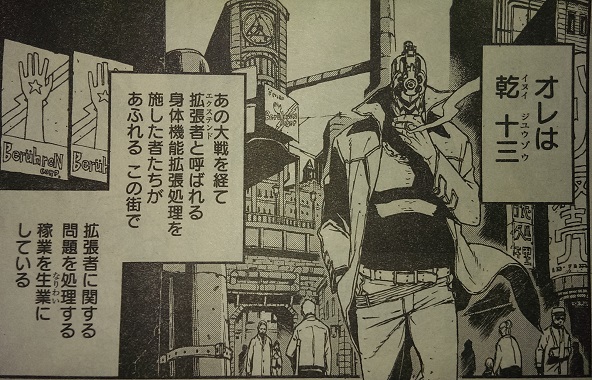
13th of the sexagenary cycle
The protagonist of this work, an overextended man who runs a treatment shop in town. He has a gun in his head as well as in his fist. His true identity is that of a strategic weapon-type expander called a gunslave unit, which was active during the Great War. While powerful, it also puts a strain on his nervous system, so he regularly uses a sedative-laced cigarette called "Tanegashima. Despite his rugged appearance, he also likes to clean the house.
He has no memory of the time before he became an extender, and does not seem to know what kind of person he was.
Gunslave units are controlled by a partner called "Hands," who exerts their power. During the war, Juso also had a "Hands," but he is currently unaccounted for.
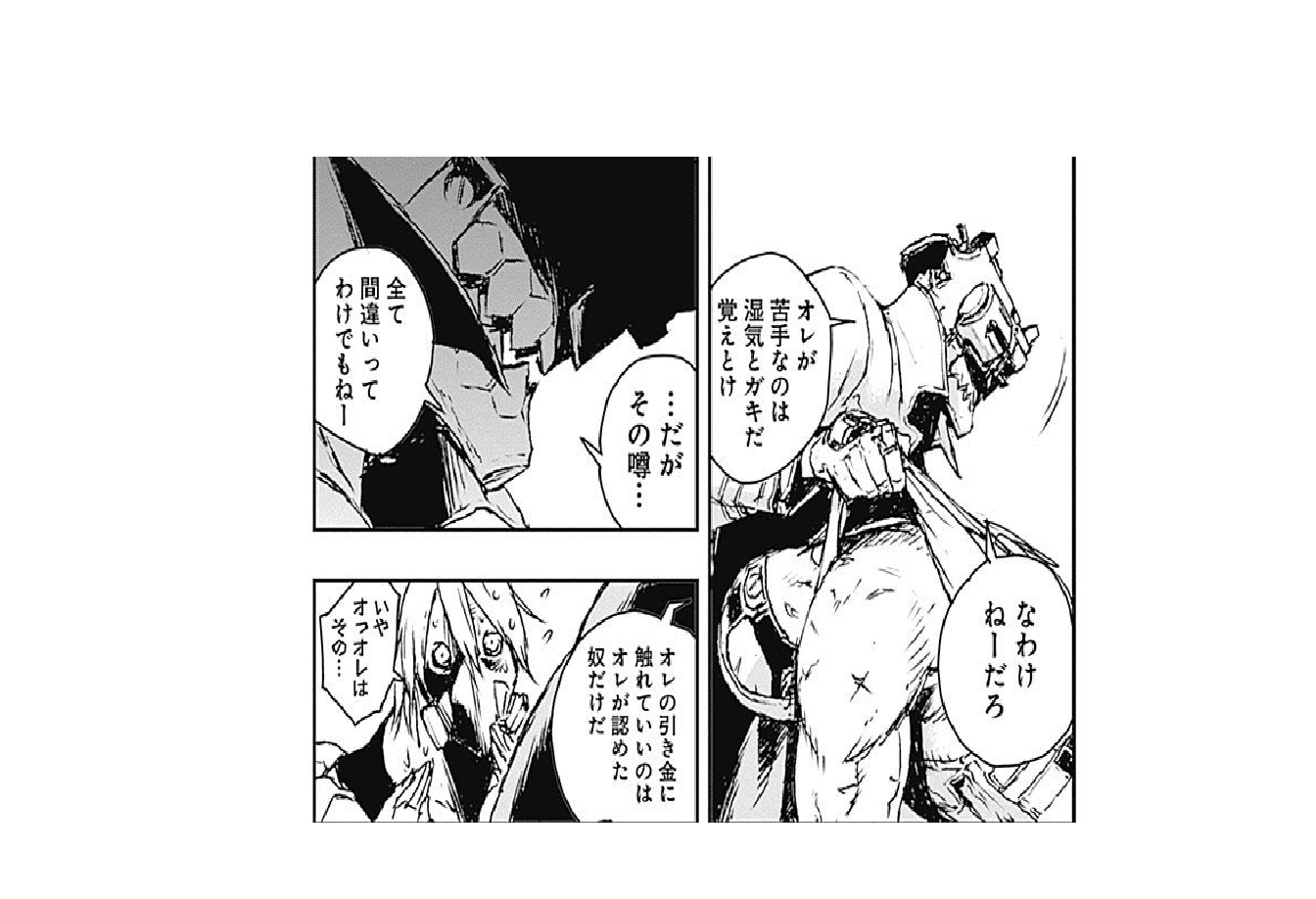
The only people allowed to touch my trigger are those I approve of."
Volume 1 Source.
The beginning of the story of this work. When Juzo was fighting off two expansionist thugs who were rampaging through his store at the request of a city bar owner, one of the thugs saw an opening and tried to grab the grip and trigger on the top of Juzo's head. They had heard rumors that Juzo did not like having the trigger put on his hand, and they thought that was Juzo's weakness.
While it was true that Juzo did not like someone pulling his trigger, it was not a weakness. Thirteen easily knocked down the thugs who tried to pull the trigger, and after saying, "The only people who can touch my trigger are those I approve of," he then said, "And...I'm not going to approve of anyone," with a terrific grin, and sent the two thugs away.
This is a scene and line from early in the film that highlights the character of Juso, who has a gun on the top of his head.
Juso's true identity is that of a "gunslave unit," an expansionist who was active during the war and who was able to demonstrate a high level of fighting ability even with his bare hands, but whose true value was demonstrated when he was under the control of an expansionist who was a marksman called "Hanz. The shot fired from the top of his head was so powerful that it could change the course of a battle (the gun on the top of his head could be fired without the hands). ) And with the permission of the Hands, they could fight with their internal weapons, which were capable of destroying an entire town. However, because of its fighting power, it was considered too much for man to handle, and at the end of the war, the military high command decided to scrap the gunslave units.
The gunslave units, except for Juso, attempted to escape, but were killed by Juso's sniper fire. At that time, Juso was shocked to find that he had killed his own people, even though he had been ordered to do so by the military. Until then, Juzo was a man who simply followed the orders of the military and did not have much of a will of his own. He had been following the orders of the military and had not been willing to use his own will, and he had taken the lives of other gunslave units, his own comrades.
He regretted not having made the decision of his own volition, and his guilt drove him out of control, destroying his friends and the town.
Thirteen does not hate to touch the trigger; he hates to be controlled by anyone.
The Gunslave Unit is full of mysteries. The weapons and "vertebral articulation hangar" stored in the spinal cord section of the extended body can hold equipment to deal with any situation and repair a body damaged in battle. The key to the hangar is a control device attached to Hanz's arm.
The hangar and the weapons to be removed from it are obviously larger than the main body of the gunslave unit, so the gunslave unit is thought to have a four-dimensional structure.
One of the fascinating aspects of the story is the pursuit of the mystery of this gunslave unit.
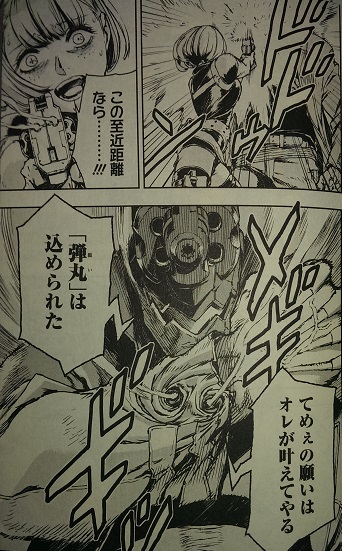
I'll make your wish come true. The bullet is loaded.
Volume 1 Source.
Juso was asked to protect a child with severed tendons in his limbs by a mysterious dilator who broke into his office. The dilator took the bait to mislead the eyes of the security bureau and left without a trace. Thirteen tries to carry the child to safety, but is attacked on the way by Belewren assassins. Jyuuzo is unable to fight properly because he is carrying the child in his arms. The mysterious extender appears again to help him, but he is turned back by Beryullen's assassins and dropped into an underground water vein. Thirteen grabs him in the nick of time, but he is also carrying a child and cannot pull him out. Knowing that the child would fall into the hands of the assassin, Juso puts the child down and tries to save the expander, but the moment the assassin puts the child down, he fires a deadly bullet at Juso. Juso and the expander fell into the underground water vein, but the expander took his own life to protect Juso.
When the dilator asked the child's name, it turned out to be Tetsuro, a boy who had been experimented on by Belewren with the "Harmonier," a device that allows remote control of the dilated body. The extension that appeared to Juso was controlled by Tetsuro. In other words, it was not the extended body that had been talking to Juzo, but the child Tetsuro that the extended body had been carrying. Tetsuro's limbs and vocal cords were cut off by Belewren, and he used the Harmonier to escape in order to gain his freedom, but he fell into Belewren's hands again. The extension he was controlling had been damaged in the fight with Belewren's assassins and could no longer withstand the load of the Harmonie. Tetsuro gave up on everything, and when the extension was at its limit, he thanked Juzo and cut the connection.
To help Tetsuro, Juzo broke into the private train in Belewren where he was being escorted and, addressing the restrained Tetsuro, issued a proclamation, "You kids be kids and see what you can do! he proclaimed. In response, Tetsuro activated his Harmonier, took over the body of a nearby extension, and pleaded with Jyusan, "Save me...! He pleaded with Juzo, "Save me...!!! Hearing these words, Juzo said, "I will grant your wish, the bullet (wish) is loaded," and he went on to fight Belewren to save Tetsuro.
Perhaps because the top of his head is a gun, Juzo uses this line when he accepts a job from a client, referring to "wishes" as "bullets.
When Juzo was in the military, he was a man who only did what the military ordered him to do. Gunslave units would be under the control of a partner named Hands, so he had to live as a tool without a will of his own. Eventually, Juzo is tasked with executing the same gunslave unit that deserted after betraying the military, and he goes berserk out of remorse for having killed them, destroying a town in the process.
Thirteen was released by the mouth of his own hands and left the military. He then took up residence in the town, calling himself a "processor," and began to make a living granting wishes to others.
Having no will of his own, and having trampled on their wishes to be free by killing his fellow Gunslave units, Thirteen believes that the only way to make amends is to use his power only for someone who needs help, with the Gunslave units' power blocked.
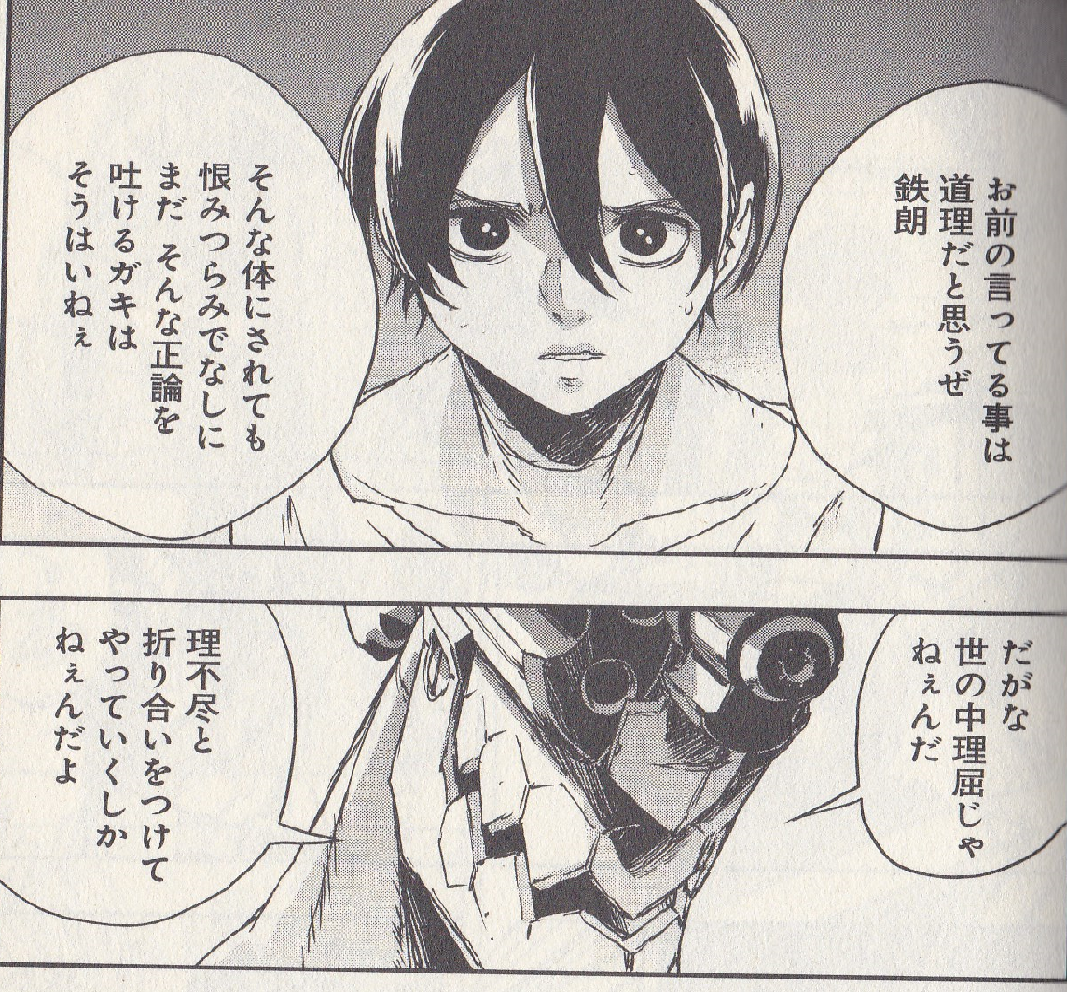
It's not about logic in this world, you have to deal with unreasonableness.
Volume 1 Source.
After saving Tetsuro, Juzo learned from the TV news that Tetsuro was the son of the CEO of Belewren. He then went to the "Nine Star Cave," a section of the city where immigrants congregate, and there he hid Tetsuro in the lab of Mary, his personal extension engineer. Then Juan, an executive of the "Nine Star Society," a yakuza group that manages the Nine Star Grottoes, appeared in search of Tetsuro. He had come to ask Juzo to take care of an incident at the Nine Star Cave in which a child who had become an expansionist was attacked.
Juan thought the incident was the work of the Spitsbergen, an anti-expansion technology terrorist group, but Juan saw that it was not the Spitsbergen but Belewren who had done it to smoke out and find Tetsuro, and he refused the request to protect Tetsuro.
When Tetsuro learned that a child, a complete stranger, had been attacked in order to smoke him out, he felt responsible and asked Juzo to handle the case, but Juzo shunned him, saying that he was too busy helping Tetsuro and could not afford to help a stranger. Tetsuro, however, argued that as the son of the CEO of Veluren, he was obligated to stop this evil, but Juzo coldly replied, "There is no logic in this world, and you have to deal with unreasonableness.
Tetsuro wants to help the children of the Nine Star Cave out of a genuine sense of justice and a sense of responsibility, but Juzo rebukes him and tries to make Tetsuro accept the unreasonable reality that a sense of justice alone is not enough. Although Juzo values the feelings of others, he is still limited in what he can do. No matter how many innocent children are being sacrificed, if he makes a rash move, he will put Tetsuro in harm's way. In order to protect Tetsuro, we have no choice but to remain silent and watch this incident.
The composition of a child who speaks out righteously and an adult who tells him the unreasonable reality is an impressive scene, and Juso's words express the bitter feelings of an adult who has always accepted the unreasonable.
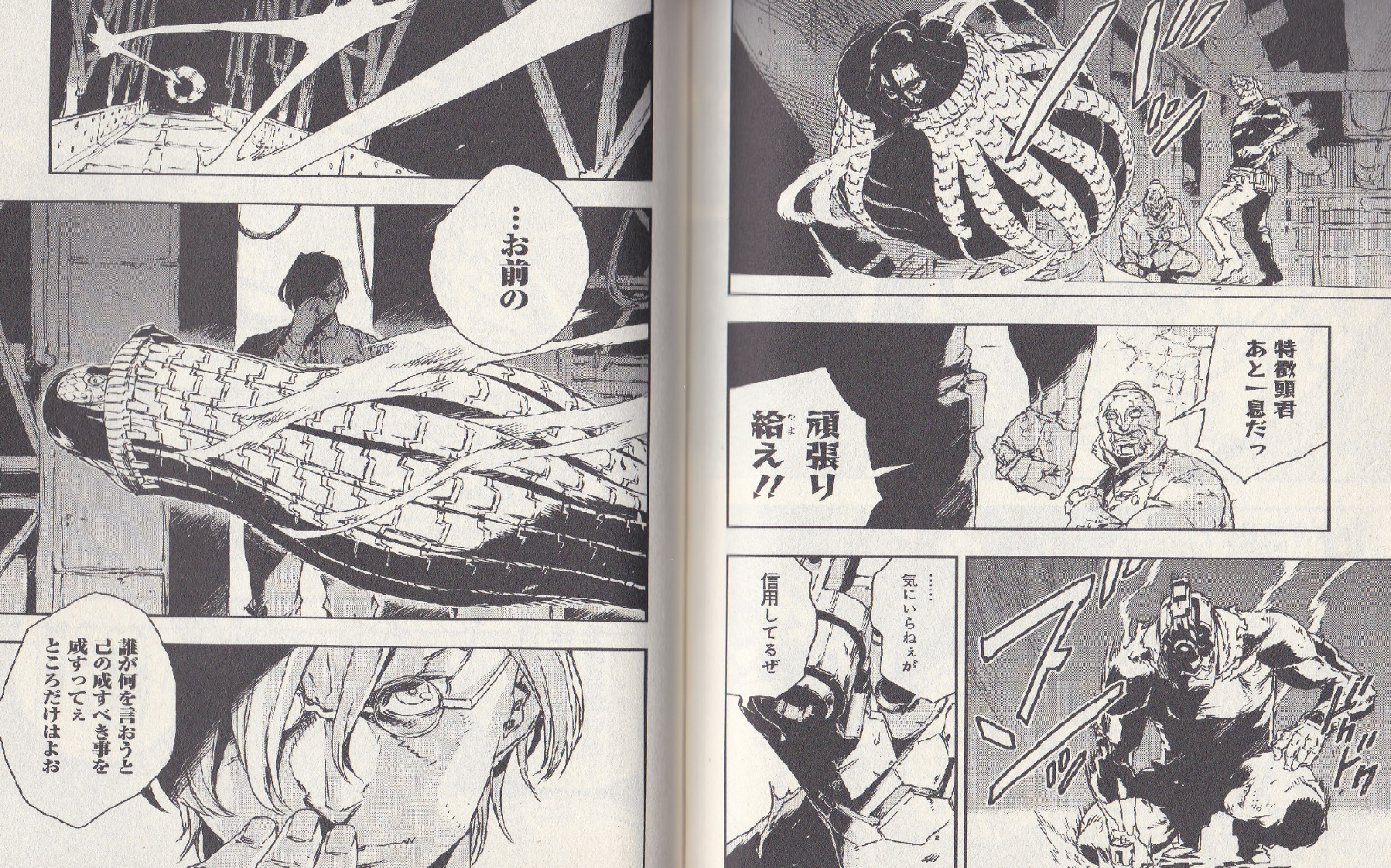
...... I don't like it, but I trust you... to do what you have to do, no matter what anyone says."
Volume 2 Source.
Thirteen was asked by Olivier, the head of the EMS (Extensionist Management Service) of the Reconstruction Agency, with whom he has a close relationship, to investigate an escaped extensionist prisoner. The prisoner's name is Hayden Gondry. He escapes with the help of someone else. Gondry had been out of control before his arrest and had killed at least three people in the 48 hours since his escape.
Gondry's arrest was during wartime and he was on special duty in the military, so there were no records of his arrest. He had an auxiliary brain abnormality, and during the war he had run amok in the Norscott laboratory, killing a military police officer who had come to inspect the laboratory and a friendly soldier. (The augmented person has an AI called an auxiliary brain attached to his spinal cord to reduce the strain on his brain when controlling his body.)
When the incident occurred, proponents of augmentation technology, who had wanted to promote it during the war, feared that it would hinder the spread of augmentation technology to the general public, and insisted that Gondry's outburst was solely his own fault. The military police, on the other hand, argued that there was a problem with the auxiliary brain. The argument went on and on, culminating in Gondry's indefinite confinement. (According to Olivier, it postponed the issue.)
While Juzo was investigating at the residence of one of the victims, Philippe Lecaret, a high-ranking official of the Reconstruction Agency, he discovered from a fallen photograph that Gondry had been acquainted with the victims since the war. Then Kronen, an EMS agent and Olivier's subordinate, appeared before Juso. He too had come to the mansion to investigate Gondry. Thirteen judged that the next person expected to be attacked by Gondry would be "Mega-armed Sai Tokisada," a compatriot of Gondry's and said to be the first full-body expander, and he and Kronen rushed to Tokisada's place.
The two men, who were monitoring Tokisada, saw Gondry, who had mimicked a young girl, about to attack Tokisada; the two men fled with Tokisada and learned from Tokisada that Gondry was an overextended person with the ability to mimic. He had been using this ability to perform assassination missions during the war, but Gondry's deformed shape, like a squid or octopus, and his special mimetic function put a tremendous strain on his auxiliary brain, and he finally went berserk.
While protecting Tokidate and investigating Gondry, Kronen was instructed by his superiors to relinquish his position at EMS. Olivier was relieved of his post as director, Gondry was to be disposed of rather than arrested, and his duties were to be assumed by someone else. (Upper management had originally left Olivier in charge of Gondry's disposition, but Olivier saw it as a chance to bring Gondry to justice in public and was about to arrest him.) Upper management wanted to keep the case completely in the dark. (The reason EMS backed down was because they were going to use illegal means to get rid of Gondry, and Olivier said that they were suspected of being in league with Belewren.)
Kronen had to leave the scene, but Gondry appeared again and tried to attack Tokisada. Tokisada prevented Tokisada's attack with his own fists, and challenged Gondry to a head-to-head fight. Eventually, both were exhausted, and Gondry withdrew because his auxiliary brain had overheated, but Kronen was waiting for him on his way out. Kronen drove a needle into Gondry's auxiliary brain, blocking his body from moving.
Kronen had left everything in Kronen's hands, saying, "I don't like ...... it, but I trust you... to do what you have to do, no matter what anyone says.
Kronen is a raw body, but he possesses the technology to put needles into the expander's trigger points (power system) to block the expander's movement. He and Juso do not get along well, and the two fight constantly, but they recognize each other's abilities and sometimes cooperate with each other.
The two are proud of each other as "workmen" who try to accomplish what they need to do without being distracted by personal feelings, and the quote expresses the strange relationship between the two.
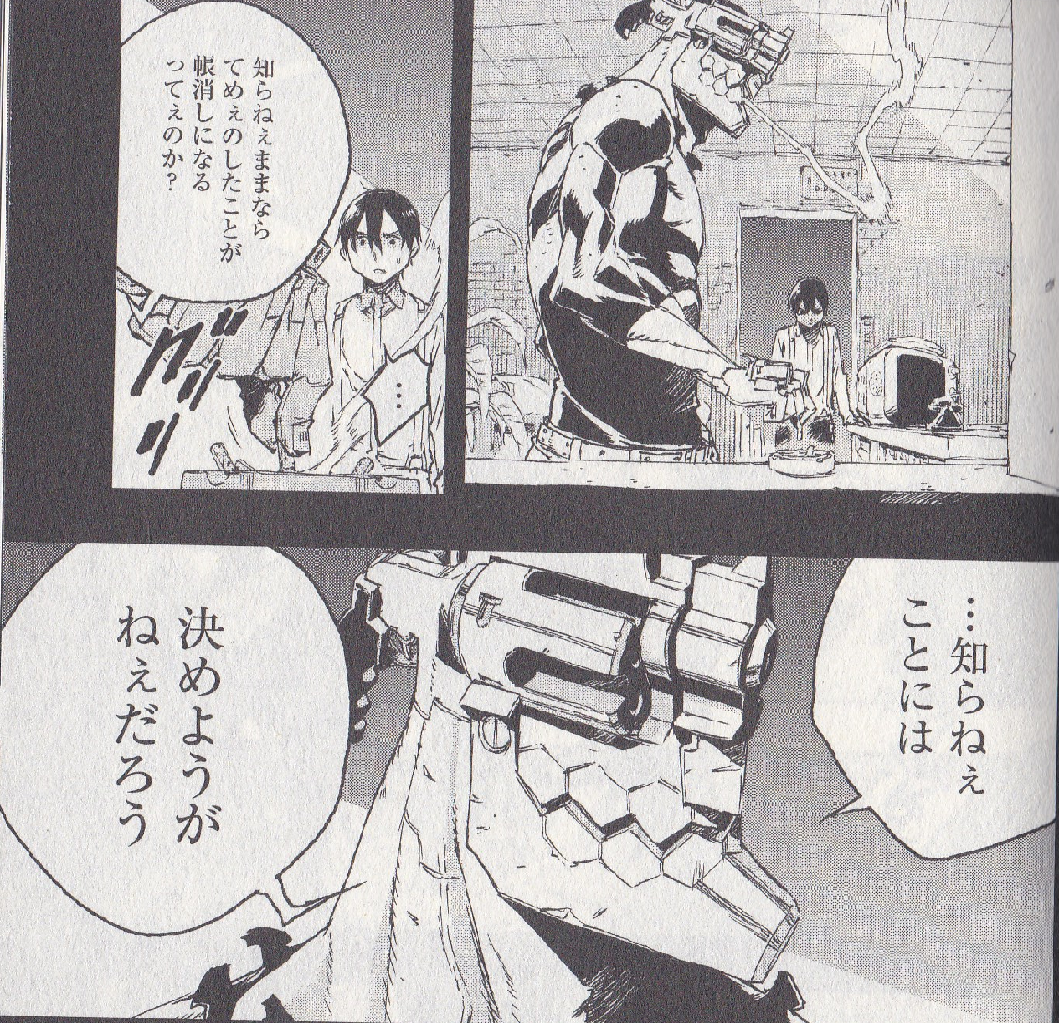
I fell asleep, because your lecture was so boring."

Volume 3 Source.
Ten years ago, Hayden Gondry killed a military police officer at Norscott's Expansion Technology Laboratory. The truth of the matter was that Tokisada had arranged for Gondry, who was already out of control at the time, to incite the military police to cover up the illegal expansion experiments using prisoners of war. Among the victims was Olivier's father, who was a member of the military police.
When Olivier learns the truth, he is enraged, but then the sedative in his cigarette wears off and he goes berserk, and Juso enters and attacks Tokisada. Tokisada is attacked by Juso, but Juso misses Tokisada's fist, which he swings at Tokisada. Then, Juso's auxiliary brain overloaded to the limit, he finally collapses.
Tokisada, who was saved in the nick of time, began to insist to Olivier that the world wanted him to be a hero, that he was the bridge between the expansionists and non-expansionists, that he had kept the peace in this country, and that his existence was the cause of the world.
Olivier, who had even had murderous thoughts toward Tokisada, realized that Juso was just barely trying to fulfill Olivier's wish to catch the culprit alive when the outraged Juso removed his attack on Tokisada.
When Olivier learned of Juzo's thoughts, he remembered that his true wish was not revenge, but to catch the culprit and avenge his father's death. He then gave her a mouthful of Tanegashima smoke, Juso's favorite sedative cigarette, and said, "...you ...... are going to let your client die? Juso" to bring Juso back to his senses. Tokisada tried to skewer both Olivier and Juzo with an iron pipe, but was interrupted by the awakened Juzo.
Tokisada then said, "I fell completely asleep. Your lecture was so boring, you know," he said in a hateful tone. The contrast between Tokisada's speech and Tokisada's flimsy and unjustified argument is striking, and it is also a famous scene in which Olivier gives Tokisada a cigarette to wake him up.
Once, in the famous Chaplin film "Murder Madness," there is a saying, "If you kill one person, you are a criminal, but if you kill a million people, you are a hero. Not only Chaplin, but also Dostoevsky's "Crime and Punishment" and the ancient Chinese thinker Sumi Zi said the same thing.
Heroic deeds include acts of barbarism, which are sometimes regarded as great deeds. In war, for example, one may kill tens of thousands of the enemy's people to lead one's country to victory. When Machiavellianism is used to protect a country or people in a crisis, the public praises it as a heroic act. No matter how horrendous the deed, if the person is skilled in the cause, oratory, and performance to mislead the public, he can be imprinted in the public memory as a hero.
Tokisada excelled at this. He was so adept at public stunts that he not only took out the officials who came to inspect Norscott's laboratory during the war, but also played a role in the cover-up of the incident. However, Tokisada's insightful mind was not fooled by his principles and cause. Tokisada was arrested by Olivier.
During his escort, Tokisada tried to tell Olivier about Beleuren, the man who had made him a hero. Tokisada told him that the Belewrens were too powerful for EMC to handle, but before he could tell him everything, Tokisada was purged by the Belewrens' processor, Gunslave Unit Seven, and its hands, Pepper. And as for what was going on in Norscott's laboratory during the war, it was kept in the dark.
What's important is what you choose to do with what you know.
Volume 6 Source.
Because Juzo has obtained a recording medium containing information on Berylene, Christina, the owner of the building where Tetsuro and Juzo's office is located, is abducted by the anti-expansionism "Spitsbergen" who want to get their hands on it. For some reason, however, the Spitsbergen released Tetsuro and Christina.
While Tetsuro was being abducted by the Spitsbergen, the leader of the organization informed him that he had become an experimental subject of Harmonie and had cooperated with the Spitsbergen before losing his memory. Tetsuro cannot hide his shock at learning that he had been complicit with the terrorists, and after telling Juzo about it, he said that he did not want to know the truth if this was the case.
In response, Juzo admonishes Tetsuro, saying, "...you can't make a decision if you don't know. What is important is what choice you make in response to what you have learned.
When he was in the military, Juzo was a man who mechanically followed the orders of the military, partly because of the Gunslave Unit's characteristic of not being able to demonstrate its true value without the Hands. Furthermore, the Gunslave Unit's power was such that if he tried to use it without Hands, a safety device would kick in and he would lose consciousness. Therefore, Thirteen never tried to make decisions or choices on his own. However, when he killed his fellow Gunslave Unit members, he regretted that he had never made a decision on his own.
After the war ended, Juzo was left to live in the city, but like other returning expansionists, he had a rough time, not knowing how to live or where he belonged. Eventually, with his powers sealed away, Juzo was given the job of handling problems related to the expansionists. This was the path Juso chose to face his abominable past.
While Juso taught Tetsuro how to face the abominable facts and the past through these experiences, the lines also make us feel that Juso himself is always wondering how he can live with the fact that he killed his own people.

Tags
Contents
- Overview of "No Guns in My Life"
- Famous quotes and lines / Famous scenes / Famous scenes by Inui Juzo
- The only people allowed to touch my trigger are those I approve of."
- I'll make your wish come true. The bullet is loaded.
- It's not about logic in this world, you have to deal with unreasonableness.
- ...... I don't like it, but I trust you... to do what you have to do, no matter what anyone says."
- I fell asleep, because your lecture was so boring."
- What's important is what you choose to do with what you know.
- Thirteen "bullets are" Tetsuro "wishes are" Thirteen & Tetsuro "contained!"
- Mary Steinberg Quotes and Sayings / Famous Scenes and Scenes
- What are you talking about? Of course there is!
- He said, "I want people to know that even if they lose something and are grieving for a while, they have the strength to make up for what they lost with something else eventually."
- Tetsuro Arasai's Famous Quotes / Famous Scenes / Famous Scenes
- Even if I know it's just a picture, if the beauty of that sky makes me yearn for it, I will seize it with my life!
- 'People's ideas change, don't they? I'm sure it's not all bad."
- Olivier Van De Velme Quotes, Famous Lines / Famous Scenes, Famous Scenes
- My father was a man who sacrificed his own small happiness for a cause that was so insignificant. ......, but deep in his heart, he was a strong man who wanted peace for his country."
- Kronen von Wolff Quotes and Sayings / Famous Scenes and Scenes
- Look, this car is pre-WWII vintage, and nothing else in this condition exists, and those of you expansionists who think there's a substitute for everything will never understand its value."
- Colt's Famous Quotes and Lines / Famous Scenes and Scenes
- "Then you tell my family that it's wrong to kill them, so you'll just have to put up with it and die!
- Pepper's Famous Quotes and Lines / Famous Scenes and Scenes
- The printed word becomes a thing, and a thing can be picked up and made one's own.
- "Spit on it."
- Seven's Famous Quotes / Famous Lines / Famous Scenes / Famous Scenes
- "It's disgusting, really, I can't believe I'm asking you to do this...Iniju 13, please get Pepper to do this for me."