
This is a summary of the "time school" initiated by a group of Japanese writers in the 1960s. Even if it was just their fad, the mystique remains flaunted.
What is the Time Faction?
The group was formed in 1962 by Ushio Nakazawa, Fuji Tanaka, Tatsuo Doi, Shozo Nagano, and others, who had been conducting a study group with Yusuke Nakahara as an advisor.
Source: www.artscape.ne.jp
It seems kind of scary.
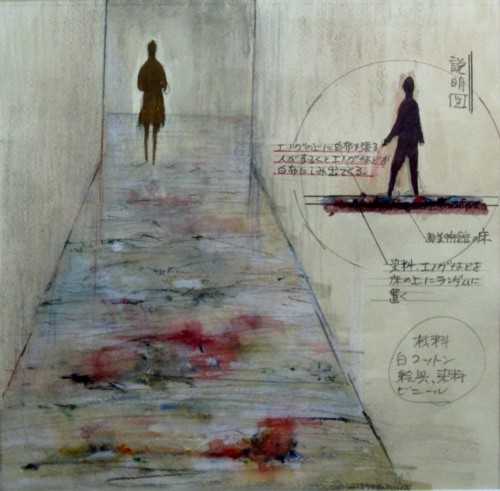
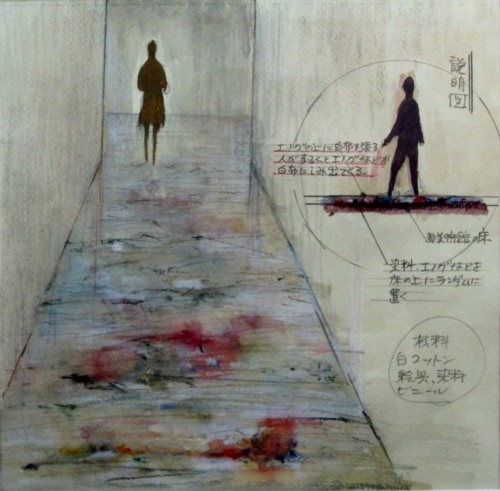
Above is a work by Ushio Nakazawa.
Incidentally, I wanted to search for other people's works, but could not get a good hit.
In the exhibition, Ushio Nakazawa exhibited a work in which the plastic bag underneath was torn and the dye color spread when the audience walked on the white cloth, but the museum ordered him to remove the bag.
Source: www.ntticc.or.jp
It seems a mystery to me why they were ordered to remove them....
He also questioned the concept of authorship, and created works collectively without names. At the second exhibition at Mime Gallery in March of the following year, in addition to the works exhibited in this exhibition, a screen with a tube on the floor on which light moves subtly when the viewer steps on it, and a giant kaleidoscope were also presented. In October of the same year, he held an event called "Gigi" with Kazuo Ohno and Akira Kasai at the Asahi Auditorium, in which he transformed the relationship between the "viewer" and the "seen" on stage by making the audience shine lights, hear roaring sounds, and smell foul odors.
Source: www.ntticc.or.jp
The time group also seems to have a high outlaw temperament.
In the "Declaration of the Temporalists," "absolute time is replaced by inherent time, and an unknown dimension is given to art.
Source: www.artgene.net
So the presentation of works like the one above was for an unknown dimension.
He collaborated with other genres such as theater and created kinetic art-like works using light, but ended his career in 1966.
Source: artscape.jp
However, it was only four years, a short period of activity, like a burnt-out music band.
What is artistically fashionable?
A fad is a phenomenon in which a particular thought, form of expression, product, etc. that is newly observed within a certain limited temporal and spatial expanse permeates and spreads in that society.
Source: artscape.jp
Was your activity as a time group also a sort of fad?
A voluntary group of people belonging to a certain society adopts a certain trend by some chance, follows it enthusiastically for a long or short period of time, and suddenly abandons it as soon as a new trend appears.
Source: www.artscape.ne.jp
It will be interesting to see how the time group members move after the breakup.
However, a search of their names did not turn up anyone definite. Perhaps they saw that since they had dared to do works that were unnamed in the time school, if they did any notable activities after the breakup, they would lose their significance as a time school.
The student movement was at its peak during the 1960 Security Treaty struggle and the 1968-1970 All-Campaign University Conflict, but since then it has been on the decline. The reasons for this decline include a shift away from politics as society became more affluent, and an aversion to radical movements such as internal strife.
Source: ja.wikipedia.org
The 1960s were these years. Are the time groups closely related to this?
It may be enviable to burn up one's youth within a few years, but it is meaningless if one becomes a shell of one's former self afterwards. (I'm not talking about the Hourists.)
(I am not talking about the members of the Time Faction.) Still, even if you are only a few, how does it reflect on you that the Time Faction has left its mark so that it is still spoken of as a term of art?
