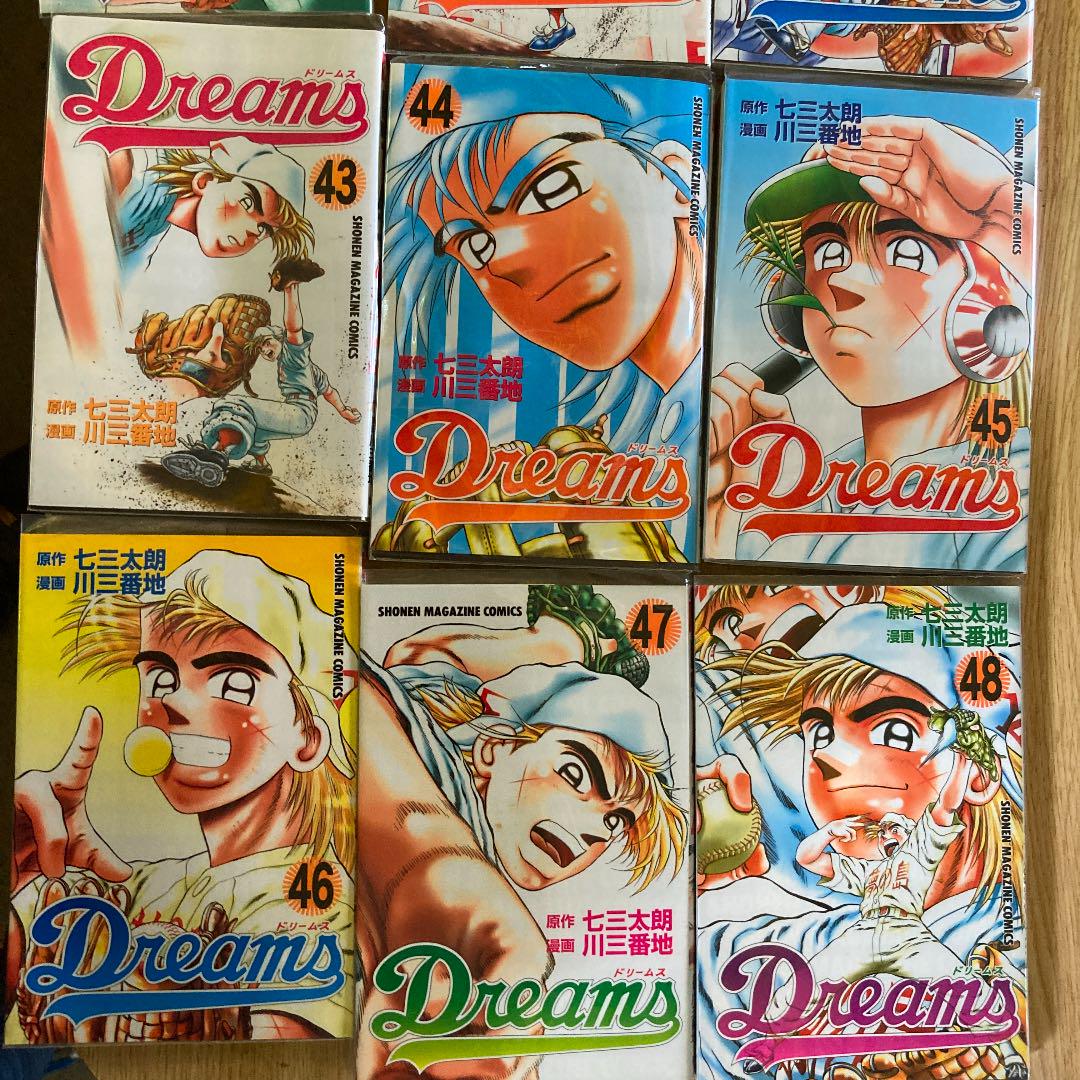
Dreams" is a baseball manga written by Shichisantaro and drawn by Kawasanbanchi. The work features supernatural magic balls, characters and characters with astonishing physical abilities, and is highly regarded for its detailed depiction of games. Here, we will discuss whether a variety of unique and unique breaking balls can actually be thrown, such as the "Bakuball Series" and "Bakuball 0" by the main character Takeshi Kuri, the "Magic Ball KOBE" thrown by Ikuta of Kobe Tsubanari, and the "Magic Ball 1.7" by Nagura of Shokutokan, by comparing the principles of breaking balls and existing changing balls.
Pitchers throwing breaking pitches
Takeshi Kuri
The protagonist of this work. He is an athlete who has everything going for him, running, offense, and defense. However, he is also a troubled kid who easily gets mad and causes problems such as violence. He has a great sense of baseball, but no high school would recruit him because of his bad behavior. Although he has a personality disorder, he gradually finds harmony with the other members of the club and transforms the baseball team from a dropout to a strong team. He throws right-handed and bats right-handed.
Yohei Ikuta
He is a pitcher for the baseball team of the spring champion school, Kobe Tsubasaisei High School, known as the "Goubaku" lineup. He lost his parents in the Great Hanshin Earthquake and continues to play baseball while taking care of his younger brother and sister. He is also a good hitter, and loves to use a wooden bat with the intention of becoming a professional hitter. He throws left-handed and hits left-handed.
Nagura Matoya
He is the ace of Shokutokan, which is coached by Kuri's father. According to the coach, he is a "finished product". He throws right-handed and hits right-handed.
Shurijo Kirari
A female member of the baseball team at Churaumi Seito High School. Originally, girls were not allowed to participate in the Koshien tournament, but since the team had already reached the third round, they were allowed to participate as a special exception. She has a flexible pitching technique that is unique to girls. She throws left-handed and hits left-handed.
Variations considered whether they can actually be pitched.
Bakuball Series
bug ball
First up was the "bakuball," the first pitch thrown. This is a pitch that swings subtly from side to side and is intended to be batted away, not struck out. This kind of breaking ball is also described as a "moving" or "violent" pitch. This is a "moving fast" and refers primarily to fastballs thrown by major leaguers. It has the property of making subtle changes through the passage of irregular stitches and rotational misalignments.
As an aside, major league pitchers do not like their pitches to be caught by the catcher with a good sound catch. They seem to recognize that if the catcher can catch the ball well, the hitter has a good chance of hitting it.
For Kuri, who is aiming for the major leagues, the "bug ball" is an effective pitch to take.
Bakuball 2
A pitch that slides in front of the batter from a fastball. In other words, in real baseball, it is a fast slider. Although there are ambiguous views, generally speaking, a slider of around 140 km/h is called a fast slider.
In Japanese baseball, names such as Tomohito Ito, formerly of the Yakult Swallows, and Kenshin Kawakami, formerly of the Chunichi Dragons, threw high-speed sliders.
Buckball 3

Jordan Hicks of the U.S. Cardinals throws a high-speed sinker. This ball is close to "Buckball 3".
The opposite of "Buckball 2," this ball sinks like a sinker while shooting and spinning. In real baseball, it is similar to a high-speed sinker.
In Major League Baseball, Jordan Hicks of the Cardinals throws a 164 km/h high-speed sinker.
Buckball 4
A pitch that is a combination of "Buckball" and "Buckball 2." In other words, it is a slider from moving. In real baseball, major leaguers who throw a fast slider almost always throw a ball that moves like "Buckball 4".
Bomb Ball 0
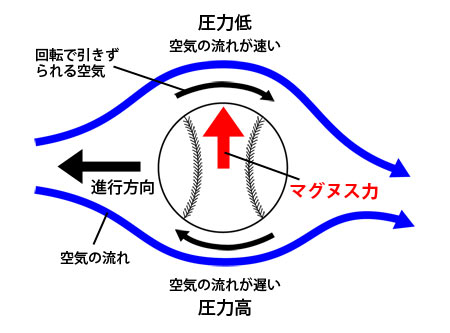
It is a 4-seam ball like a normal fastball, but with the seams reversed so that it extends in the opposite direction of a normal fastball. In reality, it corresponds to the "rise ball," which is a softball-specific breaking ball.
The "rise ball" is a ball thrown from a level ground or below the waist, which appears to float in the batter's hand as if defying gravity due to the "Magnus effect," a phenomenon in which a vertical force acts on a spinning ball placed in a uniform flow.
Yukiko Ueno, a member of Japan's women's national softball team, can throw this variant.
The thrown ball changes depending on the stitching and the number of revolutions. Normally, professional baseball players throw the ball with a RPM of 30 to 40. There are actually players who throw overthrows and good three-quarter throws who have thrown something close. Daisuke Matsuzaka, the "Monster of the Heisei Era," throws a straight ball at 41 RPM. Fujikawa Kubo, famous for his "fireball straight," threw a 45 rpm straight. Masashi Yamamoto, a starting pitcher for the Chunichi Dragons, had an astonishing 52 RPM.
By raising the rpm, the pitch defies gravity and does not stall until it reaches the catcher's mitt. And by reversing the stitching, the ball becomes a "rise ball," a ball that floats. Since not a few professional baseball pitchers throw knobby balls, it is theoretically possible to pitch a "bomb ball 0" by adding an upper angle.